Research/A Hundred Years of Wind/Ⅴ Life & Place
Ⅴ Life & Place · 60 / 100
The Name Seogwipo
Where a Place-Name, Memory and Painting Meet
서귀포라는 이름
Reading Three Characters Slowly
The characters in Seogwipo, 西歸浦, suggest west, return and a waterside place. They invite a story of homecoming. Reading those meanings is not, however, the same as establishing the historical formation of the place-name. A name can open the imagination without imagination taking the place of a historical record.
Looking back over Byun’s life, it is tempting to connect the name with his return. Born in Seogwipo, he passed through Osaka, Tokyo and Seoul before establishing a base for work again on Jeju. But saying that a name foretold those movements would remove the person who hesitated and chose. The meeting of a place-name and a life is more complex than a prearranged route.
A name can be a way of recalling experiences rather than a command directing a person’s movements. For one person, Seogwipo is a childhood house; for another, a first workplace or a room briefly occupied. The same name calls up different memories. Reading one painter’s Seogwipo means following one route among those many recollections.
Allowing a Legend to Remain a Legend
The story that Xu Fu came to Jeju seeking an elixir of immortality and then returned west is transmitted in connection with the name Seogwipo. The Jeju Tourism Organization’s account of the Seobok Exhibition Hall also presents it as a tradition. It documents a story attached to the place, not proof of every stage of Xu Fu’s travels or of changes in the written name.
Distinguishing a legend from historical fact does not remove its imaginative force. A harbour can prompt thoughts of those who left, while a departing boat can suggest a route back. The story can be read as a vessel for such imaginings. Rather than filling gaps in evidence, it allows us to hear something that people have continued to tell.
The same distance is needed when bringing the legend beside Byun’s paintings. A small boat does not make a picture a depiction of Xu Fu’s vessel. Legend and painting can share questions of departure and return without answering one another conclusively. A story beside a name can open an approach to a work rather than confine it within an imposed title.
From Seohong-ri to Hyodon-ri
In Byun’s testimony, Seogwipo divides into smaller names: Seohong-ri, where his home stood, and Hyodon-ri, where his maternal grandparents lived. He recalled his father carrying his younger sibling and taking him there on a horse. At the end of the journey was the memory of his grandfather bringing out a honey jar and offering a spoonful. A large place-name contains such short journeys.
The recollection is not sweet alone. He also remembered bodily soreness after riding without a saddle. A place is not made only of beautiful light and evocative smells. It includes paths travelled, bodies ridden, things eaten and uncomfortable sensations. The memory of fūdo is closer to these immediate experiences than to decorative local colour.
This childhood horse cannot therefore be declared the single origin of every pony painting. The testimony conveys one experience; the pictures show choices made at other times. Placing them together can deepen a question about their relationship. Memory becomes more particular when one experience is not made to cause an entire style.
Ithaca Too Was Initially Unfamiliar
In Book XIII of the Odyssey, Odysseus reaches Ithaca asleep. After waking, his long absence and the mist cast by the goddess prevent immediate recognition of his own land. Even in this classic of homecoming, arrival and recognition are not simultaneous. Home appears as a place that must be established again after it has already been reached.
The episode need not be used to turn Byun’s return into a greater myth. It lets different lives and narratives share a question: what does arriving back conclude, and what does it begin? The process through which his brief teaching visit became a long stay allows that question to be considered in everyday time rather than mythic time.
Odysseus has a time of hearing a name and recognising the land; Byun has time to live further in a place and discover what painting might become possible there. These are not the same story. They meet in refusing to end homecoming at the doorway. Days still have to be lived after the threshold has been crossed.
A Village Arranged Differently from a Map
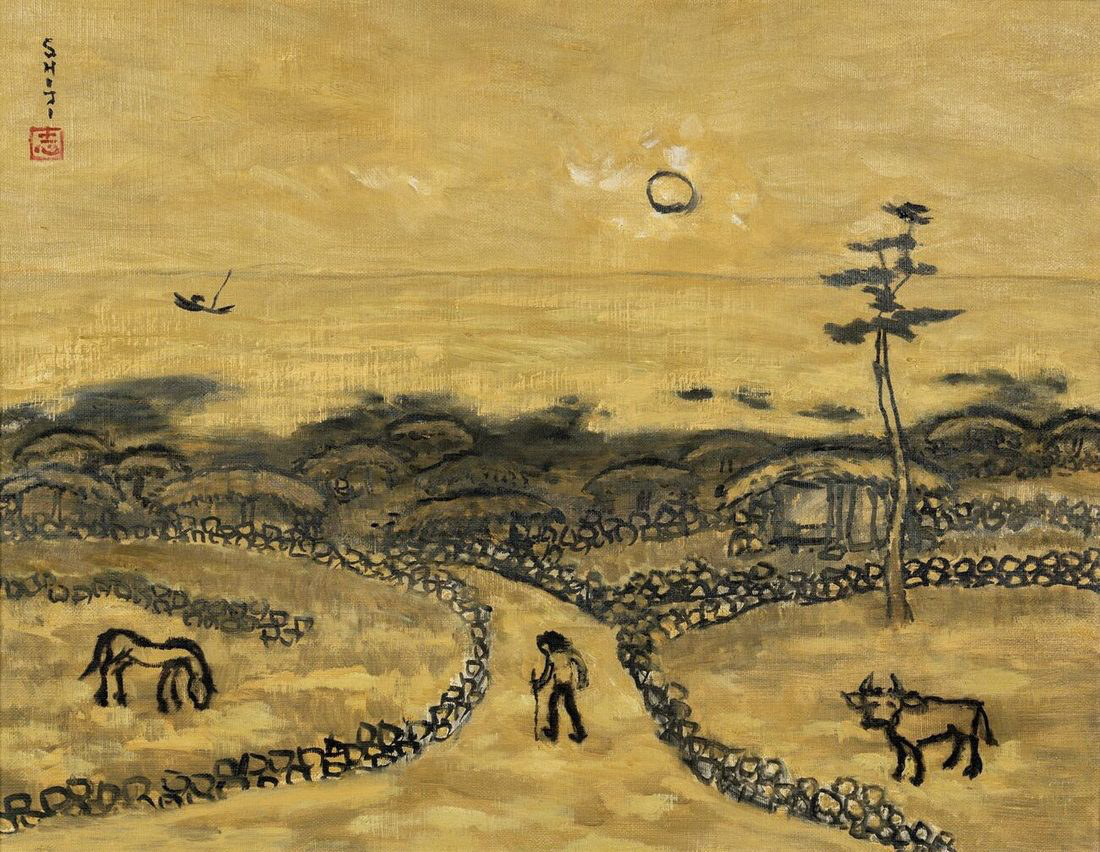
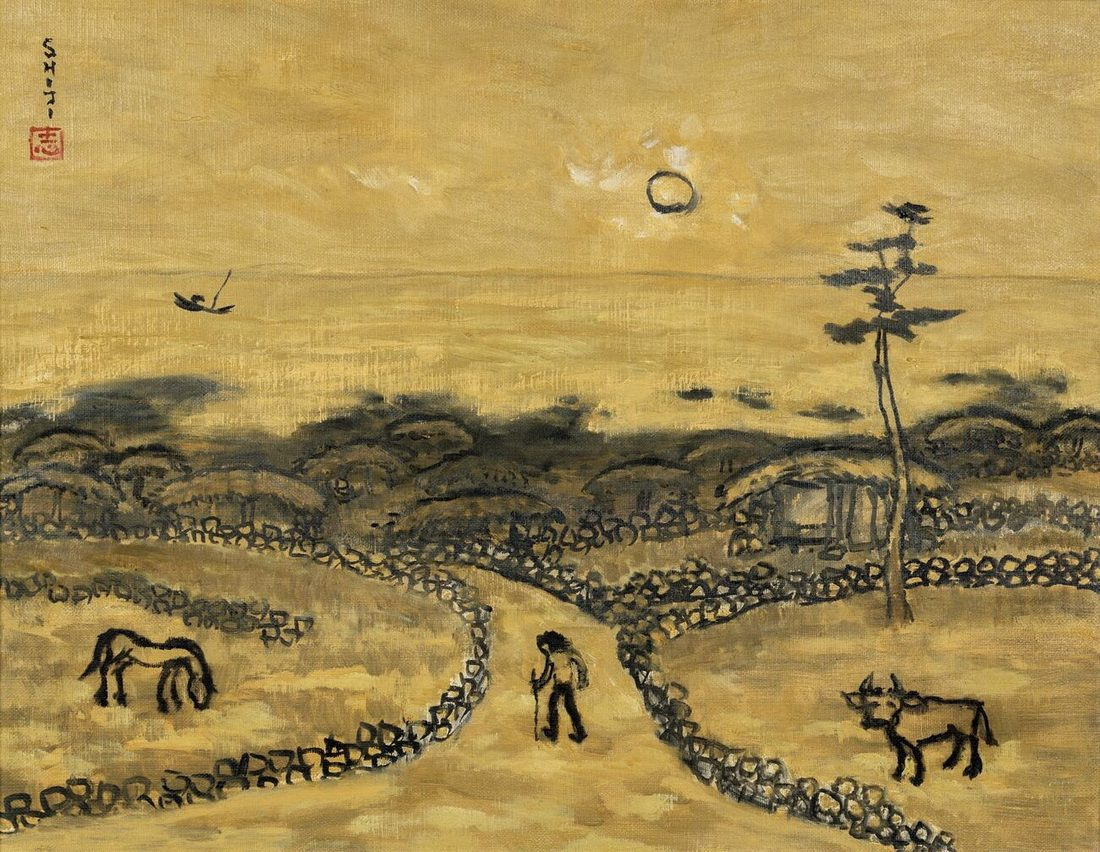
In Seaside Village (2002), stone walls curve in from the lower part of the picture. A person stands between them, with a pony to the left and a cow to the right. Beyond houses and a tree, the sea extends. The village is not simply an inventory of buildings. It appears through the ways path, bodies, animals and walls share out space.
No evidence presented here identifies the painting as an exact map of a particular street. Relationships that can bring Seogwipo to mind nevertheless remain: life close to the sea, small places divided by walls, and a path continuing between them. A sense of place need not depend solely on matching buildings to coordinates.
The pony on the left lowers its head, while the animal on the right holds its head up. The person between them does not repeat either gesture. Even within the name of a single village, life has several directions. A shared name need not bind every living thing to one meaning. A composition that retains these differences makes the place feel more inhabited.
The Name Remains while the Landscape Changes
The persistence of the name Seogwipo does not mean that its landscape remains unchanged. Byun recalled trees lost when roads were widened. He also spoke of an old tree still standing bringing the earlier surroundings back to mind. Change and memory were taking place together beneath the name.
A picture cannot restore a vanished place completely. It can instead prompt questions about what remains and what is no longer visible. The shape of a tree, the height of a wall, or the distance between house and sea can become a cue to memory. A place painted by one artist is not a changeless paradise; it is a place composed again amid change.
Affection for an older landscape can sometimes diverge from the needs of those living there now. An interpretation that pretends to resolve every such divergence makes the place simpler than it is. What deserves to remain is not only one painter’s memory but also the question formed where that memory meets present life.
A Name to Retain in Another Language
In English, Seogwipo should remain Seogwipo. Replacing it entirely with a gloss such as “the harbour of westward return” would remove the name by which a reader could find the actual place. The name can stand first, with tradition and daily context beside it. Translation need not eliminate all unfamiliarity; it can provide a way of becoming acquainted with it.
The same applies when presenting Byun. Retaining only general words such as wind and solitude thins out the time actually lived in Seogwipo. Listing place-names and dates alone can make the paintings’ sensory force disappear. Accurate names, particular works and concise interpretation need to support one another.
The name can be said to have acquired new artistic meanings through one painter. This does not make it meaningless before him. Seogwipo already held many people’s lives and words, departures and stays. Byun’s paintings added a distinctive part to that longer story.
A Door for Leaving and Returning
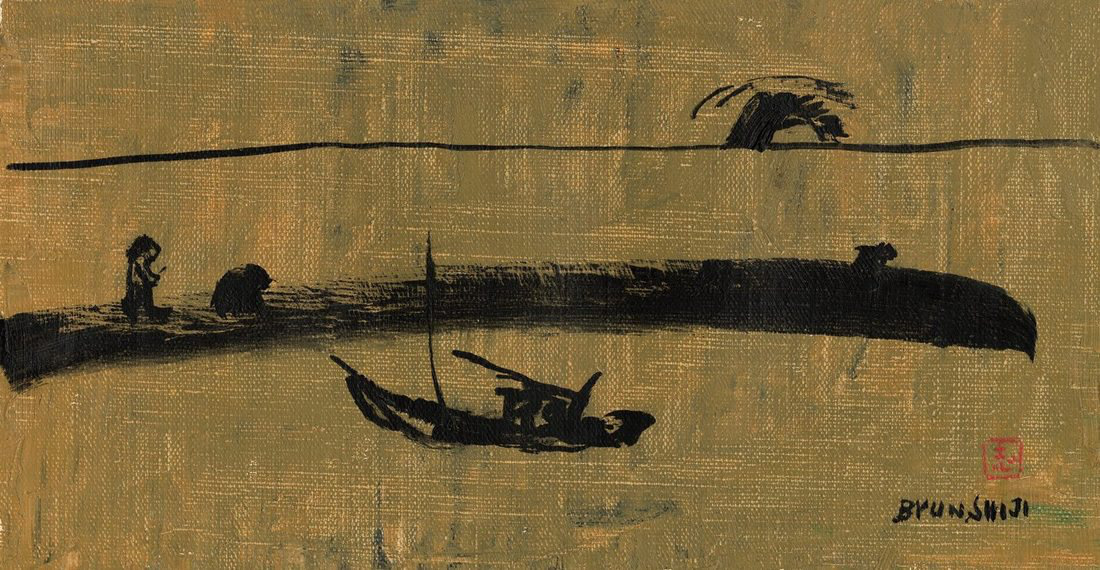
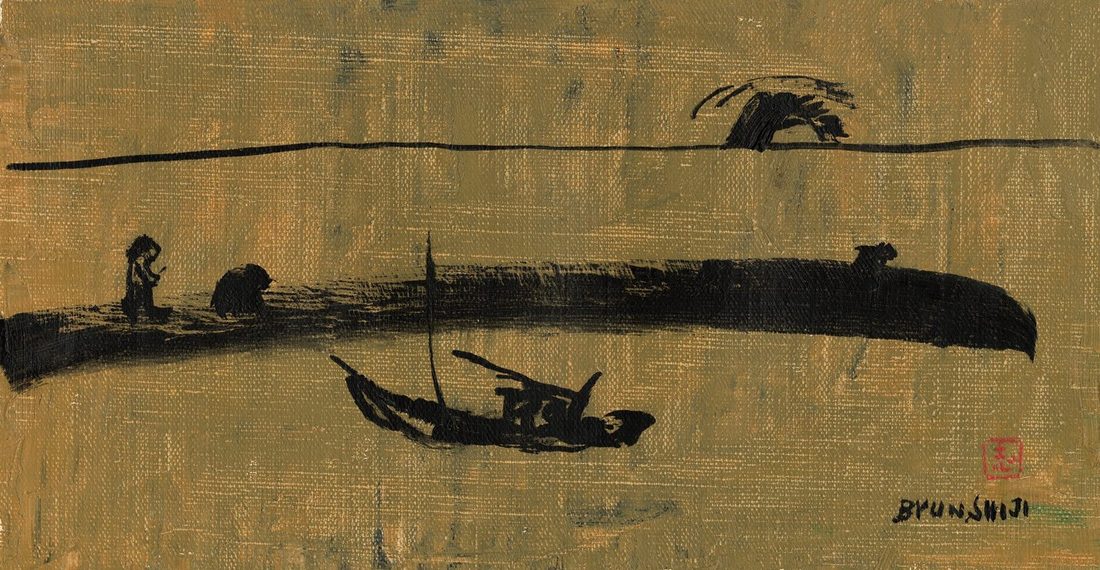
A harbour is a place of leaving as well as entering. The childhood testimony contains a transfer by small boat to a larger ship; The Jetty places boat and shore close together. Decades separate the two sources. Even without treating them as records of the same harbour, they allow different forms of crossing to be considered together.
The reading of Seogwipo should finally return to a painting rather than conclude with an explanation of destiny. We look again at person, boat and the interval between them. The name does not solve the scene. It offers a place that lets us remain a little longer before the picture.
Below the dark shore lies a boat. A person stands a little way off. Boat and land have not joined into a single line.