Research/A Hundred Years of Wind/Ⅴ Life & Place
Ⅴ Life & Place · 59 / 100
The Landscape of Homecoming
The Time That Begins after Arrival
귀향의 풍경
At First, It Was Eleven Days
In his testimony, Byun begins the account of coming to Jeju in 1975 with an unexpectedly short visit. He initially intended to teach aesthetics and art theory for eleven days and return. On arrival, he found that practical classes had been added, extending the schedule to twenty-three days. At the beginning of a long settlement lay a short teaching schedule, not a lifelong promise.
He said that attachments grew during the stay and that others encouraged him to remain. A semester and a year followed as possible commitments. This recollection does not diminish homecoming. It shows how a life not wholly knowable in advance gained time. Even a decision that becomes long-lasting may initially be made in short intervals.
Describing homecoming only as the moment when someone recognises their destiny would erase that hesitation and those relationships. The painter did not arrive carrying a completed answer. He taught, tried living there, and came to want more time to paint. Return grew in this way into the time after arrival.
The Life between Dates
Counting calendar years, forty-four years separate the move to Japan in 1931 from the establishment of a base on Jeju in 1975. Within that span, life in Seoul begins in 1957. Calling it all time in Japan, or describing the interval before homecoming as thirty-eight years, confuses different periods. The thirty-eight years from 1975 to 2013 refer to the later Jeju period.
An interval between years does not automatically prove an absence without a single visit. Moving the centre of one’s life should be distinguished from travelling somewhere briefly. Even after settling, family and work can require journeys elsewhere. Homecoming may be less the endpoint of movement than the process of deciding where to return to work.
Seen in this way, homecoming is larger than a line in a chronology. It includes those who issued an invitation, students waiting for a class, family in Seoul, and time spent hoping a new picture would emerge. Painter and place should not be isolated from the relationships that enabled their meeting.
Two Colours of the Year of Return
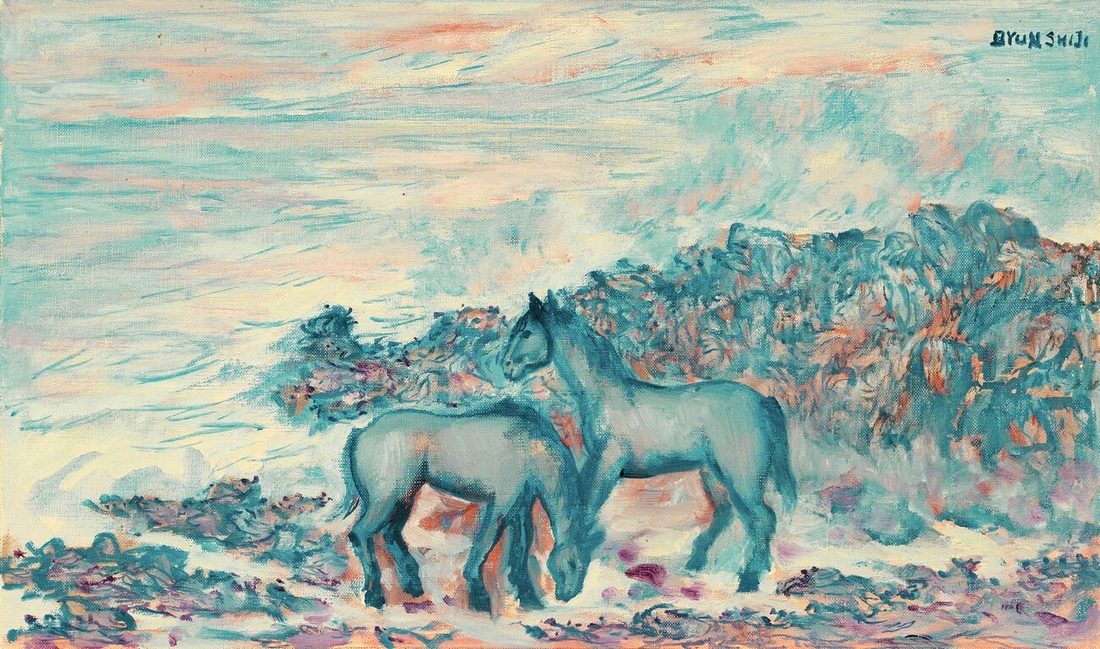
The two animals in Jeju Ponies (1975) do not share a single posture. The nearer pony lowers its head, while the one behind holds its neck up. Blues and pinks meet the colours of a light ground and darker vegetation. This picture presents a different beginning from an account in which every colour vanished at the instant of arrival on Jeju.
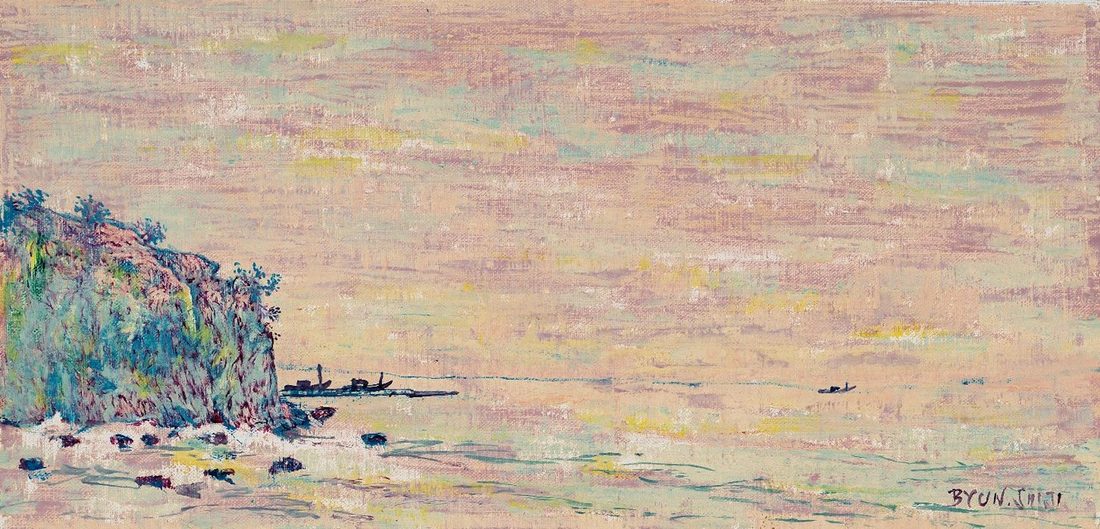
In Sunset, also dated 1975, the coast at the left meets a broad expanse of water. Small boats lie in the distance, while pinkish and bluish passages extend horizontally. The sea has not been reduced to a single black line. The eye moves between water and sky through slight differences in colour.
The two pictures have value beyond serving as a threshold to a finished late style. Ways of looking at horses and sea are already established here. At the same time, the possibility remains that what needs to change in the new place has not yet been settled. The year of homecoming did not close around a single colour.
Trying in Paint What Was Seen on the Shore
Byun said that he initially painted on Jeju in the Biwon manner. He began to feel a mismatch between a Jeju subject and what living there brought him to experience. He thought that people’s lives and history, not only the shapes of trees, had to enter the picture. The question of fūdo became deeper than changing a background.
The testimony locates a colour observation on the shore. Byun described seeing white things turn yellowish under strong sunlight and deciding to try painting in that tonal range. Seeing is followed by an attempt. Light did not automatically become a finished painting; he still had to decide the relationships through which what he saw could be transferred.
Dried-grass colour is a critical term for reading this experiment. It can evoke time bleached by sunlight and the work of memory, but it does not identify a single pigment or one flash of revelation. Byun said that even within the yellowish range the tone changed according to what he painted. The colour of homecoming is closer to a language continually revised than to an answer discovered once and stored away.
The Unfamiliar Eye and the Familiar Eye
A familiar landscape can appear newly to someone who has been away for years. Ways of comparing acquired elsewhere may make that possible. This possibility should not become a claim that those who stayed cannot see. An eye that has remained may know small distinctions of season and daily life. Different kinds of knowledge can meet.
Byun himself suggested that people who could not put the sensation into words might nonetheless have lived with an unarticulated awareness of such colour. Here he considered others’ perception and response rather than asserting solitary originality. What the painter made newly visible and what residents already sensed through living do not have to exclude one another.
Fūdo is not a secret recognised only by a painter. It is formed through bodies, daily practices, relationships and memories, without being experienced identically by everyone. A painter works within those conditions. The picture becomes distinctive not by possessing the place exclusively, but by offering a particular response to a shared world.
Between Jeju City and Seogwipo
The island name Jeju contains more than one place. Byun recalled living in Jeju City while maintaining a separate studio in Seogwipo and travelling between them. This prevents the life after arrival from being reduced to time spent in a single house. Places of teaching, painting and family could remain apart.
He spoke of his pleasure in watching bent roadside trees during those journeys, and of his regret when road widening removed them. Home had not stopped changing for the sake of the person who returned. A landscape seen again continued to alter and could diverge from the landscape held in memory.
This divergence leaves work for painting to do: remembering what has gone and looking again at what remains. It need not make a photographically restored past. It can ask how a form still present calls back an earlier sensation. The returning painter continues to move between present experience and memory.
The People within One Person’s Homecoming
In the testimony, the stay on Jeju lengthens through discussion with family and journeys between places. Life in Seoul did not simply vanish as life on Jeju began. Wanting more time to work had to be negotiated alongside the circumstances of family life. Homecoming held more people’s time than an image of the painter alone before the wind might suggest.
Writing those relationships only as obstacles to the painter’s freedom would erase other lives. Family members also have work, memories and waiting of their own. Reading the solitude of someone choosing art requires leaving room for the time of those who live beside that choice.
Homecoming is therefore not a simple choice between freedom and responsibility. Gaining a little more time for the next picture goes together with asking how and with whom that time can be shared. Life does not follow an initial resolution unchanged. Pictures are also made while commitments are discussed again.
Before a Painting Not Yet Settled
If homecoming is treated as the instant a completed style appears, the paintings that follow become mere repetitions of it. Yet neither the initial stay nor the initial colour was settled. There was time spent recognising a mismatch in a new place and painting again. “Return” becomes more accurate when it does not shorten that time.
The two bodies in Jeju Ponies are close without lowering themselves in the same way. The early picture already allows us to see that sharing ground does not require a shared posture. The person who returns and the person who stayed, family and fellow workers, can likewise be together while retaining different directions.
The nearer pony’s muzzle is close to the ground. Behind it, the other stands with its neck raised. Blue and pink continue in small passages behind the two bodies.