Research/A Hundred Years of Wind/Ⅴ Life & Place
Ⅴ Life & Place · 58 / 100
Seoul and the Biwon Painters
A Life and a Practice Built through Returning to the Garden
비원파의 서울
A Return to a City Yet to Be Lived In
In 1957 Byun returned to Korea. Seoul, where he began his new life, was neither Seogwipo, where he had been born, nor Osaka, where he had grown up. He recalled considering his return after an invitation from Seoul National University. Having a country to return to was not the same as having an everyday life ready within it.
The expectations raised by an invitation should not be confused with a complete record of employment. Life had to be organised again through teaching, work and new encounters. Byun recalled arranging classes in the mornings so that he could paint in the afternoons. A painter’s day needed a timetable as well as the name of a country.
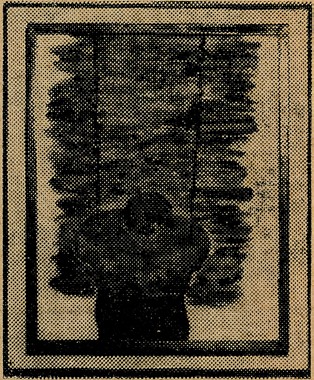
The beginning in Seoul cannot be seen only through the beauty of palace gardens. The Porter (1958) sets a load much larger than the body above the person carrying it. The supplied plate is a small printed reproduction and limits close detail, but the difference in scale between load and body is clear. Seoul was both a garden and a city in which people bore burdens.
People Returning to the Same Garden
Biwon is a name for the rear garden of Changdeokgung Palace. In his testimony, Byun recalls the painters who returned there to work. He identifies himself, Son Eung-seong and Cheon Chil-bong as frequent visitors, while distinguishing Jang Ri-seok’s visits from theirs. The name “Biwon painters” contains meetings of different frequency rather than necessarily a single shared declaration.
Painting in the same place does not mean making the same picture. One person may attend to a pavilion’s form, another to seasonal light. Even along the same path, easels can stand in different places and painters can leave at different times. Such practical exchanges give substance to a name that might otherwise sound like a unified school.
The garden need not be seen only as a fortress against new art of the period. While other forms of practice developed, Byun addressed his own questions here. Explaining his choice does not require dismissing other painters’ experiments as imitation. Differences are better sought in what was painted and how it was composed.
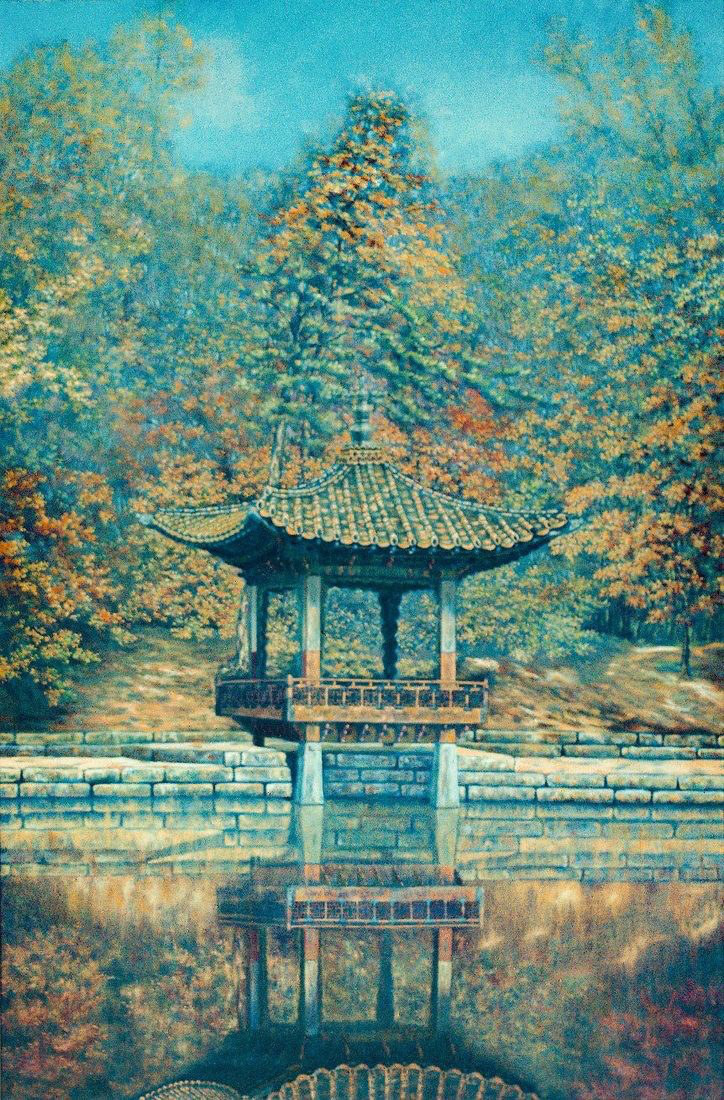
Above and Below in Aeryeonjeong Pavilion in Autumn
In Aeryeonjeong Pavilion in Autumn (1965), the pavilion anchors the composition. Columns stand beneath the roof’s curved edges, with autumn trees crowding behind and above. Blue-green atmosphere coexists with yellow foliage. Rather than assigning a single cool emotion to the Seoul period, the eye can follow these relationships of colour near and far.
The water below shows the pavilion again. Yet object and reflection do not divide the picture into equal halves. The height occupied by the trees above differs from the length of the reflection below. Repeated architecture changes its darkness and colour in the water, placing a solid structure beside an appearance that could be disturbed.
There is no need to declare the reflection a symbol of the painter’s divided identity. First there is the movement of attention created by trees, roof and water. The eye establishes the building above, finds it again below, and returns upwards. The picture’s stillness arises not from the absence of movement but from the unhurried character of that return.
Precision Can Also Be a Relationship
Byun recalled that in the garden he initially examined roof tiles and railings individually as he painted. What he learned in this way later remained available to memory without the object immediately before him. Such precision need not be only a cool distancing. It can also be the process by which repeated looking becomes an acquired bodily familiarity.
To infer non-belonging simply from detailed depiction would overlook the different forms attention can take. One painter may create intimacy through few lines, another through small differences examined over time. Intimacy cannot be measured by the width of a brush. The time spent looking into darkness beneath a roof is also part of a relationship.
Even with knowledge of the later Jeju work, Aeryeonjeong Pavilion in Autumn should not be treated as a picture still lacking a language of its own. Its painter decided the pavilion’s scale, the trees’ height and the reflection’s length. The space made by those choices deserves to be read within this work, here and now. Later changes do not erase its value.
Afternoons Made Available for Painting
In his testimony, Byun remembers with pleasure going to Biwon to paint each day. It was a life of finishing morning classes and then entering the garden. Fellow artists were there, as were students who came to see the paintings. Describing the Seoul years only through isolation and emptiness would erase this remembered pleasure and the people who shared it.
Relationships through buying and selling were part of that life. He spoke of an agreement with a Japanese gallery, showing work for sale in Seoul, and advising that buyers’ contact details be kept so that invitations could be sent. Commerce cannot simply be dismissed as something worldly outside painting. It was also connected with the time and materials needed for further work.
Commercial recognition does not satisfy every question. But a painting that sells is not thereby an empty painting. A later change can involve asking new questions of an already established practice in another place. The afternoons at Biwon were not time wasted while waiting for Jeju. They were time lived in their own right.
What Becomes Visible Again Elsewhere
Byun recalled knowing Chusa’s calligraphy while in Seoul. On Jeju, however, looking at old writings and pictures alongside the shapes of bent branches gave him another appreciation of their forms. Knowing the same name and finding the same form newly compelling are different experiences. A change of place can prompt an earlier acquaintance to be read again.
This recollection need not be used as a verdict against Biwon. The Seoul garden and the trees of Jeju reached him in different ways. Rather than deciding which experience was more authentic, we can ask what had changed enough to require another form. Reading fūdo is not a declaration that one place has defeated another.
He also pointed out that his houses and trees differed from those in Sehando. A related feeling did not make the forms identical. That distinction offers a sound beginning for comparison: follow an affinity in feeling without losing sight of different roofs and branches. Another painting can help us see the particularity of this one more closely.
The Continuing Hand and the Changing Picture
Byun said that at first on Jeju he painted in the manner developed at Biwon. Changing the subject did not immediately change the picture. As he felt that local life, history and ways of enduring difficulty also had to enter the work, he reconsidered colour and form. Change involved both what was already known and what no longer seemed to fit.
Accounts of a movement from fine brushwork to rougher lines should be read within that process of choice. A fine line is not necessarily an unfeeling record, nor is a rough line the only living expression. Width and interruption function differently in relation to surrounding colours and intervals. More useful than a slogan about abandoning skill is a question about the changed work that skill performs.
Observation practised at Biwon could combine with memory to make different paintings on Jeju. The eye that watches a pond and the eye that watches waves are not wholly separate eyes. The hand travels to a new place with what it has already seen. What to retain in that place must nevertheless be decided again.
The Pavilion Remains beside the Pond
Too much is lost when the Seoul of the Biwon painters is labelled only “before Jeju”. There was a city of working bodies, a garden shared with fellow artists, time divided between teaching and painting, and relationships through which works changed hands. Retaining that life makes homecoming legible as a change chosen by a real person, rather than a single revelation.
No single subject contains an entire homeland. A palace, a person carrying a load along a street, and a low house beside the sea can each belong to it. A painter moved among them and revised the language of his pictures. The emergence of a later language does not make everything spoken earlier untrue.
The columns of Aeryeonjeong stand by the water. Below them, another column descends upside down. Something of the leaves’ colour remains in the water.