Research/A Hundred Years of Wind/Ⅴ Life & Place
Ⅴ Life & Place · 57 / 100
Light and Shadow in Tokyo
Recognition and the Making of One’s Own Painting
동경의 빛과 그림자
A Painter Arrives in Post-war Tokyo
Byun moved to Tokyo after the war. In his testimony he places the move towards the end of 1945, without firmly identifying the month. His account of meeting Terauchi Manjiro follows in the next year. Rather than forcing the recollection into a precise date, we can first attend to learning and work beginning again in the post-war city.
His recollection of the first approach is not a grand ceremony. Recognising the painter on a bus, he asked whether he might visit, and later brought work to show him. Learning began with placing something already painted before another person. To show a picture is to expose not only acquired technique but also judgements that are still being formed.
Tokyo was not merely the name of a style he had to follow. It was a place where painters met, compared pictures and held exhibitions. Reducing an art world to a summit and those beneath it would erase those exchanges. The young Byun needed not only recognition but also places in which another picture could be tried.
A Name in the Award Record
The Kōfūkai’s official award list records 宇城時志 among the recipients of the Kōfū Prize at its 34th exhibition in 1948. In his testimony, Byun explains his use of the name 宇城 in Japan. Comparing records preserved under different names and in different languages makes it possible to trace a career more precisely.
The award is an important indication that his work received public recognition early. An award within one association does not, however, mean the conquest of the whole of Japanese art. Retaining the particular setting and scope of recognition gives the achievement firmer ground. The more expansive the praise, the greater the need for precision in the record.
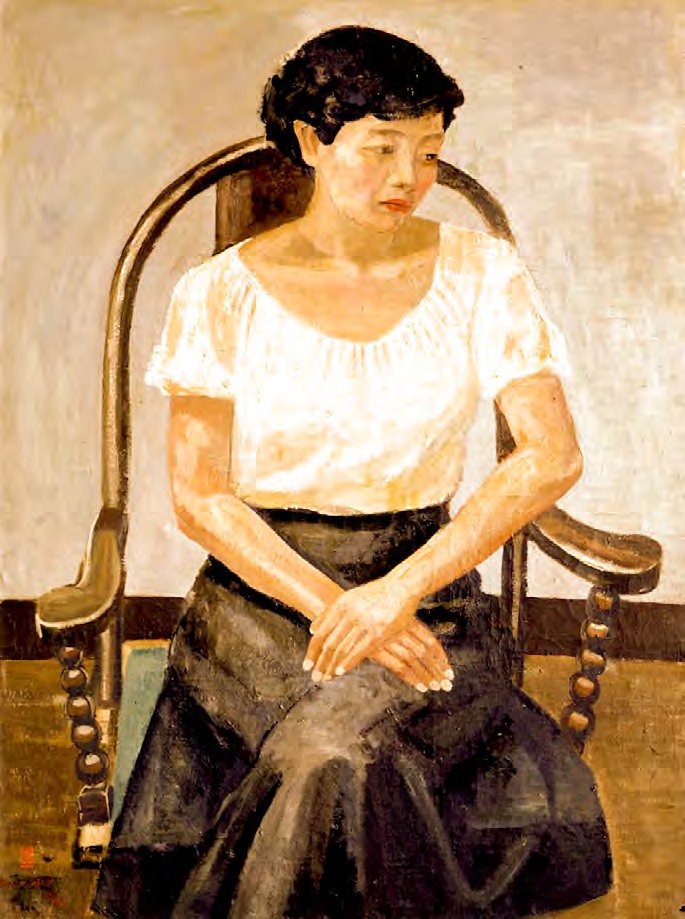
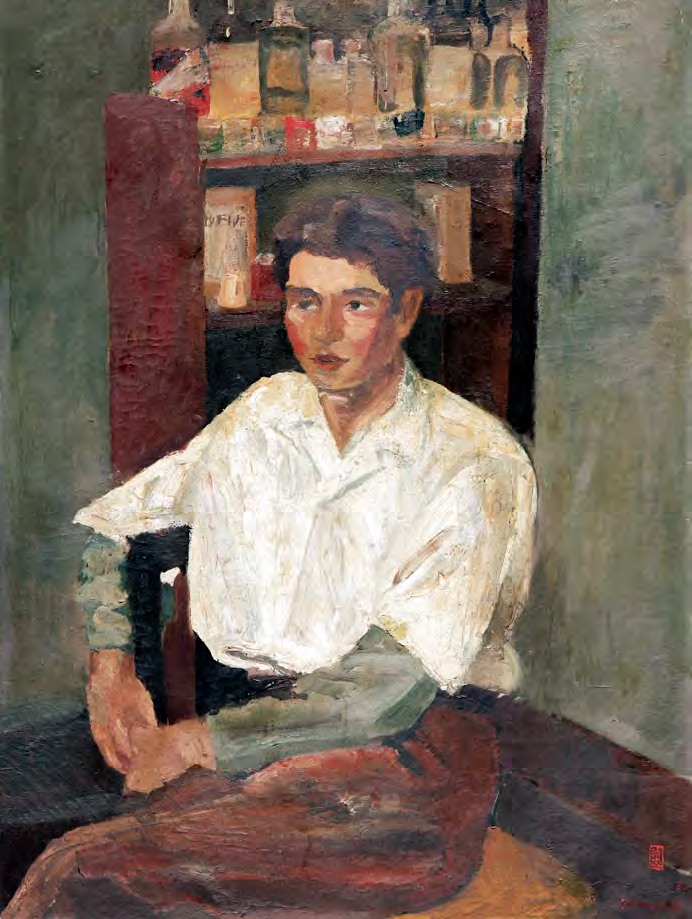
Nor should paintings of the period be viewed only as illustrations of an award. Placing Portrait of Nemo (1951) beside Man (1950) reveals different arrangements within portraiture itself. One centres attention on a chair and overlapping hands; the other includes the space formed by a body and a bookcase. The questions of painting continued after recognition.
What Was Learned and What Was Painted Differently
Byun recalled working in two directions while in Japan: pictures influenced by Terauchi and others painted according to his own judgement. He said that his solo exhibitions included simplified still lifes and landscapes. The search for a language of his own did not suddenly begin on Jeju. Different choices were already developing within his training.
It is therefore inadequate to call the Japanese-period work merely perfect imitation. Using techniques learned from others is not the same as lacking judgement of one’s own. Decisions about the figure’s scale, where to stop the background, and what colours to retain in shadow already involve a painter’s choices. Independence does not exist only outside a tradition.
These changes need not be judged as a victory or defeat between teacher and pupil. Newly acquired knowledge can help someone recognise another route. The painting learned from Terauchi and Byun’s more personal experiments worked against and alongside one another within the same practice. Retaining that tension allows the later path to Jeju to be understood as more than a break.
The Picture Placed before the Teacher
The testimony includes a memory of Terauchi defending his pupil’s picture against other people’s judgements. Byun also recounts strong praise attributed to Saitō Yori. He places that episode at his first acceptance at Nitten. Moving it into the judging of the following year’s Kōfūkai award would merge two different occasions.
The significance of this recollection is not only the scale of a memorable compliment. It also concerns a reluctance to correct a picture immediately because it differs from others. Teaching can involve learning a shared language while also making room in which difference can be watched and tested. Both possibilities belong to the teacher’s role.
A letter connected with his return belongs to a separate inquiry into its original wording and context. The teacher-pupil relationship does not require an unverified farewell speech. Bringing pictures on a visit, experimenting in another direction, and remembering the teacher’s acceptance of that difference already reveal a particular relationship.
White Clothing, Different Spaces
In Portrait of Nemo, a bright blouse meets a dark skirt. The hands overlap on the lap, while the curved chair back surrounds the head and shoulders. The gaze turns down and aside. Without first assigning a Latin meaning to the title, there is already ample tension in the way the body occupies its place.
In Man, the plane of the white shirt gives the torso a strong presence. The face turns to one side, and shelves of books are visible behind it. The light clothing and its reddish-brown and greenish surroundings change one another’s appearance. These colour relationships are too complex for the Japanese-period work to be summed up as a melancholy cool blue.
The fact that neither gaze meets the viewer directly does not establish that either person is inwardly closed. Clothing, hands, chair and background first reveal relationships within the picture. Feeling is read through those relationships. No colour, on its own, is a finished sentence speaking on behalf of someone’s interior life.
Post-war Time and the Individual Face
The post-war date is an important context. Yet reading every garment and expression as a war wound would reduce different faces to a single expression of the age. The bookcase in Man and the chair in Portrait of Nemo make particular interiors. History belongs beside these objects, without pre-empting all that they can mean.
His activity was not confined to a single artistic circle. He recalled discussing art with fellow painters of different tendencies. Encountering a new tendency and adopting it unchanged are separated by judgement. Continuing to paint figures does not, in itself, establish a wholesale refusal of the avant-garde.
Light and shadow do not divide neatly into success and unhappiness. Recognition, learning, relationships and hesitation can coexist within a single day. Rather than calling the whole Tokyo period empty, we need to look at the pictures actually made within it. The two figures remain seated in their different ways.
There Was More Than One Route at Departure
Before returning to Korea, Byun considered whether living there might help him understand his individuality more fully. His testimony speaks of wanting to know Korean life, fūdo and history more deeply. This differs from claiming that ancestry had already determined his painting. It acknowledges something still to be learned through living.
He also thought of going to France and hoped for employment in Korea. His family worried about the difficulties of post-war life. Keeping these practical matters in view may make the return seem less heroic. It also makes it more urgent as a decision about finding a life in which painting could continue.
Departure did not invalidate earlier achievement. He later described continuing to submit work to the Kōfūkai even when he felt that his Jeju style no longer fitted its prevailing atmosphere. Moving away from one relationship is not the same as severing it entirely. His route included long continuities as well as departures.
Eyes That Had Passed through Tokyo
What Tokyo left cannot be reduced to a foundation in drawing. It included showing a picture to someone, comparing it with other pictures, and moving between learned practice and personal judgement. Those experiences did not vanish when different colours and lines were chosen on Jeju. A hand in a new place is not a new hand cut off from the earlier one.
Knowledge of the later work reveals continuities when we return to the early portraits. Searching only for those links, however, risks overlooking what remains unfamiliar in the early pictures. We should attend both to lines that lead towards Jeju and to those that do not lead there directly. A painter’s life becomes larger when it is not forced into a single line.
The two hands in Portrait of Nemo still overlap on the lap. The chair’s curved line passes behind the shoulders. Below the bright blouse, the dark skirt falls.