Research/A Hundred Years of Wind/Ⅴ Life & Place
Ⅴ Life & Place · 56 / 100
Memories of Diaspora
From Osaka to Jeju: A Life Shaped by More Than One Place
디아스포라의 기억
From the Small Boat to the Ship
Byun Shi-Ji remembered the journey to Japan as a child. The large ship could not come close to the shallow harbour. Passengers approached in a small boat, and hands reached down to pull them aboard. A woman’s white rubber shoe slipped off into the sea. This was the departure that remained in his later testimony.
At the centre of this memory are the height between two boats, a helping hand and a lost shoe, rather than a grand outline of the whole island. Before migration becomes an arrow on a map, it involves moving a body. The child did not know what kind of painter he would become. His later pictures need not be placed in that sea in advance.
Born in Seogwipo in 1926, Byun moved to Japan with his family in 1931. He grew up in Osaka and worked in Tokyo after the war. He returned to Korea in 1957, and from 1975 established a base for life and work on Jeju. These dates are markers along a route. Between them lies more daily life than a single line of chronology can hold.
A Family’s Choice within Colonial Conditions
When recalling why his father chose Japan, Byun spoke of the children’s education. His father had visited Japan and wanted them to study there. Calling the family’s migration a forced deportation would erase this particular account. The colonial conditions of the journey and the decisions made by an individual family must be considered together.
The presence of choice does not make the conditions of choice equal. Where could a child obtain an education? In what language and under what name was a person to introduce themselves? A family’s hope for a better life can coexist with unequal power around that life. Migration cannot always be divided into wholly free travel on one side and wholly passive suffering on the other.
Diaspora is not a single name that explains everything about Byun. It is a way of attending to memories and attachments extending across places. The term becomes concrete when family circumstances, opportunities to learn, relationships and paintings are considered together. Erasing Osaka and leaving only loss would make the time actually lived there harder to see.
Allowing the Young Face Its Own Present
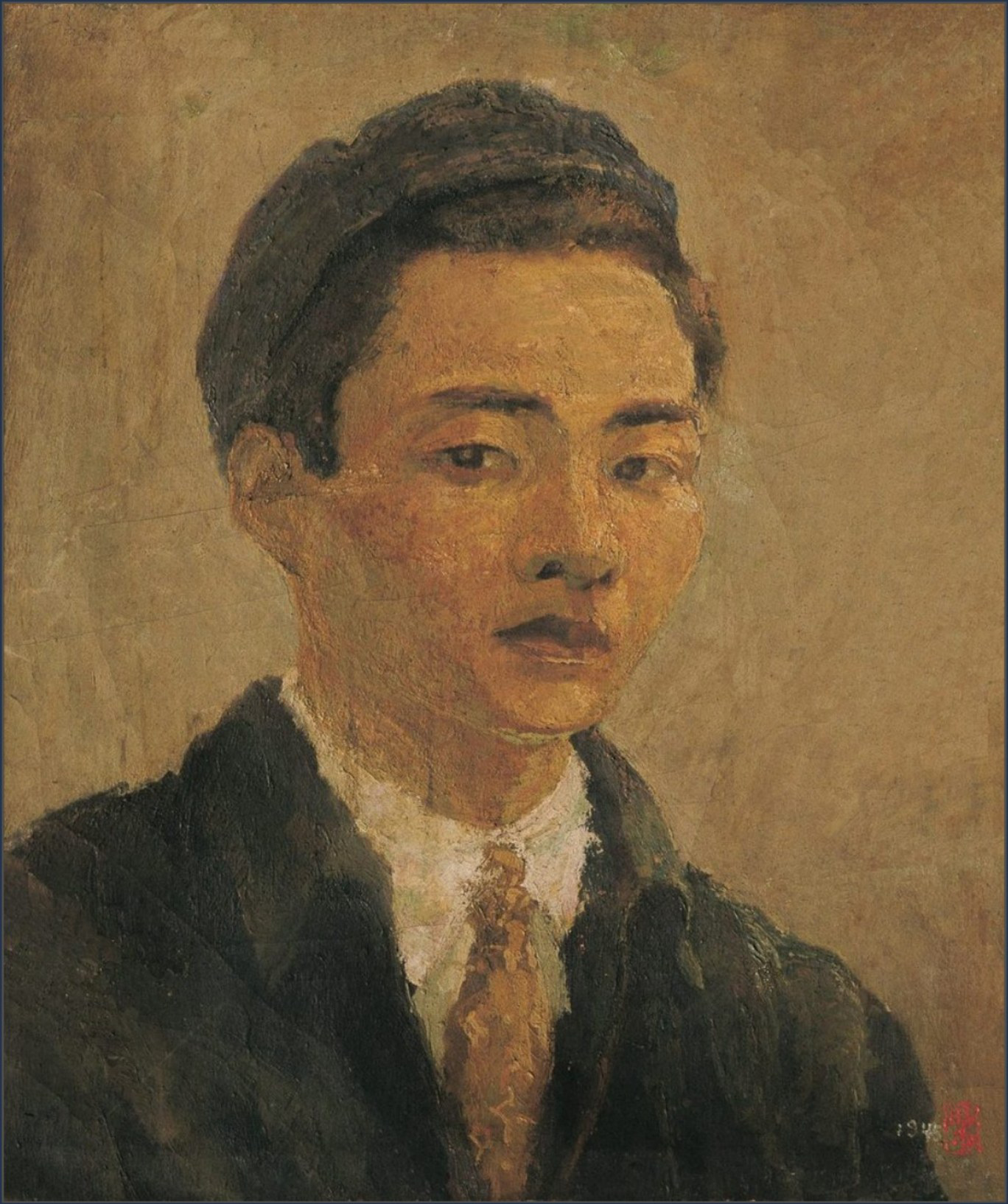
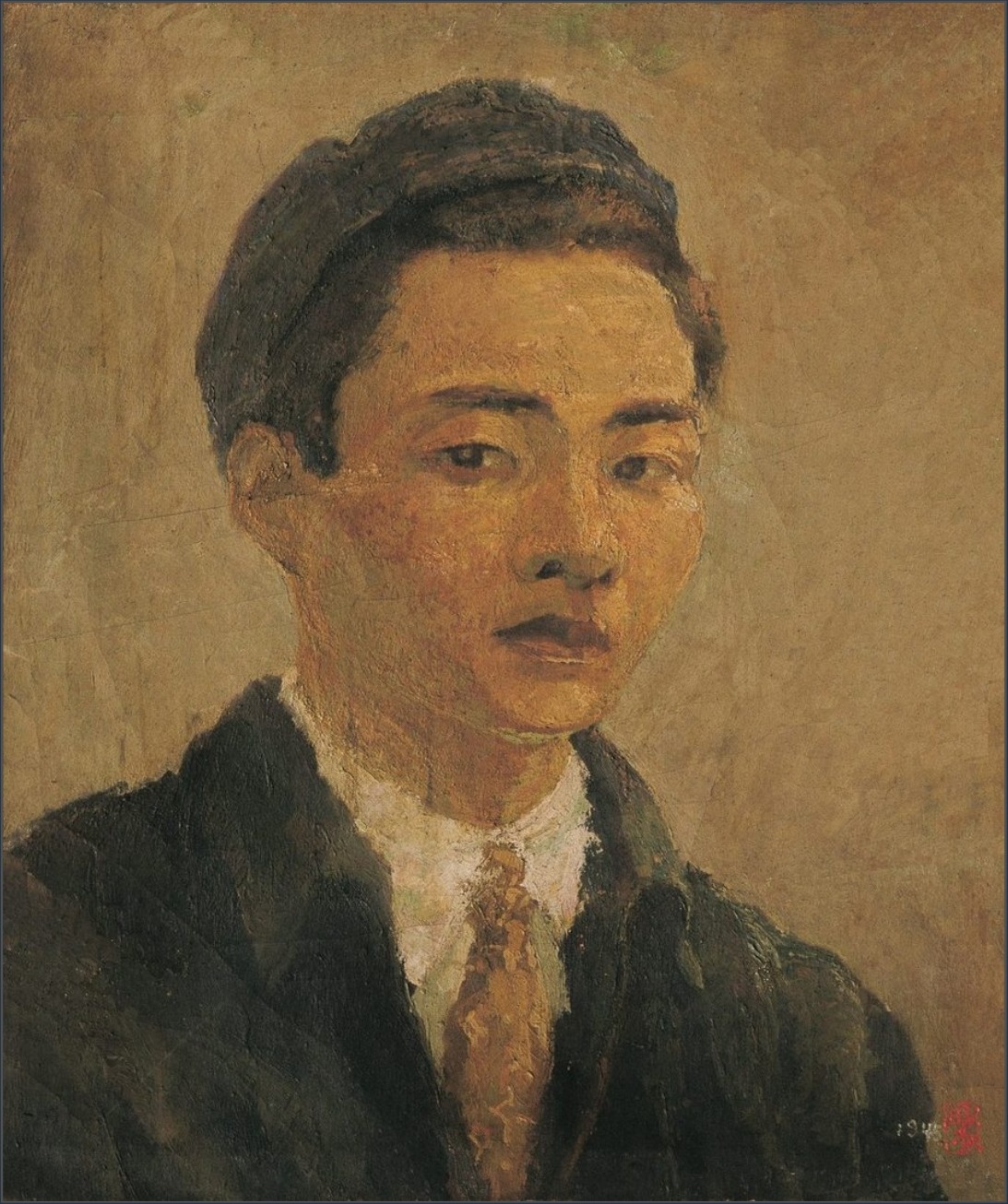
In Self-Portrait (1944), a young face is close to the picture’s surface. The neck appears between dark clothing and a light shirt, and the eyes turn out of the painting. The face shares brownish tones with the background without disappearing into it. Byun was already both someone looking at himself and a painter deciding how to make that self visible.
Reading this face immediately as the bent old man of the later Jeju paintings would shorten the young man’s present. A young face has its own light and scale, and its own way of occupying a canvas. Early self-presentation can be compared with the later lowered body without making either an unfinished version of the other.
Nor can the picture be explained solely through bodily difficulty or colonial background. Even under difficult conditions, a person learns, takes pleasure and makes choices. Rather than treating the face as evidence of destiny, we can attend to the distances established between eyes, mouth and shoulders. The weight of a life does not take the place of a painting.
Between Returning to a Country and Returning Home
The return to Korea in 1957 and the establishment of a life on Jeju in 1975 were not the same event. In his testimony, Byun recalled arriving in Seoul on 15 November 1957. Seoul was not Seogwipo, where he had been born. Between returning to a country and living again in a childhood place lay the work of making a new life.
He considered a route to France as well as a return to Korea. An invitation from Seoul National University and expectations about earning a living also entered the decision. Explaining his return solely as the recovery of a lost essence would erase the alternatives then before him. Unlike a reader who knows the ending, the person leaving did not yet know the shape of the next life.
The years in Seoul were not an empty passage on the way to Jeju. He painted people and gardens, taught, sold work and met fellow artists. Living in several places does not mean discarding all but one in a search for the only true home. Ways of seeing learned earlier continue to work within a later place.
Seeing More Than One Place at Once
In “Reflections on Exile”, Edward Said likens the experience of a new environment alongside memories of an earlier one to counterpoint. He does not, however, treat creativity as adequate compensation for the losses of exile. The possibility of seeing several worlds at once remains bound to the difficulty of living between them.
This comparison offers a question for Byun’s work: when he painted what he saw on Jeju, where were the eyes trained in Osaka, Tokyo and Seoul? The early handling of form, the attention sustained before palace gardens, and colour relationships reconsidered in another place could meet within one canvas. This does not make forced exile and family migration the same event. It is a method of comparative reading, not a claim of direct intellectual influence.
The persistence of one dominant colour does not mean that only one memory persists. Looking across a broad field of dried-grass colour, we can recall the painter’s account of its changing tone from picture to picture. Experience is not simply stacked up; it is selected and arranged again. A painting of memory is an act in the present, not a copy of the past.
The Distance Remaining after a Boat Arrives
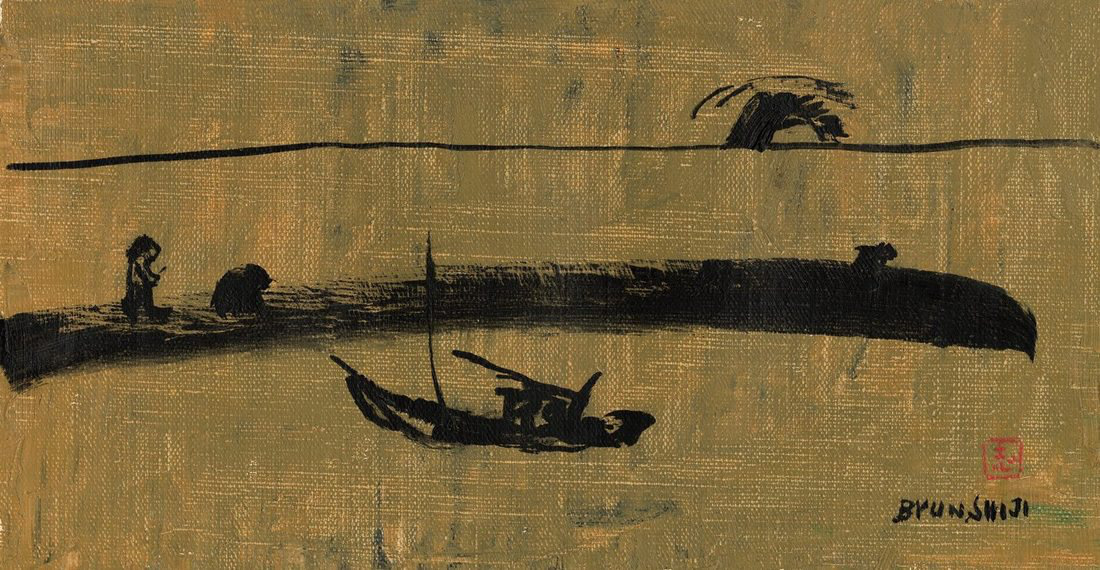
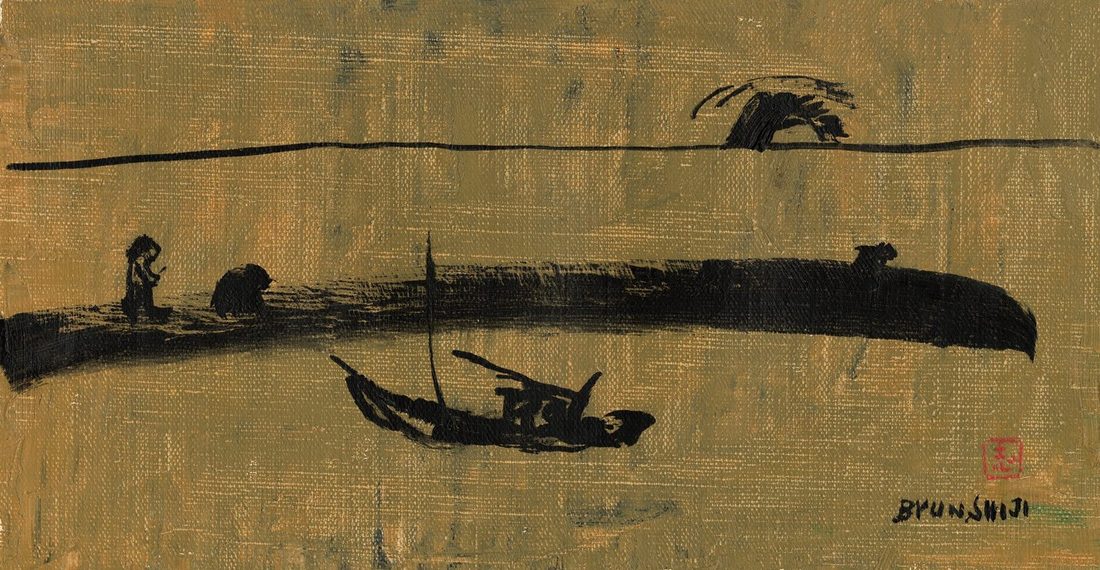
In The Jetty (1979), a dark strip of land extends across the picture, with a boat close below it. A small figure stands towards one side of the land. Boat and shore appear near one another without joining into a single mass. The narrow lighter interval between them keeps the forms apart and briefly holds the eye.
Read in relation to return, the scene matters for more than an indication of arrival. There is also the interval that remains after coming close. A return need not end with crossing the sea. Someone who returns may need time to form relationships anew. The picture invites that thought through the distance between boat and shore rather than through an account of events.
This does not make the painted vessel the ship on which the child Byun travelled. The departure in the testimony and the landing in the painting are different kinds of evidence. What joins them is a question about crossing and arrival, not proof that they depict the same boat. When the work is not confined to one autobiographical record, other experiences of return can also find room before it.
A Painting Travels to Another Place
Paintings move between places, as painters do. Byun recalled works from his Seoul years travelling through his dealings with a Japanese gallery. Returning to Korea did not sever every connection with Japan. Relationships through which pictures were shown, judged and passed on could continue across a change of country.
International exhibition histories also need precise places and dates. The Smithsonian’s National Museum of Natural History records its Korea Gallery exhibition as running from June 2007 to July 2017. That record cannot be moved back into the 1990s. Bringing a work to a distant audience also requires care for the particular history through which it was encountered.
An exhibition in a particular museum does not by itself prove a painting’s universality. A distant viewer can learn more about life on Jeju; a viewer familiar with Jeju can encounter another way of seeing it. International access need not erase place in translation. It can instead provide approaches to unfamiliar names and small painted forms.
Memory That Does Not Reduce to One Place
Reading Byun’s Jeju does not require erasing Japan or Seoul. A place inhabited for years can remain in a person’s eyes and hands after departure. Homecoming can mean forming new relationships while carrying the intervening life, rather than recovering a pure self that existed before the journey.
From this perspective, diasporic memory is neither a record of lack alone nor proof of an at-last completed return. It accepts that different times do not fit together easily. Their misalignment need not be corrected away. It can become the interval through which one person’s paintings are read from several places.
In The Jetty, the boat is close to shore. The small figure remains on the dark land. Between boat and earth, a slender passage of dried-grass light continues.