Research/A Hundred Years of Wind/Ⅳ Technique & Medium
Ⅳ Technique & Medium · 48 / 100
The Ontology of Fog
Between the Visible and the Invisible
안개의 존재론
A World Remains Where Sight Is Unclear
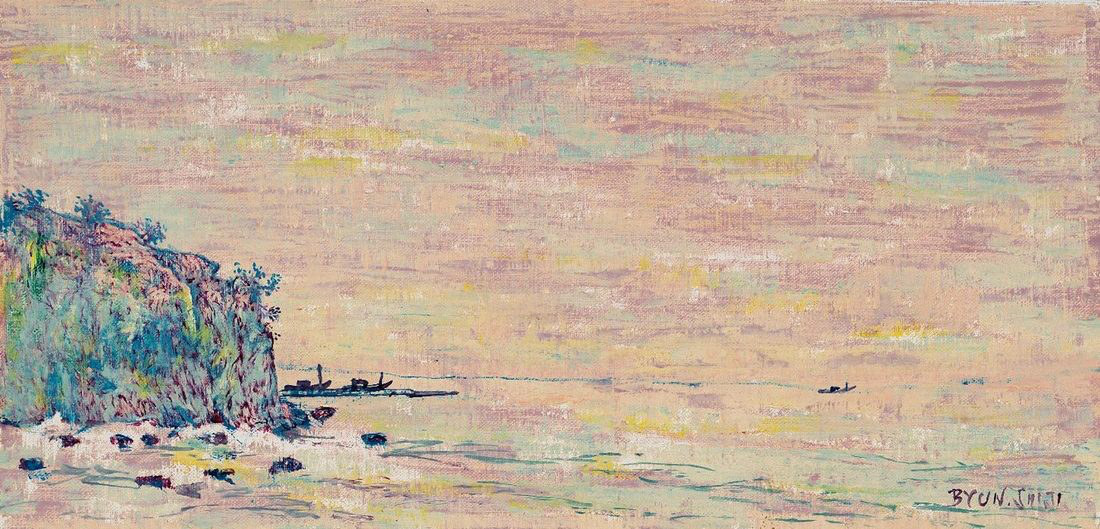
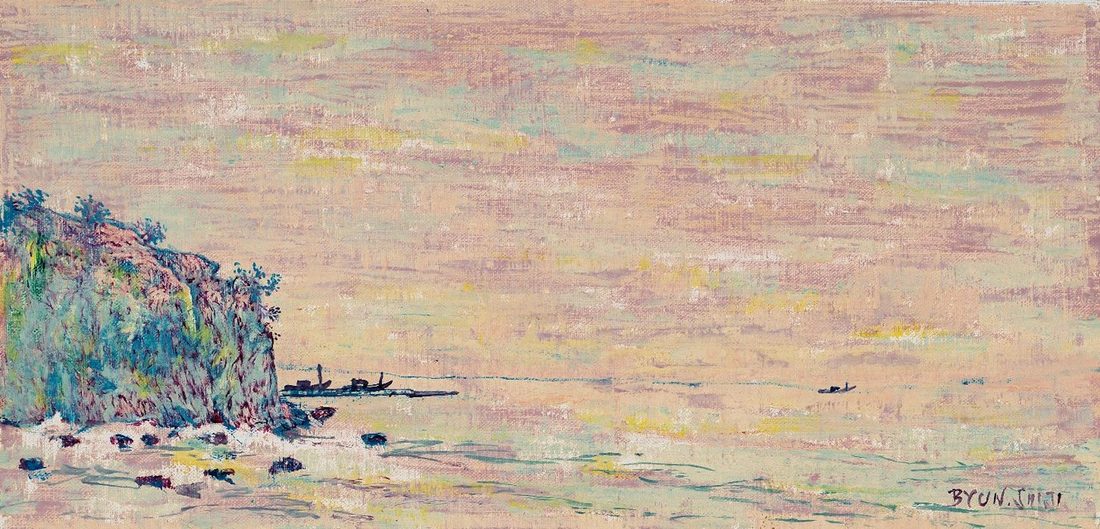
In Sunset (1975), broadly dispersed light appears before any round sun. Pale pink and blue-tinged passages overlap horizontally, while small dark forms hold the shoreline below the cliff at the left. Farther away, short marks take the place of large masses. The picture opens a sea without making every object equally clear.
We may be tempted to call this fog. Yet a painting alone does not establish a single cause for faintness. It may be an effect of represented light, or of colours brought close together. The first task is not to assign a name. What matters is that even where sight is less definite, we feel something continues to occupy the world.
The question raised by fog meets us at this point. Does something cease to exist because I cannot see it? Does the world shrink when the range of sight contracts? Before a painting, the question shifts: how can a painter make us feel space extending beyond what has been explicitly described?
Weather and Pictorial Effect
In meteorology, fog involves tiny water droplets suspended in air near the Earth’s surface. It can reduce visibility without removing objects. That distinction is useful for painting too. Something hidden by an obstruction, something omitted from depiction and something difficult to distinguish because of similar colours are different cases.
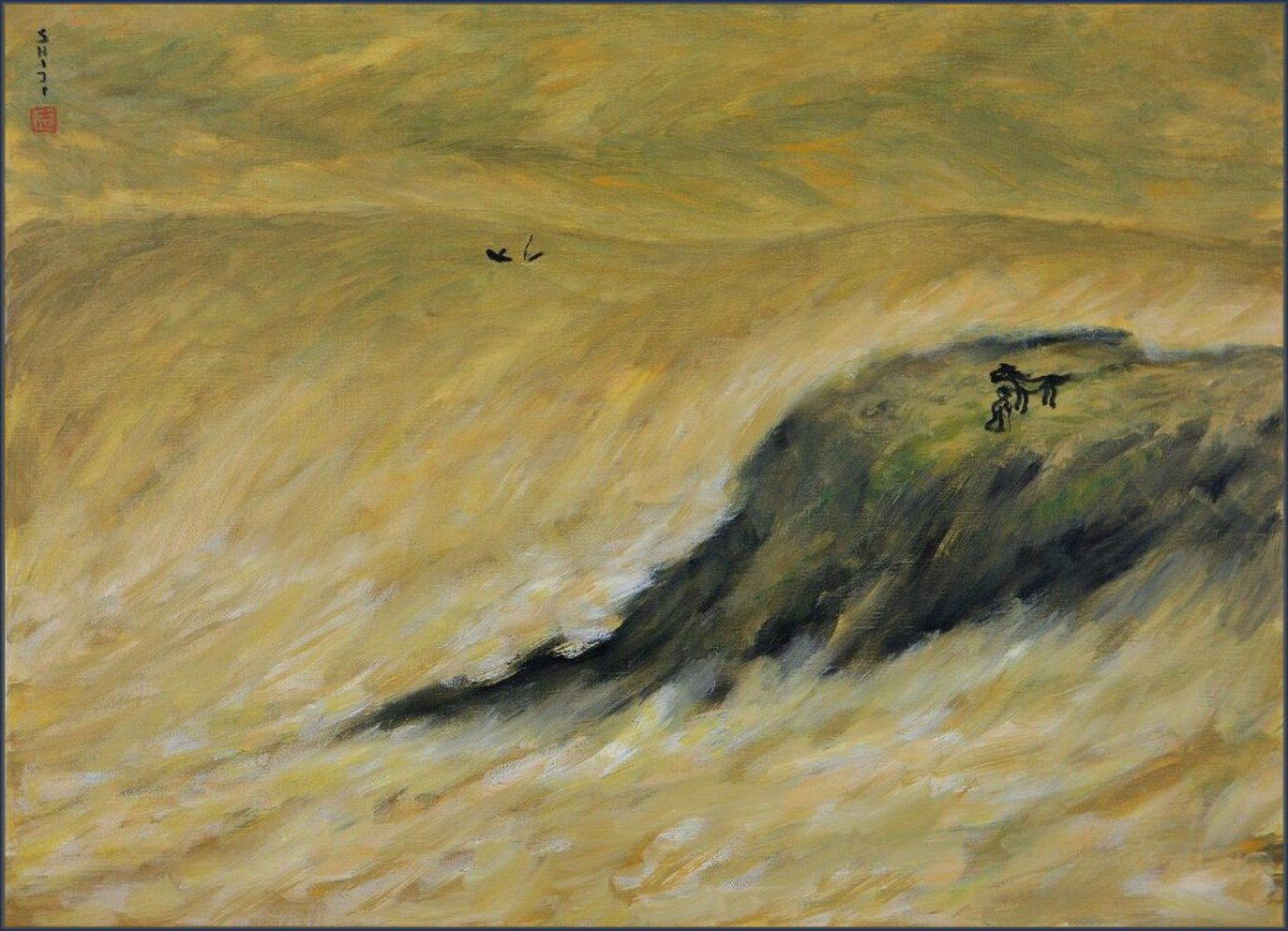
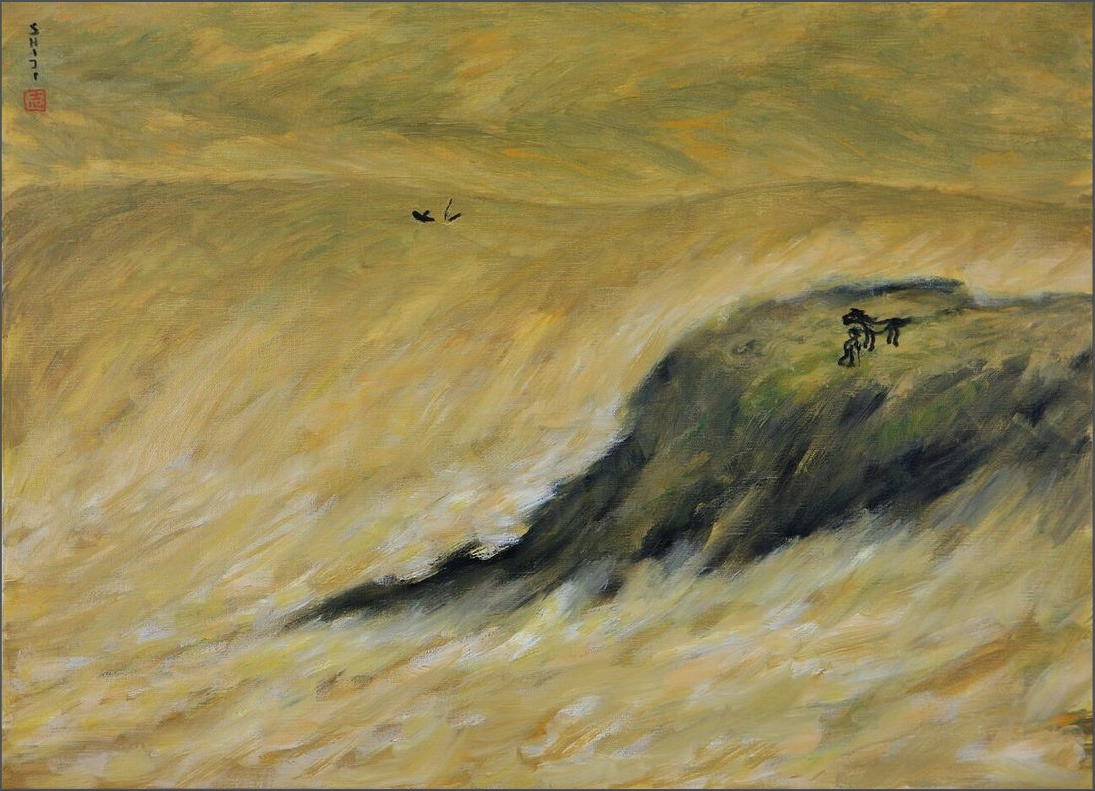
In A Wavering Horizon (2005), pale strokes move diagonally around a dark headland. Waves and spray can be read in their flow. Calling all of it fog would obscure the direction of the sea’s movement and the weight of the rock. A shared quality of partial visibility does not make different natural phenomena identical.
The painter’s dried-grass colour cannot be renamed as a single weather phenomenon. It can hold sun and sea together without belonging exclusively to either. A meteorological term describes a condition of the air; pictorial colour creates relations that may include such a condition. The two can meet without becoming interchangeable.
An Emerging Line, a Receding Field
On the headland at the right of A Wavering Horizon are small dark forms of a person and a pony. The surrounding water spreads and flows, but the bodies remain dark. The whole picture cannot therefore be described as blurred. Clarity and indeterminacy work together to make the small bodies feel closer.
The distant boat appears in a few strokes. It has little detail, yet its contrast with its surroundings catches the eye. The much larger water, by comparison, extends through light and dark bands that cannot be grasped at once. The small is distinct; the large spreads. Differences in visibility organise attention differently from physical size.
An aesthetics of concealment does not mean that more blur necessarily produces more depth. It involves deciding what will remain distinct. If every boundary disappears, the cues for proximity and distance may disappear as well. In Byun Shi-Ji, the dark marks that persist matter as much as the boundaries that recede.
Not an Eye Outside the World, but a Body Before It
Merleau-Ponty’s philosophy of perception offers a perspective that does not detach knowing the world from engaging with it. From this standpoint, a change in visibility is more than a reduction of information. It changes where a body places itself, how far it approaches and what it seeks to check again.
Before a painting, the eye is not a fixed window either. Move nearer and brush marks separate; step back and the sea gathers. Turn attention to one side and the figure appears; look farther out again and the boat becomes small. The picture does not move, but the body before it changes the relation of looking.
This does not mean that the painter illustrated Merleau-Ponty’s philosophy. The comparison opens a question, not a lineage of influence. Can I possess everything in a picture at once? Even as I move through its visible parts, do the parts I am not attending to continue to surround my field of sight?
Memory Is Not Simply Fog
We are familiar with the metaphor of distant memories being faint and recent ones clear. Yet part of an old scene can remain unusually vivid. Pictorial omission therefore cannot be read merely as weakened memory. What disappears, and what returns? This selective persistence offers a way to think about memory and painting together.
In his oral history, Byun Shi-Ji explained how an old tree surviving within an altered landscape could bring earlier surroundings to mind. The landscape of the mind is not an ungrounded mist here. A present object becomes an occasion for memory. One remaining tree can call up surroundings that no longer exist.
The painter is not simply superimposing photographs of present and past. He translates what has been seen and remembered into his own picture. Both faintness and clarity should be examined as results of that translation. Rather than naming a faint trace a distant childhood memory, we can first consider what that trace does in the painting before us.
Between Not Knowing and Feeling
Even when the details of a small form remain unknown, we can feel its proximity to a large sea. These are not contradictory positions. A lack of precise biography does not make an encounter impossible. It means we need not invent a story and attach it as fact in order to be moved.
The small boats in Sunset may bring a journey home to mind. But the painting does not tell us their points of departure or arrival. A manner of writing emerges in that interval. At times, saying that they feel as though they are returning preserves the picture’s openness better than declaring that they depict a return.
Feeling need not always retreat. The persistence of pink water and the small boat’s hold on the eye are real parts of looking. The uncertainty arises not in the feeling experienced before the picture, but when it is converted into a settled intention of the painter. The metaphor of fog leaves distance between the two.
Reading the Conditions of Seeing
Reproductions can introduce another kind of fog. A small display, a compressed image or a brightness setting may obscure detail. This is not the same as indeterminacy painted by the artist. When describing what cannot be seen, we must distinguish a quality of the work from a limitation of the conditions in which we view it.
Enlarging the slender boat in A Wavering Horizon does not necessarily create more information. It may only enlarge the marks already recorded. Magnification helps us inspect position, but cannot supply an unrecorded eye or expression. Looking more closely can also mean learning where further description must stop.
That boundary is not a failure of interpretation. It is a place from which to remain more precisely with what is visible. As on a foggy path, we proceed from what can be discerned to the next discernible point. Without knowing everything in the distance, we may encounter the small form before us more clearly.
The Small Boat Appears Again
Reading painting through fog does not mean erasing every outline. It means attending to how the visible and the less visible form a world together. Faintness need not be proof of mystery, nor clarity the whole truth of an object. Between these positions, looking becomes a little slower.
Sunset and A Wavering Horizon do not present the same atmosphere. One spreads pale horizontal light; the other drives water around a dark headland. Preserving this difference gives the comparison with fog its use. Instead of placing both paintings inside one name, it asks anew what each reveals and what it leaves unresolved.
The eye travels out across the pale water and returns. A small dark mark becomes a boat again. Beyond it, the water extends to the edge.