Research/A Hundred Years of Wind/Ⅳ Technique & Medium
Ⅳ Technique & Medium · 47 / 100
What Empty Space Says
Where the Wind Dwells
여백의 말
Between the Boat and the Landing
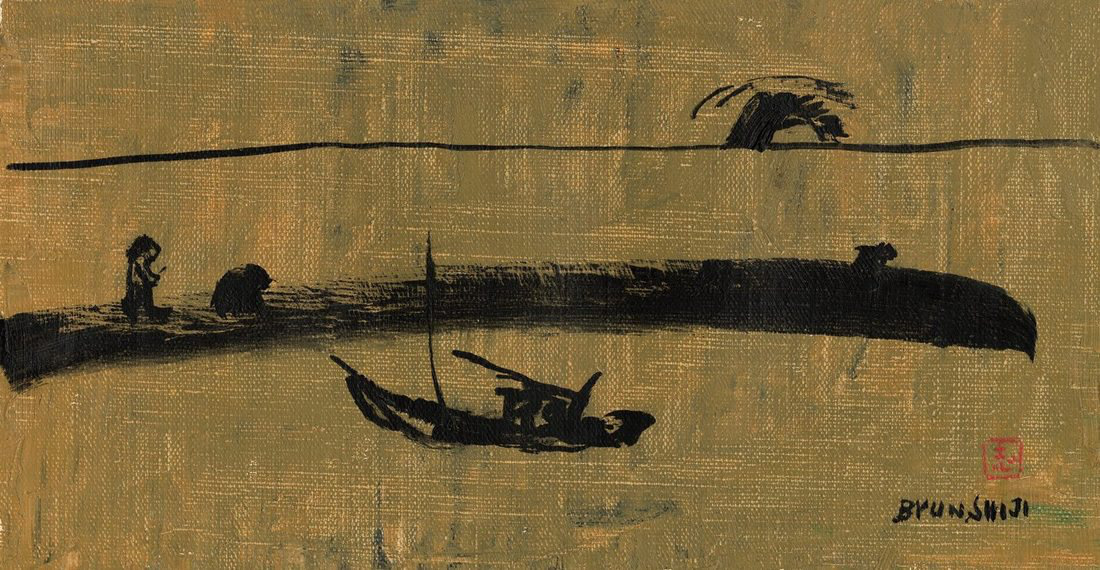
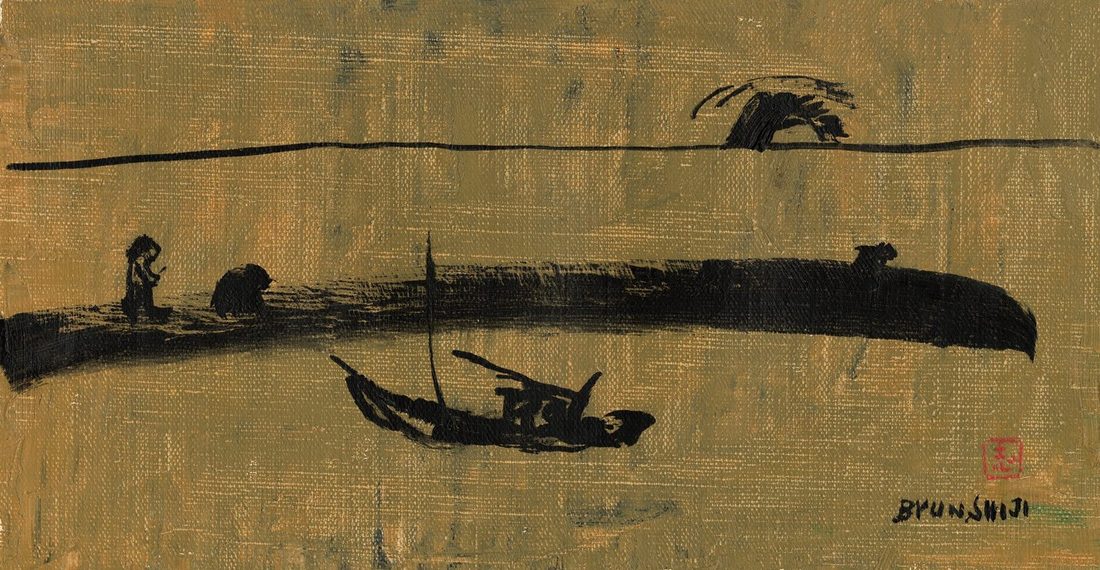
In The Jetty (1979), a dark line extends across the picture. A boat lies below it, with a small figure to the left. The dark forms appear first. Looking longer, we notice the pale interval between boat and landing. That interval prevents vessel and shore from merging. Within their proximity, a space still remains to be crossed.
Can this narrow interval be called a mere remainder? Join the boat to the landing and the tension changes. Enlarge the boat and it approaches; reduce it and it recedes. A place with no additional object is altering the relations between painted objects. Empty space works between forms in just this way.
The space does not first declare itself sorrow. It might suggest approach or waiting. Either way, vessel and land remain apart. Feeling arrives upon that distance. Reading empty space in Byun Shi-Ji begins less with supplying a meaning for a vacant area than with noticing the kind of distance it makes.
Open Space Can Be Painted
The broad sea in this painting is not untouched canvas. Pale light and rough marks lie within its yellowish key. Having few objects is not the same as having no paint. Byun Shi-Ji’s open space is often a place in which no further object has been inserted, although colour and brushwork are already active there.
We need not be bound too tightly to the whiteness suggested by the Korean word yeobaek. White paper is material, and an area covered with paint can perform the work of empty space. What matters is not whether it is white or yellowish, but what it separates and connects. As the ground colour continues, dark lines divide places that remain within one atmosphere.
To read empty space only as nothingness is to lose the surface’s tactile suggestion. The eye follows lighter and darker paint and its grain. It sees not a sea in which nothing exists, but a sea that has not been filled with more objects. Emptiness may be not the disappearance of material but a different way for material to command attention.
Moving Ink and the Stillness of Paper
In the supplied transcription of the handwritten notes, the section on ink painting considers the movement of ink, the quiet of white paper and the rhythm between them. Empty space is not treated simply as a residue left by ink. The discussion moves towards a pictorial space made substantial by the meeting of different qualities.
The differences must remain when this thought is brought to oil painting. Ink entering paper is not the same as paint on canvas. Yet the question of a picture that cannot be constituted by one side alone can continue. A line’s movement needs a space that receives it. Stillness, too, is more than mere inactivity.
Look again at the pale water below the long dark band in The Jetty. The band gains weight against that lightness, while the light area seems more extensive because of the band. Neither must be declared more important in advance. Together they open the distance in which the boat can be placed.
Empty Space Need Not Be a Broad Blank
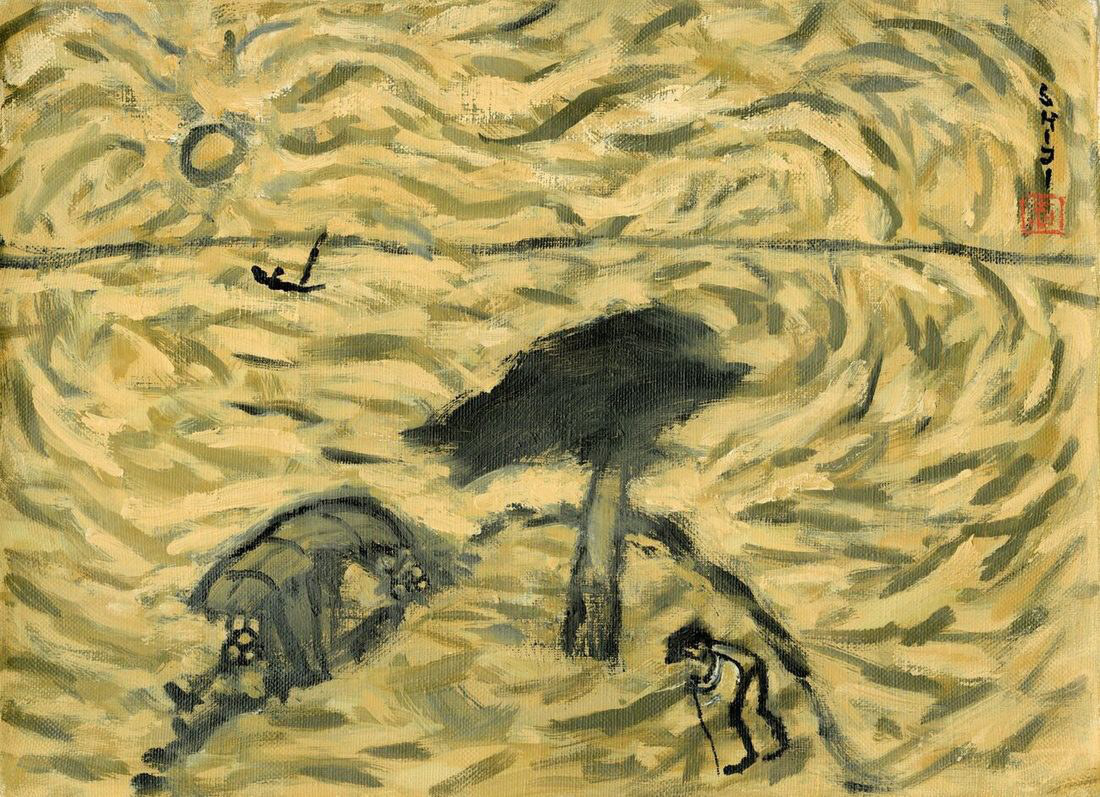
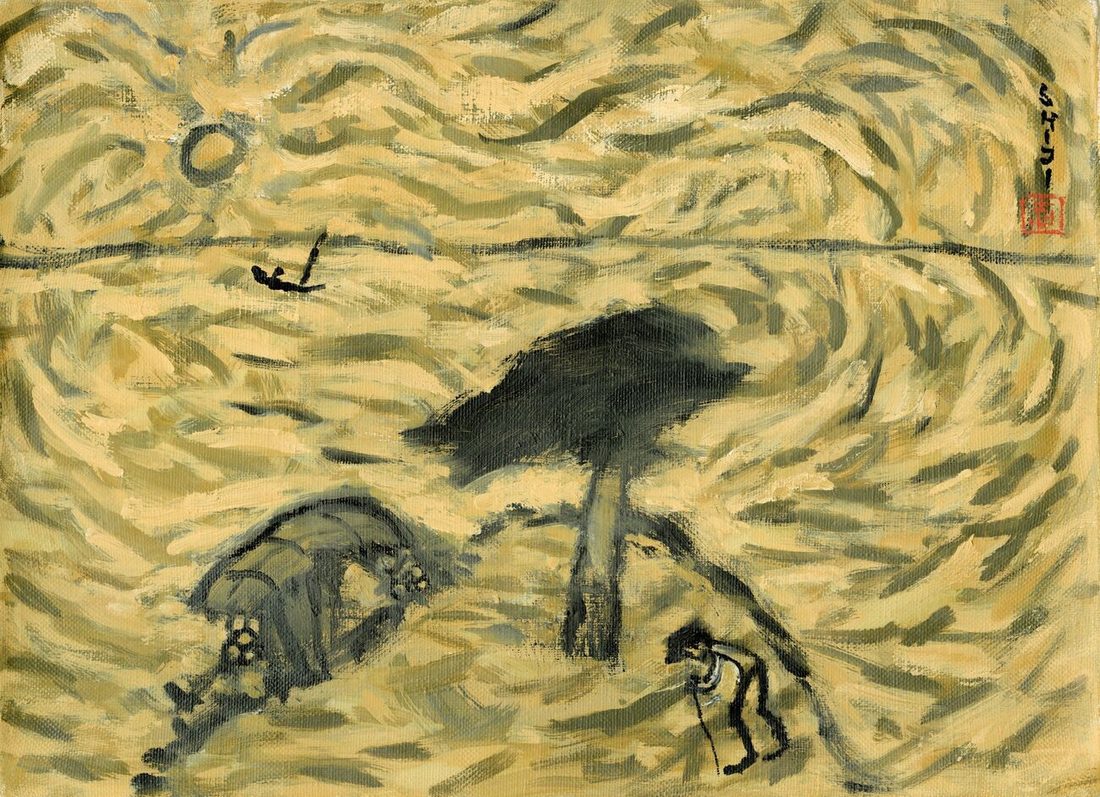
Noon (2007) is full of strokes. Short, curved marks fill the surroundings of house, tree and figure. An account that requires late painting to become sparse misses this density. Here, empty space comes alive less as a single vacant field than as the small bright intervals passing between strokes.
Around the tree’s dark mass, the flow of marks changes. A light area touches the small figure’s bent body. It makes the body visible, while the body makes its extent perceptible. Empty space is not only a matter of the area it occupies; it is also a matter of the differences that allow the eye to move.
Keeping the figure and tree intact is not enough when cropping a reproduction. Narrow the pale gap between them and the body’s breathing room changes. Remove an original margin and the boat’s manner of being distant changes too. Respecting empty space means not merely liking attractive blankness, but preserving the intervals established by the work.
Looking Beside Tōhaku’s Mist
In its account of Hasegawa Tōhaku’s Pine Trees, Tokyo National Museum draws attention to pines and mist articulated through differing ink densities. Space opens between clearer and fainter trees. This example invites us to consider empty space not merely as white area left over, but as something working with differences in visibility.
Byun Shi-Ji’s sea is not equivalent to that mist. The dark band in The Jetty remains relatively definite, and the boat retains its dark shape. Distance here is not created only by forms fading away. It also arises when forms remain clear but the interval between them cannot be readily crossed.
The comparison does not decide who left more empty. One work may open space through fading; another through the separation of dark forms. Without treating Tōhaku as evidence of direct influence, this distinction helps us see Byun Shi-Ji’s empty space more precisely. Finding different operations is more useful than relying on a shared descriptive word.
Distance Exists Without a Measurement
We cannot say how many metres lie between landing and boat. That does not mean there is no distance. The boat’s scale, overlaps, the height of a line and the width of pale water produce nearness and remoteness. Space does not become infinite simply because it cannot be measured like a map. The painting directs our eyes through concrete cues.
A division between perspective as closed space and its absence as open space is insufficient. Precise perspective can make a distant place longed for; a flat plane can obstruct passage. Byun Shi-Ji’s empty space, too, can hold openness and obstruction together. It becomes a place we seem able to approach yet cannot finally cross.
The viewer’s body remains outside the painting while the eye tests the extent of the distance. We trace an imagined passage to the boat. We have not literally entered the picture. Yet the smallness of our body and its possible reach may briefly feel different. Empty space can summon this bodily imagining.
Time Spent Without Filling
The eye does not necessarily rest before a broad field. One viewer may feel calm; another, desolation. A figure that seems to wait for a boat may also seem simply to have paused. Empty space guarantees no single emotion. It does, however, leave time for feeling without immediately closing it with an explanation.
That does not give every interpretation equal weight. A reading that ignores the interval between boat and land differs from one that begins there. Empty space is not a blank sheet into which anything can be inserted. Painted forms already orient it. We may look freely, but must return to the distances the picture establishes.
The painter, too, may have waited before an open area. His oral history describes establishing ground colour and composition, waiting for paint to dry and looking again. That account cannot be assigned as the exact sequence of a particular work. It does remind us that an apparently empty area may contain time spent choosing and waiting.
Where Words Have Been Left Out
A line shows what has been placed. Empty space lets us feel how things have been placed together. It is not merely what remains after forms are reduced; it is determined alongside them. We can count forms and intervals separately, but cannot separate them in looking. The small boat does not make itself distant on its own.
What empty space says is not a declaration that silence stands above all language. It means attending for a moment to relations that premature words may obscure. Before saying solitude, look at the separated boat. Before saying wind, notice the pale intervals beside tree and figure. Names can arrive afterwards without arriving too late.
The boat lies below the landing. Pale water remains between them. The eye passes through that narrow place once more.