Research/A Hundred Years of Wind/Ⅳ Technique & Medium
Ⅳ Technique & Medium · 46 / 100
The Simplification of Form
What to Keep, What to Leave Out
형태의 단순화
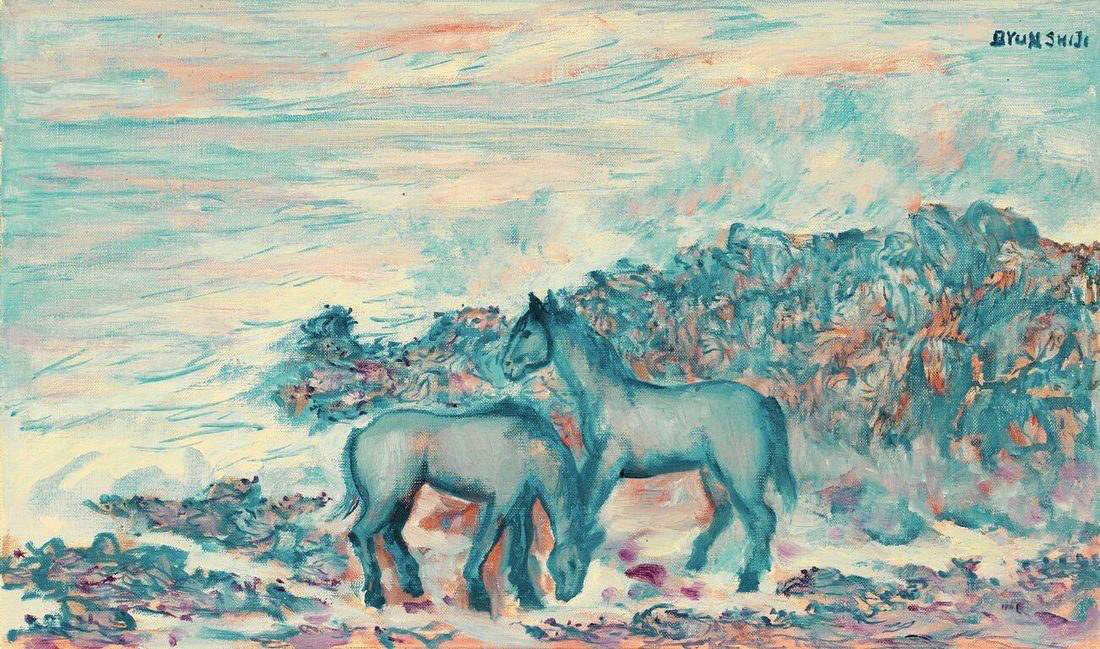
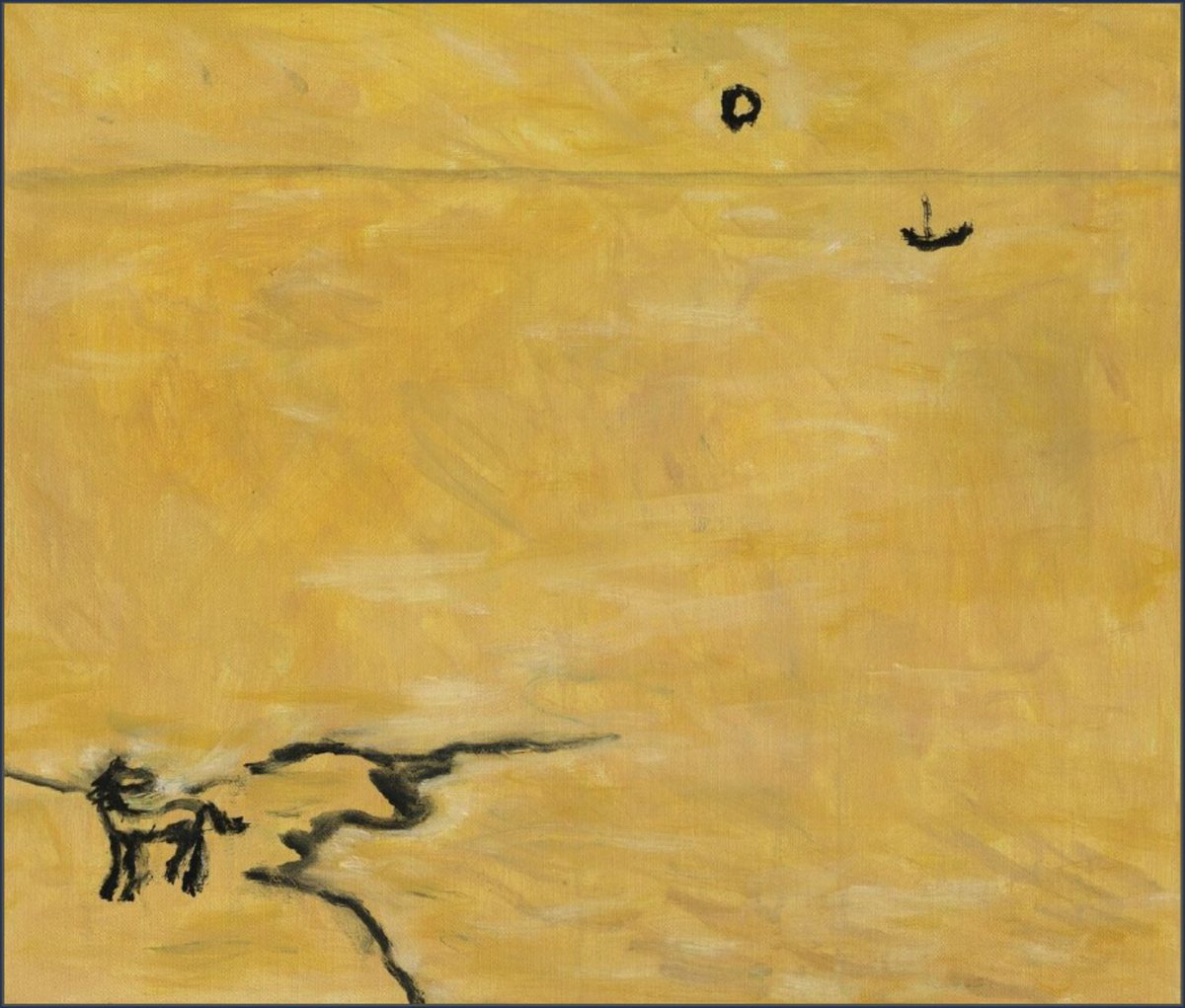
Beginning with Two Ponies
Jeju Ponies (1975) contains two animals. The one in front lowers its head; the one behind holds its neck upright. Reddish and pale brush marks surround their blue-tinged bodies. Animals of the same kind take different postures. The painter makes them recognisable as ponies without making the two bodies identical.
In The Last Work (2013), a pony remains in a few dark strokes. But it is not the only thing left. A shoreline bends, and above it are a sun and a small boat. The difference between the two paintings cannot be counted in details alone. Some of the information once carried by the animal’s body is now carried by the wide intervals around it.
Simplification here is not merely a smaller summary. It redistributes emphasis. Fur can be left undescribed while the ground beneath the feet and the direction of the head remain. More important than saying that less has been painted is another question: what can be left out while the body still feels alive?
Form Does Not End at the Outline
Imagine cutting out the pony’s shape and placing it on white. The same lines would make a different impression. The sea that gives the body its scale, the sun above it and the distant boat would be gone. Form in this painting includes not only what lies within an outline but also how it is separated from other things.
When a leg appears elongated or a back bent, we cannot immediately diagnose a physical condition. Proportion and the direction of a line alter the impression of the body on the canvas. A bend may suggest endurance. It need not become a diagnosis, or a single emotion assigned to every figure.
Reading deformation is not a matter of separating correct bodies from incorrect ones. It means observing where lines meet and how that meeting inclines a body. Lengthening one side changes the apparent length of another. Even a small body can acquire weight when much space is left around it. The force of form arises within these relations.
Cézanne, Too, Had a Mountain of His Own
The comparison narrows if Cézanne is treated solely as a painter of geometry who removed place and feeling. The Metropolitan Museum’s account of Mont Sainte-Victoire and the Viaduct of the Arc River Valley identifies a landscape he had known since childhood, seen from near his sister’s house. His investigation of structure was not detached from a familiar place.
There is no need, then, to set Cézanne’s supposed coldness against Byun Shi-Ji’s warmth. The question is how each painter organised relations within a place repeatedly observed. Aligning the directions of a mountain and a road, or leaving distance between a pony and a far-off boat, involves judgement in reconstructing a world. Life cannot be assigned to one side and geometry to the other.
Byun Shi-Ji’s difference can be found within his own painting. In The Last Work, the pony makes a small interruption in the broad colour of the water. A thin shoreline separates the ground beneath it from the space occupied by the boat. Simple lines do not make those positions the same. His simplification gains its particular force as a few forms disclose one another’s situations.
Memory Does Not Abolish Observation
In his oral history, Byun Shi-Ji described looking repeatedly at a site before painting at home. What the eye had learnt was translated into his own style rather than copied unchanged. Painting from memory did not make observation unnecessary. What could be remembered was already connected to a trained way of looking.
This account suggests another passage between early description and later omission. It is not a journey in which the painter first learnt surfaces and only later acquired an inner life. It is a renewed judgement about what persists from what has been seen, and the scale and direction in which to render it. Skill can change its role rather than disappear.
This is also why the two bodies in Jeju Ponies should be viewed beside the small pony in the final canvas: not to reduce the earlier work to practice for the later one. Each painting does something different. In one, the difference between two postures is encountered at close range; in the other, the interval between a body and the distant world persists.
Recognition Is Not Complete Knowledge
The simplified pony is recognisable. Yet we do not know where it intends to go or whom it may be waiting for. Identification and explanation are different acts. If looking ends when we name it a pony, the landscape around that body remains unread. A form that still requires attention after it has been named is more than a diagram.
Less facial detail does not mean that an individual life has vanished. Its impression changes with the direction of a lowered head, its proximity to another body and what lies before its feet. Even when speaking of a broadly shared human figure, these small differences must be preserved. A form that many people can enter is not a form without differences.
Nor does a greater amount of omission necessarily make a painting deeper. Remove a necessary point of contact and a body may float; erase distinctions between intervals and a world may become flat in an unproductive sense. The achievement of simplification lies not in how little is painted but in how precisely the remaining elements need one another.
Repetition Does Not Make a Dictionary
When pony, house, boat and tree recur, the viewer learns the painter’s vocabulary. A table equating pony with consolation, boat with parting and house with return is not enough. The same boat feels different near a house and beneath a distant horizon. The words may recur, but each painting forms a different sentence.
In Jeju Ponies, two animals stand close without a human figure. In The Last Work, a broad field of colour lies between the small pony and the boat. Calling both simply the painter’s solitude overlooks the different relations the pictures establish. Interpretation should recognise recurrence, then spend longer with what has changed.
Fūdo is not a fixed label either. A picture is not of Jeju merely because it contains a thatched house, nor does Jeju vanish when the house is absent. A sense of place can emerge through a lowered body, broad water and the distances between things set slightly apart. The eye moves from naming motifs to seeing the conditions under which they occupy a world together.
The Final Canvas Is Not a Formula for an Ending
The word “last” can make our eyes hurry. We may wish to say that everything disappeared into a single point. Yet this canvas contains a pony, a boat, a sun and a shoreline. We cannot erase what remains in order to obtain a satisfying meaning for the end. A few things are not the same as nothing.
The small pony’s back and the turn of the shore are different kinds of line. One gathers a body together; the other divides a space. The little boat above them offers another measure of distance. Few forms remain, but they have distinct tasks. Omission does not abolish difference; it can make the differences that remain more palpable.
The final work need not become the one correct answer to perfect simplification. The many paintings before it retain their own densities and complexities. This canvas does not discard their world. It arranges things again at different intervals. Even at the end, that world is not closed into a single form.
What Must Not Be Erased
The question of what to keep is followed by another: what cannot be lost? Decoration may be removed, but not necessarily the relations that give a body its situation. Byun Shi-Ji’s simplification should not be read as a residue that failed to reach abstraction. It is a choice through which distance remains alive among a few forms.
The viewer, too, has something to leave out: the habit of hastily applying words such as solitude, consolation or serenity. Delay those words and the thickness of a line and the direction of a body return to view. Before translating the picture into a general meaning, we need time for the slight displacements that belong to this painting alone.
Below is a small pony. Above is a boat. Without filling the interval with anything else, the eye returns to the turn in the shoreline.