Research/A Hundred Years of Wind/Ⅳ Technique & Medium
Ⅳ Technique & Medium · 45 / 100
Learn the Line
Between the Observing Eye and the Revising Hand
선을 배우라
What Needs Attention before the Hand Moves
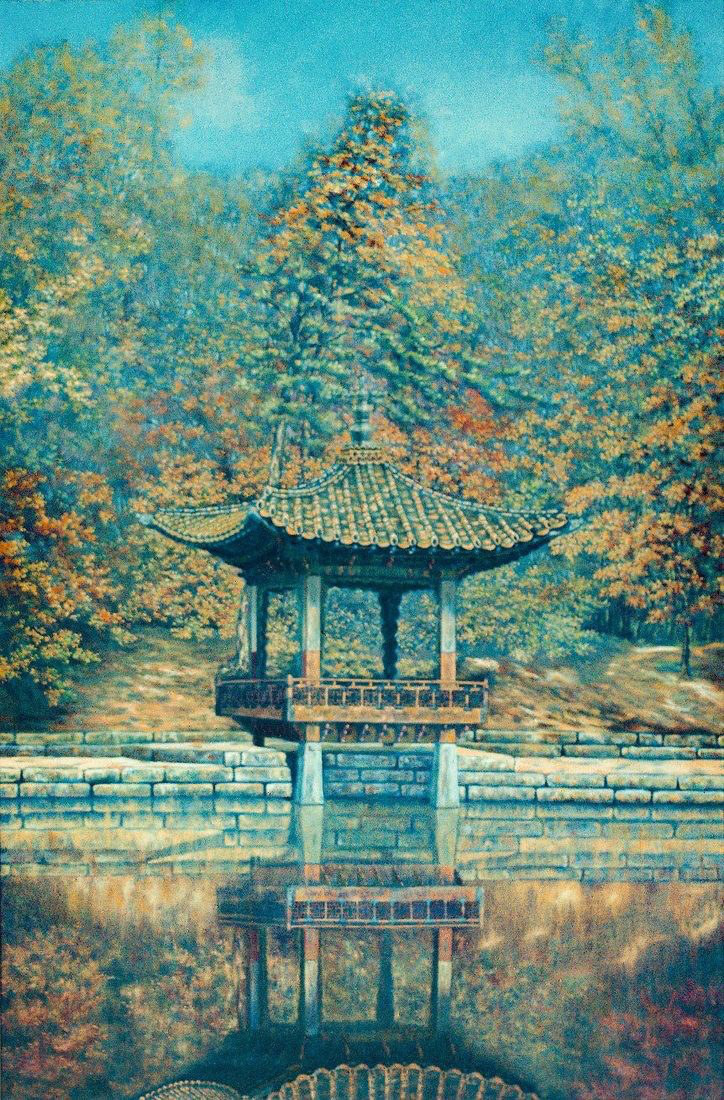
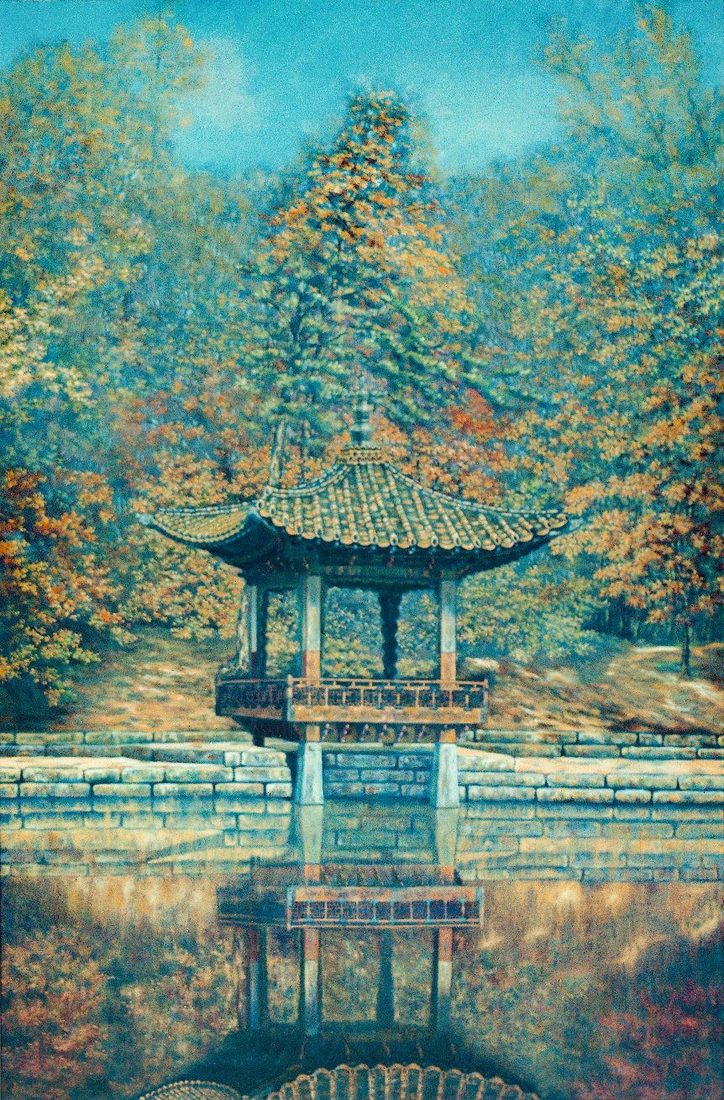
The columns and railings in Aeryeonjeong Pavilion in Autumn (1965) are distinguished by small differences. Darkness beneath the roof, the lightness of columns and the unsettled reflection coexist. Learning line here involves more than accurately following an outline. It also asks which lines establish structure and which boundaries between colours appear to function as lines.
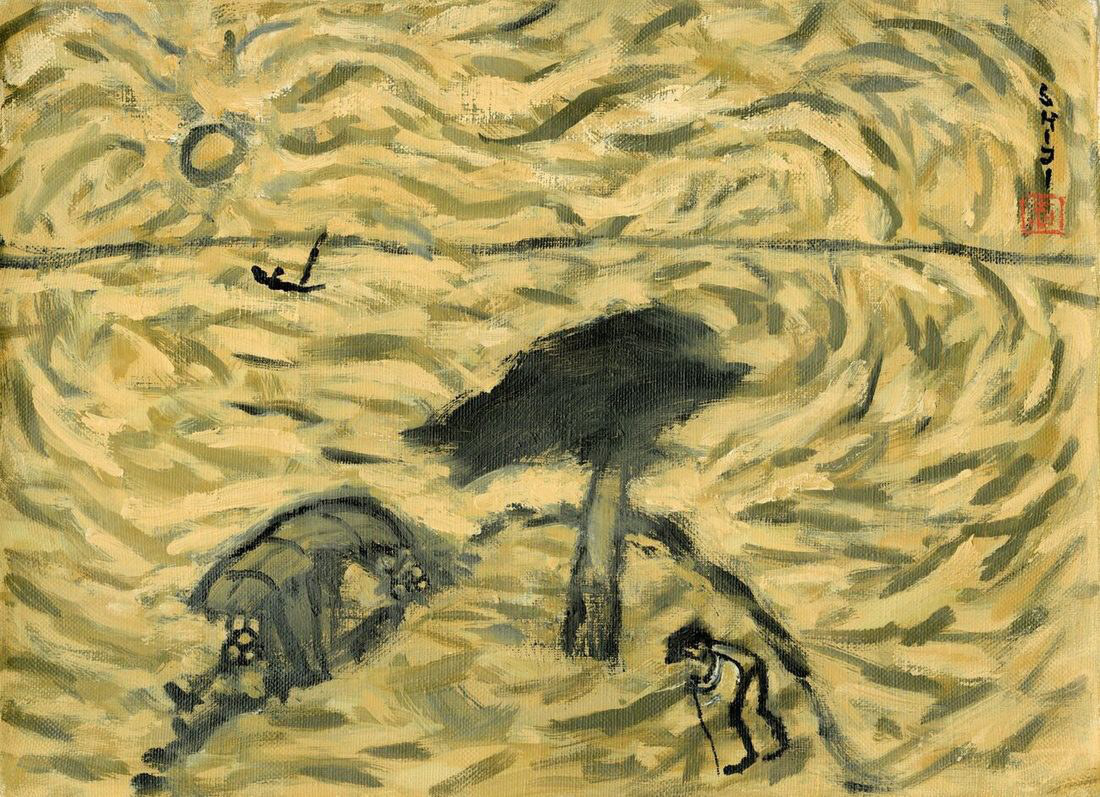
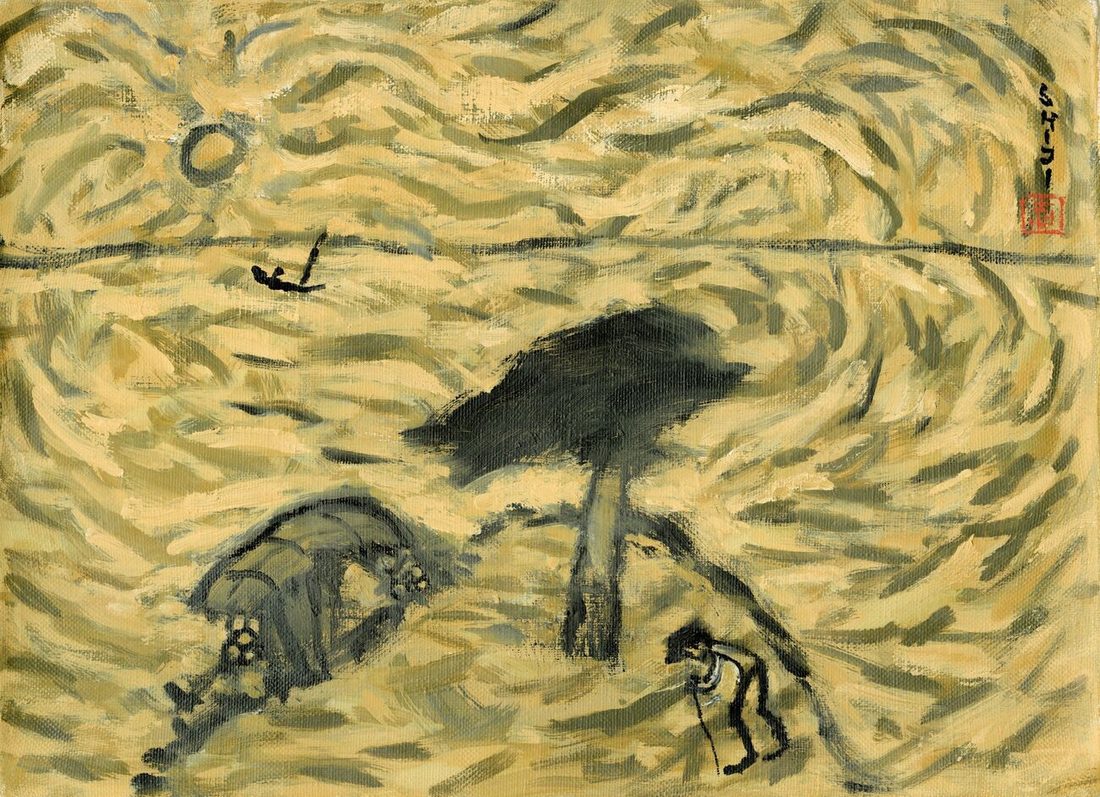
The curved strokes in Noon (2007) do different work. Passing around house, tree and person, they connect areas of the picture through an apparently moving texture. Dividing the two works simply into precision and roughness misses the learning between them. What changed was not merely the hand’s capacity, but what the line was asked to do.
Learning line therefore begins with questions. What does this mark make recognisable? Where does it lead the eye, and what lightness does it leave? Imitating a rough stroke without asking those questions may produce roughness alone. Learning its work rather than merely its appearance opens a possibility of making another painting.
Painting from Memory Does Not Mean Not Looking
In his oral testimony, Byun Shi-Ji stresses the training of looking closely on site. He describes counting roof tiles and observing railings in Biwon, later retaining enough to paint without looking at them directly. Memory was not a shortcut around observation. It resulted from sustained practice in making what had been seen available again.
He also says that he painted Jeju storms at home after observing and taking in actual scenes. Not painting on site did not mean severing the connection with experience. Between the place of looking and the place of painting lies a time of memory and judgement. Within that interval, the picture can become something other than a copy of the scene.
He describes carrying what he has seen into his own style. Preserving the appearance before him unchanged was therefore not training’s sole purpose. Recalling a structure, he reconsiders proportion, colour and the work of line. When observation and imagination are not enclosed in separate compartments, observation becomes a support for expression rather than its opposite.
Why Return to Ingres and Degas?
The National Gallery recounts Degas’s meeting with Ingres in 1855 and the advice to draw lines from nature and memory. What matters for this comparison is not simply an injunction to accurate draughtsmanship, but the conjunction of observation and memory. Byun Shi-Ji’s testimony also keeps them together. Before establishing a direct route of influence, we can recognise related questions about learning.
The same museum’s account of Degas’s ballet dancers describes combining observation and memory in the studio and testing compositions repeatedly. Depicting movement did not mean capturing everything instantaneously on site. This returns a question to Byun Shi-Ji’s wind: a turbulent-looking painting need not have been made within one turbulent instant.
The comparison should not close into three compartments: Ingres as stillness, Degas as movement, Byun Shi-Ji as force. Structure, motion, choice and revision can coexist in each painter’s line. Byun Shi-Ji’s particular question concerns their reconfiguration within life in Jeju. Constructing a lineage need mean neither erasing differences nor declaring the earlier painter surpassed.
Thought That Changes as the Brush Makes Contact
If the hand merely transfers what is already in the mind, the material’s part disappears. Related movements can leave different marks according to the paint carried and the condition of the surface. The next movement is chosen in response to small differences between intention and result. Painting is not only the execution of an order settled in advance.
The strokes in Noon differ in width, length and the way they leave light intervals. They do not look like a pattern copying one curve at fixed spacing. Their variation invites us to consider adjustments between hand and surface. It does not allow us to recover an exact brush speed or pressure from the finished reproduction.
The phrase the hand follows the mind can then widen. The eye looks again at what the hand has left, and judgement also changes. This is a returning relation rather than a one-way transmission. Forming an intention and receiving an unforeseen difference are both needed. A personal line need not emerge only from insisting on one of them.
Stopping Is Also Part of Learning Line
The claim that a living line requires never stopping does not fit the testimony. Byun Shi-Ji describes laying in a ground and returning later, or rethinking a composition as his ideas change. The finished painting may not visibly announce those waits. Unseen time nevertheless belongs to its making.
Stopping may mean looking again at a line already made. A stroke that seemed forceful close up may disturb the house’s scale from farther away. A seemingly weak line may work adequately against a broad ground. A brief interruption that changes viewing distance can change the reason for the next stroke.
Slowness need not be made an unconditional virtue. Byun Shi-Ji also says that a work is not good simply because it took a long time, or poor because it was made quickly. The time needed may vary. Training includes recognising what is required now, rather than only finishing quickly or persisting for a long time.
The Hand That Revises and the Hand That Refrains
The testimony describes how something valuable may arise unexpectedly and be lost through further work intended to improve it. This differs from prohibiting all revision. It cautions against continued addition without recognising what has already succeeded. An eye for what needs changing and an eye for what should remain untouched are needed before the same picture.
The possibility of revision does not mean that an earlier state can always be restored exactly. He speaks of wanting to return to the effect before reworking, only to find it gone. The repaintability of oil and the difficulty of recovering a particular effect coexist. Possibility and irreversibility belong within one practice.
Learning line includes the judgement to draw less, but adding nothing is not always the answer. One line may be needed to establish a relation; another may obscure a relation already present. Reasons for stopping or continuing must arise from the picture. Restraint is not achieved merely by making fewer marks.
From Copying a Mark to Looking Differently
A viewing exercise can be proposed here. Draw a tree while looking at it, then cover the drawing and draw it again from memory. Do not decide beforehand that the second should be better. Compare what has been forgotten with what remains. This is not a reconstruction of Byun Shi-Ji’s classroom, but a present-day exercise prompted by his account of observation and memory.
Next, instead of darkening the same line, attend to the space beside it. Is the interval between trunk and branch too narrow? Can the eye pass between tree and house? Practice in line becomes observation beyond line. Where a well-made stroke is placed may change the painting more than the stroke alone.
Such exercises do not guarantee a style resembling Byun Shi-Ji’s. What can be learned is less a formula reproducing a particular roughness than a practice of looking, remembering, comparing and revising. Bodies, tools and places of living differ, so outcomes can differ too. Transmission need not multiply identical lines; it can help other lines find their work.
The Next Place Left by Learning
Calling line life rather than technique erases the long time of technique. Calling it only technique removes the life in which its uses are chosen. Byun Shi-Ji’s testimony brings together trained observation, experience of place, drying paint and revising judgement. Without separating life from technique, line approaches us as an actual practice rather than an abstract virtue.
The form made by that practice enters relations with open space. Learning line leads towards further questions: what should remain, and how should the undrawn area be left? Even where the hand rests enters the picture. Learning may continue not at a moment of perfect control over every stroke, but in the room to look again at what has been placed.
Waterlight remains beneath the columns in Aeryeonjeong Pavilion in Autumn. Light strokes lie beside the dark tree in Noon. Following a line, the eye pauses for a moment beside it.