Research/A Hundred Years of Wind/Ⅳ Technique & Medium
Ⅳ Technique & Medium · 43 / 100
The Power of the Black Line
Force Made through Contour, Interval and Brushwork
검은 선의 힘
Dark Marks Do Not All Do the Same Work
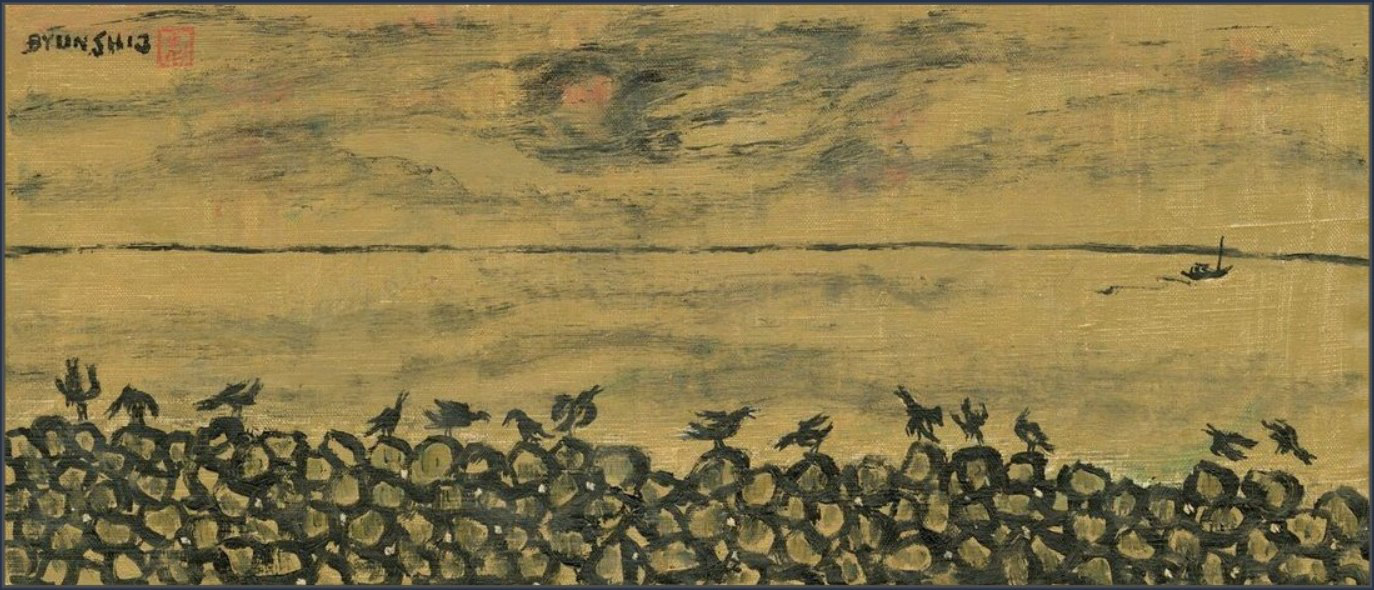
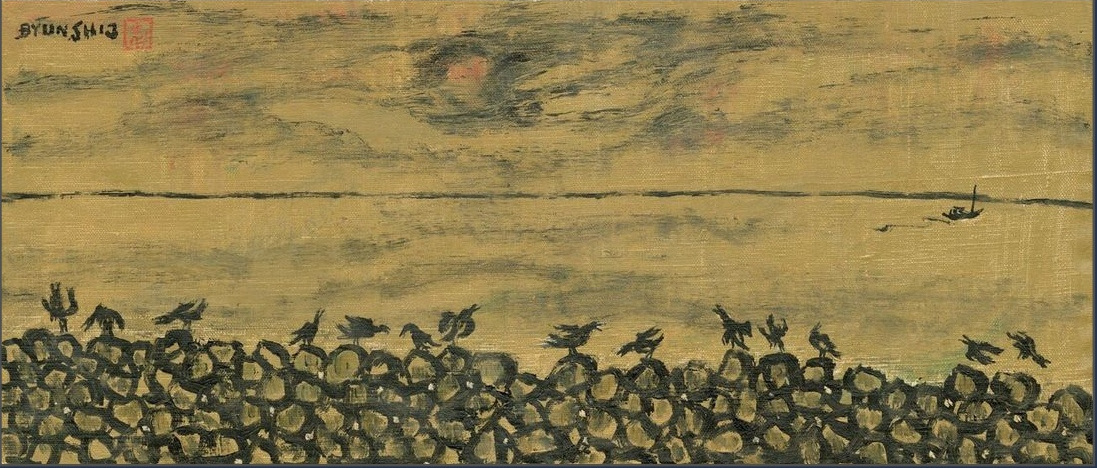
Along the lower part of Crows on a Stone Wall (1983), dark forms of stones and birds follow one another. Lines around the stones make rounded units; those of the birds extend or turn sharply. Farther away, the horizon passes as a thin line. Though all appear dark, they do different work: supporting, directing a body and opening distance.
A small stroke belonging to a bird would not read as the same bird if moved into a stone’s contour. A line’s meaning does not reside in shape alone. Placement, contact and the lightness left around it act together. Its force arises not only from the intensity of its darkness, but from its relations with what surrounds it.
Dividing the painting into line and ground is only a beginning. Line does not say everything while ground merely provides support. The concentration of dark forms below makes the space above seem more extensive. Conversely, that expanse gives the short strokes below their density and weight.
Where a Line Becomes a Posture
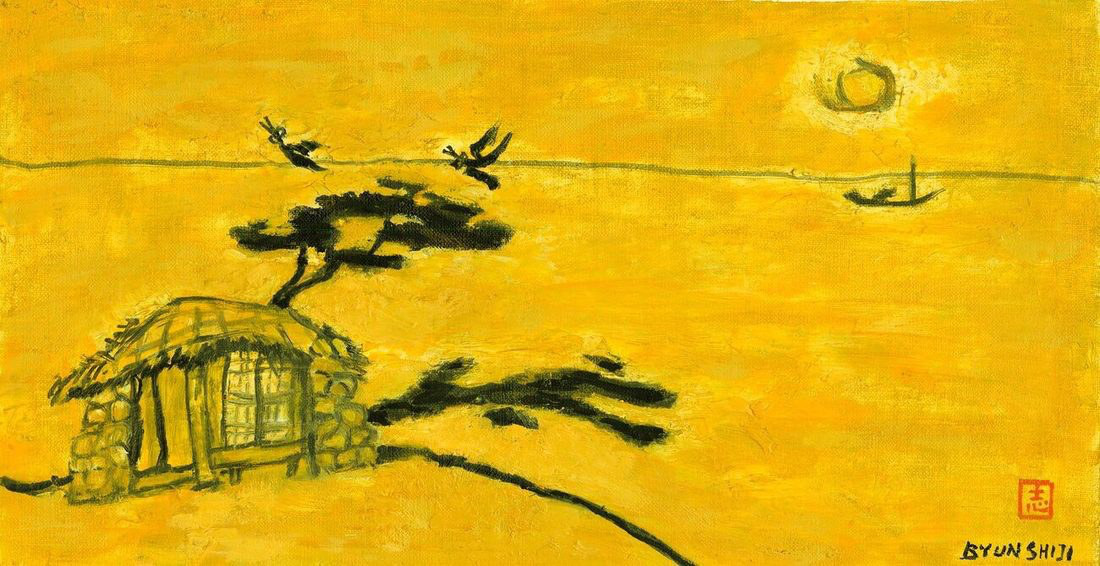
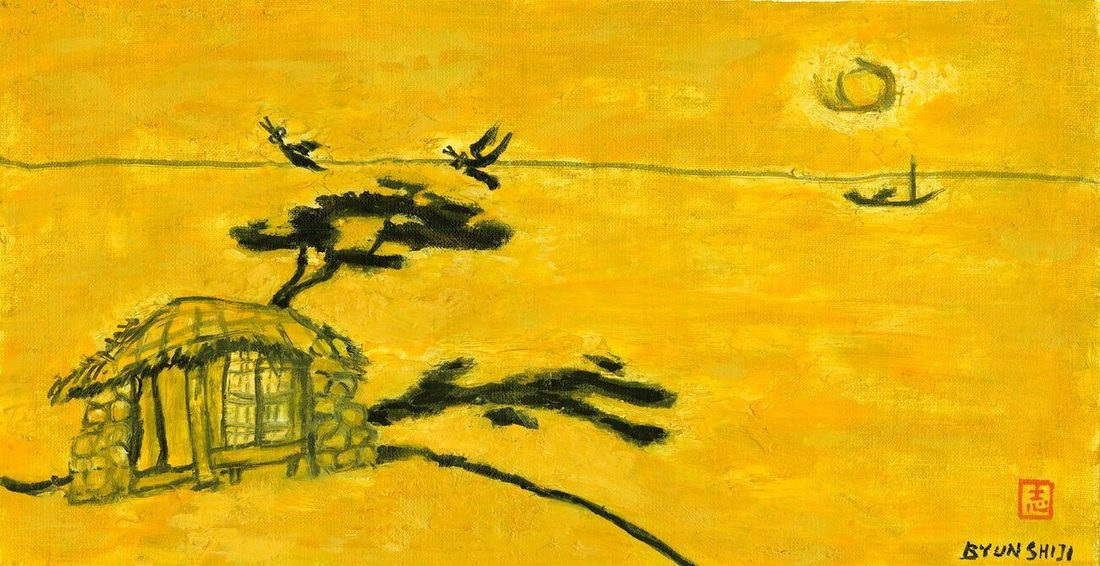
In Empty House (1987), the tree trunk does not rise straight. Above the small house it bends beneath a dark spread of branches. The two birds nearby open their wings at different angles. Following bent trunk and spread wings, the eye connects distinct directions. Rather than finding a separate shape called wind, we sense a tension among directions.
We can read the line as a trace of force, without claiming that an actual wind path has been recorded. Through bent forms and open space, the painter creates conditions in which force can be sensed. A line is both an object’s boundary and a route for attention. Recognising a shape and sensing movement meet within the same mark.
Contour and expression need not exclude one another. Recognising a horse’s neck allows its lowered angle to register as bodily weight. Recognising a tree trunk allows its bend to carry tension. The line that tells us what something is can also let us sense how it occupies its place.
Black Chosen through the Memory of the Ink Brush
Explaining why he began working in black on a yellowish ground, Byun Shi-Ji recalls the practice of writing with an ink brush. A black familiar in Korean life could, he thought, become a language for painting. The testimony prevents the line from being reduced to private preference alone. Culturally learned memories of hand and eye enter the choice of colour.
Cultural familiarity is distinct from biological nature. Having dark hair or eyes does not make people draw the same line. We can respect the painter’s association without extending it into an inevitable aesthetic shared by all Koreans. Ink-brush experience is a practice that can be learned, chosen and changed, not a destiny completed at birth.
Tradition then becomes usable experience rather than a fixed origin to which one must return. A written stroke and a painted branch do not have the same meaning, but they can share sensations of moving and stopping a brush. Byun Shi-Ji’s choice can be read as allowing an older experience to work again on another ground and within another scene.
Looking Like Ink and Being Ink
A dry, rough-looking stroke in a reproduction can recall dry-brush work in ink. Resemblance is not evidence of identical materials. The pigment, binder and ground require documentation or technical examination. Here dry brush first names a visible effect: a stroke that breaks, grazes and leaves areas of ground exposed.
In his testimony, Byun Shi-Ji describes waiting for oil paint to dry sufficiently before returning to it. This differs from an account of work completed in a single gesture. Drying, reworking, adding paint and sometimes scraping enter his description. Even where a line seems to pass quickly, the time of the whole painting cannot simply be assumed to be quick.
The present evidence does not establish that all oil was removed to turn oil paint into ink. Altering a paint’s composition and changing the amount carried by a brush are different operations. What we can read here is the pictorial difference made by thickness, interruption and overlap. Technical terms should sharpen observation rather than outrun it.
Not Dividing Line and Colour between Continents
Dividing line into Eastern spirit and colour into Western matter narrows both traditions. Byun Shi-Ji’s line appears within an oil-painted surface, and the ground’s colour alters its weight. Neither works alone. To make him a painter who abandoned colour in recovering line would also contradict his account of varying colour between works.
MoMA’s discussion of Matisse’s monotypes attends to the construction of bodies with reduced outlines and detail, giving importance to white line against black and to an economy of line. Even this example makes a story of line defeated and eliminated by colour in modern Western art inadequate. Byun Shi-Ji’s distinctiveness does not depend on other painters lacking line.
The comparative question needs to change. Rather than ranking lines, we can ask what each is made to do against its particular ground. Byun Shi-Ji’s trees and birds are read with the broad dried-grass-coloured space. Within it, the bend of a trunk and intervals between birds alter one another’s force. Distinctiveness lies in that particular conjunction.
A Continuous-Looking Line and a Single Stroke
The eye may travel uninterrupted from a tree’s roots to its branches without proving that the brush was never lifted. Continuity in the finished image differs from continuity of execution. Several strokes can make one flow, while a single stroke can bring attention to a halt within it.
In Crows on a Stone Wall, the short directions of body, beak and wings meet. Their connections make a bird recognisable without making all its parts alike. The wall’s repetitions work similarly. Related small units differ in size and tilt. Difference within repetition both leads the eye and gives it places to stop.
This rhythm can be likened to the painter’s breathing. It cannot disclose an exact emotional state or breathing rate at the moment of execution. The metaphor’s value is in evoking bodily movement, not certifying an unseen interior. Staying longer before a line need not mean asserting more; it can mean becoming more responsive to visible differences.
There Is Force between the Lines
No heavy line joins the house and distant boat in Empty House, yet the eye crosses between them. The size of the near house, the smallness of the remote boat and the horizon above them make a route. An undrawn connection works with the drawn lines. To see the force of line, we also need to see where line is absent.
The interval between one small bird and the next works in the same way. Narrowness gathers bodies; a wider space gives their directions more independence. An interval is not merely background adding meaning from outside. It helps determine how separately or jointly lines act. Relations do not arise only where things touch.
A darker mark is not necessarily stronger. Where its surroundings are already dark, it may disappear. A thin line beside broad lightness can draw the eye farther. Byun Shi-Ji’s black line cannot be explained by roughness and thickness alone. At times, the quiet ground around it carries more of its force.
From a Mark of Paint Back to a Bird
Close up, a stroke appears as an edge of paint. A little farther away, it becomes a wing. From farther still, it participates in a rhythm made by several birds. These distances are not alternatives from which one must be chosen and the others discarded. They are levels through which the eye moves before the same work.
The force of black line does not arise only after the image of a thing has been abolished. We recognise a form while sensing a stroke, and see a stroke while rereading the distance around it. Line is neither only a boundary enclosing a bird nor only a gesture unrelated to it. Moving between those possibilities sustains attention to the small form.
Birds stand on the wall. Beside one dark body a light interval remains. Across it, the next bird’s beak points another way.