Research/A Hundred Years of Wind/Ⅳ Technique & Medium
Ⅳ Technique & Medium · 42 / 100
The Discovery of Yellow-Brown
How Dried-Grass Colour Becomes a Pictorial Language
황갈색의 발견
The Colours Did Not All Change at Once
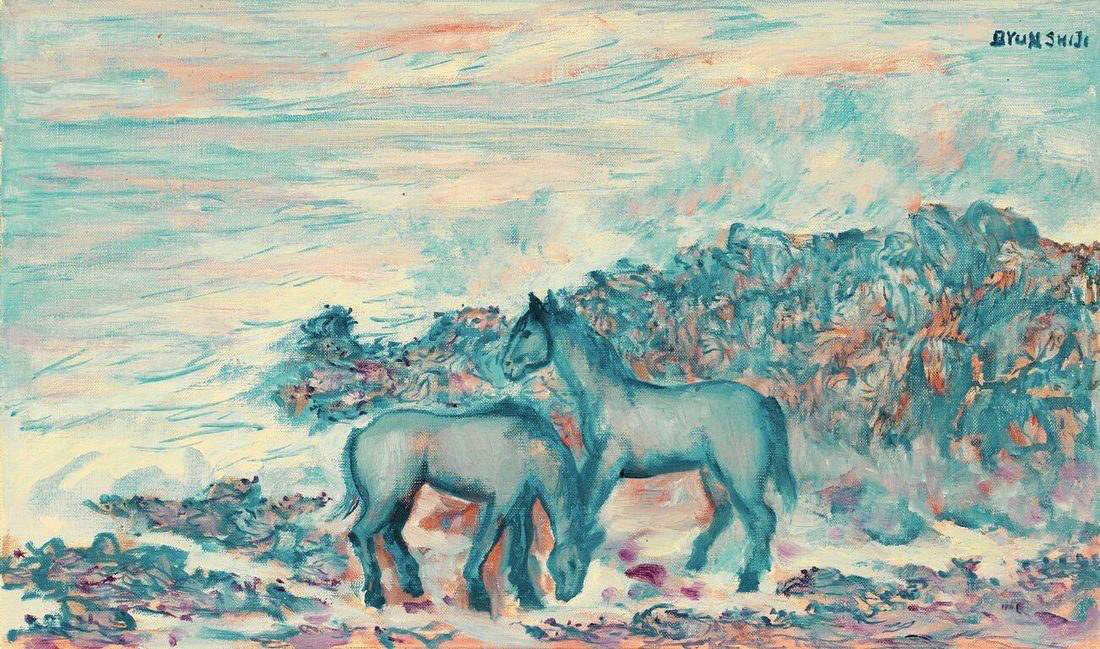
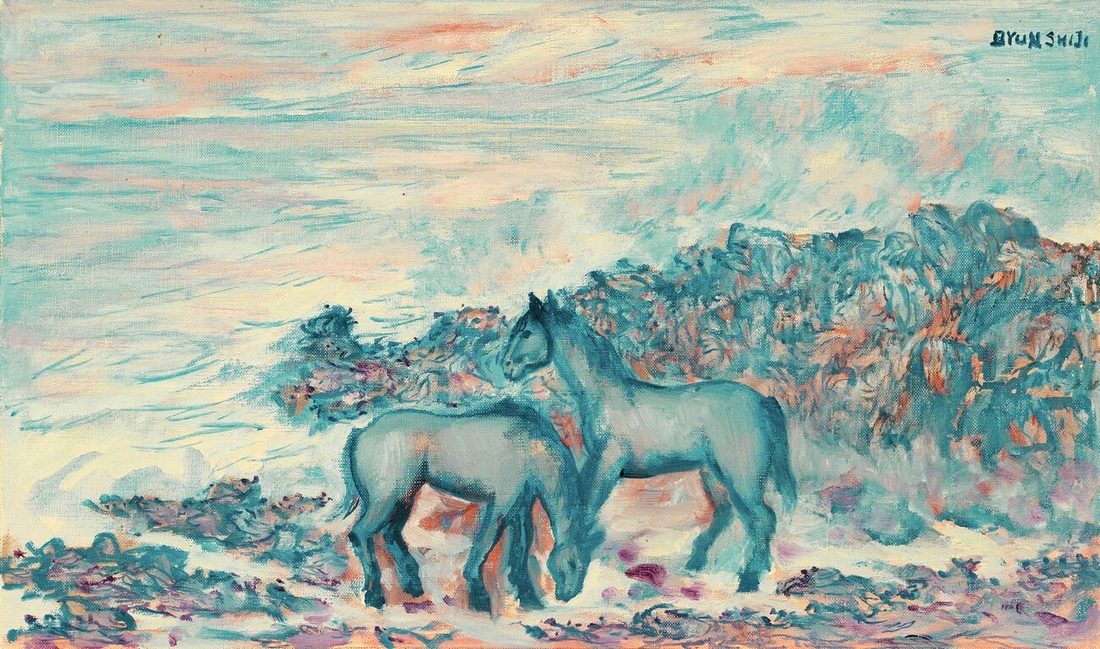
The sea in Jeju Ponies (1975) carries a broad blue cast. Pink and turquoise enter the rocks and the horses’ bodies, while the two animals hold themselves differently. Beginning with this painting makes it difficult to say that every colour contracted into one at the moment of return to Jeju. Arriving at a place and changing the language in which it is painted are not the same event.
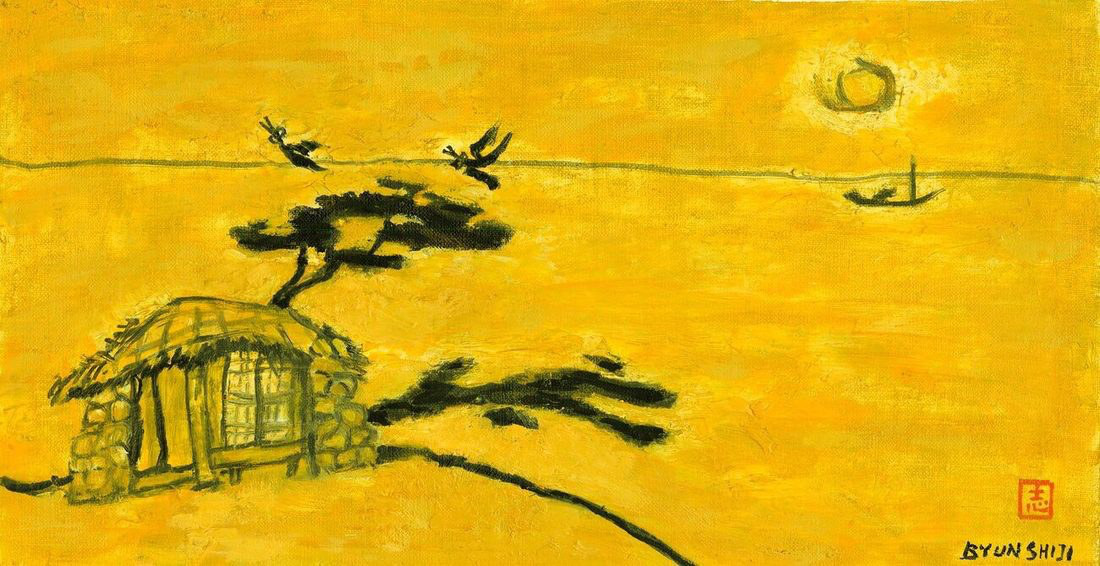
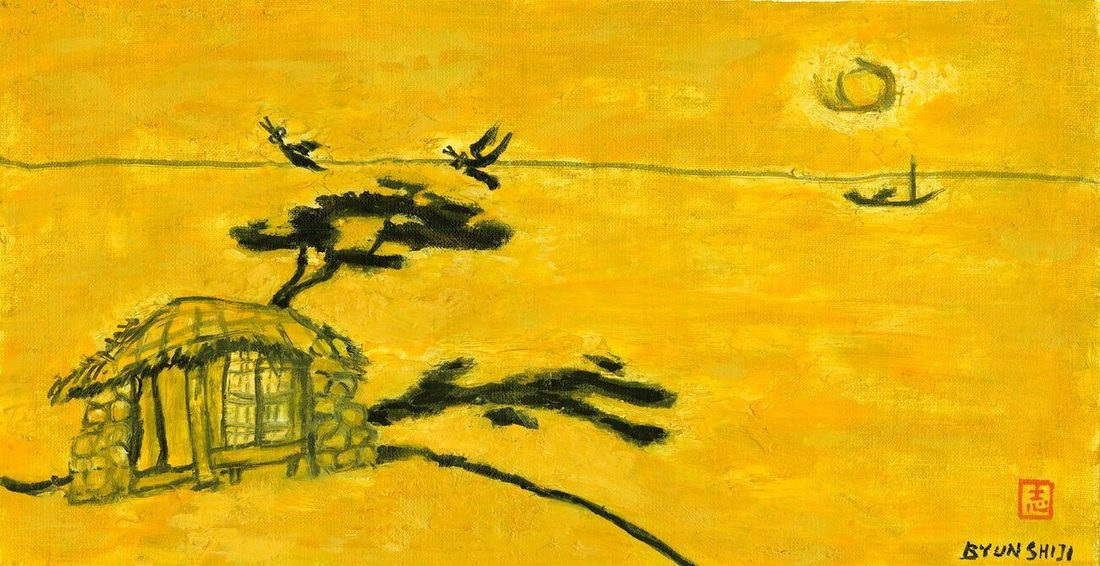
In Empty House (1987), an extensive yellow-brown field and dark lines come forward. These two works cannot establish every stage of the transition. What their comparison offers is not a story completed by one revelation, but paintings in which different relationships of colour have been made. Change becomes more concrete between pictures than within a single entry in a chronology.
Discovery includes a moment of unexpected recognition. Whether what is recognised can be used in the next painting is another question. A glimpse of light does not immediately become a style. Choices remain about which colours to retain, which contrasts to reduce, and how a house or horse will appear against the resulting ground. This chapter attends to what follows the moment, rather than celebrating the moment alone.
The Shore Remembered in Oral Testimony
In the seventh oral-history session, Byun Shi-Ji says that he initially continued painting in his Biwon manner after moving to Jeju. The subject was Jeju, but he felt that its life and fūdo had not sufficiently entered the work. His change of colour is not explained simply as admiration for a new landscape. There was first a mismatch between his manner of painting and the place in which he was living.
He recalls seeing something white appear yellowish under strong sunlight while thinking on the shore. He then considered whether a yellowish tone might stand for Jeju and tried to carry that thought into painting. His account moves through seeing, considering and trying. It is not a story in which colour completes itself during an absence of consciousness.
The testimony also mentions drinking at night during that period. But drinking and discovering one’s colour on a canvas the next morning are not the same event. The passage examined here describes observation on the shore. Keeping an airport revelation or a morning-after discovery separate from this account allows the painter’s own description of observation and choice to become clearer.
Between Observed Light and Painted Colour
The recollection of white appearing yellowish records the painter’s perception. It is not a measurement establishing that every white object in Jeju always turns the same colour. This distinction does not diminish the discovery. It asks how a perceived phenomenon became a pictorial possibility. Natural light and painted colour are connected without being identical.
In Jeju Ponies, the colours of sea, rocks and bodies invite attention in turn. In Empty House, the continuity of the broad ground comes forward, with the dark house and tree set within it. We can read the first as distributing more differences and the second as asking fewer differences to do more work. This is a change in the organisation of sensation, not its abandonment.
Dried-grass colour should therefore not be called nature’s definitive answer. It names a relationship we read in the painting. It evokes grass weathered by sun and wind, without claiming that the actual pigment came from grass or soil. The term does not replace a materials record. It remains a critical language for the texture of time we sense before the colour.
Recognising What Chance Offers
Setting chance and judgement against each other oversimplifies discovery. An unforeseen colour may appear, but decisions follow: whether to retain it, how to place it with other forms, and whether to test it again. Surprise can begin a choice without making that choice for us. Discovery requires an eye that distinguishes as well as one that receives.
MoMA’s account of Pollock’s One: Number 31, 1950 considers organised order within a process that makes use of gravity and moving paint. The entry of chance does not remove every act of regulation. The comparison does not make Byun Shi-Ji’s method identical to Pollock’s. It prevents either painter from being confined to an absolute of control or its absence.
In John Cage’s Music of Changes, I Ching-based chance procedures enter decisions about sounds, silences, durations and dynamics. The score publisher also describes a precisely notated result. A procedure for chance and an experience of unexpected recognition are distinct. For Byun Shi-Ji’s colour, the observations and experiments he recounts should come first.
The Colour of Galjungi and the Colour of a Painting
Byun Shi-Ji discusses galjungi clothing in his testimony, yet distinguishes his colour from an account that derives it directly from those clothes. Even within a yellowish range, he says, the tone changes from painting to painting according to what he paints. The distinction resists a simple equation between a local object and a picture. Finding a similar colour does not complete the explanation of painting.
Recalling objects associated with a place can be useful. But letting one object determine every role of the colour pushes tonal differences and contrasts with line aside. The ground in Empty House extends the space beyond the house and distances the small boat. That spatial work cannot be explained solely by asking which garment its colour resembles.
Dried-grass colour must undergo the same scrutiny. The name is useful when it brings us back to the painting; it obstructs us when it suggests that every canvas has an identical yellow tone. A useful name does not replace observation. Even after learning it, we need to attend separately to what is unusually light and what remains dark in a particular work.
Choosing Again within a Tonal Family
The painter’s statement that colour differs from work to work is modest but important. It restores choices easily concealed by the phrase a lifetime spent repeating one colour. Even where a yellowish ground recurs, its lightness, mutedness and relation to the weight of dark forms must be reconsidered. The persistence of a style does not mean that choosing has ended.
With fewer colours, small differences may have more to do. Distance and weight change according to how dark a boat is made against its surroundings, or how closely a house wall approaches the ground in tone. Counting colours misses this work. What matters is not only how many were used, but how precisely the remaining differences act within the picture.
Repetition then need not reproduce an identical conclusion. It can meet related conditions and test a different answer. A lighter, broader ground may expose a small form; a multiplication of strokes may make the intervals seem unsettled. Even within familiar colour, the picture is organised anew each time.
The Limits of Saying That Earth Became Paint
The sentence Jeju’s earth became paint is readily understood. But its metaphor must not become a claim about materials. The pigments and binders used are matters for documentation and technical examination. A reproduction may evoke an earthy texture without revealing its composition. Describing an impression and establishing a material are different tasks.
Writing colour’s discovery only as a transcendent event makes the painter’s hand disappear. He becomes merely someone recording a colour that arrived by itself. The testimony preserves another account: he judged a former manner inadequate, took a thought from observed light and tested it in painting. Fūdo offered conditions; it did not finish a canvas in his place.
Discovery becomes less mysterious but more approachable. The painter does not possess all the world’s light. He may miss something, recognise it later or choose again in the next work. Its depth may lie less in a single certainty than in continuing to test that certainty through paintings.
The Painting after Discovery
The discovery of yellow-brown was both a recognition of colour and an acceptance of the problem of painting differently. Changing colour alone does not turn an unchanged composition into another world. The roles of line, the scale of things and the intervals between them also enter the question. What begins with colour soon concerns the painting as a whole.
The blue canvas should not therefore be left as a failed preliminary stage. The two bodies, rocks and light surface of the sea in Jeju Ponies already form relationships within that work. Knowing the later manner need not reduce an earlier painting to an unfinished prediction. Change does not erase the earlier picture; it adds another possibility beside it.
Two horses stand before a blue sea. In another painting there are a small house and a distant boat. The eye moves between the two. The painter’s colours have not settled into a single name.