Research/A Hundred Years of Wind/Ⅲ Animals & Life
Ⅲ Animals & Life · 41 / 100
Companionship between Animals and Humans
Sustaining One Another in a Shared Place
동물과 인간의 동행
Two Bodies before a House
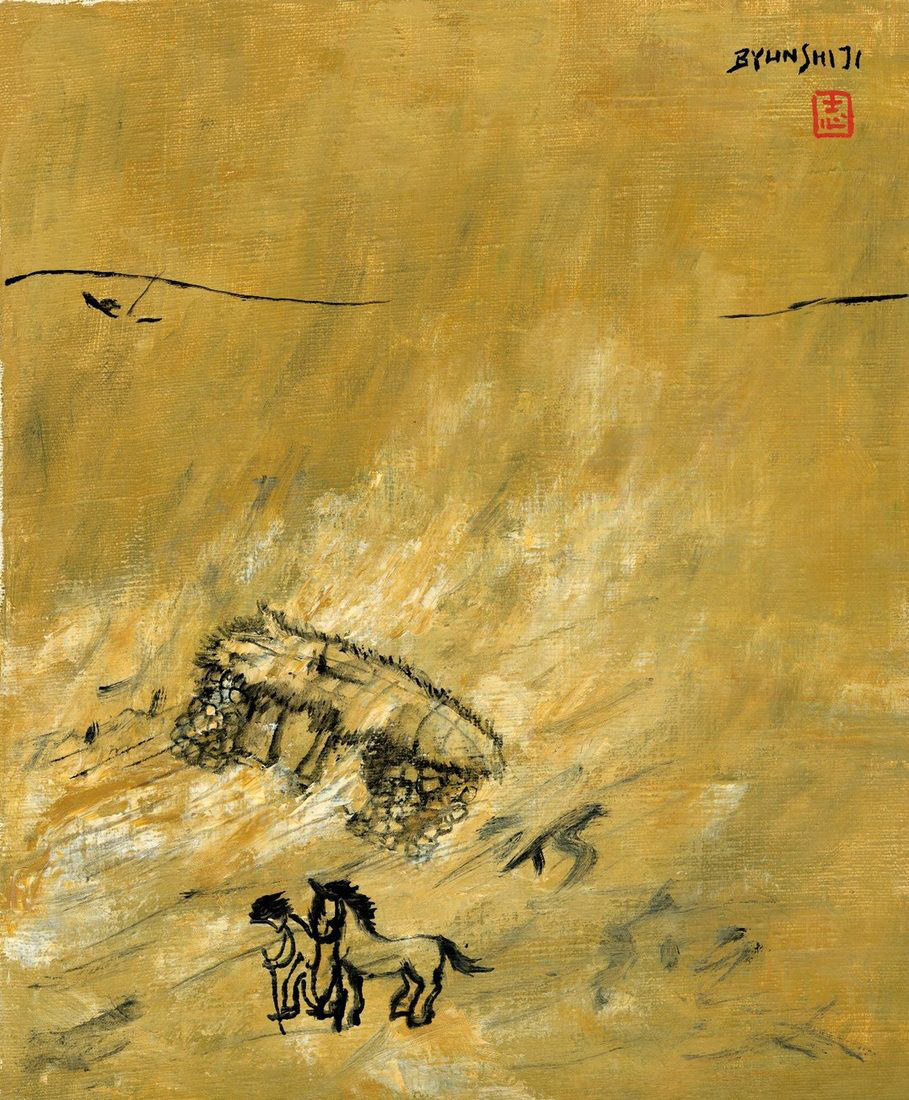
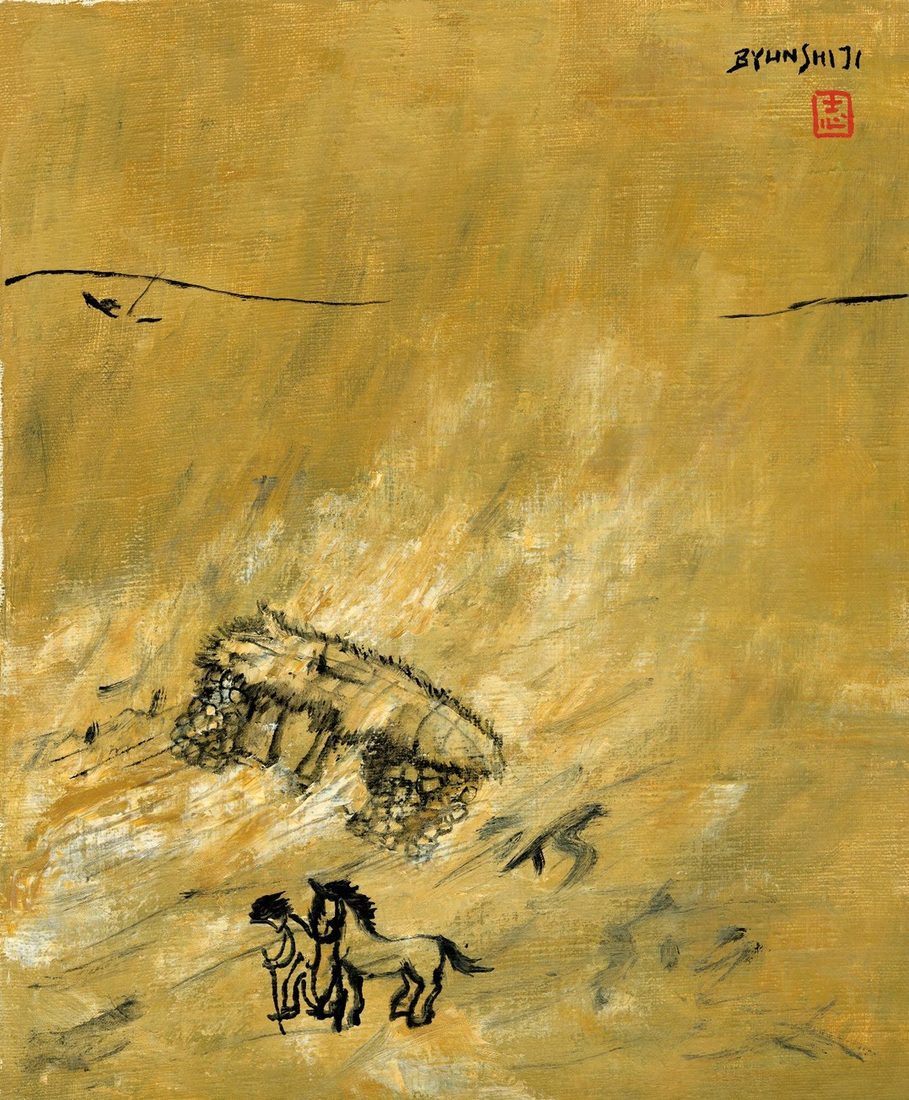
Near the bottom of Stormy Seas (1983), a person and a horse stand close together. Dark strokes overlap where the person’s arm meets the horse’s neck. Behind them is a low house, with pale diagonals crossing house and ground. Before assigning a precise action to either figure, we notice how little distance separates their bodies. Within this broad, turbulent picture, their closeness is small but distinct.
Is the person protecting the horse, or leaning on it? Assigning protection entirely to one side diminishes the tension of the scene. The person’s bent body and the horse’s standing body occupy their places differently. That difference makes contact possible. Companionship here does not mean becoming alike. It means remaining close as different bodies.
The house behind them does not mean that the two bodies are already safe. Even the short distance to it includes ground to be crossed. The painting does not divide secure interior and dangerous exterior into two clear compartments. House and bodies alike are surrounded by the diagonals of the picture. Being beside another does not abolish the storm, but it changes where a body can place itself within it.
Not Gathering Everything into One Scene
When reading Byun Shi-Ji’s animals, it is tempting to combine several paintings into an imaginary landscape, as though person, horse, cattle, crow, crab and grass were always present together. Yet the relationship in Stormy Seas differs from that in Seaside Village (2002). Distinguishing close contact in one work from separation in another allows different forms of companionship to emerge.
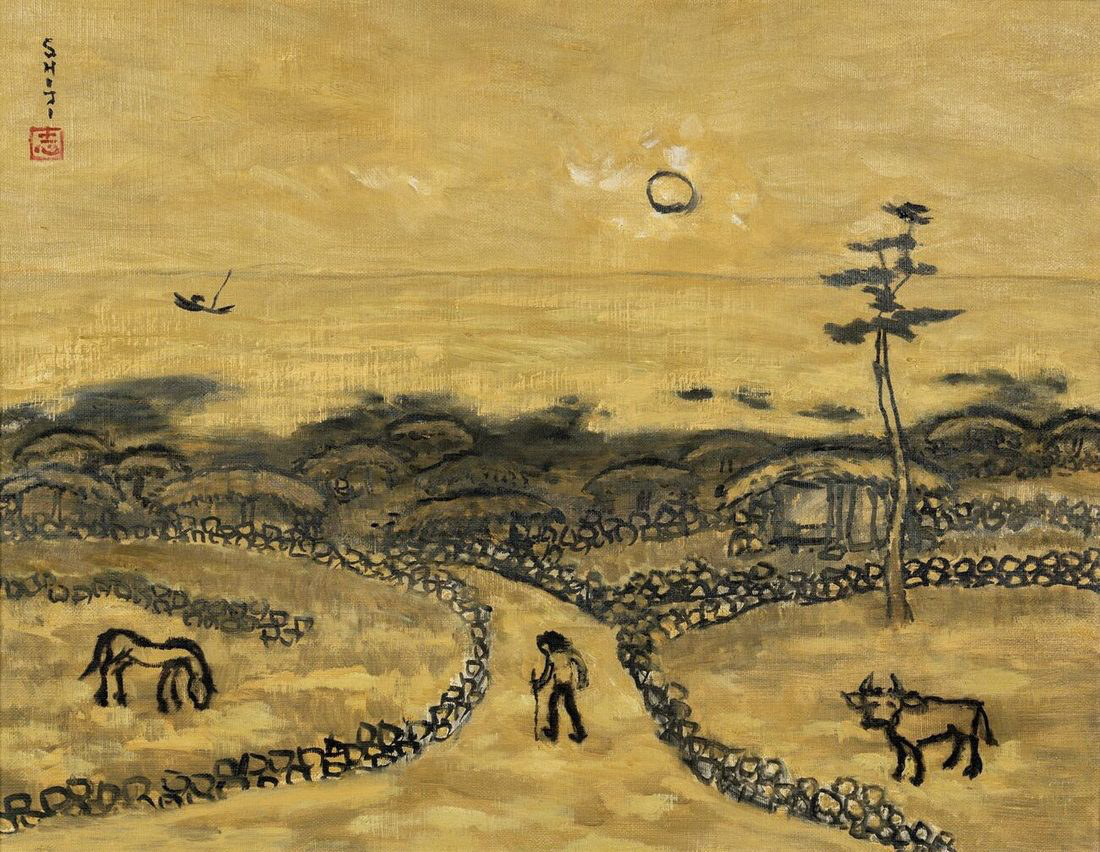
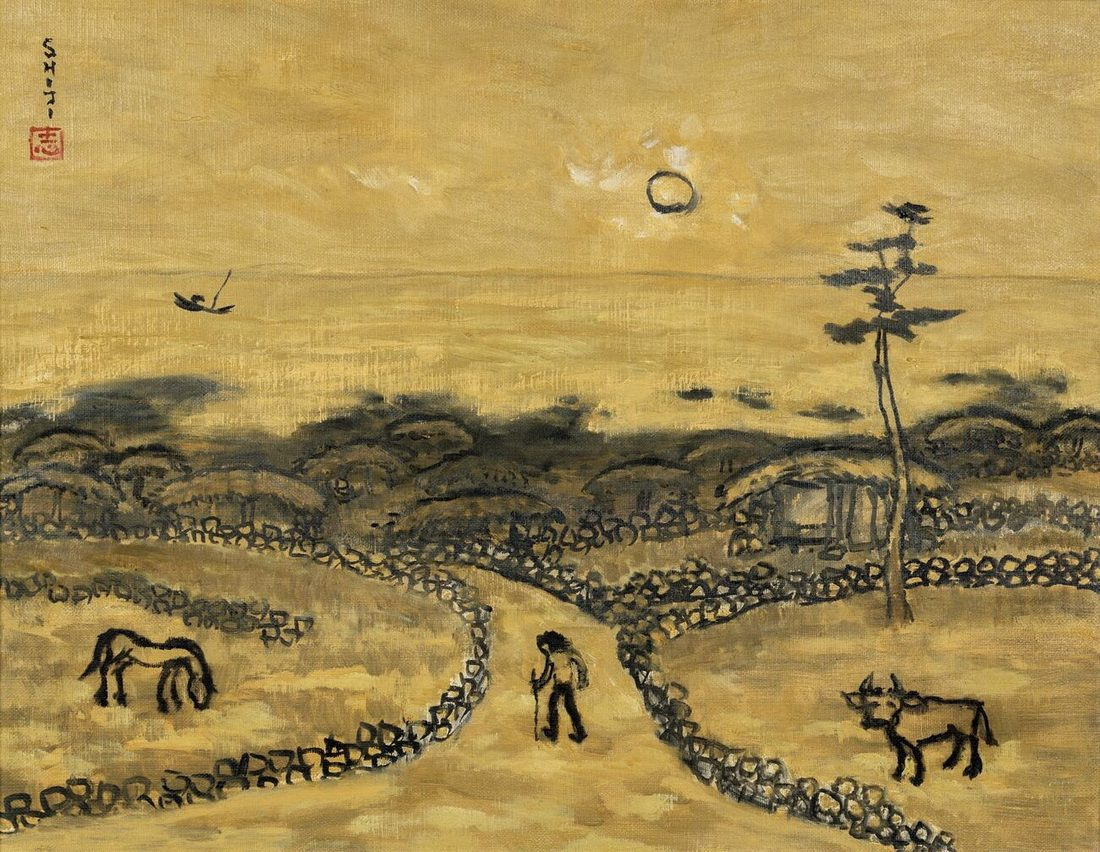
In Seaside Village, stone walls divide the paths. A person occupies the central path; a horse lowers its head to the left, while a bovine raises its head to the right. The three do not cluster into a single mass. Paths and walls intervene. Here togetherness concerns placement more than touch. Even without pressing close, their separate positions participate in making a shared place.
This difference keeps relationships from becoming fixed symbols. Reading the horse invariably as consolation and the bovine invariably as endurance would overlook what their differently held heads do in the picture. Recognising the motif is not the end of looking. An animal’s meaning lies not only in its name, but also in the position it occupies in this particular painting.
Differences a Shared Colour Does Not Erase
Related tones run through the houses, paths and animal bodies in Seaside Village. Yet dark outlines and lighter areas remain distinct. Horse and bovine are still recognisable. Shared colour does not simply dissolve the creatures; it suggests that different forms occupy the same light. Their relationship requires both a common ground and their separate contours.
Similarity of colour cannot by itself establish equality in the world. Nor does the absence of a visible rein erase every relation of ownership and labour. Yet domination alone does not exhaust the relationships in this picture. The sizes and positions of bodies, and the directions of paths, permit another question: who makes room for whom, and what are they passing through together?
To read fūdo as shared ground is not to abolish difference. A human dwelling and the ground beneath a horse are connected without serving identical purposes. The same weather may place different demands on different bodies. A common tonal field brings those differences into proximity. Closeness is a more cautious word than sameness, and may be more useful for reading companionship.
A Relationship That Does Not Demand Endurance
Looking longer at the two bodies in Stormy Seas makes the question of superior strength less pressing. The lowered human body and the horse’s legs meeting the ground remain before us. We may read assistance here. But we need not add an unspoken declaration that the horse willingly suffers for the person’s sake.
For companionship to offer consolation, the other must not be reduced to an instrument of comfort. Remaining beside us is no reason for us to overlook that body’s fatigue. Warmth and burden can be considered together. A scene of mutual reliance is moving not because reliance costs nothing, but because leaning on another calls for care.
Endurance then ceases to be a test. We avoid a story in which only the body that remains standing has value, while the resting or fallen body is excluded. What is needed is less proof of strength than somewhere to place a body. The small house and nearby horse can be considered as possibilities of support rather than emblems of victory.
A Comparison through Companion Species
Donna Haraway’s When Species Meet does not leave human–animal encounters at the level of abstract affinity. Through concrete relationships of training and living together, it asks how respect and knowledge arise. The publisher’s account also stresses that such encounters carry no guaranteed happy ending. A relationship is tested through what beings actually do together, not merely through declarations of kinship.
This comparison is useful for Byun Shi-Ji because it discourages us from calling pictorial silence perfect understanding. Two beings without words cannot simply be assumed to know everything about each other. We can instead examine permitted distance, visible contact and different bodily orientations. Concrete relationship takes the place of completed understanding.
The painting should not become an illustration of Haraway’s theory. This is a question a present-day viewer can bring to the work, not a claim that the painter followed her thought. The picture says less than a theory and remains before us longer. Looking at the horse beside the person, we begin to allow that the horse may have a day different from the human’s.
A Life Shaped by Paths and Walls
The stone walls in Seaside Village are more than decoration. They bend the paths and place bodies in different areas. Reading the relation between human and animal also requires attention to the structures between them. The presence of houses and walls makes it difficult to call this untouched nature. The forms of an inhabited place have already entered the picture.
Being part of nature should not become a way of diminishing human responsibility. A being capable of making a wall also has reason to ask what that wall does to another body. The painting does not report actual husbandry, but its divisions return concrete questions to the phrase living together: to whom is a route open, and to whom is it closed?
With this question left open, animals become neither ornaments of paradise nor proofs of misery. They remain bodies needing places to feed, rest and move. The person, too, is not the sole eye surveying a world, but one body using its paths. The possibility of peace lies near the question of how relationships are made, not in the absence of relationships.
Fūdo Moves from Background to Relationship
In his oral testimony, Byun Shi-Ji explains that painting Jeju as a subject was not enough. He wanted the island’s history, ways of living and efforts to continue living to enter the work. This prevents fūdo from being reduced to climatic effects alone. It includes not only a body bent by wind, but also the making of paths and forms of reliance within that wind.
We need not claim that wind strikes every being with equal force. Behind a house and on open ground, large and small bodies occupy different situations even within the image. A shared condition does not mean an identical experience. Attending to that unevenness prompts us to ask why one body might move closer to another. Companionship arises between differences, not after their disappearance.
The painting need not add a grand symbol to make this relation available. A nearby neck, a bent arm or a low line dividing a path may suffice. Small formal decisions turn fūdo from background into a question of living. Attention moves from recognising the name Jeju to considering how these bodies have been placed together here.
The Distance That Companionship Leaves
Where the preceding essays considered birds, horses, cattle and grass separately, this chapter attends to what lies between them. Looking at individual beings and looking at their relations require one another. Without both, animals become either isolated signs or indistinct components of an atmosphere. Byun Shi-Ji’s small forms retain their own contours within a shared picture.
Being together does not resolve every problem. But examining its particular shape changes our questions: from who is larger to who is where; from who wins to who leans on whom. The change does not eliminate the human position. It places that position once more beside other life.
The house in Stormy Seas is still behind them. The dark lines of person and horse meet closely. Pale strokes pass beneath their feet.