Research/A Hundred Years of Wind/Ⅲ Animals & Life
Ⅲ Animals & Life · 38 / 100
A Flock of Birds in the Sky
Remaining Distinct Within the Flock
하늘의 새떼
First We See the Flock
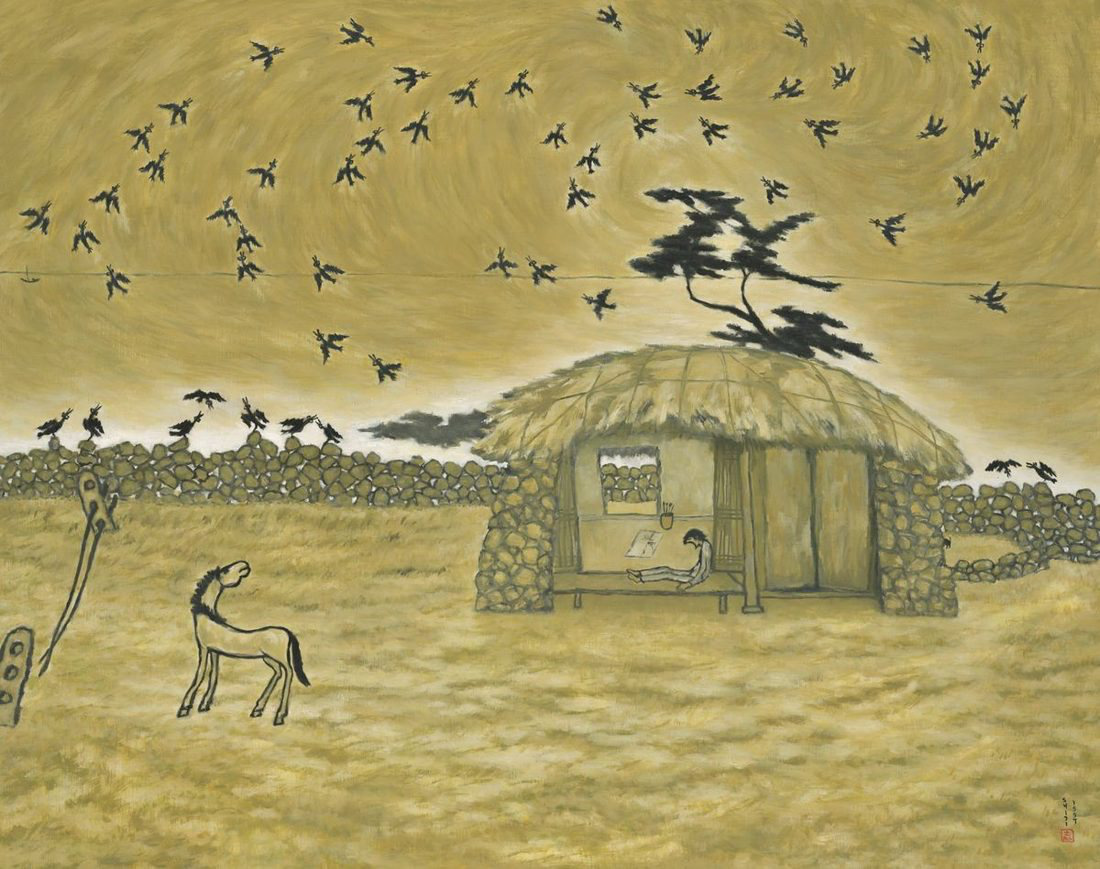
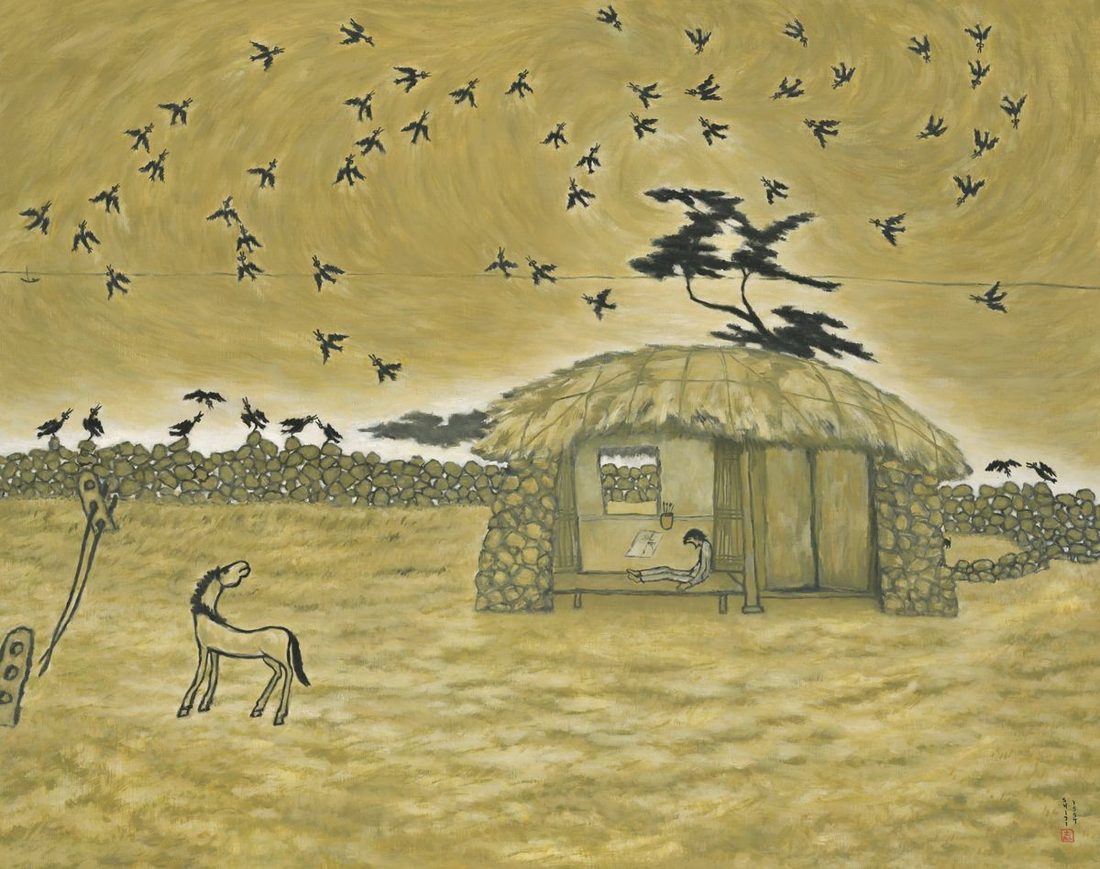
From a distance, dark birds fill the broad sky in Wild Dance (1997). Closer, their wing angles and bodily inclinations differ. The flock that first appeared as a mass opens into individual forms. It is not a collective in which individuals have vanished. Its arrangement allows us to see many together and still return to one.
The number of birds does not determine the atmosphere by itself. The same number feels different when clustered closely or scattered widely. Number asks for a counting eye; interval asks for an eye that lingers. Reading this flock requires both. After asking how many, we ask how they are placed in relation to one another.
An equation of one bird with solitude and many with freedom would pass over this difference. An isolated bird need not be abandoned, and a flock need not be peaceful. Meaning emerges less from a ready-made answer attached to quantity than from the density, direction and gaps that quantity takes on in a particular painting.
The Sky Between Birds
Wild Dance contains more than birds. A dried-grass-coloured ground continues between them. Some intervals are narrow and others broad. Following these open areas creates a route different from following the dark forms. While the birds populate the sky, the sky also keeps them apart.
Calling open space mere absence would miss what it does. The interval between two wings distinguishes a closeness that may suggest collision from an opening through which the forms seem able to pass. The painted birds do not actually move. Our eye moves between still forms and reads a possible movement there.
The flock’s rhythm therefore does not belong to dark marks alone. The lightness left between them also makes rhythm: a small opening beside a broad wing, a wide area beyond a sparse group. The speed we feel while looking is shaped jointly by what has been painted and what has been left between forms.
Birds in Flight and Birds at Rest
Not all the birds in this picture are airborne. Several are placed on the stone wall below. Wings scattered high up share the surface with small bodies close to stone. Sky and earth, movement and stillness cannot be assigned exclusively to different species. Forms of the same kind occupy different positions.
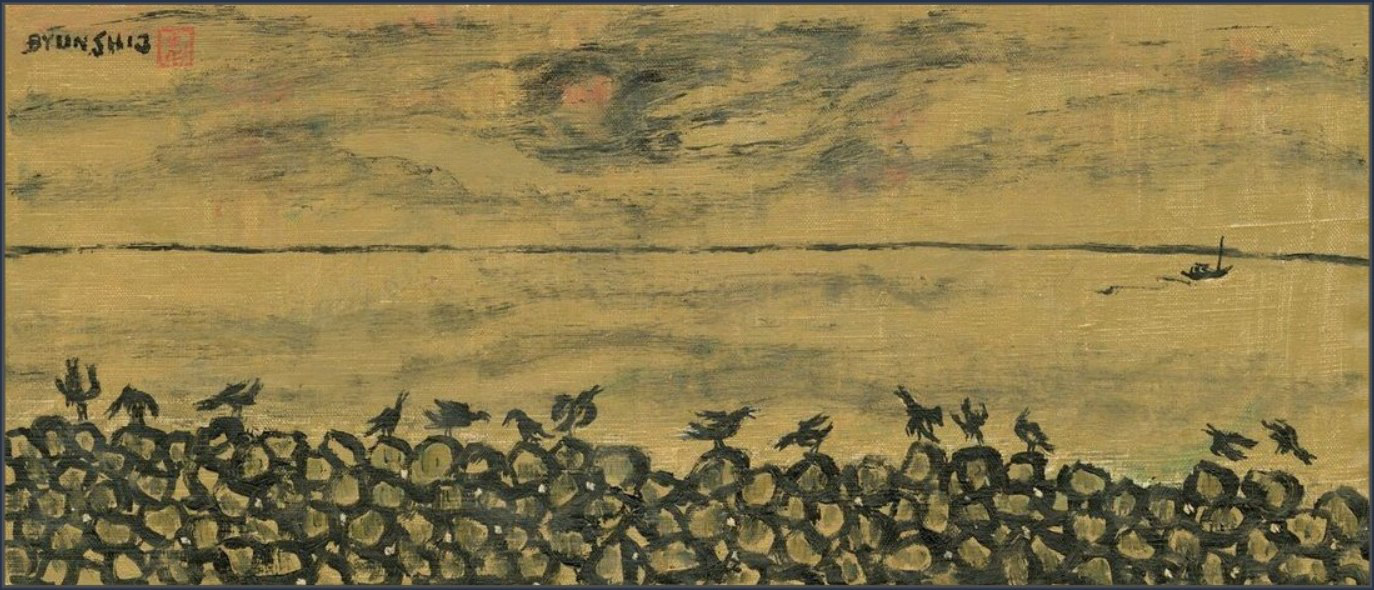
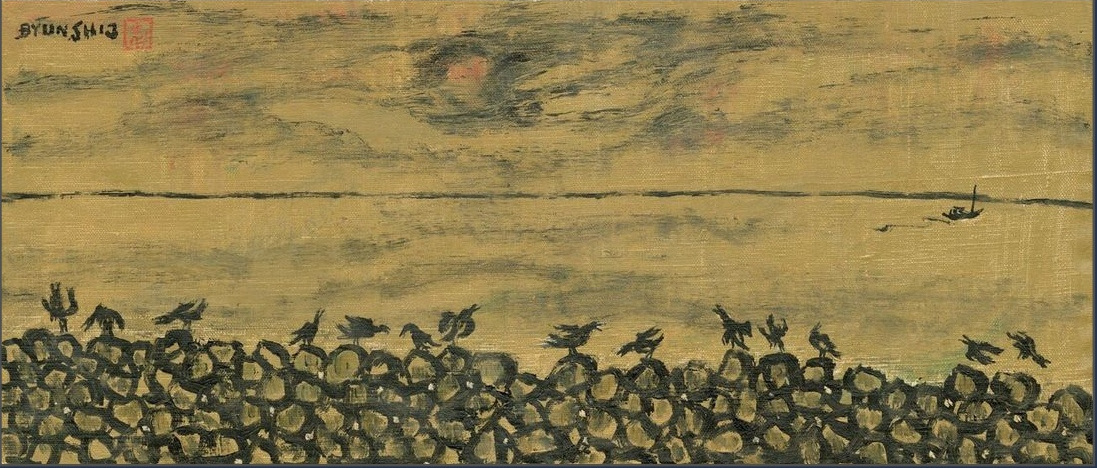
In Crows on a Stone Wall (1983), the wall’s long direction is more prominent. The birds form a sequence without reproducing one identical posture. Stone heights and bodily orientations vary together. Compared with the broad aerial gathering of 1997, the work shows that a flock need not be made by filling the sky. A group can also extend along a low boundary.
Just as a resting bird need not be called a bird unable to fly, stillness need not mean the loss of possibility. The painting does not establish whether this is a moment of departure or arrival. It shows a place in which bodies are briefly gathered. We can attend first to their resting presence, and only then imagine movement.
Flock Research and Pictorial Order
Studying a living flock differs from reading pictorial rhythm. Ballerini and colleagues’ 2008 field study reconstructed the three-dimensional positions of starlings and reported interaction with an average of six to seven neighbours. This concerns a particular species and observational setting; it cannot simply be transferred into a universal rule for all birds.
There is no basis for applying that number directly to the crows in Wild Dance. The painting provides depicted positions, not measurements of responses unfolding in real time. A relationship identified by science can prompt new questions of a painting. Claiming that the painting proved the research in advance would confuse the different work of art and experiment.
What is useful here is less a celebration of a world without a conductor than a habit of examining nearby relationships. When looking at one bird, we also attend to its distance from the next. When reading the overall flow, we notice directions that do not readily fit it. Between the labels disorder and order, many concrete differences remain to be examined.
Recurring Marks, Distinct Bodies
The birds are reduced to a few dark marks, but those marks are not identical signs. Widely extended wings, wings that seem more closely folded, and inclined bodies occupy different positions. Close up, what looked like one stroke may thicken or break. A concise form is not necessarily an interchangeable sign.
The marks may give an impression of a swiftly moving brush. The finished surface alone cannot establish that every bird was painted in a single stroke. For looking, the important question is what speed and weight the visible traces suggest, rather than a claim to reenact the making. The result of a mark differs from the actual sequence by which it was made.
A comparison with calligraphy is possible at this level. Dark marks and light intervals alternate; similar shapes vary enough to create a flow. This does not make the birds actual characters decipherable as a sentence. They approach readability yet remain a painting. In that interval a bird becomes a mark, and the mark becomes a bird again.
The Person in the House, the Horse Outside
A house stands on the right of Wild Dance, with a person seated in its open space. The horse occupies the lower left outside. Looking only at the airborne birds can conceal these different forms of staying. Following house, person, horse and birds on the wall reveals further relationships in the lower part of the picture.
A contrast between one person and many birds is not enough. The person has a building beside the body, a yard in front and a distance from the horse. Being indoors does not establish complete isolation, just as plurality does not establish the birds’ complete unity. The contrast becomes concrete only when the positions of bodies are read together.
These different positions can be likened to counterpoint, not because painting literally performs a musical technique, but because one rhythm is felt without cancelling another. Looking up after attending to the seated body changes the birds’ apparent movement. Returning to the house after looking at the birds changes the person’s place.
Together Does Not Mean the Same
We may wish to read the flock as an ideal community. But its politics and feelings are not established by this surface. Calling it a free society without coercion or conflict would express a viewer’s wish. What the painting does provide is a form in which several distinguishable bodies occupy one space.
That form offers enough to think about. The presence of many does not make one unseeable. The presence of a whole does not require every part to submit to it. The different direction of a single bird can interrupt the overall flow, and that interruption may make the flock feel more alive.
This reading does not immediately command a human lesson. It asks how much difference we allow when we look at things together. Have we erased a small divergence in the name of harmony? Before Byun Shi-Ji’s birds, we can practise moving between one and many rather than choosing one scale against the other.
Returning to One Bird
At first the whole sky seemed to move. Now we choose one bird within it. Its wings differ in direction from its neighbour’s, and a light interval opens below. Following that interval leads to another bird. Seeing the whole becomes not the abandonment of one, but a passage of relationships from one to another.
The title Wild Dance brings disorder and dance together. The eye feels scattering, then finds a flow; following the flow, it encounters divergence again. Because this movement does not close, the painting is not exhausted by one moment of admiration. Still birds continually approach us as another arrangement within the time of looking.
One bird sits on the stone wall. Above it, another has spread its wings. Light sky continues between the two.