Research/A Hundred Years of Wind/Ⅲ Animals & Life
Ⅲ Animals & Life · 37 / 100
The Butterfly Dream
Transformation and the Difference That Remains
나비의 꿈
The Question That Remains After Waking
At the end of “The Adjustment of Controversies” in the Zhuangzi, Zhou becomes a butterfly in a dream. On waking, he wonders whether he dreamed of the butterfly or the butterfly is dreaming of him. Yet the passage also retains a distinction between the two. It calls the change the transformation of things, without erasing every trace of difference.
It is worth resisting a quick conclusion that everything is one. The question arises because the position of the butterfly differs from that of the waking person. The position I now take to be certain may also be unsettled by another experience. What matters is less an instruction to abolish distinctions than an invitation to look again at the self that makes them.
Something comparable can happen before a painting. At first I think I am looking at a mountain. Then my attention moves to a small person facing it. Looking again, the mountain’s curves may approach the curves of a body. The mountain has not physically become a body. My position in relation to the same picture has changed.
A Mountain Resembles a Body, but Is Not One
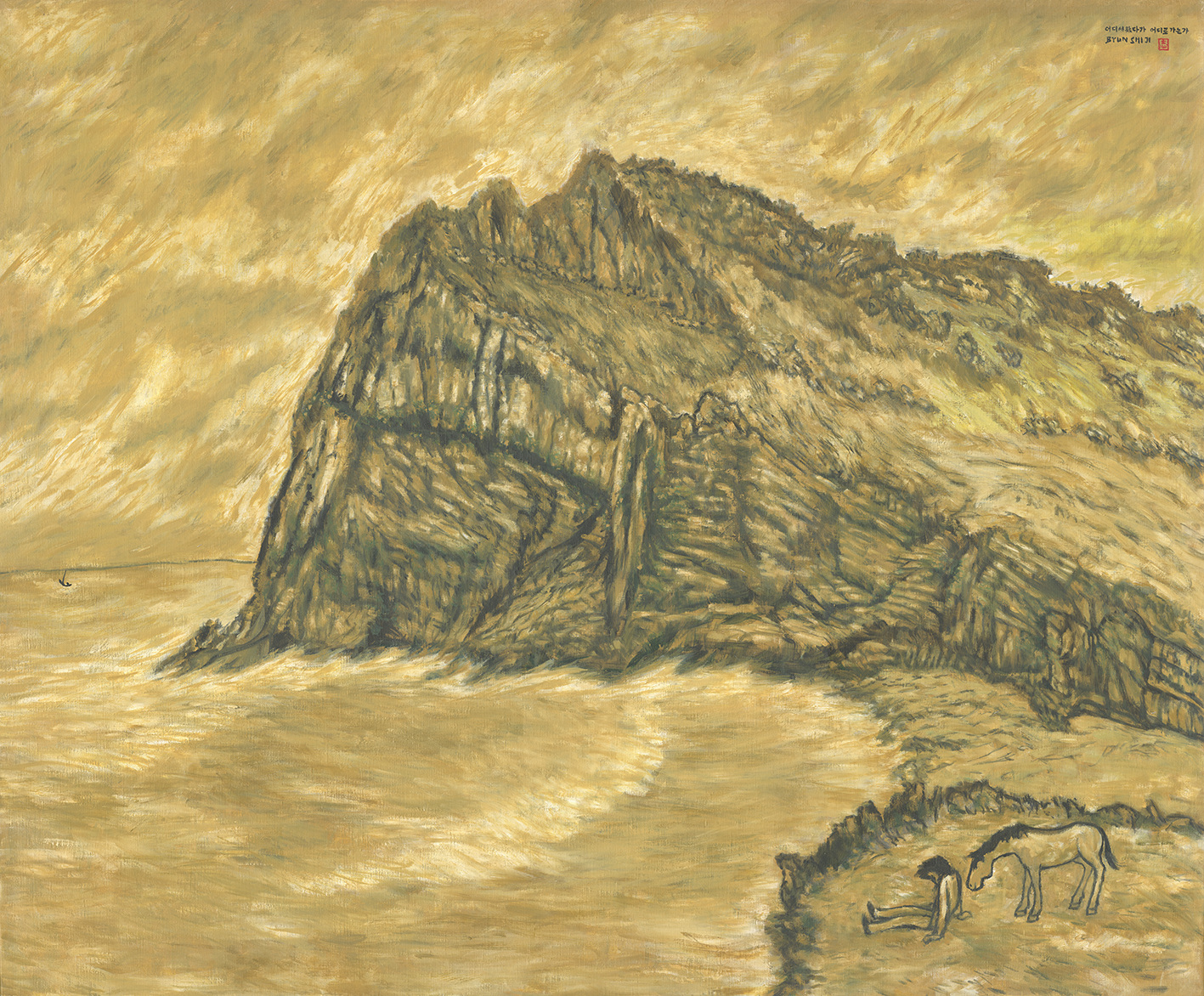
The mountain in Where Do We Come From, and Where Are We Going? (1992) has deep clefts and a long ridge. At the lower right, a person extends the legs forward and lowers the upper body; a horse lowers its head nearby. Looking together at the large mountain’s curves and the small body’s bending produces a resemblance. It is a relationship of forms, not an identity of scale.
Resemblance does not require one side to disappear. Identifying the mountain definitively as a person would diminish the roughness of rock and the weight of terrain. Calling the person only a part of nature would weaken the tension of the small place occupied by that body. They can illuminate one another while remaining different. The painting lets us dwell between them.
This relationship may be called fūdo taking bodily form. It is not a declaration that a hidden anatomy of the mountain has been conclusively mapped. It means that bodily sensation enters a gaze that previously treated nature only as an external view. Conversely, the scale of surrounding earth enters a gaze concerned only with its own body. Resemblance works in both directions.
Distinctions Within a Shared Colour
Mountain, sky and sea share related tones in this work. They are not therefore indistinguishable. Dark marks on the rock, slanting brushwork in the sky and broad lightness on the water create different surfaces. Colour affinity and formal difference act together. A shared colour makes distance felt differently rather than simply abolishing it.
Dried-grass colour offers one language for reading this proximity. It recalls time weathered by sunlight and wind, without implying that every object consists of the same material. Within a related ground, stone reads as weight, water as breadth, and the horse through slender legs. Without such small differences, the relationship of being together would itself become hard to recognise.
Restrained colour need not be translated directly into the sameness of all things. It can be read as a way of keeping differences present without placing them far apart. Each form retains an outline in a world of affinities. Bringing the question of transformation into painting can begin, more delicately, with such a form of coexistence.
Before Calling It the Colour of a Dream
A landscape in unfamiliar colours may feel dreamlike because it departs from the colours in which we habitually remember sky and sea. But a dreamlike viewing experience differs from an image actually obtained by the painter in a dream. One concerns an encounter with the picture; the other concerns its making. Connecting them requires separate evidence.
The work’s strangeness can be examined through the visible form itself. Mountain and water have related colours, the small body occupies an edge, and marks in the sky prevent it from settling into a quiet blank. Familiar objects are placed in unfamiliar relationships. Even before we call it a dream, the painting has begun to change our ordinary way of seeing.
Understanding colour does not require us to know what intoxicated the painter or what vision he experienced. We can first read the pictorial decisions made in paint. Which differences have been reduced and which lines retained? What has been broadened, and where has a body been placed? Even a dreamlike feeling reaches us through such concrete choices.
What It Means to Enter a Painting
To say that we seem to enter a painting expresses the intensity of looking. Yet the viewer remains before it, and the canvas keeps its edges. Those edges need not disappear for the experience to be deep. We can remain outside while feeling distance within. Our position of attention changes without a physical journey.
Attending to the small person in the 1992 painting makes the mountain seem heavier. Lingering first over the mountain makes the person’s place seem smaller. The eye moves back and forth between these scales. This movement, unable to settle entirely in either, produces tension. The viewer’s body may be still while the distance of attention continues to change.
The comparison with the butterfly dream is useful here. Am I always a being who judges the same object from the same position? Or does my judgement change as I attend to another form? The question does not turn a viewer into a butterfly. It loosens the certainty that my gaze occupies the only position from which a world can be seen.
Holding Lightness and Weight Together
The lightness of a butterfly and weight of a mountain need not become fixed opposing essences. In a painting, weight is not determined by an object’s name alone. A small dark form may hold attention more firmly than a broad light surface, while a large mountain may loosen between broken strokes. Pictorial and physical weight are not measured on the same scale.
Following the ridge, the eye pauses in an interval between rough marks. What appeared as a mass divides into brushstrokes. Rock seen from a distance becomes places occupied by paint up close. The form does not disappear. We begin to see material while still seeing form. One does not finally displace the other; the two readings overlap.
This overlap may be closer to painting than an account that either completely separates dream and reality or wholly merges them. Knowing that it is paint, we see a mountain; seeing a mountain, we recall a body. Looking does not end with a single act of naming. We meet the same surface again while leaving room for another reading.
Not Filling Everything with My Meaning
A paradox arises if transformation becomes confidence that a human can understand all of nature. The moment butterfly, horse and mountain are all declared to be me, their possibility of differing from me diminishes. Intimacy can become another name for possession. This is why felt resemblance needs to coexist with an acknowledgement of what remains unfamiliar.
A mountain resembling a body has not thereby yielded its entire meaning. Nor is the horse beside the person exhausted by a role of human consolation. Feeling close to a painted being differs from incorporating it entirely into my story. A difference left intact need not prevent relationship; it can allow relationship to continue.
In this chapter, undoing a boundary therefore means reconsidering it more than abolishing it. How much have I seen, and where have I begun adding meaning? What resemblance have I felt, and what remains different? With such questions intact, philosophy becomes not a label covering the painting, but a route back to it.
Meeting the Same Painting Differently
What we can take from the butterfly dream is a flexibility of attention rather than a final answer. A world I thought I had depicted can also be seen as a world that has surrounded and changed my body. This does not make the artist’s decisions disappear. The relationship between milieu and making is more complex than one side automatically painting the other.
Before Byun Shi-Ji’s mountain, we can bear that complexity by not hurrying. We see the mountain as mountain, feel a bodily resemblance, and return to the mountain. Attention moves from the small person to the horse. Forms that do not wholly explain one another support a single painting together.
The mountain remains. A small patch of ground lies before the person’s legs. The horse’s head has lowered close to it.