Research/A Hundred Years of Wind/Ⅲ Animals & Life
Ⅲ Animals & Life · 36 / 100
The Form of the Crab
Another Direction Opened by a Small Body
게의 형상
From the Mountain to a Crevice
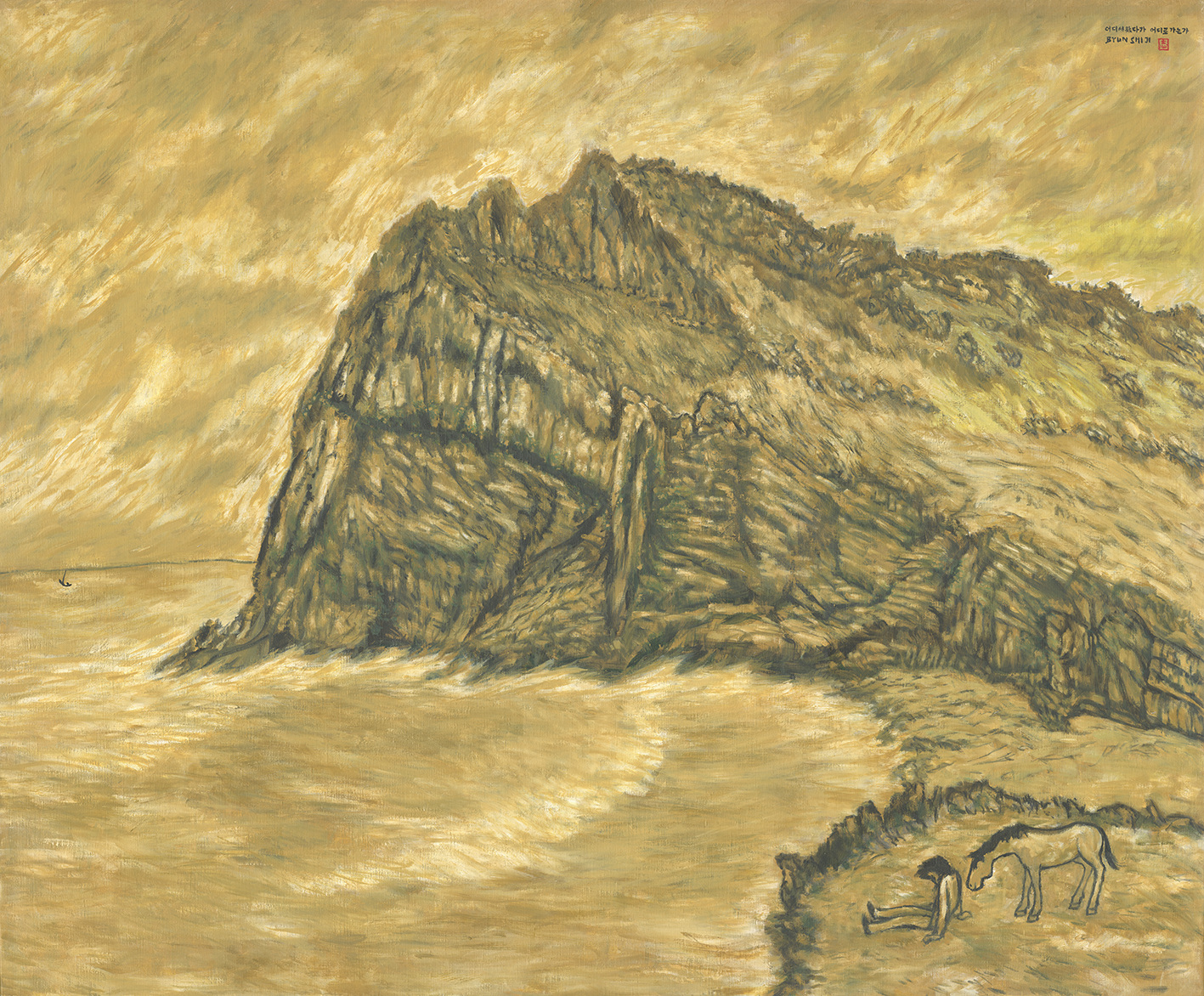
In Where Do We Come From, and Where Are We Going? (1992), the mountain occupies much of the picture. The person and horse at the lower right are small beside it. Yet lowering our gaze from the mountain to the shore opens a landscape at another scale: an angle in the rock, the edge where water meets stone, a narrow place that might briefly accommodate a body. Even within one painting, a change in viewing height changes the scale of the world.
Thinking about a crab can begin at this lower level. A human gaze that treats a mountain as background differs from the situation of a small body negotiating the lip of a rock. A minor irregularity for us may be a route or an obstacle for another creature. Rather than magnifying the small into something grand, we can reconsider a large landscape from the height of a small body.
From this position, landscape has no permanently fixed centre. The mountain first seen from afar need not stand for everything, nor must the horse beside the person occupy the only place available to life. Attention can linger at an edge we have not yet named. The crab offers a threshold into that attention. The task is not to add an unseen animal to the painting, but to ask what we have been treating as its centre.
What It Means to Go Sideways
Crabs cannot all be assigned the same gait. A comparative study of 50 species found both predominantly sideways and predominantly forward movement. Sideways locomotion is important, but it is not the only mode across crabs. In thinking about another creature’s body, we need to prevent one familiar image from standing in for the whole of its life.
Nor does going sideways imply the absence of a destination. The word sideways arises when a body’s orientation is compared with its direction of travel. Another body need not follow what a human calls the front. The thought available here is simple: a route is not fitted to only one posture. A body moving differently reveals possibilities in the route that our own gait may overlook.
In painting, a sideways step can also become a movement of the viewer’s attention. An eye travelling directly from the figure to the horizon pauses to follow the grain of a rock. Instead of identifying the largest form and moving to the next work, it attends to a small interval beside that form. Rather than going further forward, it looks further to the side. Depth of attention can begin with such a slight change of direction.
A Boundary Is Not the Same Place for Everyone
The shore in the 1992 painting does not appear merely as a thin line on a map. The foot of the rock face is irregular, and light areas of water approach its edges. The boundary between land and water acquires thickness. From a distance it is a line; close up it is a succession of turns and contacts. Reading that thickness changes the shore from a background into a place.
Being between water and land does not in itself amount to freedom. A boundary may be a passage, but it may also be a difficult place to remain. Conditions needed by one creature can burden another. To describe the boundary only as a privilege of enjoying two worlds is to overlook the concrete work of sustaining a body between them.
This difference matters in reading Byun Shi-Ji’s fūdo. Facing the same sea does not expose a person, a horse and a small coastal creature in identical ways. Sharing a milieu does not mean repeating one fate in several bodies. It means asking what conditions one place presents to different bodies. Coexistence becomes a richer idea when their differences are not erased.
The Time of Shedding a Shell
A carapace invites thought about the relation between protection and growth. The US National Park Service’s account of Dungeness crabs describes shedding an existing exoskeleton during growth and seeking shelter while a new shell hardens. The process includes not only release but a period in which protection is needed again. Isolating the moment of shedding shows only half the change.
Moulting can be used as a metaphor for a painter’s transformation. Yet earlier paintings need not all become shells fit only to be discarded. Learned observation and habits of the hand can remain active in a different picture. What changes may not be the whole past, but what is retained and how it is rearranged. A new pictorial language need not begin empty-handed.
The metaphor must retain its limits. A crab’s growth is not the same event as an artist’s decision. Bodily change and the choice of a painterly language are different processes. Setting them alongside one another yields questions, not a causal explanation. What supports a body while it changes? Where can it continue living after it has emerged?
A Landscape That Leaves Room for a Small Smile
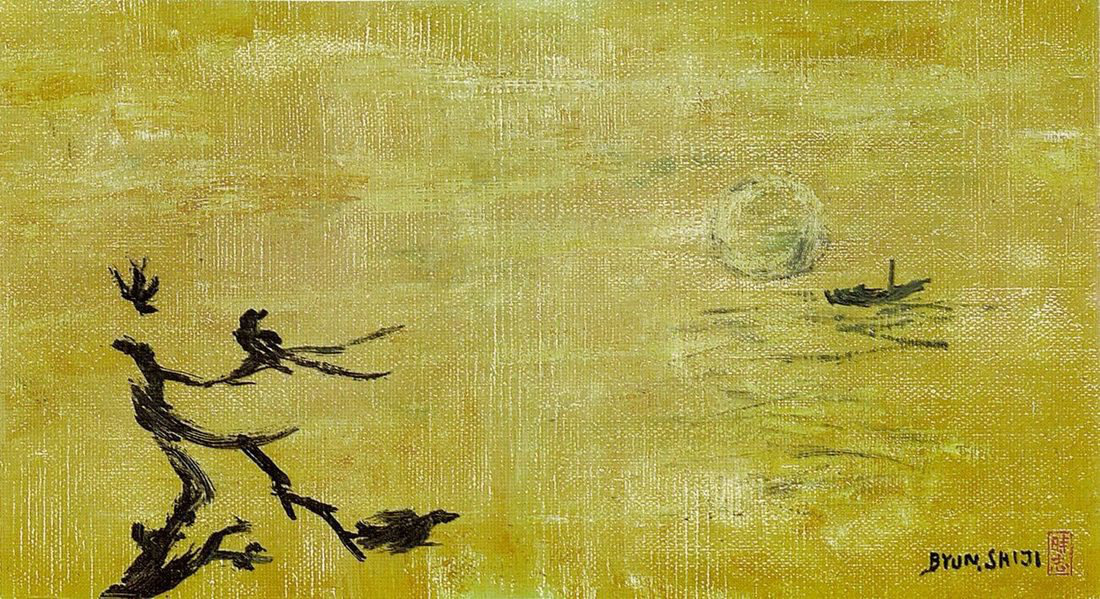
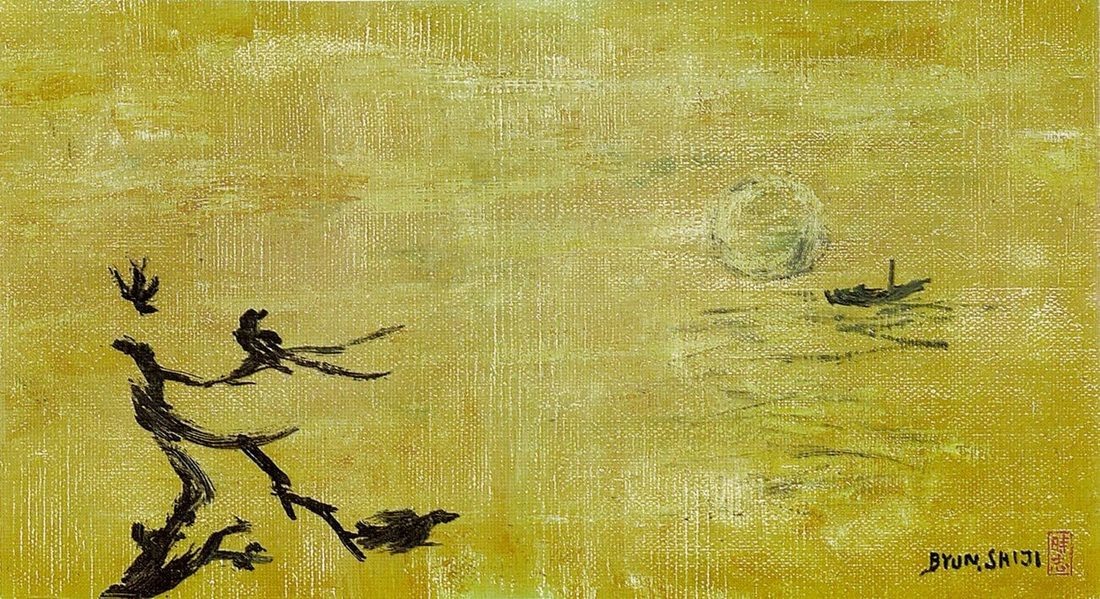
The title A Merry Afternoon by the Sea (1979) already opens a different rhythm. The eye moves among the tree and birds on the left, a distant boat and the broad surface of the water. Reducing the work to tragedy would lose the opening offered by its title. Rough marks and a livelier mood can occupy the same painting.
If a crab’s sideways movement makes us smile, it may be because our expectation has been slightly displaced. A movement outside the familiar order of front and back refreshes the eye. But a viewer who feels amusement should be distinguished from an animal classified as ridiculous. A small creature does not exist in order to entertain us.
Byun Shi-Ji’s paintings, too, are better served by more than one emotional register. There may be an afternoon within waiting, a lighter interval among forceful strokes. A smile does not deny sorrow. It prevents sorrow from explaining everything in the picture. Reading an artist’s world deeply includes leaving room for these other temperatures.
Setting Aside the Name of Insignificance
The word insignificant already contains the observer’s scale. The judgement that something small is negligible differs from the fact that it is easily overlooked. A body smaller than a palm still has to find a place for itself. If we can attend to it only by turning its life into a grand human narrative, its own scale disappears once more.
A reading of the crab as the painter’s double is possible. It need not become everything the crab can mean. Before attaching solitude, resistance or freedom to it, we can consider its spreading limbs, low body and contact with the ground. A symbol should not be a name that makes form disappear, but a question that brings us back to form.
The same principle extends to a small boat or bird in a painting. Smallness does not entail little meaning; nor must every small thing represent the universe. A form may simply make a place beside another form. It changes a relationship in the picture without a grand declaration. The force of something small can be evident in a change of that order.
Reading the Rock’s Edge Again
Returning to the mountain of 1992, we find the shore below it continuing towards the place occupied by person and horse. A contrast between the mountain’s scale and a small body’s finitude is possible. Ending there, however, would lose the ground between them. The turns connecting nearby earth and distant rock also compose the painting.
To read landscape as relationship is to avoid skipping this middle ground. If we retain only the terms human and nature, the crevice, bodily height and water’s edge become a backdrop for explanation. Yet these concrete places are where the eye actually travels. A large meaning has to pass through small contacts before it reaches the painting.
The theme of the crab’s form therefore changes a habit of looking rather than delivering a final answer. When a small creature is visible, we attend to the surface on which it is placed. When it is not visible, we do not invent its presence. We can still retain the texture of shore newly noticed while thinking about it. Imagination does not replace observation; it opens a direction for observation.
Another Direction Can Be a Route
The metaphor of going sideways need not leave a lesson in success. It does not promise that stepping away from the centre automatically produces new art. It offers the possibility that placing a body differently can reveal conditions previously overlooked. That possibility includes blocked routes and times when rest is needed.
Byun Shi-Ji’s shore can be read as a place for that possibility. Looking towards the distant sea and looking at the ground do not substitute for one another. One opens distance; the other searches for contact. As the two glances alternate, the sea ceases to be a vague destiny and earth a simple origin. They become places through which bodies pass.
The eye descends below the mountain. Light water meets the edge of the rock. A little to the side, the rock continues to turn.