Research/A Hundred Years of Wind/Ⅲ Animals & Life
Ⅲ Animals & Life · 35 / 100
Cattle and Grass
The Feeding Body and the Place That Sustains It
소와 풀
First, the Bovine Holds Its Head Up
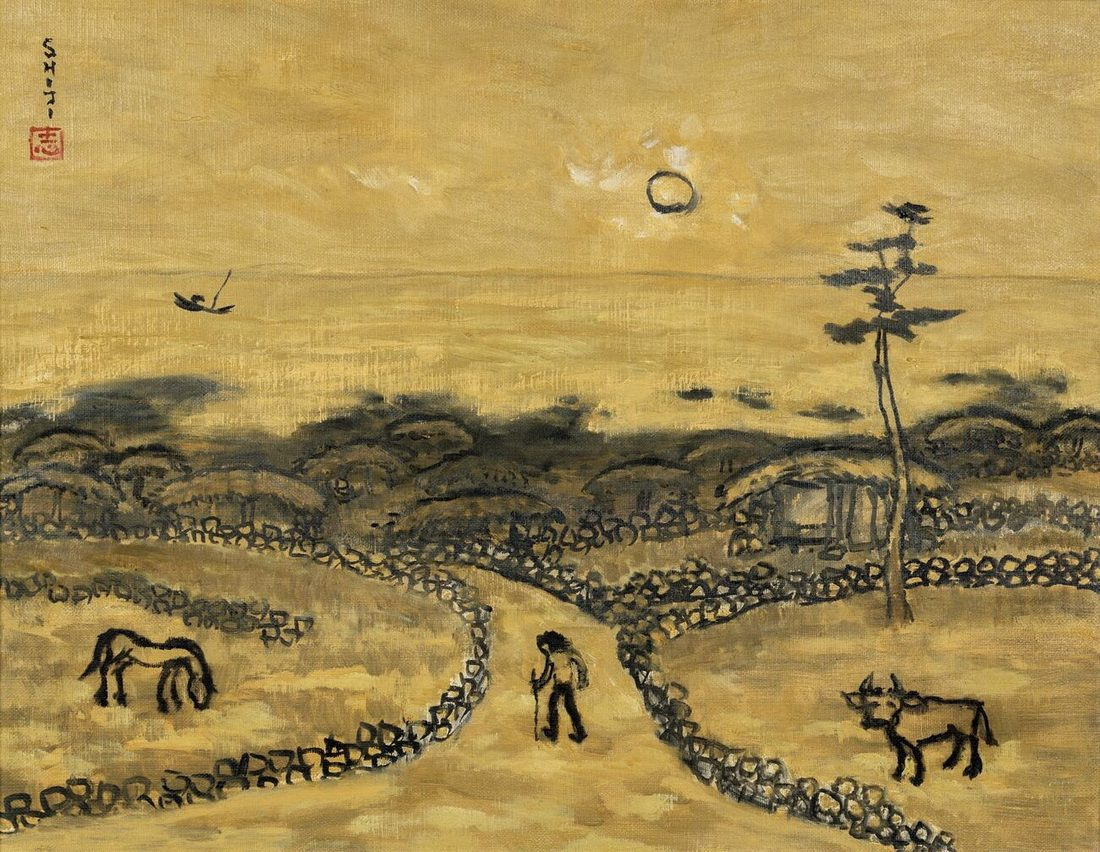
In the lower right of Seaside Village (2002), a horned bovine holds its head up. The horse on the left lowers its head, while a person with a walking stick occupies the central path. Stone walls divide the ground occupied by the animals from the person’s path. Before illustrating cattle grazing, the painting directs attention to three differently oriented bodies.
Reading every lowered animal as bovine, or describing cattle as always grazing, erases the actual scene. We cannot say that the bovine’s mouth touches grass in this work. General knowledge about a feeding animal must be distinguished from its depicted posture. The brief moment with its head held up can then acquire significance of its own.
Yet the absence of a feeding gesture does not remove the relationship to food. The ground under the body and the spaces divided by walls invite that question. “Cattle and Grass” becomes the title of an essay asking what sustains the body before us, rather than a title claiming that a particular action is depicted.
An Eye for Landscape, a Body That Needs Food
For the viewer, grass may be a small pattern in a landscape. For a feeding body, plants are a condition of life. Cattle are ruminants, and their stomach has four functional compartments rather than four independent stomachs. This biological fact does not explain a peaceful expression. It provides a concrete starting point for thinking about dependence on surrounding matter.
The species of grass or quantity of food cannot readily be identified in the ground of Seaside Village. Nor need every short mark be named as a particular plant. Yet knowing that an animal is not self-sufficient within its body changes how we look again. The surrounding ground, modestly represented, becomes more consequential than a mere background.
This differs from turning an animal into a lesson for humans. Before saying that cattle lower their heads from humility or move slowly from wisdom, we can consider a body that feeds, rests and depends on its surroundings. Life’s significance need not reside only in elevated symbols. It also belongs to small conditions that sustain a body today.
Places Divided by a Stone Wall
The stone walls in Seaside Village curve along both sides of the path. The person occupies its centre; the animals stand apart on either side. Houses gather further away, with sea and boat beyond them. The divisions of nearby inhabited ground coexist with the openness of distant water. The picture does not contain untouched nature alone.
A wall is not simply a sign of separation. It makes the path legible and distinguishes the places occupied by different bodies. It obstructs passage in one direction while revealing where passage is possible in another. A shared place is not a place without distinctions. Different bodies can occupy different positions while remaining part of one another’s surroundings.
These divisions cannot be treated as a map of actual ownership. Yet walls, houses and paths bring to mind the work of making and maintaining a place. Fūdo is not composed only of wind and soil. It also includes structures through which living beings are sustained or constrained.
A Small Bovine and a Monumental Bull
Paulus Potter’s The Bull (1647) makes a bovine commanding through scale. The Mauritshuis describes the elevation of an ordinary subject to a monumental canvas and the work’s close observation. Reading naturalistic representation merely as the human objectification of an animal can overlook the attention given to a single animal’s body.
The bovine in Byun’s Seaside Village does not occupy the whole picture, but that need not imply less attention. Brief lines of horn, back and legs establish its lower-right position distinctly. Where Potter gathers the eye through scale and detail, Byun lets us rediscover a small body through its distances from surrounding things. The large and the small offer different modes of attention.
There may also be routes through symbols of labour or spiritual practice. Before taking them, we should look at what this animal is actually doing. A scene without a plough or herder cannot be supplied with a person directing work. Even when a symbol is borrowed from another tradition, what this picture does not say should remain open.
Rumination Is More Than Repetition
Rumination is more than repeating an act of swallowing unchanged. It belongs to the processing of food within a body. Yet that biological process cannot be matched directly to the sequence of making a painting. Digestion and painting are different activities. A metaphor of rumination needs to establish both likeness and difference.
In section 8 of the preface to On the Genealogy of Morality, Nietzsche invokes rumination as an attitude necessary for practising reading as an art. Reading once does not mean that meaning has been fully deciphered. Transferred to painting, the metaphor suggests returning to a work to attend to relationships previously missed. This is not a claim that Byun followed the passage.
At first we may have read horse and bovine as opposing symbols. Looking again reveals the lowered head on one side and the raised head on the other. Looking longer reveals the path and walls between them. The painting has not changed, but the reading has. Rumination is not the repetition of one conclusion; it is time in which returning can allow a conclusion to change.
Bodies Remain Distinct Within Related Colours
Horse and bovine in Seaside Village share tones close to the surrounding ground. The broad dried-grass-coloured field does not divide them into sharply separate colours. Dark lines nevertheless establish backs and distinguish legs. Colour connects while line differentiates. The bodies remain linked with the landscape without disappearing into it.
Shared colour does not establish that hierarchies in life have vanished. A relationship between pigments does not directly prove a social relationship. It can, however, place different bodies within one sustained field of attention. Human skin, animal body and the ground’s surface are not divided into wholly separate worlds.
Within that field, the bovine’s horns make a form distinct from the horse. Because a small difference has been retained, the animals remain distinguishable within related light. To picture coexistence may not mean making everyone alike. It may mean allowing different beings to share a place without removing their differences.
Care Is Needed Even When No Owner Is Shown
The absence of a person commanding the bovine does not establish a world without domination. Ownership, the provision of food and a day’s labour cannot all be known from this scene. Their invisibility does not make them unimportant. It leaves room to think about care that does not appear in the image.
The simple thought that an animal needs forage, water and a place to rest helps keep it from becoming decoration. The bovine is not there in order to console a person. Its body has needs of its own. For “living together” to become concrete, our reading must extend to the needs of beings that do not speak to us.
We look again at the central person. The figure’s occupation cannot be determined, but a body in the middle of the path is not easily reduced to a spectator unrelated to the animals on either side. Houses, walls and path place them within an inhabited setting. Fūdo can be read, before it is scenery, as a place where bodies become conditions of one another’s lives.
The Time of Raising a Head Also Belongs to Life
The painting can feel peaceful. But peace is not sustained by a story in which cattle always eat and never register wind. A living body has times of feeding and pausing, of turning downwards and lifting its head. When more than one condition remains possible, the sensation of calm becomes more alive as well.
The relationship between cattle and grass is not wholly visible in a single action. We can think of food even when feeding is not shown, and remember a body’s needs even when it is painted small. This degree of attention changes the viewing of landscape. Ground that served as a beautiful setting becomes a place where someone lives.
The horse on the left lowers its head. The bovine on the right has raised its head. Between them, a path passes along the stone walls.