Research/A Hundred Years of Wind/Ⅲ Animals & Life
Ⅲ Animals & Life · 34 / 100
The Crow on One Leg
One Visible Leg and the Judgement of What Is Unseen
외다리 까마귀
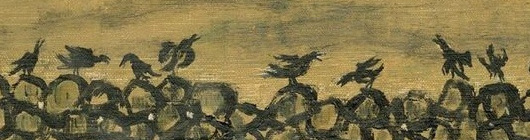
The Fact That One Leg Is Visible
A fine line appears beneath a small bird’s body. As soon as we read it as a leg, we look for the other one. But not being visible differs from not existing. It could be hidden by the body, overlap another mark or remain undifferentiated by the painter. The word “one-legged” can close these possibilities too quickly.
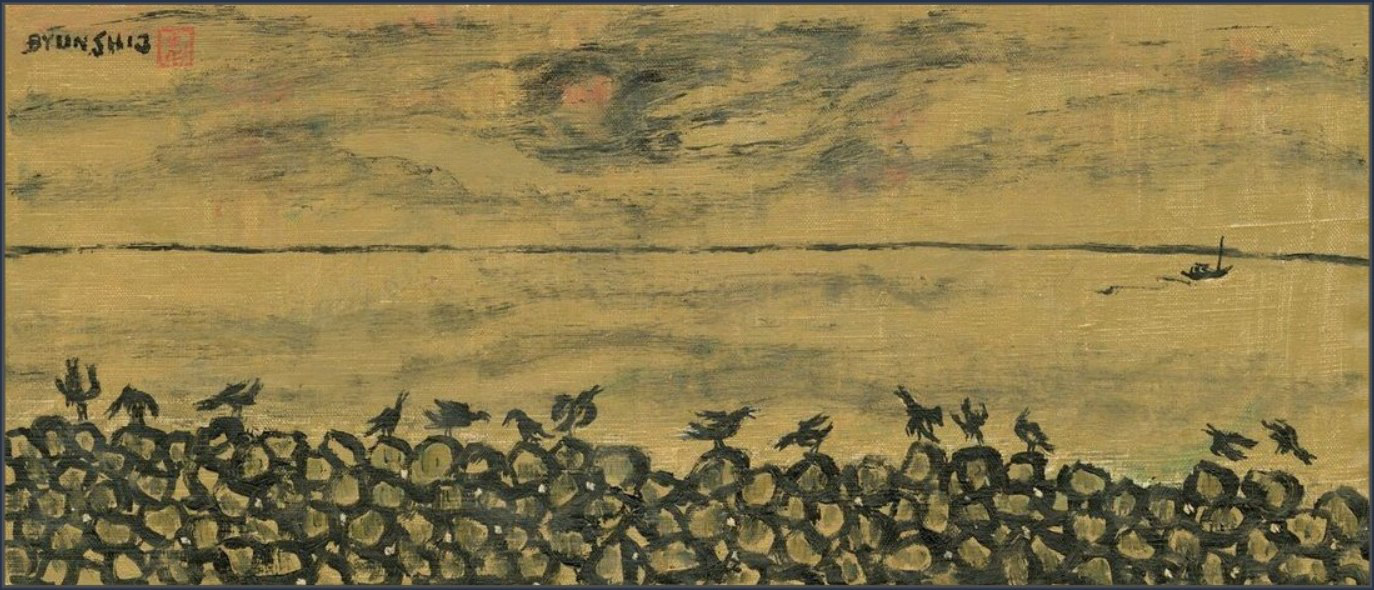
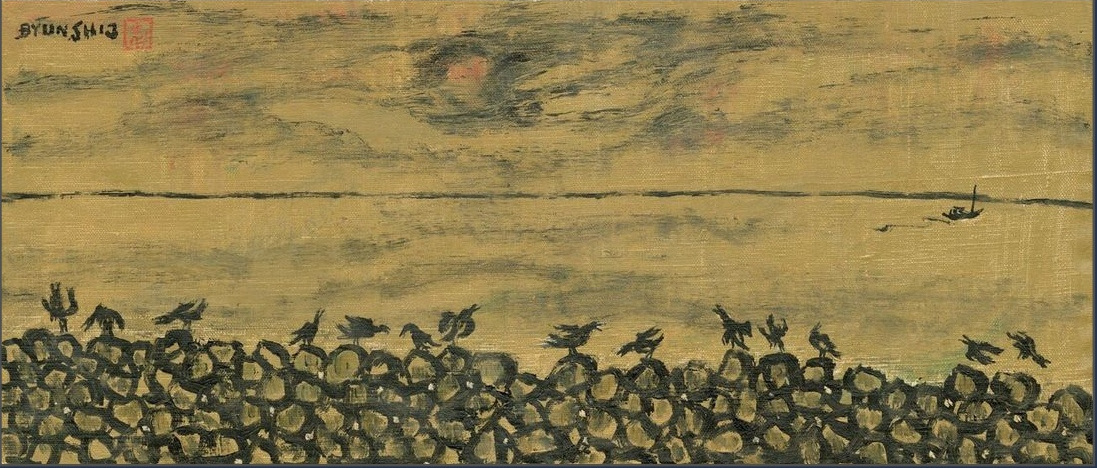
In a detail of Crows on a Stone Wall, dark bodies, short lines and the outlines of stones meet closely. In places they cannot be separated clearly. The small scale of the reproduction also limits judgement. What can be read here is not an injured leg, but the way a body and its support meet through a few marks.
Keeping the distinction changes the question of the essay. Instead of asking what is deficient, we ask how standing becomes legible in a spare form. The bird’s body rests above a brief mark. Following that contact, the eye begins to think about weight. Tension can emerge without a verdict that a life is incomplete.
Standing on One Leg Need Not Mean Precariousness
A living bird tucking up one leg is not the same as a bird losing it. As the Cornell Lab of Ornithology explains, birds may keep one leg close to the body to reduce exposure to cold. This general account cannot establish the condition of a particular painted bird. Animal behaviour and pictorial omission are different questions.
We readily transfer the feeling of standing on one leg as a human to a bird. A small dark body may therefore seem precarious immediately. But that unease may originate first in the viewer’s body. Before assuming knowledge of the bird’s difficulty, we should consider which of our own experiences we are adding to its form.
The painting does not prohibit such bodily projection, but we need not harden it into fact. A thin line may prompt concern; a body leaning to one side may hold our attention. The experience remains possible without claiming that the bird is actually injured. Looking can become more precise when certainty is reduced.
Before Symmetry, a Relation of Support
Asymmetry does not make a form alive, nor symmetry make it dead. Pictorial balance does not depend only on matching left and right. The weight of a dark area, the position of the line supporting it and the surrounding light space act together. To look at a small body is to attend to these conditions together.
The dark area of a crow’s body is close in tone to the outlines around the wall’s stones. They can appear joined, then separate again through a small light gap. Contact and separation occur together. Looking at that brief interval may bring us closer to the picture’s tension than locating an individual foot.
Balance in a picture does not mean that weight has disappeared. A few lines receive a body that seems capable of weight. Here, “few” does not mean “insufficient”. It means that a relationship can be recognised without further explanation. The purpose of a line emerges together with the body it supports.
A Mended Vessel and a Living Body
Kintsugi repairs ceramics with lacquer and makes seams visible with materials such as powdered gold. Smithsonian collection accounts show how an unconcealed repair becomes part of a vessel’s history. What matters is not breakage alone, but the hands and time spent making something usable again. Damage and care are not the same thing.
A vessel’s seam can be compared with a bodily scar. But the comparison must not become a demand that someone be wounded in order to become beautiful. Pain does not exist to instruct a spectator. A living body is not an object that needs a golden repair. Comparison becomes honest when it preserves differences as carefully as likenesses.
The same applies to a crow’s visible leg. As soon as we think something is missing, we try to fill the absence with consolation or triumph. That may not be what is first needed before the small body. We can attend instead to the stone beneath it and the surrounding distances, allowing attention to last longer than explanation.
Simplicity Is Not a Cult of Deficiency
Terms such as wabi or meot may come to mind. But these aesthetic names do not establish a defect in the bird’s body. Nor should different traditions all be gathered into a celebration of imperfection. What first deserves attention here is the distinction that remains after elaborate description has been reduced.
A body’s direction can be read without every feather being drawn. Even without a clear pupil, we may discern where the head turns. These remaining differences move the viewer’s eye. Simplicity is not the abolition of distinction. It can be a choice to retain necessary differences through limited means.
That choice is not an infallible formula. Some things require more description; others emerge through less. Before this bird, the question is not only what has been omitted, but which relationships remain active after omission. When a stroke reads as a leg and an area above it as a body, the spare form is already sufficiently complex.
Do Not Reduce the Brushwork to the Painter’s Body
The painter’s bodily experience can be considered alongside painted postures. But claiming that difficulty in a leg caused a rough line requires separate evidence. A bodily condition cannot directly establish the character of brushwork. Such a claim reduces observation, choices and time spent working with materials to a single cause.
The same applies when the crow is read as the painter himself. An autobiographical interpretation may be one possibility, but the bird disappears when every line is turned into the painter’s wound. Between the represented body and the body that made it, both resemblance and distance remain. Preserving that distance is one way to respect both.
Praise claiming that disability made art possible also requires care. It can turn into a demand that a person produce something from suffering. A painting’s value is not determined as such compensation. We can acknowledge a life lived with difficulty while reading the work through the forms and relationships it actually presents.
From the Detail Back to the Whole
We draw back from the leg that held our attention. Other birds appear and the wall’s long line returns. Above it lie the broad sea and a distant boat. The tension of the isolated detail acquires a different scale within the whole. The small body does not establish balance alone; it makes a picture with the surrounding forms.
Magnification can reveal more while narrowing what we see. Isolating a bird removes forces supplied by the wall’s rhythm and the directions of other birds. A detail therefore does not replace the work. It is a temporary pause from which to return to the whole.
We can see the whole without forgetting the small contact, and the detail without losing the surrounding expanse. When these ways of looking move together, “one-legged” changes from a verdict into a question. Less important than what is missing becomes the question of what supports the body now visible.
Standing Requires No Proof of Worth
A small body is not valuable only because it has not fallen. Resting, leaning or needing support from another does not diminish its value. Even when a painting is read as a symbol of endurance, bodies unable to endure must not be abandoned on the other side of that interpretation. Dignity is not a prize for passing a test of balance.
The crow need not prove the completeness of its body. Nor must it turn a wound into a triumphant story. The viewer’s task is to attend carefully to what is visible without deciding too quickly what is unseen. The space left open in this way may be not an inadequate explanation, but room for another life.
A short line lies beneath the dark body. The line touches a stone. The light gap beside it remains unfilled.