Research/A Hundred Years of Wind/Ⅲ Animals & Life
Ⅲ Animals & Life · 33 / 100
The Being of the Jeju Pony
Different Bodies Standing on Shared Ground
조랑말의 존재
One Pony Holds Its Head Up
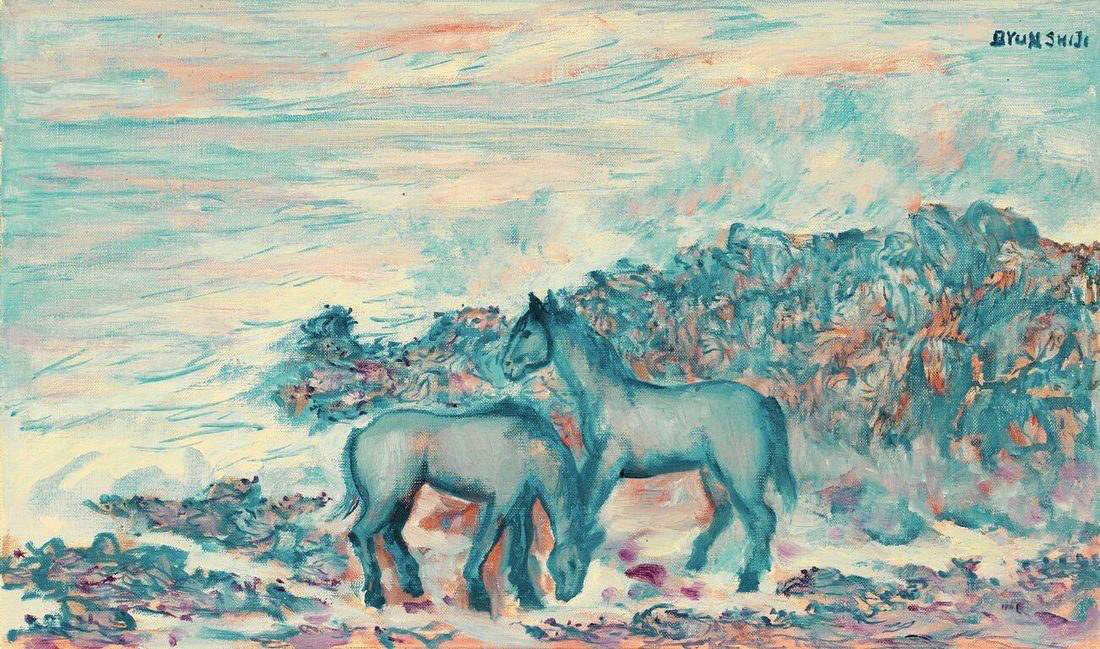
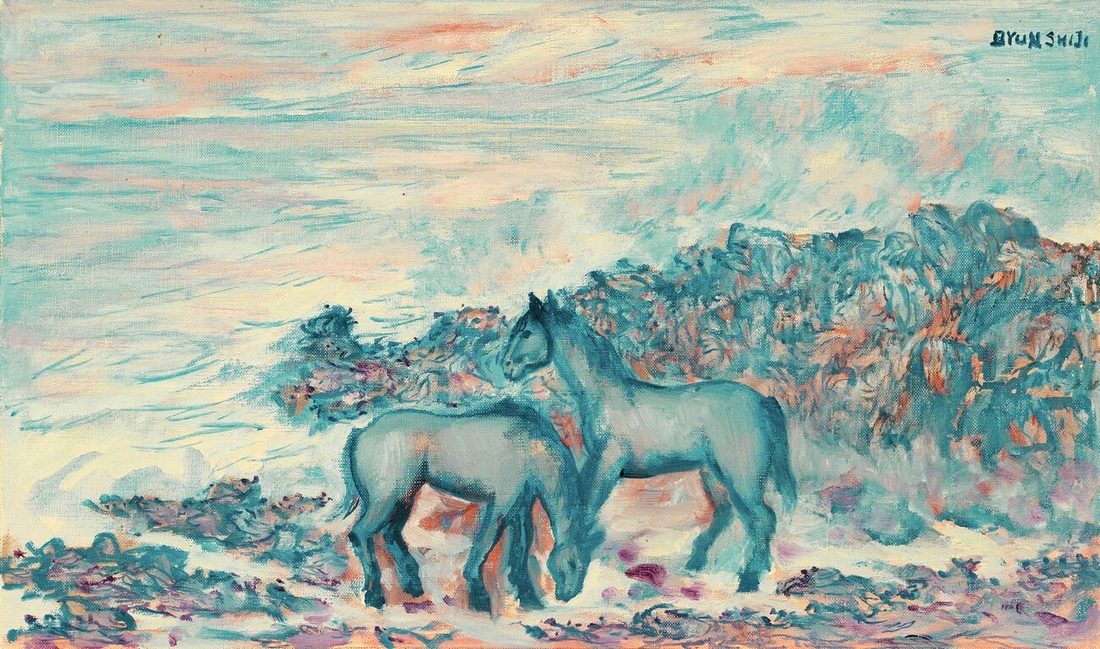
There are two ponies in Jeju Ponies (1975). The nearer one lowers its head; the one behind it holds its neck upright. Bluish tones connect their bodies with the sea, while reddish and lighter strokes mingle in the rocks and ground. No person is visible. Before offering consolation to a human, the ponies constitute the picture as two lives in different postures.
Being together does not establish that the two are looking at the same thing. A lowered head and a raised head lead our eyes to different places. One opens the nearby ground; the other opens space beyond it. Their difference keeps the picture from closing around a single feeling. To stand beside another is not to become the same.
Remembering Byun’s horses only as beings with lowered heads makes us miss this scene. Reading a recurrent posture is different from erasing exceptions. A change in the height of one horse’s head is enough to make us reconsider words such as humility or resignation that we have attached to these paintings.
Fūdo Is Not a Single Cause of the Body
To explain the Jeju horse by saying that wind reduced its height or salt roughened its mane turns fūdo into too simple a cause. A 2019 genomic study analysed the Jeju horse as genetically distinct while closely related to Mongolian horses. Such research concerns population history and genetic variation. Those questions cannot be answered by a pictorial metaphor.
This does not remove the relationship between body and place. The ground an animal stands on, what it eats and how it lives with people remain important questions. But the formation of a biological body must be distinguished from the painter’s treatment of it. A small painted horse does not in itself demonstrate the evolutionary history of a small body.
What painting makes available is the form of a relationship. In Jeju Ponies, bodies, rocks and sea share related colours while different marks keep them distinct. The horses appear as bodies situated within their surroundings rather than specimens cut out of them. There remains a distance between sharing a light and becoming the same being.
A Celebrated Horse Is Still a Horse
Night-Shining White, attributed by the Metropolitan Museum of Art to Han Gan, depicts an emperor’s horse. The museum discusses its capture of the animal’s spirit as well as its appearance. Covering the image with the phrase “imperial glory” can obscure the tension of the body. A distinction between prestigious and ordinary horses is not enough to explain the difference between two painters.
Comparison with Byun should ask how a body receives attention within the picture, not only whether the horse was celebrated. One form directs concentration towards an individual animal; another makes differences between two animals visible within a surrounding landscape. Independently of stories that elevate a horse’s status, each painting sustains attention to an animal in its own way.
We could place the small pony beside the image of a gifted horse that travels a thousand li. Yet recognising the pony’s value need not diminish the celebrated horse. More important is to avoid making either animal merely an instrument for explaining human success or failure. Even without demonstrating its ability to run, a horse remains a body worthy of attention.
The Riderless Horse Is Not Unique to Byun
There is no rider on the horse in Stubbs’s Whistlejacket either. In the National Gallery painting, a broad ground replaces an elaborate landscape and the animal’s body is prominently displayed. The claim that Western horses were always painted in service of human power is inadequate even before this single work. The shared absence of a rider provides a more precise starting point.
Whistlejacket concentrates attention upon one body, whereas Byun’s two ponies distribute it among sea and rocks. The first cannot simply be translated into domination and the second into coexistence. Scale, the use of open space and the degree of separation between body and setting can be compared. Formal differences should precede ethical conclusions.
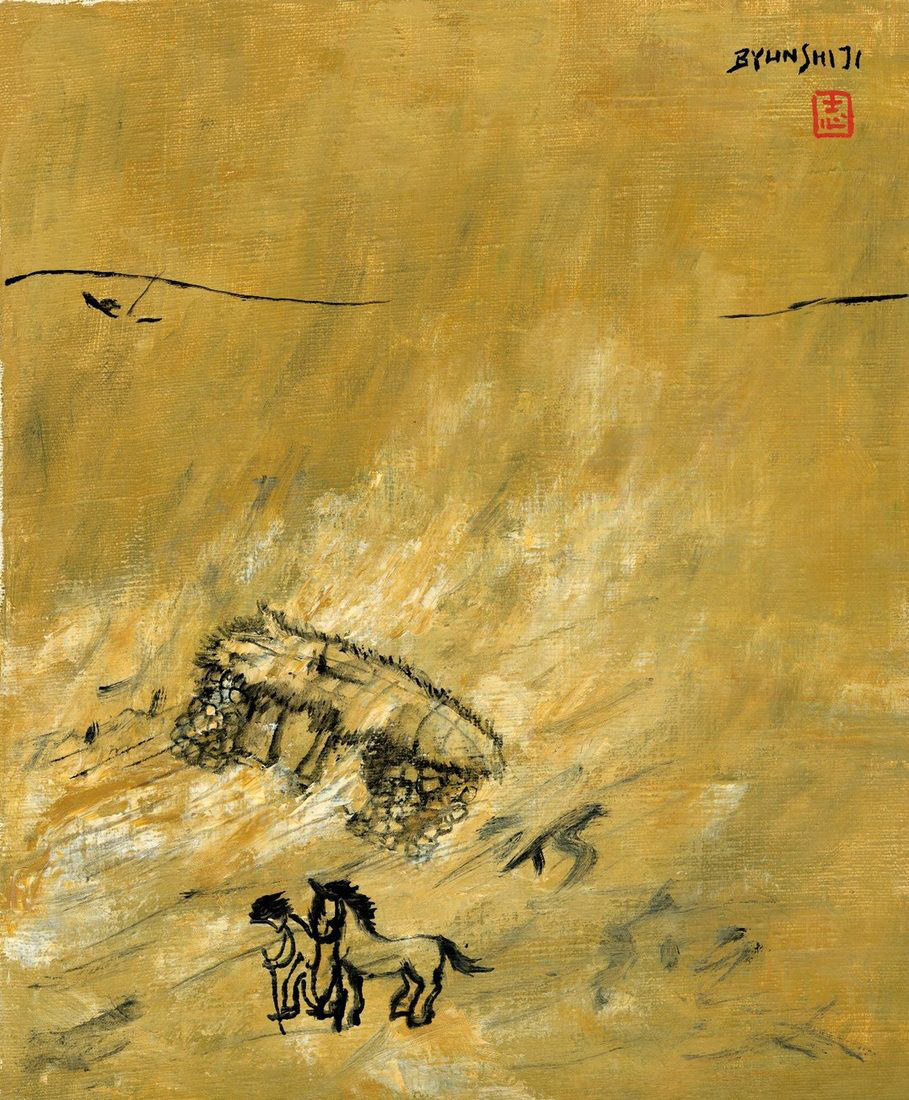
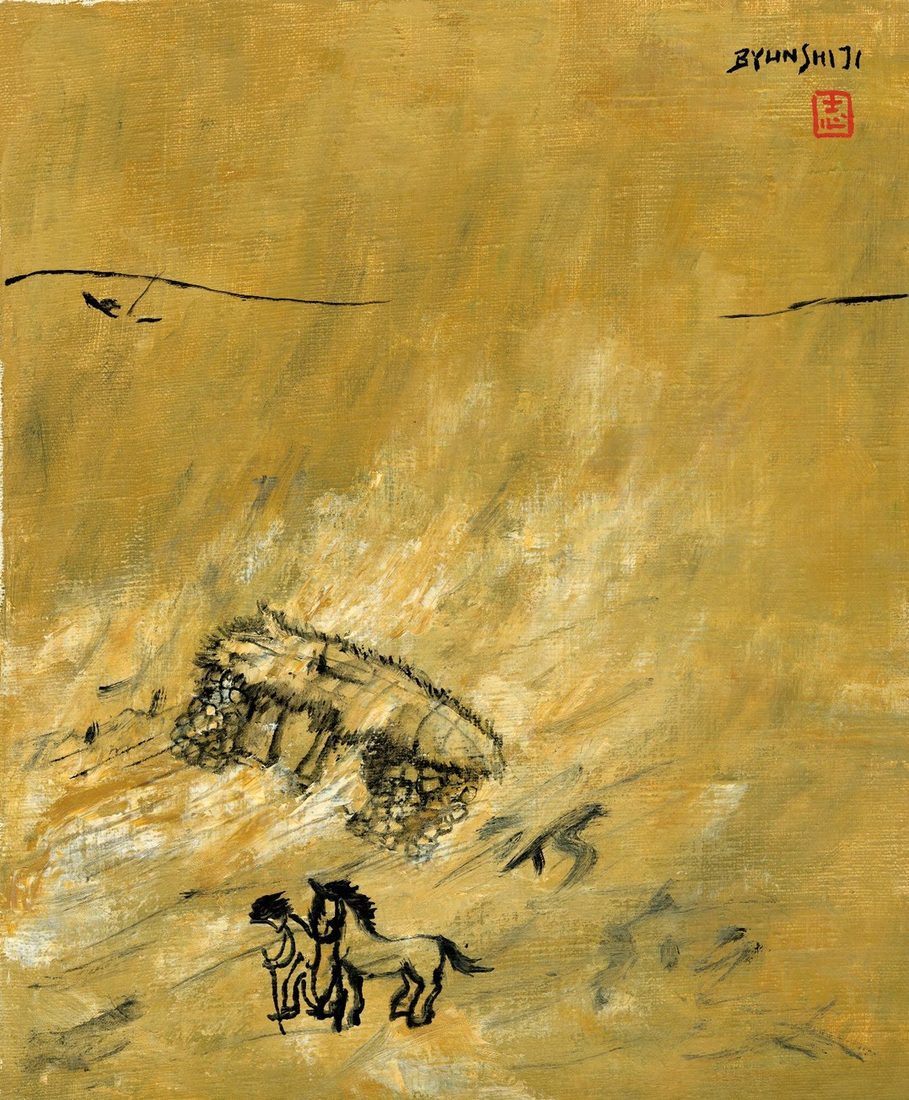
In Rough Seas, person and horse stand beside each other. This arrangement can be said to produce a different sensation from the vertical relation of an equestrian portrait. Yet the absence of a rider does not erase histories of ownership and labour. The proximity proposed by the picture is not a declaration that all real relationships have been resolved. It is one scene through which to look differently.
What to Look for Before Speaking of a Tether
A standing horse can easily prompt a story about a tether preventing departure. First, however, we should look for a rope. In the supplied reproduction of Jeju Ponies, no clear tether holding the two bodies is apparent. Being represented in a still image is not the same as lacking freedom to move.
“Tamed wildness” also needs to be reconsidered. It cannot establish the nature of the Jeju horse or the painter’s character. It is useful as a question: can an animal living close to humans be explained wholly by human needs? Even a familiar animal retains movements and concerns we do not fully know.
Attending to the direction of a neck or an ear is a small way to acknowledge that remainder. Even when the image cannot establish whether the horse seeks grass or listens to a sound, we can see a body oriented differently from a human one. After a person has read their own feelings into it, the horse still exceeds that interpretation.
Two Spaces Made by the Height of a Head
In Jeju Ponies, the lowered head makes the ground before the body an intimate, nearby area. The upright neck behind it connects with the sea above. Although the bodies overlap closely, their directions differ. A sense of being together becomes more concrete through this small difference than through perfect agreement.
In Rough Seas, the horse holds its neck up beside the person’s bent body. Against the surrounding diagonal strokes, that neck forms a short but distinct alternative direction. Person and horse need not both bow the same way to occupy a shared wind. Bodies responding differently to a common condition can constitute one picture.
We should therefore resist reading a lowered head only as submission or a raised head only as dominance. Posture belongs with its surroundings. Change what supports a body, where it faces or the distance to its neighbour, and the same inclination feels different. A horse’s posture is not a moral diagram. It is a place where relationships take form.
Humans Are Not the Only Ones Who Look
In The Animal That Therefore I Am, Jacques Derrida questions the habit of reserving the position of the looking subject for humans, beginning from the experience of being seen by an animal. He also examines the singular term “animal” used to gather so many different lives. This question helps us see Byun’s horse not as an empty vessel for human feeling but as a body with another orientation.
Of course, we do not know what a painted horse is thinking. Not knowing does not mean that the body has no inward life. What the viewer receives is an orientation of eyes, an angle of the head and an interval to another body. Attention remains possible without complete knowledge. A reading of companionship can begin at just that distance.
A nearby horse is not obliged to resolve a person’s solitude. Nor need the person hastily declare that the animal has been understood. Look at the two bodies in Rough Seas this way and shared exposure precedes mutual explanation. The house is behind them. Both bodies are still outside.
The Horse That Remains Beyond the Double
There are moments when horse and person seem alike. An inclination, a small scale or a low position within the surrounding expanse can recall the other. Resemblance, however, is not identity. When the horse is not made to carry an entire human biography, the picture becomes broader than one person’s confession. Another life retains its place.
Fūdo may place bodies together without erasing their differences. Related colours connect body and sea, while different lines distinguish one pony from another. Connection and distinction occur together. To read Byun’s ponies is not to choose one over the other, but to hold both within the act of looking.
The nearer pony lowers its head. The pony behind holds its neck upright. A little blue continues between the two bodies.