Research/A Hundred Years of Wind/Ⅲ Animals & Life
Ⅲ Animals & Life · 32 / 100
The Ontology of the Crow
Looking at the Bird Before Assigning Its Symbol
까마귀의 존재론
The Black Birds Do Not Share One Posture
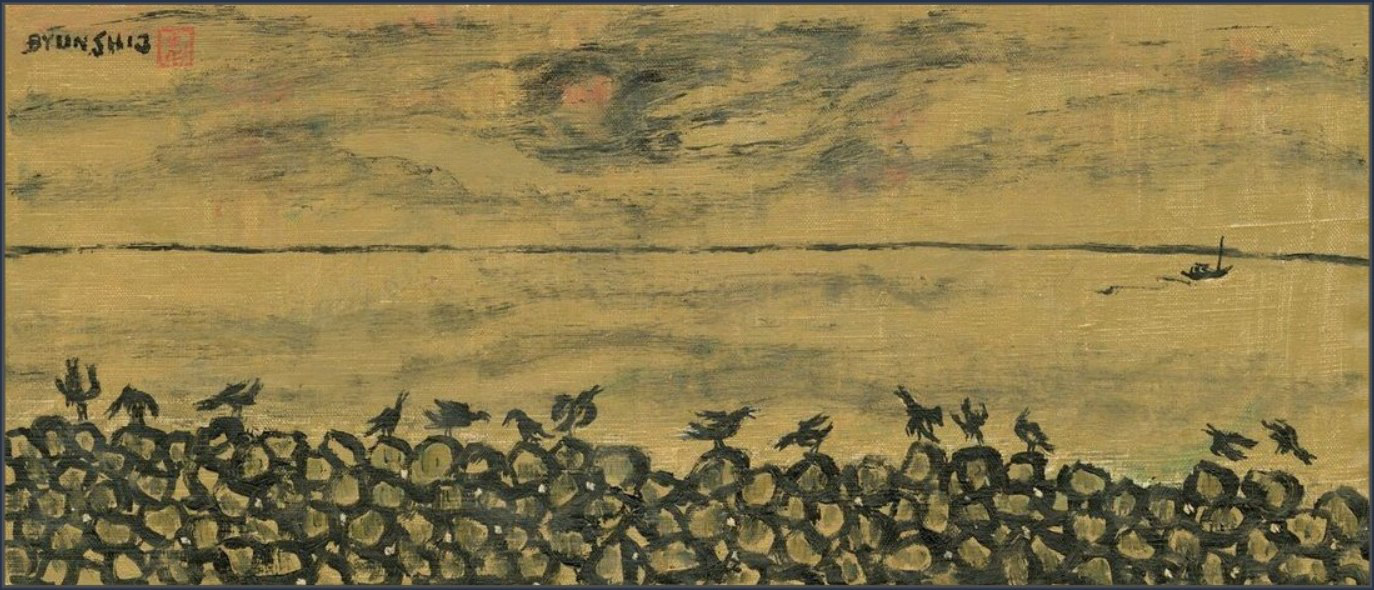
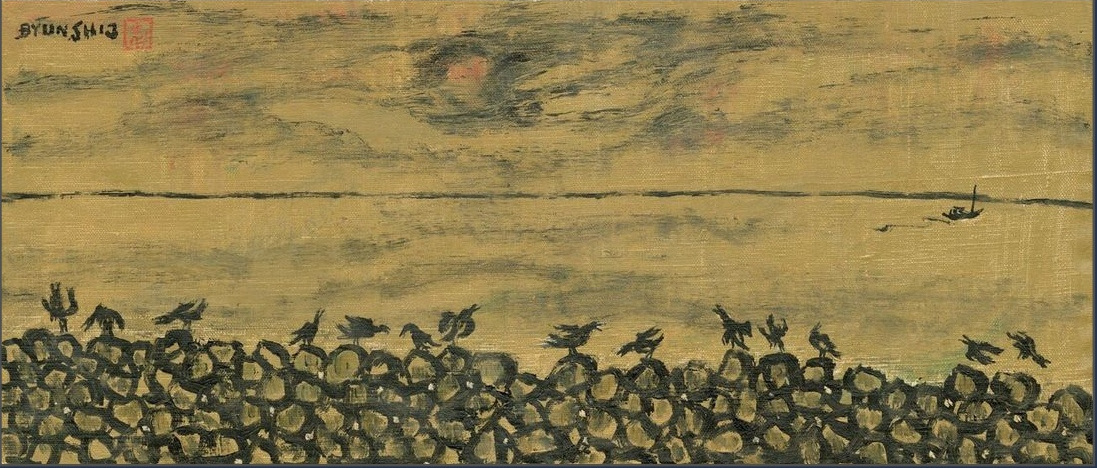
In Crows on a Stone Wall (1983), the wall extends across the lower part of the picture. The birds above it are not arranged at regular intervals. Upright bodies, lowered bodies and forms that seem to spread their wings establish different directions. The distant boat is small. The eye moves out to sea, then returns to the nearby black forms.
The name “crow” gathers these birds into a kind. The painting preserves small differences within that name: the direction of a beak, the gap between body and stone, the angle of an open wing. Reading each crow immediately as a sign of solitude or death suppresses the fact that forms sharing one name have been placed differently.
Ontology here does not attach a hidden answer to the bird. It asks how the bird appears as a painted form and how it relates to what surrounds it. Before conveying a meaning, the crow occupies a place in the image. Reading symbols should begin again with attention to that small place.
A Bird of Loss Cannot Simply Be Transplanted
In Poe’s The Raven, a dark bird visits a speaker remembering the lost Lenore. Loss deepens through the interaction of the speaker’s questions and the bird’s repeated word. This meaning does not arise from blackness alone. Room, night, memory and verbal repetition produce it together. To carry the bird from that poem into another picture requires attention to those differences.
Nor is there a reason to identify the raven of Poe’s title automatically with the species of Byun’s painted crow. A translated literary title, a biological classification and a pictorial motif belong to different levels. Where a few painted strokes do not establish a species, they provide even less reason to settle a distant cultural meaning in advance.
Van Gogh’s Wheatfield with Crows should not be treated as his final painting or automatically as a prediction of death. Van Gogh Museum researchers have proposed Tree Roots as the final work. Research into sequence must be distinguished from interpretation of the birds. Once crows are no longer connected directly to the painter’s death, comparison can reveal pictorial differences rather than repeat a tragic narrative.
A Particular Scene Before a Cultural Label
Opposing an ominous Western bird to an auspicious Jeju bird makes the account simple. In that simplicity, however, particular texts and pictures become difficult to hear. We cannot presume that everyone in a region has understood a bird in the same way. A reference to folklore should begin with the place and context in which an account was transmitted.
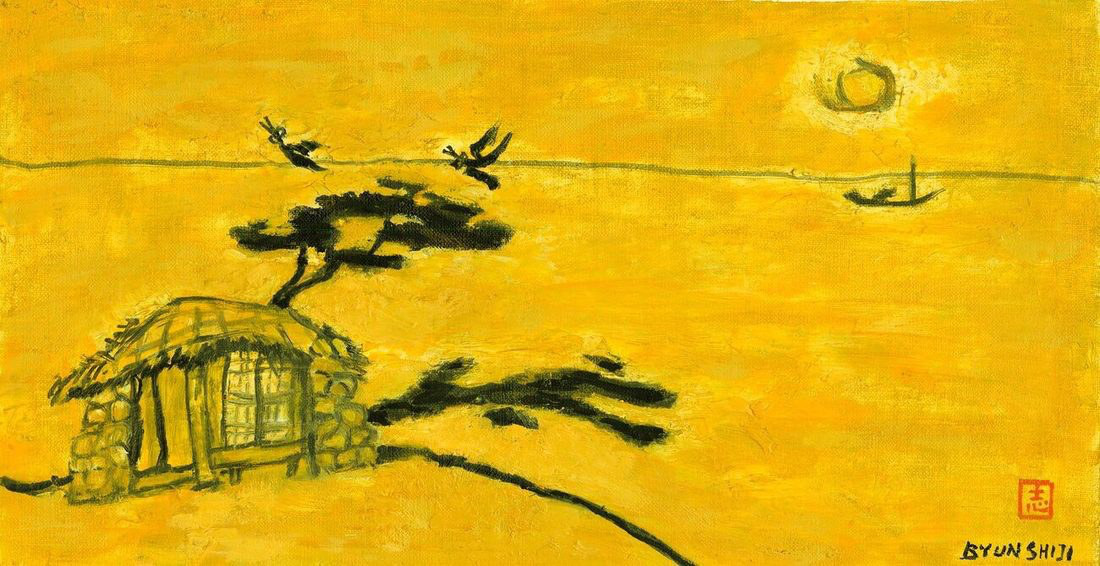
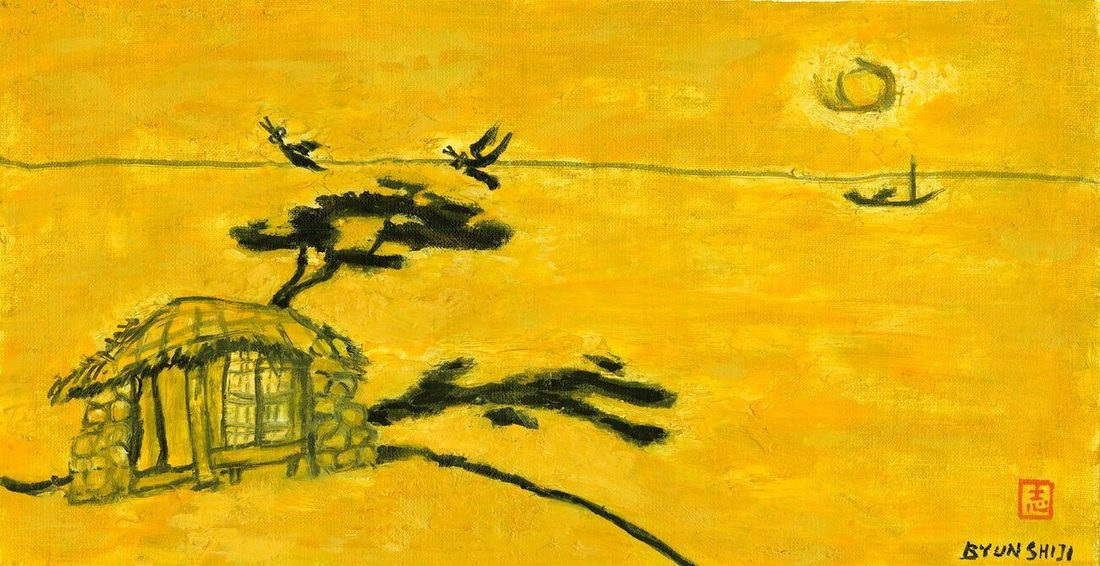
Independently of that historical task, a bird can perform different roles within a painting. Birds near the tree in Empty House do not do the same spatial work as the many birds in Crows on a Stone Wall. The former animate an area close above the house; the latter establish an extended rhythm along the wall. A recurring motif changes with its surroundings.
This does not call for the abolition of symbolism. It changes the order of interpretation. We see a dark bird, attend to its placement, read the title and relevant records, then consider meaning. That meaning remains open to revision when the posture changes. A revisable reading stays with this small form longer than a fixed dictionary can.
Is the Wall a Threshold?
A bird perched on the wall is raised slightly above the ground. The wall is both a dividing line and a surface on which a body can rest. What serves as a boundary for a person may become a resting place for a bird. The important point is that different bodies can use the same structure differently. The wall does not have just one meaning.
The liminality developed by Victor Turner concerns transitions in social status within the threshold phase of rites of passage. It can be compared with the crow’s placement, but perching on a wall is not evidence of undergoing a rite. What we can borrow is a question about a position that is not wholly fixed within one condition.
The bird does not actually fly away within the painting. An open wing or the direction of a body nevertheless invites the thought of movement to come. A place occupied now overlaps with a place that might soon be left. “Threshold” is useful at this point: not as a declaration of two invisible worlds, but as a way to read possible movement in a still form.
A Rhythm Made by Uneven Intervals
The stones differ in size and shape, as do the postures of the birds above them. Dark outlines of stones connect with dark bodies without becoming identical. The eye follows the wall, then pauses at an open wing. A flow emerges without regular spacing. Its rhythm does not merely obey a rule; it incorporates differences that depart from regularity.
Describing that flow immediately as biological self-organisation conceals the difference between painting and ecology. The movement of living flocks requires observation and measurement. What is available here is a set of forms and intervals left by a painter. Evoking natural movement is not equivalent to demonstrating its laws.
Instead, we can imagine changing the direction of one bird. A beak facing right rather than left would alter how neighbouring intervals are read. A difference in a small form participates in the balance of a broad picture. The birds are not ornaments added to a larger landscape. Their slightly different directions help establish its time.
When a Mark Becomes a Bird
Dense dark areas and short projecting strokes are more immediately apparent than detailed feathers. Yet not every bird can be said to have been painted in a single stroke. There are overlapping marks and thicker areas. The issue is not merely a reduced stroke count. It is how few distinctions allow us to recognise a head, a wing and a body.
A line is both the outline of a bird and the trace of paint passing across a surface. Close up, we see its rough edge; further away, the direction of the bird becomes legible. Neither aspect cancels the other. Pictorial vitality need not depend on movement resembling that of a real bird. It can arise from this double experience of paint remaining visible while a bird appears.
Comparison with a calligraphic stroke should preserve this specificity. We may discuss a similar rhythm, but that alone cannot demonstrate direct inheritance from a particular painting theory. First we must see the weight and direction of a mark in this picture. A short stroke beneath a dark body establishes contact between bird and stone.
Relationships Remain Without a Human Figure
No recognisable human figure appears in Crows on a Stone Wall. Yet this is not a landscape emptied of human activity. There is a wall of piled stones and a boat at sea. Birds perch on a boundary someone has made. Even after humans withdraw from the centre of the image, their work and the movements of other living beings meet in one place.
Reading a crow solely as the painter’s double diminishes this relationship. While the bird is made to represent human feeling, its own place can be forgotten. In this painting, the birds make a picture on a wall without a visible person. Their forms warrant attention even without explaining a human life.
Read as the conditions of shared life, fūdo is not something the bird merely symbolises. The bird is a form with a place among stone, sea and a constructed wall. Beings need not think alike or share one destiny in order to be together. They can occupy one wall with their bodies turned in different directions.
A Place Not Yet Left Behind
The question of good or bad omen carries the viewer too quickly towards a conclusion. Other questions are possible. Where does this bird face? How far is it from another? What does the line beneath its body support? These questions delay an answer while sustaining attention to the painting.
Freedom of symbolism does not mean permission to attach any meaning at all. It means preserving several interpretations that can return to the visible form. Even after reaching a reading, we must be able to look again when a bird’s posture fails to fit it. In this way a crow becomes unfamiliar again within its familiar name.
Black birds occupy the wall. One form rises upright; another opens its wings. A little of a stone’s lighter face remains between them.