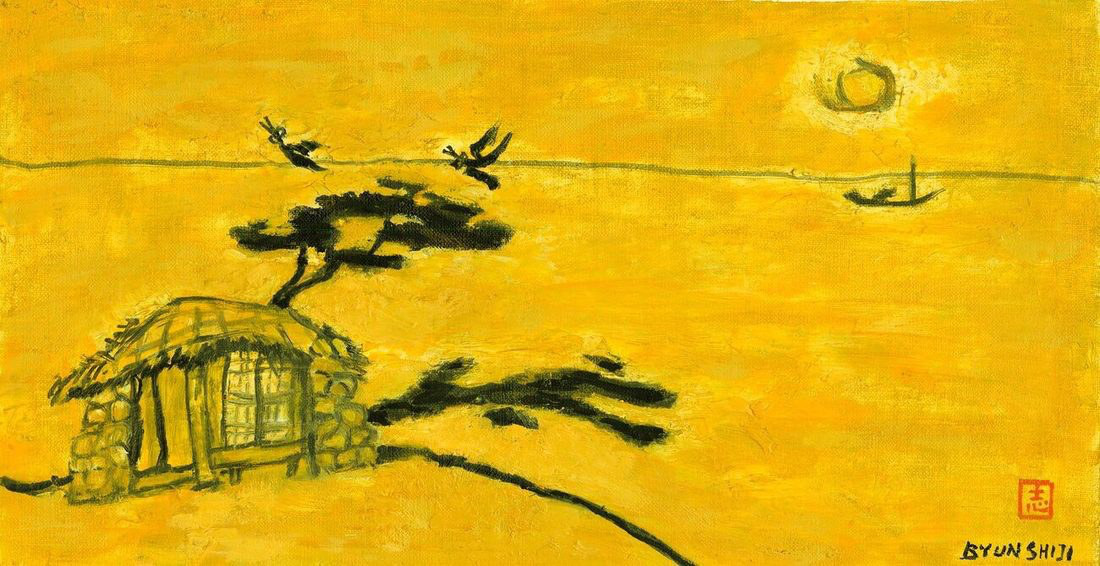
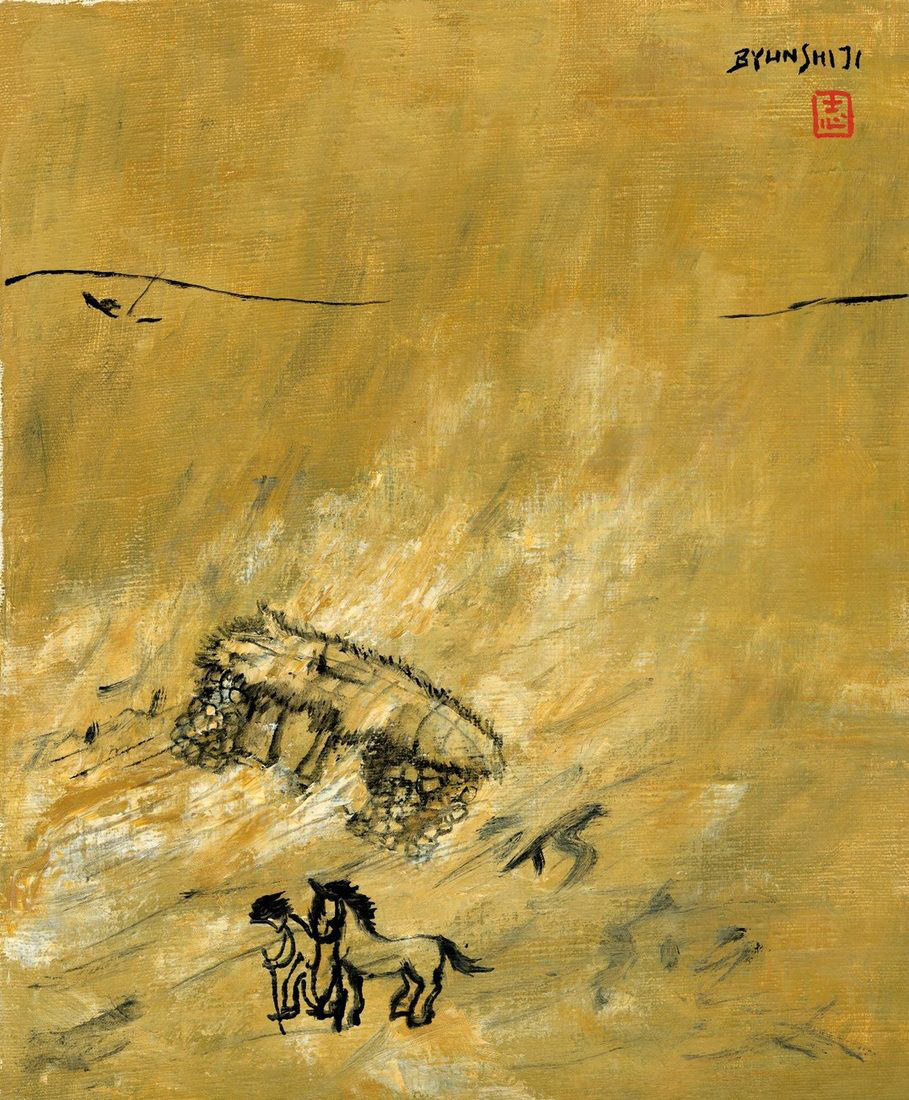
Research/A Hundred Years of Wind/Ⅱ Figure & Being
Ⅱ Figure & Being · 31 / 100
The Architecture of Solitude
Reading Aloneness Between House and Body
고독의 건축학
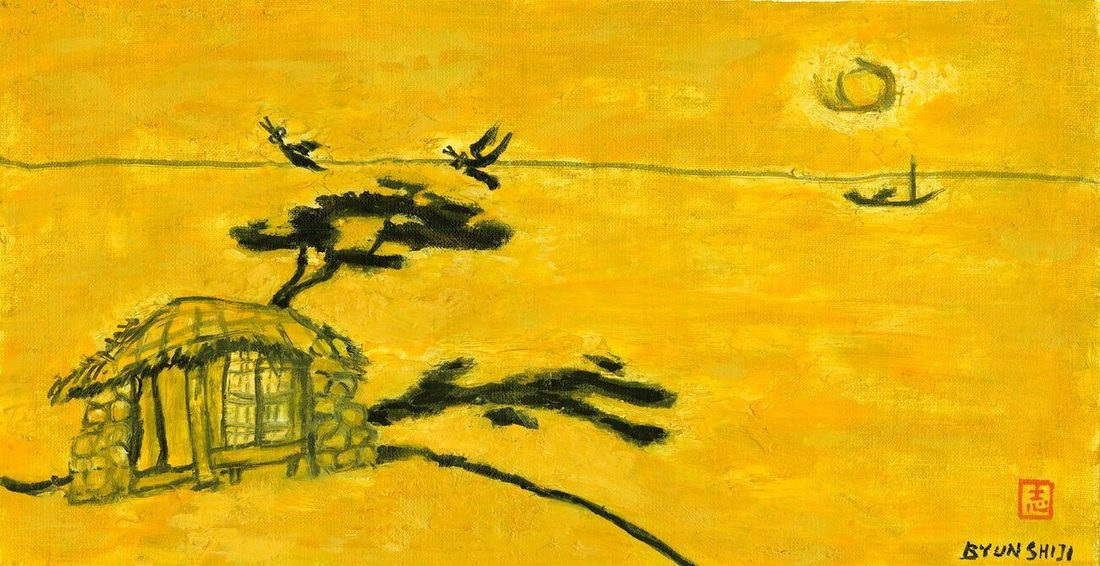
A House Without a Visible Occupant
In Empty House (1987), a low house stands beneath a leaning tree. Birds appear near the branches; a small boat lies far out at sea. No human figure is visible. Yet the door and roof bring to mind a place where someone could stay. The relationship between a person and a place need not disappear when the person is not painted.
The word “empty” in the title does not establish that the door is open or that an owner has died. The painting supplies neither story. A house, however, has a shape and scale made for people to enter and leave. Because that structure remains, an unseen occupant can come to mind. Absence may feel closer where a use survives than where nothing exists.
An architecture of solitude is therefore not a search for a lonely person to identify. It attends to a place for the body, the distances between that body and other things, and the expanse around them. Rather than assert that feeling has been converted into space, it asks what feelings a spatial arrangement makes possible. The reading begins with the placement of a single house.
What the Roof Covers—and What It Cannot
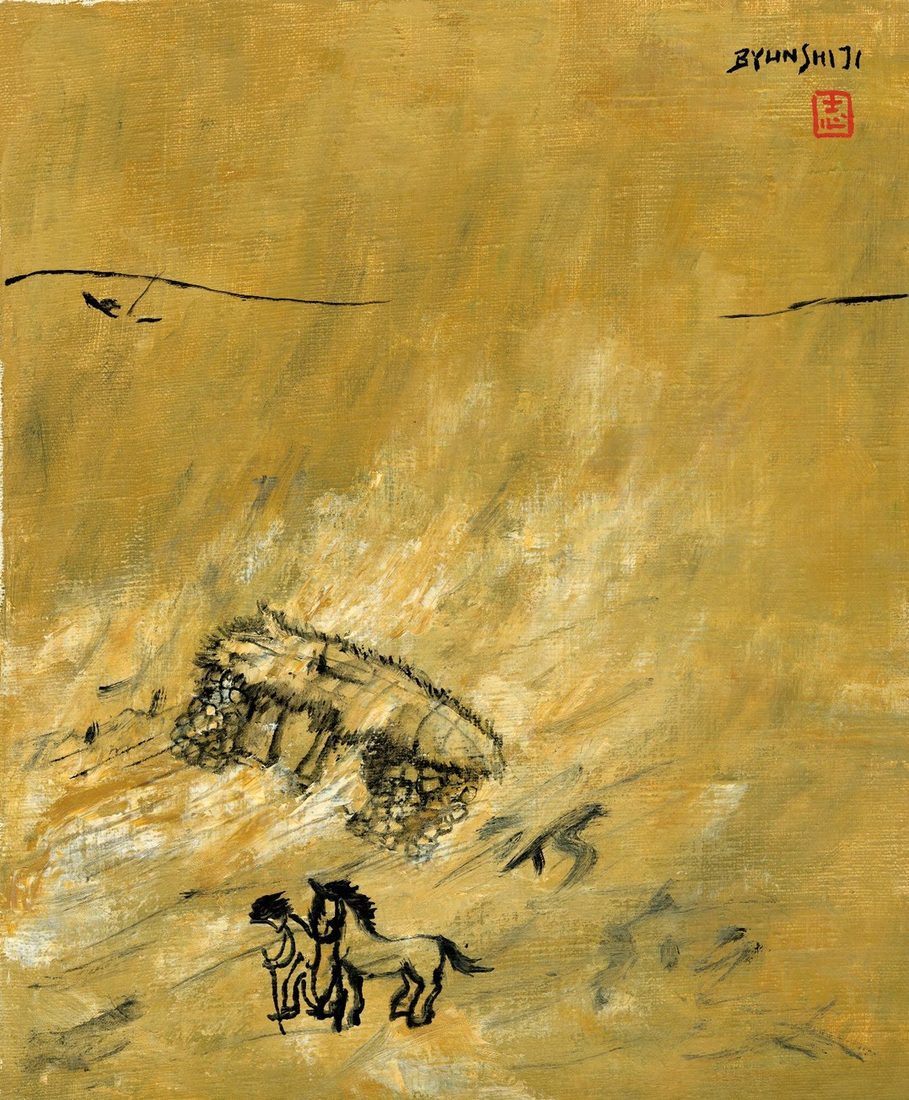
In Rough Seas (1983), a person and a horse appear near a house. They are exposed beside one another in the lower part of the picture rather than concealed indoors. The roof tilts, while pale strokes run diagonally around it. We see the house’s limited area together with the broad surrounding ground: a possible shelter and everything beyond it.
A nearby house does not automatically provide complete refuge. The distance to its door may be short, while the body remains outside. Having a house nearby and being inside it are different conditions. This slight distinction prevents the picture from becoming a simple story of escape. A wish for shelter and a body exposed to the world can occupy the same place.
The interval between person and horse also matters. They do not merge into one mass, yet they appear closer to each other than to the separate house. A nearby body seems to offer something a wall cannot. There is no need to turn the horse into a rescuer. Two bodies together and a house behind them suggest different scales of shelter.
Ways of Remembering a House
In The Poetics of Space, Gaston Bachelard approaches houses, rooms, attics, cellars, nests and shells as places of memory and imagination. What matters here is the refusal to treat a house merely as a sum of measurements. A corner may occupy memory beyond its dimensions; a little room can retain the scale of a period of life. This approach helps us see Byun’s small house as more than a miniature building.
Yet distinctions between attic and cellar cannot simply be transferred to a Jeju house. Nor should an unseen interior be filled with imagined layers of the mind. The painting offers the tilt of a roof, the boundary of a wall and the position of a door. Comparison enlarges our understanding only when it leaves room for the particular shapes that the borrowed theory does not explain.
A house can hold memory, but it need not summon a memory for everyone. One viewer may recognise a childhood home; another may see an unfamiliar small building. Neither response has to invalidate the other. Some forms do not require familiarity. To feel the scale of the house against its surroundings, we need not have lived there.
Open Space Has a Surface
The sparsely occupied areas of Empty House are not colourless holes. The ground, which can be read as dried-grass colour, retains lighter and darker textures. Our eyes cross those textures when travelling between house and boat. Open space is not simply what remains after objects have been removed. It is a painted surface that makes the distance between them perceptible.
The same area can feel different when its surroundings change. A larger house might bring the space beyond it closer; a smaller boat might send the sea further away. This is not a calculation of actual distance. Forms of different sizes regulate the pace of looking. A sense of solitude arises through these relations of scale and spacing rather than through expanse alone.
Dividing open space into Eastern fullness and Western emptiness obscures this movement. Even one area in a single picture can alternate between room to breathe and an expanse that offers nowhere to rest. Neither meaning is settled in advance outside the work. Each return of the eye to the house leaves the intervening distance slightly changed.
Four People Beyond the Glass
Edward Hopper’s Nighthawks (1942) contains three customers and a server. From the night street, we look into a brightly lit diner. The Art Institute of Chicago draws attention to the enclosure produced by the broad glass and the lack of a visible entrance. Several people being present does not abolish distance. Here, too, solitude concerns arrangement and access more than the number of figures.
Hopper’s glass reveals an interior while separating our bodies from it. Byun’s Rough Seas, by contrast, exposes bodies outside a house. In one, an interior can be seen but not reached; in the other, a nearby house leaves part of the world uncovered. More useful than a broad opposition between city and nature is the way boundaries act differently upon sight and the body.
This comparison cannot establish which solitude is deeper or more enduring. The silence of the diner and the silence outside the house each preserve particular relationships. What matters is how the image makes reaching another being difficult or possible. Byun’s horse beside the human figure shows that proximity can vary even within a scene we experience as solitary.
A Solitary Image Is Not a Whole Biography
A single figure does not establish that the painter spent every day alone. The depicted place is not a room recording the whole of a life. Some encounters are omitted; certain things repeatedly remain. To connect pictorial solitude with biography requires separate attention to letters or oral testimony. The painted surface cannot stand in for those records.
Attending to pictorial choices produces different questions. Why is this house so small, and why has the boat been placed so far away? We can ask without knowing a particular episode. The point is not to erase biography, but to resist filling every interval with it. An interval left open is precisely where the viewer can encounter the painting directly.
Solitude then becomes a relationship being formed rather than a completed character trait. The same house changes when a boat is present or absent; the same person acquires a different distance when a horse stands nearby. Being alone is not necessarily being unrelated. It can be a way of feeling with particular clarity what is close and what remains far away.
A Low Position Is Not a Lesser Value
The person and horse in Rough Seas occupy the lower part of the picture. Their position does not in itself signify surrender to nature. The eye crosses the broad ground and returns to those small bodies. They occupy little area without necessarily commanding little attention. This becomes visible when pictorial height is not immediately equated with the value of a being.
Within a field of diagonals, short legs and a walking stick establish other directions. Long flowing strokes and brief lines of contact support one another. Turning this balance into an indomitable human will can obscure what the marks actually do. The painting endures, but the bodies within it remain small and exposed. Their possible need for protection also remains.
In Empty House, even the human body is not visible. Put the two paintings together and a single blueprint of house, person and sky proves insufficient. One presents bodies in proximity; the other retains a structure in which someone might dwell. This architecture has no single formula. It comprises different arrangements of what is present and what remains unseen.
A Painting That Leaves an Opening
Not every solitary interval is a blessing. For one person it may offer necessary space; for another it may be a distance difficult to bear. The painting supplies no answer that erases the difference. Neither does it hastily turn a being placed alone into a deficient being. It sustains attention to the surroundings: the nearby body and the boat still far away.
A dwelling need not be a place where the outside has disappeared. It may offer the possibility of entering and an opening through which to look out again. Read this way, Byun’s small house brings solitude closer to a threshold than a locked room: a place where staying and passing through remain possible. Who might enter has not yet been painted.
We return to Empty House. The house is near; the boat is far away. The lines that form the door remain. A light texture in the painted ground passes beside them.