Research/A Hundred Years of Wind/Ⅲ Animals & Life
Ⅲ Animals & Life · 39 / 100
The Eyes of the Jeju Pony
Standing Before Another Gaze
조랑말의 눈
Direction Appears Before the Eye
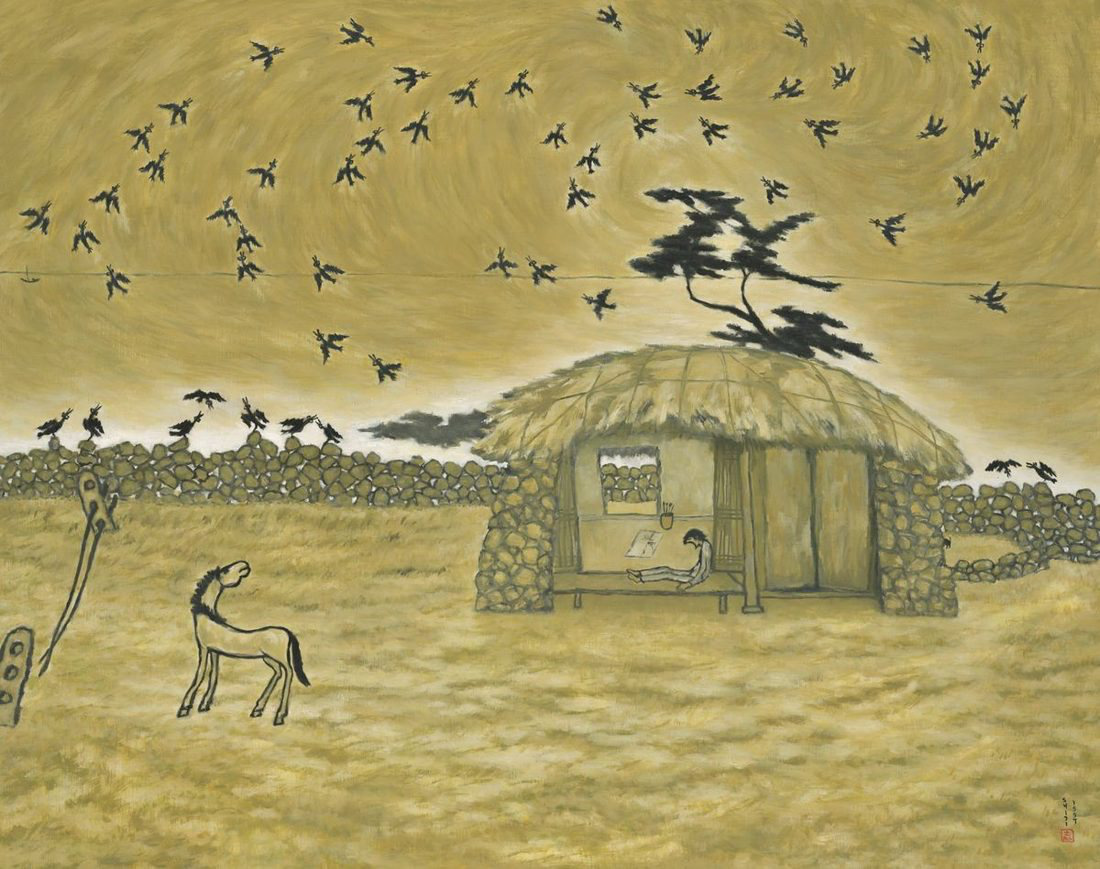
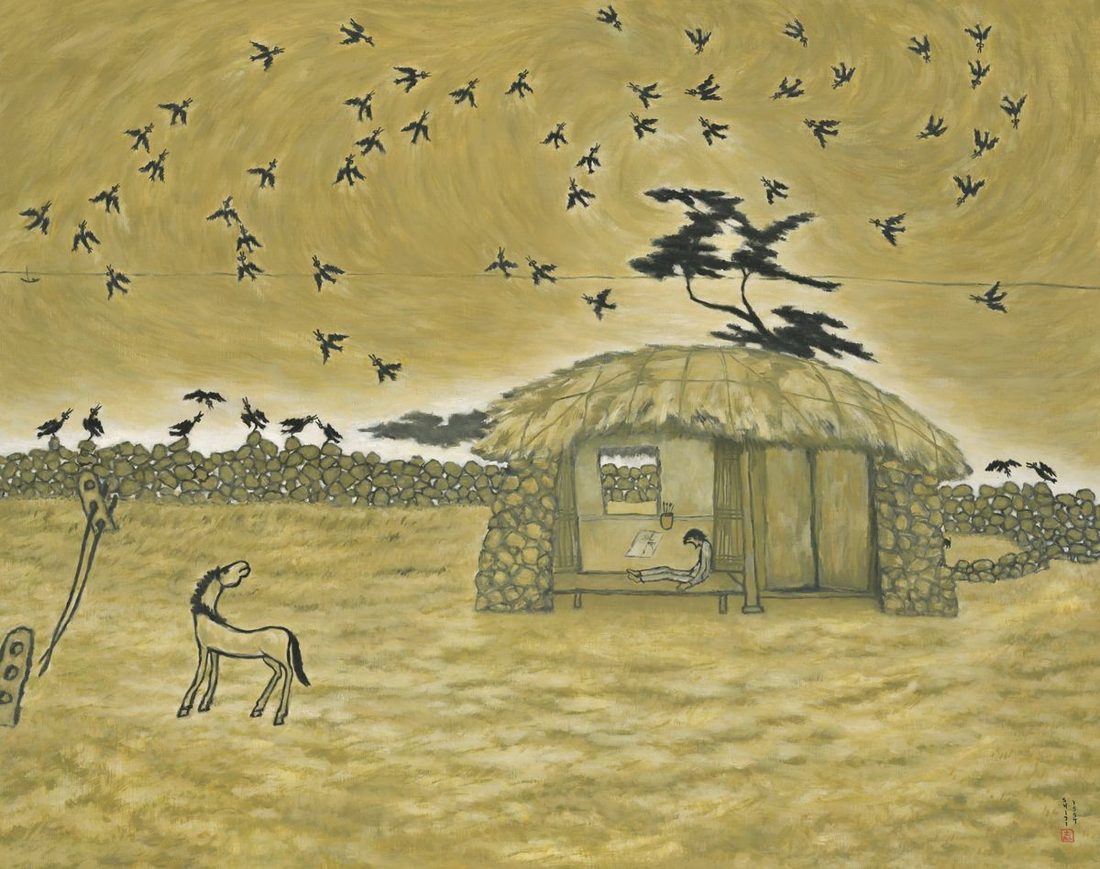
The horse in Wild Dance (1997) curves its neck and directs its head upwards. Its gaze may seem to reach the birds in the sky. What is first established, however, is the orientation of body and head. The painting does not show a sequence in which the horse has just raised its head, or establish which particular bird it is looking at.
Leaving that difference intact makes the gaze more interesting. Even without reading a detailed pupil, the head, ears, curve of the neck and bodily orientation suggest attention. Gaze is not confined to the small organ of the eye. The whole body and the space opened before it participate in making a gaze.
Reading the pony’s eyes is therefore different from guessing its mind. Before deciding whether it is sad or happy, we ask what the depicted body can orient towards. Does its direction coincide with the person’s? What lies ahead, and what is obscured? Even before naming an inward state, there are many relationships available to be read.
The Human Observer Can Also Be Seen
Derrida’s The Animal That Therefore I Am reconsiders the human position before a cat looking at him. The starting point is a particular living cat rather than the abstraction of the animal in general. Is an animal only something observed by a human? The question opens onto the possibility that a human, too, can be exposed to another creature’s gaze.
Bringing this thought to a painting need not mean that its horse literally looks at the viewer. The horse in Wild Dance faces elsewhere within the picture. Precisely because its direction does not address us, the body seems to possess a position apart from our interest. Not every being in a picture need be placed there to present itself to us.
Respecting an animal’s gaze must not become a way of writing a profound philosophy into its eyes on its behalf. A declaration that I know everything it thinks can take that gaze away again. It is better to step back: this body may attend to something beyond my reading. We leave that possibility available.
Two Horses Attend at Different Heights
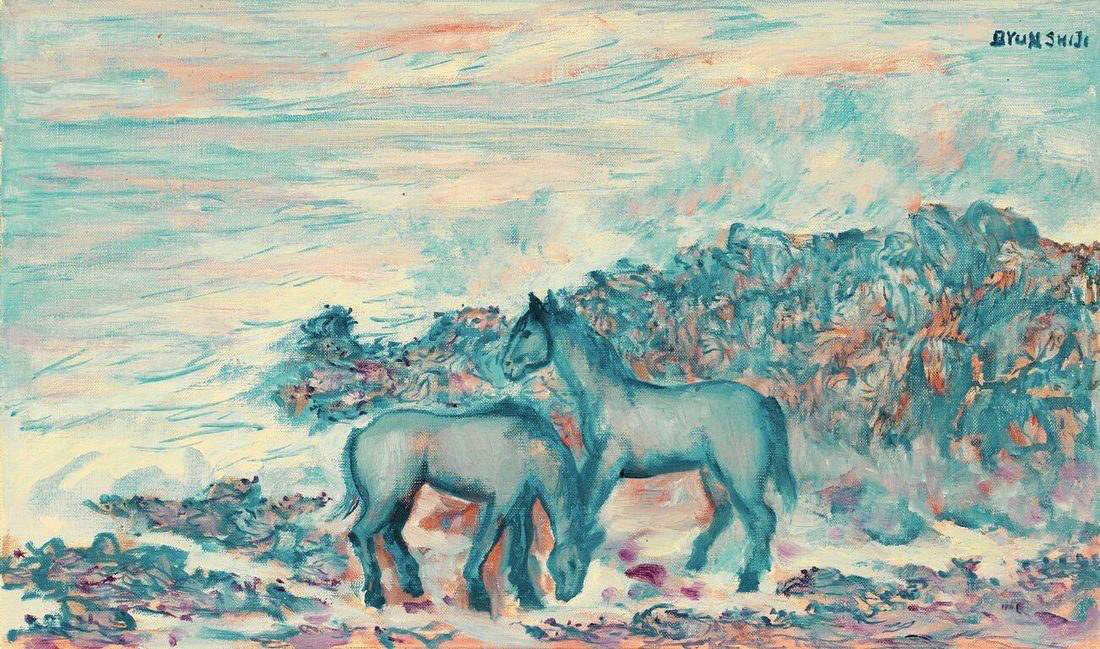
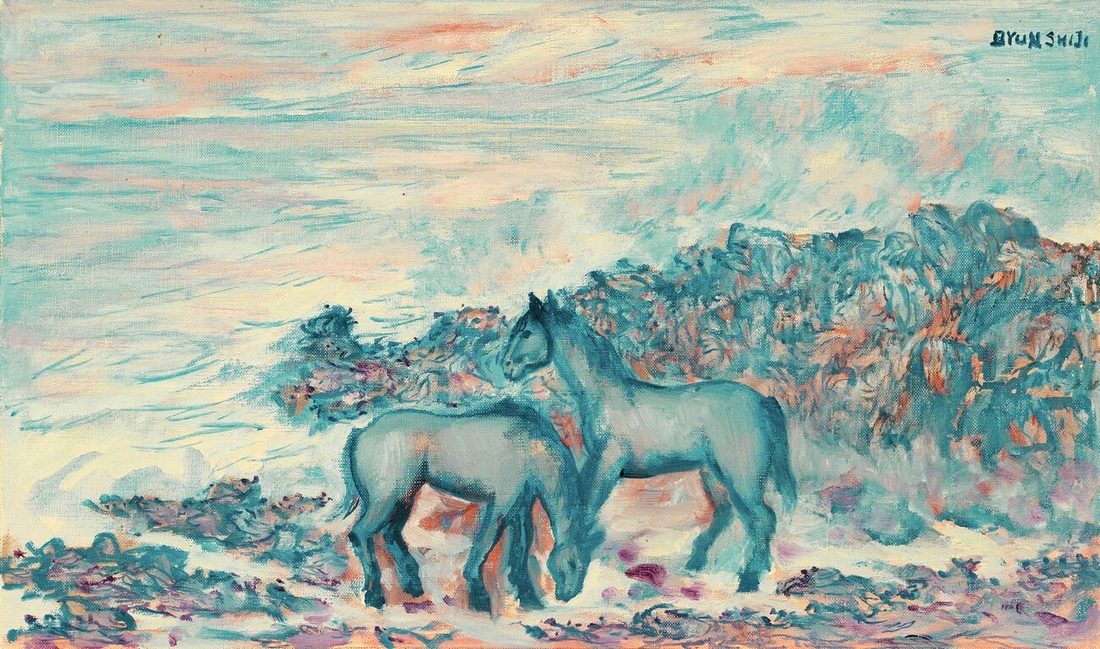
There are two animals in Jeju Ponies (1975). The nearer one lowers its head; the one behind holds its neck upright and attends at another height. Bluish tones connect the bodies and their surroundings, but their postures differ. Being together is not depicted as repetition of the same action. Different bodies can share a place.
Assigning humility immediately to the lowered head and freedom to the upright neck would turn the postures into a moral chart. Here they first make different lines and surfaces. That formal difference comes before judgement. What the animals feel is a question opened afterwards, not an answer automatically generated by posture.
Setting these two ponies beside the single horse of 1997 shows that the theme of the animal’s eyes does not end in one iconographic formula. Not only the rendering of the eye but the number, scale and spacing of bodies, and the surrounding forms, change. Even when the animal recurs, the world available to its attention is composed anew.
The Place from Which We Ask About a Fish’s Joy
In “Autumn Floods” in the Zhuangzi, Zhou and Huizi exchange questions about the enjoyment of fish. Huizi asks how someone who is not a fish can know it; Zhou asks how the other can know his knowledge. At issue are not only another creature’s feelings but also the positions from which people judge one another’s knowing.
Setting this exchange before the horse’s eyes makes both immediate conclusions difficult: that we can know nothing, or that we can fully empathise. We infer a state from bodily orientation and surroundings. The inference begins with observation, yet may go beyond it. What matters is knowing the distance between the two.
The language of looking can become correspondingly careful. Instead of saying the horse envies the birds, we begin by describing its head as directed towards the area they occupy. We may then add that we feel longing in that distance. Bodily orientation remains in the painting; longing as an interpretation remains the viewer’s responsibility.
A Visible Line Is Not Necessarily a Rein
A horse depicted without movement cannot on that account be called tethered. Not showing motion differs from showing a rope that prevents it. Even the long lines near the horse in Wild Dance require attention to their endings and connections. Turning a ground line or another object’s contour into a rein without checking can invent a story of confinement.
Conversely, the absence of a visible rein does not establish a horse free of every relation of ownership. A painting is not a document recording all conditions of keeping an animal. Depicted restraint, actual husbandry and a felt interpretation of freedom belong to different levels. Distinguishing them lightens the burden of story placed on the horse.
We can begin with the immediate relationships the painting permits. The horse is outside; the person occupies the house’s open part. Their heads do not face the same way. This interval is neither ownership nor absolute equality in itself. It is, however, enough distance to let us see the two bodies as distinct centres.
A Simple Eye, a Face That Remains
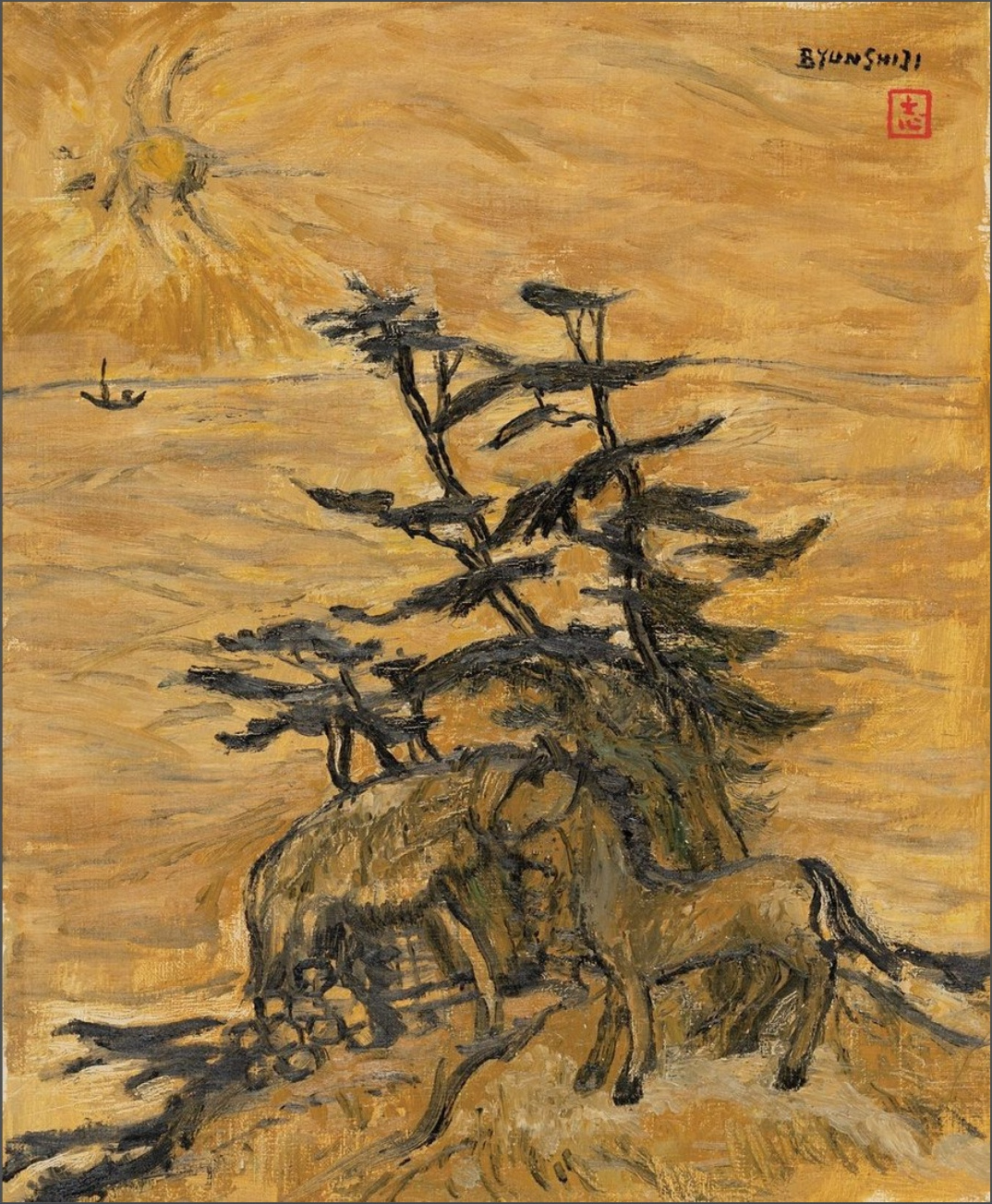
In a reproduction, the eye of a small painted horse may appear as a dot or short mark. Some details are difficult to distinguish at the resolution of print. What is not visible cannot immediately be described as deliberately erased by the painter. Simplification, small scale and the limits of reproduction need to be distinguished in turn.
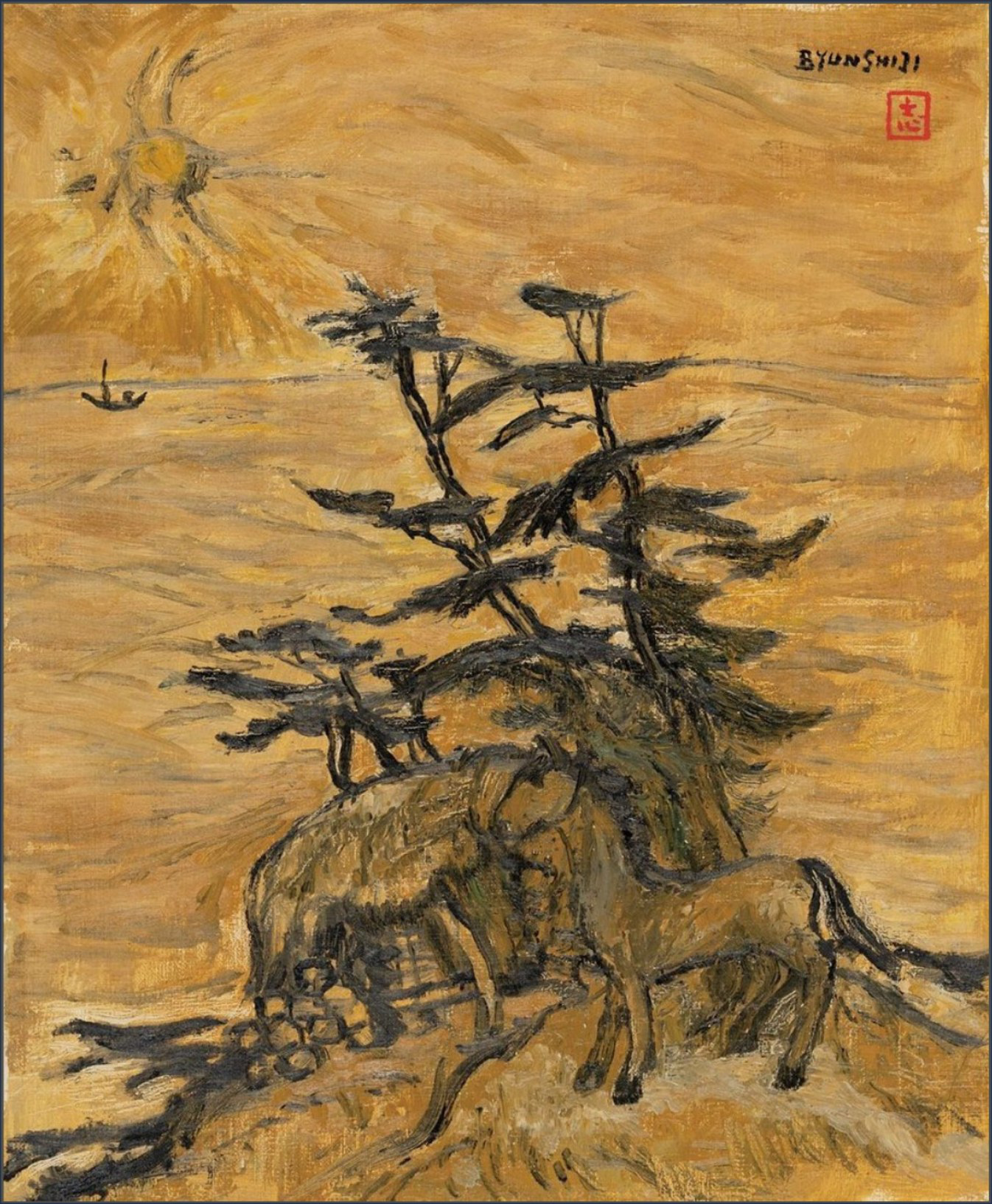
In Tropical Sun (1983), the directions of the horse’s head, neck and legs are read beside the larger masses of house and trees. Isolating and enlarging the small trace of an eye cannot substitute for that relationship. A face does not arise from the eye’s dot alone, but through the body supporting the head and the intervals around it.
Nor does reduced detail make emotional interpretation limitless. The head’s direction and the body’s balance still support some readings and resist others. Open space is not permission to insert any story. It is room in which to linger over limited clues. Here the eye is small, but the question of gaze is not.
Beyond a Double, Towards a Companion
Recalling the painter through the horse can be emotionally rich. But when the name of the artist’s double covers the animal’s difference, companionship becomes a monologue. Two beings are not together merely because they resemble each other. We also need to notice their possibility of remaining alongside one another without resemblance.
Sharing the same wind is therefore not a simple identification. Person and horse may be thought to encounter it through different bodies. Just as we can stay beside someone without removing their sorrow, a relationship remains possible without knowing another being’s sensation completely. Looking further into what might be needed can be closer to companionship than a claim to know it all.
This is not testimony about how the painted person actually cared for the horse. It is an ethical question the picture can open for the viewer. Do I finish looking at another body once I have found my consolation? Or do I consider that it must live beyond my story? A changed gaze can leave that question with us.
Leaving One More Position from Which to See
What remains after looking at the pony’s eyes is not a complete translation of its mind. It is a sense that the picture need not be organised solely around human vision. Another interval opens in the direction of its head. Following it may briefly move what I considered central towards the periphery.
The change is modest. Instead of declaring every being equal, we notice their different directions a little more closely. The same place need not be the same landscape for everyone. Recognising a position of attention left to the horse also makes the human position more precise. I become not the one who sees everything, but one who looks from alongside.
The horse’s head faces upwards. The person sits within the house. Broad sky still remains between the birds.