Research/A Hundred Years of Wind/Ⅱ Figure & Being
Ⅱ Figure & Being · 29 / 100
The Silent Figure
Reading a Painting That Makes No Sound
침묵하는 인물
Before a Painting Titled Dialogue
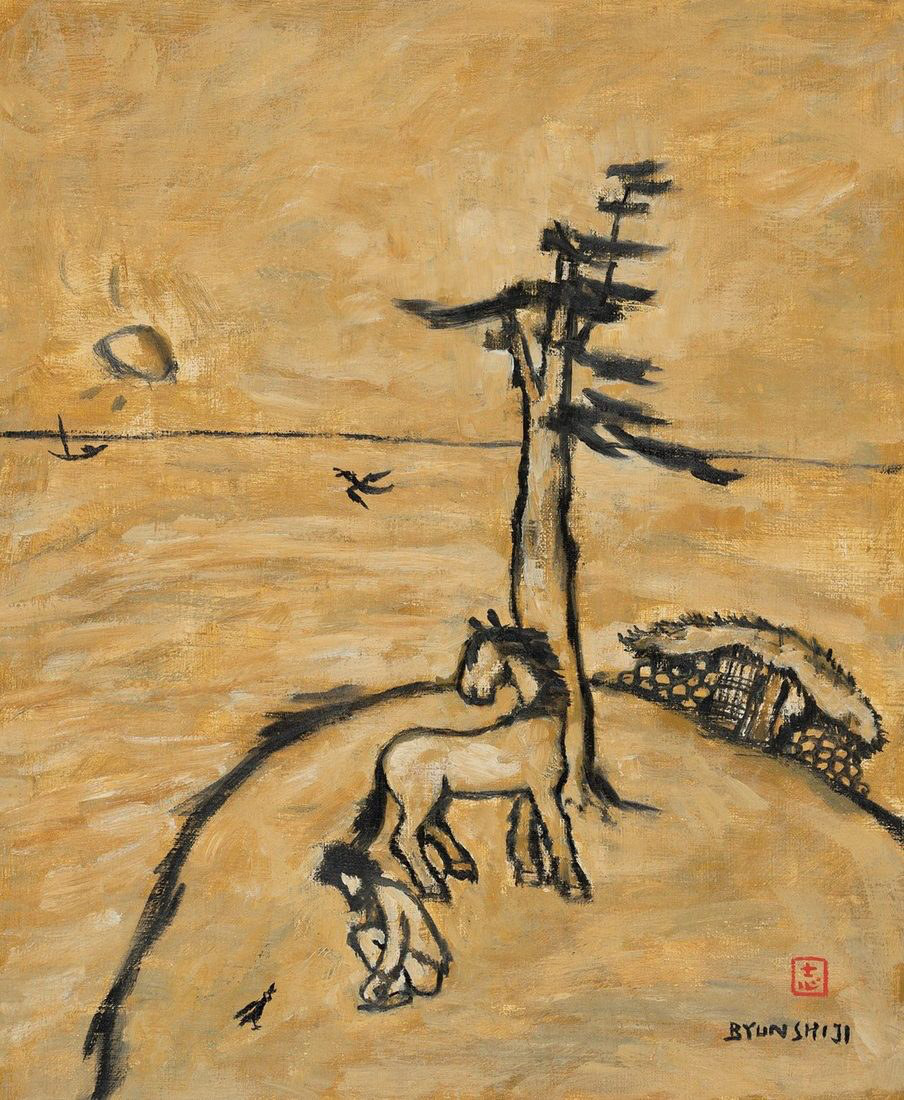
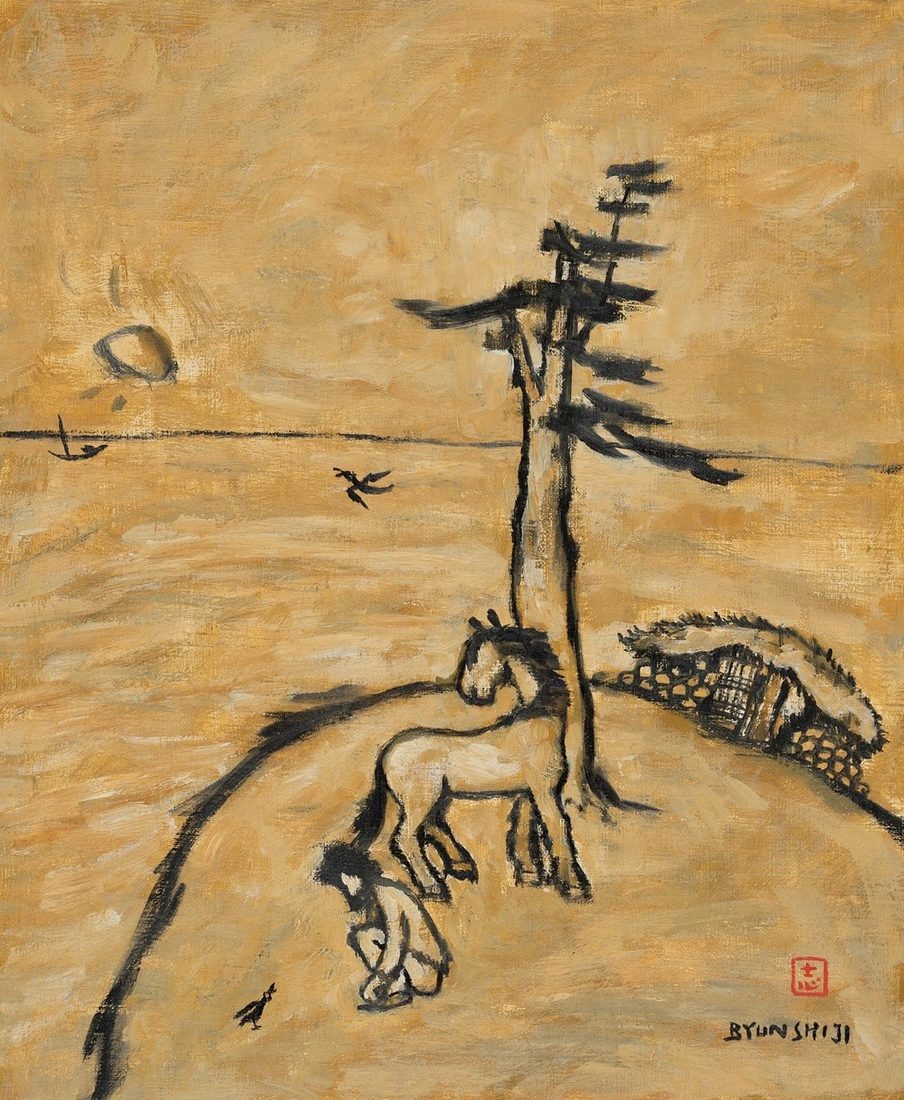
Dialogue (1986) contains a person seated low, a horse, a tree and a house. A small bird-like form appears on the ground near the person. No specific utterance is depicted as coming from anyone’s mouth. Yet the title is Dialogue. Before setting silence against communication, the painting invites us to consider how a relationship arises in a picture without speech.
A painting produces no physical sound. This alone does not establish that the depicted person is not speaking: mouths, gestures and bodily directions can depict speech. Our sense of silence arises not merely from a quiet medium, but from a composition that holds attention without specifying an utterance.
In Dialogue, the eye does not remain fixed on a single face. It moves from the low body towards the horse, tree and small house. Even restricting the participants to two would be difficult. Rather than supply an answer, the title opens a direction in which to seek a relationship. Proximity precedes a story of who said what.
When a Face Has Few Details
A small face can make expression difficult to read. But little detail is not the same as no face. The head’s direction, the connection between neck and shoulder, and the body’s height remain. An eye unable to read the face clearly moves towards its surroundings. This shift of attention also contributes to a sense of silence.
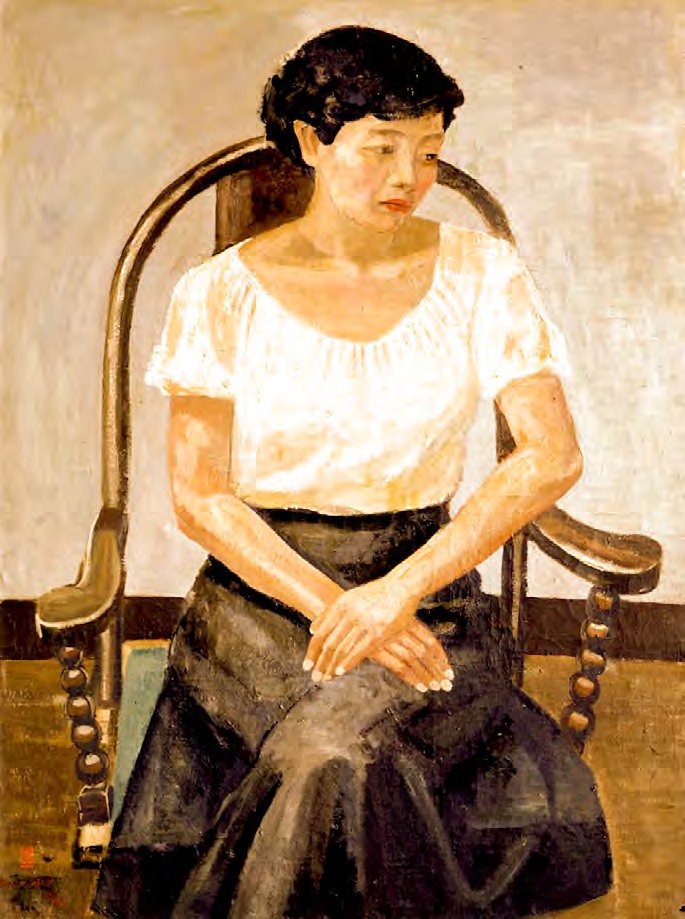
In Portrait of Nemo (1951), eyes and mouth are distinct, as are the white clothing and two hands. Yet we cannot know everything the person is thinking. Detailed depiction does not fully disclose an interior, just as a smaller face does not abolish an individual life. Amount of detail and depth of understanding are not the same measure.
Even if we call a silent figure an image of the human condition, we need not strip that figure of individuality. An unnamed person may have a time of their own; the picture simply does not disclose all of it. Silence can suggest a life not wholly given to the viewer, rather than an empty personality.
Between Saying and Showing
In propositions 4.12–4.1212 of the Tractatus, Wittgenstein distinguishes a proposition’s representing logical form from its displaying that form. The final proposition, 7, calls for silence at the limits of what can be said. Showing here must not be read directly as the superiority of visual art. An argument about logic and language is not a formula guaranteeing a painting’s emotional force.
The distinction can nevertheless make us reconsider the habits of commentary. When a picture shows an inclined body, an explanation may fix its cause in a word: fatigue, despair, waiting. Such words can provide a starting point, but cannot substitute for the length of a curve or the body’s location. We need to distinguish words that approach a painting from words that cover it.
This is not a demand to say nothing. Describing the direction of a curve or the interval between things precisely can help a viewer look longer. The problem is not language itself, but its assumption that it supplies the last answer. Good commentary does not conclude the work of looking; it leaves something to return to.
Not Speaking in the Figure’s Place
When a figure does not speak, a viewer may want to add a line: I am lonely; I will not leave. Literary imagination may do this. But presenting the sentence as the painter’s actual words or the figure’s established intention does something else. Imagination must appear under its own name.
Not speaking in the figure’s place need not be coldness. It can be a way of staying close without announcing complete understanding: feeling sorrow before a lowered head without declaring that sorrow is all it contains. A relationship may deepen through the quality of attention rather than the amount of certainty.
Looking at Byun’s figures for a long time requires such restraint. A small body is not an empty container for our emotions. It already occupies a particular distance within a painting. Add beautiful phrases without attending to that distance, and the quiet person can disappear beneath the commentator’s voice.
Intervals That Invite Imagined Sound
The branches in Dialogue do not form an undivided mass. Light ground appears between dark strokes, while the horizon extends behind the tree. The eye moves between dense and sparse areas. Following that rhythm, one may imagine wind or distant water. This is sensation prompted by vision, not a recording of actual sound.
In John Cage’s 4′33″, the performer produces no intentional instrumental sound through three prescribed movements, allowing sounds present in the setting to be heard. In comparing it with Byun, what matters is silence’s redirection of attention. Actual environmental sound in a performance and sound imagined before a painting are nevertheless different.
In painting, the quieter a person appears, the more strongly surrounding marks may reach us. Yet making wind only the spokesperson for the figure’s feelings simplifies nature. It may console, burden or be felt without a decision between the two. An untranslated interval remains between person and world.
Silence Is Not Absence
The person in Dialogue sits low without disappearing. The horse’s body and the curved edge of the ground occupy the surrounding space. A human presence changes how the world is read. Because of one small body, the ground becomes a place a body can inhabit, and distance becomes what is near or far for someone.
This does not mean that paintings without figures contain no life. Matter, light and arrangements of things can also address human sensation and relationships. Explaining the force of Byun’s figure does not require calling another painting’s silence nihilism. We can compare different ways of organising perception without dismissing one of them.
The small person here does not represent the meaning of the entire world alone. The figure adds another scale among tree, horse, house and sea. Without explaining all its surroundings, that scale makes their extent perceptible. The relationship does not disappear for lack of words.
What Words Beside a Painting Can Do
Respecting silence does not require removing titles, chronologies or oral histories. These are other routes towards a work. But a thought suggested by a title, a form visible in an image and a fact conveyed by a record should not be treated as identical. Different materials may point to one painting while having different limits of testimony.
The title Dialogue is not a transcript proving that speech occurred. Nor is it a label to ignore. If knowing the title changes our sense of the interval between person and horse, language has already entered the experience. A careful reading acknowledges that participation and considers where the work’s invitation meets our response.
An iconography of silence thus concerns responsibility in speech rather than its prohibition. Instead of assigning words to the figure, the viewer must speak more precisely: what was seen, and what was imagined? Maintaining that distinction allows writing to remain beside the picture rather than occupy its silence.
Where the Conversation Remains Open
Stay with a picture in which nobody initially seemed to speak, and the judgement can shift. The eye moves from a person to another presence and returns. We may call that movement a dialogue: not an exchange of specified sentences, but a relationship that makes each position perceptible.
Nor need we exaggerate the figure into a being greater than language. Words have their work, and paintings have work the eye must follow. Without making them compete, silence becomes a more precise name: not a mystery concealing every meaning, but the condition of a picture not yet wholly converted into our sentences.
A small bird is near the person. Behind them stands the horse. The eye passes once more over the ground between.