Research/A Hundred Years of Wind/Ⅱ Figure & Being
Ⅱ Figure & Being · 28 / 100
The Father’s Back
The Form of Memory and the Distance of Inheritance
아버지의 등
First, Look at What the Back Carries
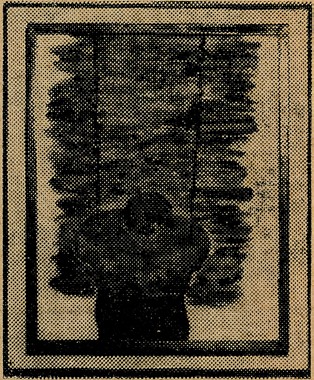
In the preserved reproduction of The Porter (1958), a load stacked high first catches the eye. The person’s head is small beneath that mass. The reproduction makes facial and clothing details difficult to distinguish, but the difference in scale between load and person remains. Here the back is felt not simply through the outline of exposed flesh, but through what it carries.
Calling this person a father does not identify the model. It brings memory to the relation between load and body: someone walking ahead, a life lived nearby but never fully known. Father in this chapter names such a position of viewing. It does not establish the sitter’s identity or family relationship.
A back often returns to memory later than a face. In someone’s presence we hear speech and watch expression; as the person moves away, the height of the shoulders and the interval of steps remain. A painting may meet that memory. Yet its figure did not originally exist for our recollection. Preserving the distance can make affection more specific.
Not Every Silence Is Sacrifice
The image of a father’s back readily invites an account of silent sacrifice. But fathers have not all lived alike, and silence has not always been care. Sustaining a feeling before a painting need not turn family into an emblem of one virtue. Warmth and distance, care and what remains unknown can coexist in a single life.
The load in The Porter must not become decoration for an affecting story. Seeing beauty in a burdened body differs from approving the conditions that keep it burdened. A figure of labour may possess dignity without hardship itself deserving praise. The picture’s weight can also question a gaze that has entrusted too much to one person.
Another viewer may think of a mother or a different caregiver. That memory does not misread the title. What matters is not making father the sole bearer of responsibility. A gaze beginning with one back can widen towards other bodies whose presence helped that person live.
Form Invites Memory but Does Not Prove It
Even in a picture showing someone from behind, departure or return is not automatically established. We need to consider where the still body might stand within a movement and what lies ahead. To declare an eternal parting simply because a back is visible removes other possibilities: a pause, perhaps, or attention shared towards the same place.
Nor should The Porter’s reproduction be called an exact record of a father seen from behind. What is clear is a body beneath a load, not a model’s kinship. From a reproduction that makes precise orientation difficult to establish, it would also be excessive to claim that the face has been wholly erased.
Memory does not weaken when it stops substituting for fact. Fact keeps hold of the person’s presence; memory explains why I remain before it. Distinguishing the two changes our sentences. Instead of saying that the painter depicted a father, we can say that this body brings a father to mind.
Not Leaving What Is Learnt Unchanged
What passes between generations is not only a resemblance of faces. Habits of looking, knowing when to stop a hand and ways of spending time at work may also pass on. But a particular family anecdote requires a record. Rather than beautifully fill an unknown childhood scene, we can examine relationships of learning through surviving works and documents.
The public archive reproduces part of Terauchi Manjirō’s recommendation for Byun’s first solo exhibition in 1949. It provides a concrete starting point for considering teacher and pupil. The existence of a recommendation, however, does not disclose every feeling between them. The place of teaching should be considered within the document’s limits.
Inheritance can differ from repeating the same picture. An order of light may be tested elsewhere; proportions learnt close to a figure may be adjusted again in an open landscape. A different result does not mean that learning has disappeared. Asking what was inherited must accompany attention to what changed.
A Back Above, a Body Below
In Friedrich’s Wanderer Above the Sea of Fog, the viewer is positioned behind a figure on a high rock. Rather than the face, we encounter the expanse towards which the person looks. A rear view is not merely a barrier: it can conceal a face while sharing a direction of attention. The elevated position need not be read immediately as the conquest of nature.
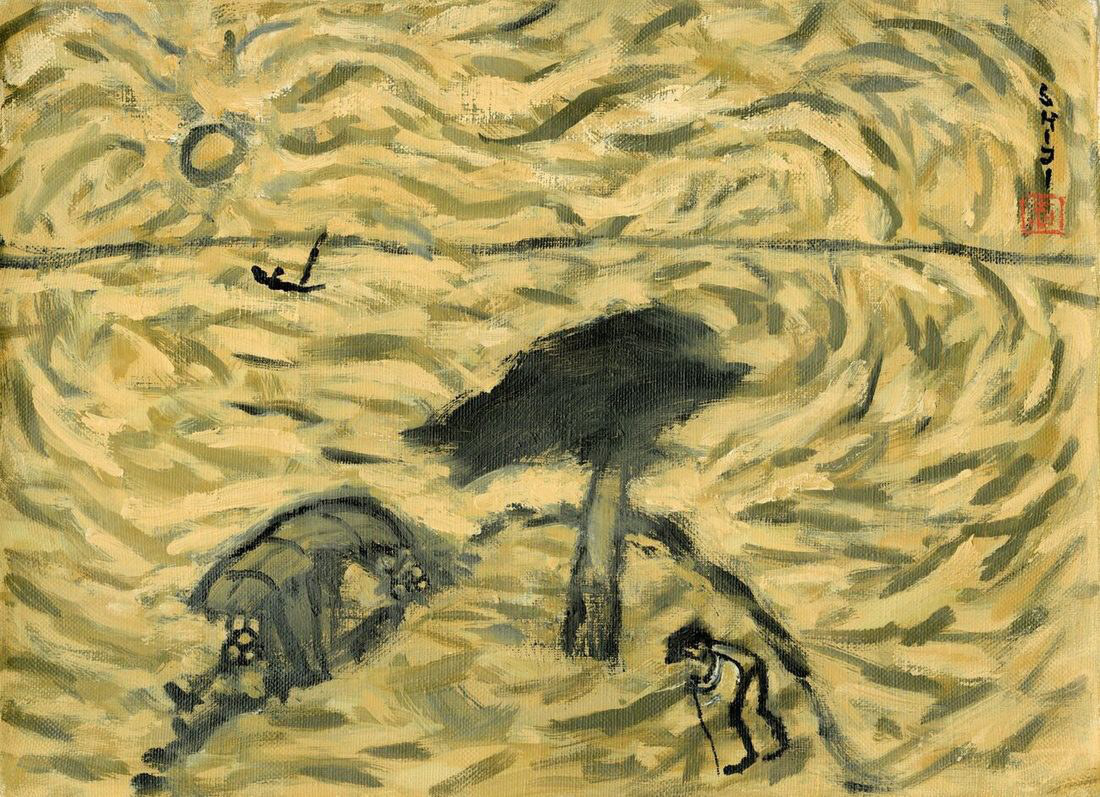
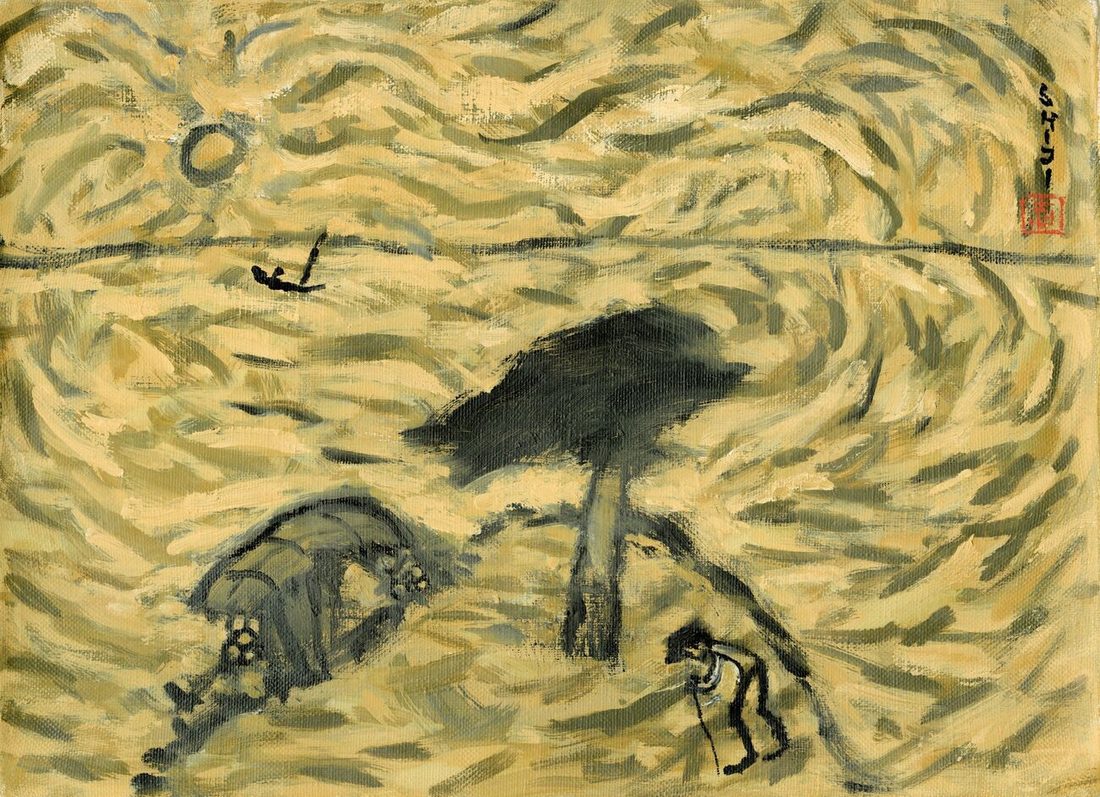
The figure in Noon occupies a different position. The body bends below the tree, while house, sun and boat stand apart. Instead of sharing a prospect from behind someone, we search for a small body within an extensive field. The difference is not between a courageous Westerner and an acquiescent Easterner. It concerns the arrangement of attention.
Memory of a father can move between these distances. At one moment it retains a large back going ahead; at another, a body unexpectedly small in a wide world. In the second moment, the sheltered child’s gaze changes a little. The person who protected me may also have been small before certain things.
An Inheritance That Leaves Room for the Unknown
The closer a person is, the easier it is to think we know the whole life. Yet time shared and time borne alone are not identical. A back turned away can recall that interval. Our ignorance does not arise only from failing to see a face. Even a face seen daily can belong to a life partly unknown.
Inheritance need not fill every gap with a descendant’s words. Passing on memory while distinguishing what was heard from what one has added is also an act of transmission. Leaving the unknown acknowledged is not indifference. It preserves the fact that another life exceeds our explanation.
The painting requests a similar distance. We may sense difficulty in a bent back without knowing everything that bent it. Feeling does not stop at that uncertainty. Instead of ending with one explanation, we can continue looking. Understanding becomes not possession, but staying without abolishing distance.
Hands That Receive the Work
Receiving what a painter leaves does not mean only drawing a similar line. It also requires checking titles and dates, keeping different works distinct and identifying a reproduction’s limitations. Preserving a painting’s place accurately is a beginning of handing it to someone else.
Returning to the small reproduction of The Porter touches this practical work of inheritance. Halftone dots are not original brushstrokes, and printed colour does not guarantee the painting’s colour. Yet the plate is not without testimony. The relationship of load and body, and the person’s scale within the frame, can pass to another gaze.
Inheritance both preserves memory and leaves open the possibility of looking again. Seal one interpretation as the only meaning, and the work is closed rather than carried forward. Keep the record precise, and leave interpretations open with their reasons. Before art, preserving what came from a father can become work this specific.
What the Person Behind Can See
A father’s back need not belong to someone who reached every answer before us. It may be the back of a person pausing to find a way. Accepting that possibility before a painting releases respect from a demand for perfection. We can approach someone who also lived without knowing.
Nor must the person remembering that body walk in exactly the same direction. A different life can still remember what it received. Later viewers of art are in a similar position: they can look again through present questions without presuming to speak for the earlier person. Transmission needs freedom to adjust distance as much as it needs continuity.
The plate is opened again. The load rises higher than the person. Beneath it, a small head and shoulders remain.