Research/Fūdo Is Not Landscape/Argument VII/Chapter 14
Academic edition · Fūdo Is Not Landscape · Chapter 14 · 23 / 34
The Labouring Body
The Taskscape of the Haenyeo, the Farmer and the Horse Handler
Argument VII · Labour and Animals Reveal the Relations and Choices of the Body
1A Chosen Body
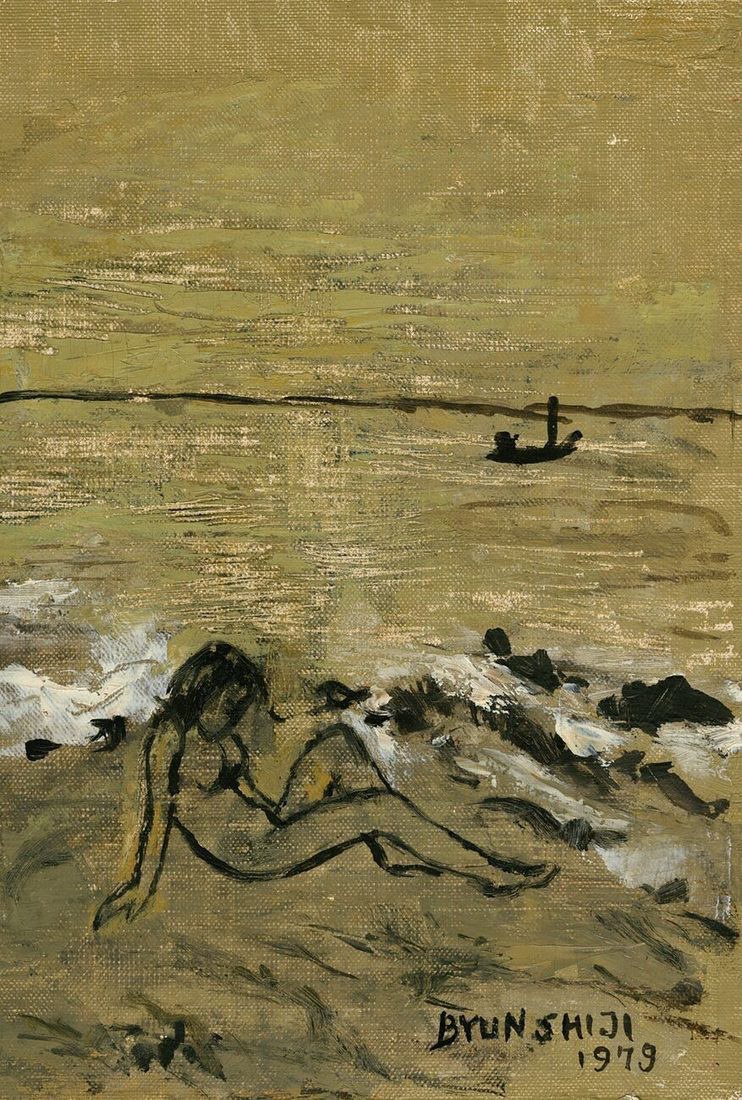
The body in Haenyeo (1979) sits by the water with knees drawn up, lean and long. Far out at sea floats a single boat. On his canvases the haenyeo is drawn like this, as a working body. In The Sea Is the Haenyeo’s Tears (1989), two people cling crouched on a black rock in the middle of the sea.1 In his lifetime the painter said: “I don’t paint fat haenyeo.”2 He did not paint the haenyeo’s body carelessly. He chose which body to paint.
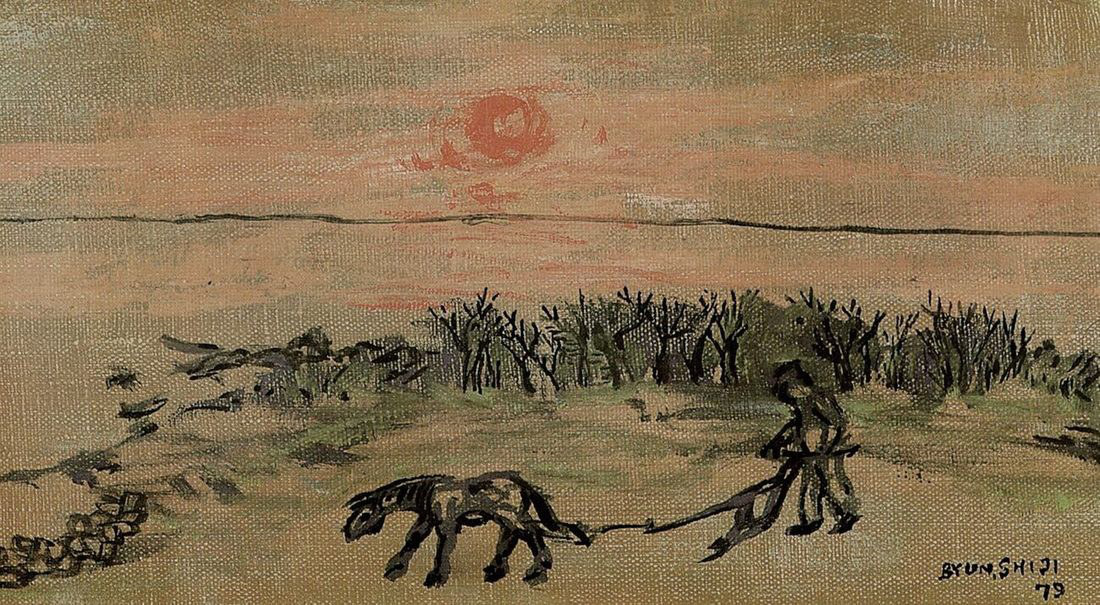
On the canvases of the Jeju years there are, besides haenyeo, horse handlers and farmers. The low house seen in chapter 13 was built by people taking account of fūdo. People come out of that house and work within fūdo. This chapter asks what posture work leaves on the body.
2Sea, Field, Horse: The Taskscape of Labour
The haenyeo’s diving, ploughing and handling horses are different kinds of labour, but all fit the body to the rhythm of a particular place. The time of holding one’s breath, the cycle of the waves, the season of the field and the gait of the horse organize the posture of labour.3
Tim Ingold, mentioned in the introduction, understood landscape not as a static background but as a “taskscape,” in which the activities of dwelling beings are entangled in time.4 Borrowing this concept, Byun Shi-Ji’s haenyeo, farmers and horse handlers read not as figures placed in a landscape but as bodies that perform the temporality of a place together with sea, field and horse.
This comparison does not mean Ingold influenced Byun Shi-Ji. It is an analytical juxtaposition to explain a pictorial structure in which the labouring body and place are not separated.
3When the Place Changes, the Iconography of Labour Changes
Set side by side, the porter and the woodcutter of the Seoul years and the haenyeo, horse handlers and farmers of the Jeju years show the iconography of labour moving with place. But the more important continuity lies in the body’s centre of gravity and posture. The back bearing a load, the body gripping a plough, the body crouched after diving do not so much “explain” labour as show the form labour left on the body.
A change of place, then, is not a simple swap of subject matter. The rhythm of labour changes, and that rhythm changes the types of body on the canvas.
4A Thick Surface, a Wide Ground
In Korean contemporary art, too, labouring figures have been treated repeatedly. The way Park Soo-keun’s figures become one body with a rough material surface contrasts with Byun Shi-Ji’s placing of small figures within a wide ground.5
5What Work Left on the Body
Repeated work leaves posture on the body—postures left differently by sea, field and horse.
The person gripping the plough leans forward, and the haenyeo by the water gathers her body toward her raised knees. The way a body leans tells that person’s work. This chapter has seen that the rhythm of labour leaves different postures on bodies in each place, and that those postures form the types of body on the canvas. Yet his pictures also hold a body that did not come from the work of Jeju: the tiger with its ribs showing. Chapter 15 looks at the bodies of animals. It first asks what, if not work, made that tiger lean, and then moves on to the horse that has worked alongside people.
The haenyeo comes back from the sea. The work of the sea comes back carried in the body.
Notes and sources
- ↑ Haenyeo (1979) is FŪDO 040 in the byunshiji.org 100 Works, The Sea Is the Haenyeo’s Tears (1989) is FŪDO 011, and Plowing (1979) is FŪDO 042. The canvases are checked against these plates.
- ↑ Words the painter spoke in his lifetime, heard directly by the author (his son) (author’s confirmation, 29 September 2026). No written source has been found. They were quoted once indirectly in chapter 12, section 5.
- ↑ Skilled haenyeo dive to around ten metres and hold their breath for about a minute at a time. The Culture of Jeju Haenyeo was inscribed on UNESCO’s Representative List of the Intangible Cultural Heritage of Humanity in 2016. Diving may reach up to seven hours a day and around ninety days a year. (Korea Heritage Service, “Culture of Jeju Haenyeo”; Korean National Commission for UNESCO, “Culture of Jeju Haenyeo.”)
- ↑ Tim Ingold, “The Temporality of the Landscape,” World Archaeology 25, no. 2 (1993): 152–174. The concept of the taskscape was proposed in this essay.
- ↑ Park Soo-keun (1914–1965). Woman Pounding Grain (1954) is in the Lee Kun-hee Collection of the National Museum of Modern and Contemporary Art, Korea. Calling his rough, repeatedly overpainted surfaces “like granite” is a widely used description of his paintings. “Park Soo-keun,” Encyclopedia of Korean Culture (Academy of Korean Studies).
Contents · Fūdo Is Not Landscape Key Terms and Analytical Categories → Bibliography →