Research/Fūdo Is Not Landscape/Argument VII/Chapter 15
Academic edition · Fūdo Is Not Landscape · Chapter 15 · 24 / 34
The Animal Body
The Lean Body and the Still Body
Argument VII · Labour and Animals Reveal the Relations and Choices of the Body
On Byun Shi-Ji’s canvases there are often animals beside people. The tiger of 1985 was an animal painted at a university’s request, and the horse was constantly in his pictures for more than twenty years. This chapter places in one chapter an animal the island never had and an animal that has lived with people. And it asks what posture the bodies of animals gain within his form.
Case AThe Lean Tiger — A Form That Passes Through a Given Subject
1The Lean Tiger
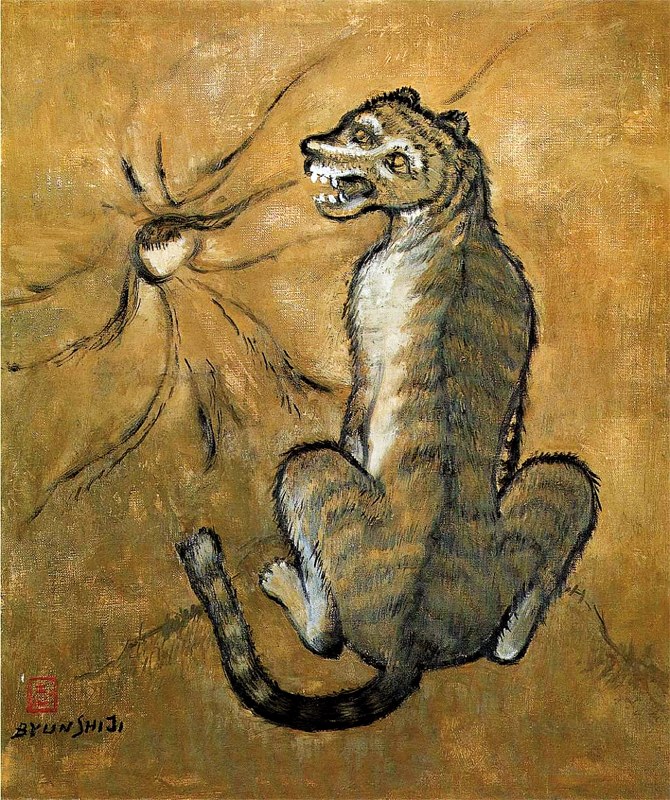
In Tiger (1985) there is one tiger. Its body is so lean its ribs show. Its mouth seems to smile.
The tiger has long been painted as an animal of power. But this tiger has no heavy body. Where did this lean body come from?
2An Animal the Island Never Had, a University’s Symbol
Jeju is known as an island without tigers. There are old tales that tell why Jeju has no tigers, and it survives in names, like Beomseom (Tiger Island) off Seogwipo. The tiger is on this island only in tales and names.1
Korea University asked Byun Shi-Ji to paint a tiger.2 The symbol of Korea University is the tiger. The university invests this animal with courage and resolve, agility and dignity. The tiger symbolizing the university is shown roaring loudly.3
The tiger as subject did not come from the fūdo of Jeju. It came from the university’s request.
The haenyeo’s body seen in chapter 14 came carrying the work of the sea. What this tiger’s body carries is not the work of the sea. Nor was the symbolic tiger lean. Yet this tiger is lean. Why did even an animal the island never had gain the lean body he paints?
The subject was given. The body was the painter’s.
3Flesh, Bone, and Mouth
Where the flesh has gone, the ribs show. On Byun Shi-Ji’s canvases bodies mostly stand by black lines. If the ribs are drawn in line, then in this picture the line has gone beyond the outline down to the body’s skeleton.
The symbolic tiger roars. This tiger’s mouth seems to smile. A lean body and a mouth that seems to smile are in one body.
The flesh grew less. The tiger did not.
4Painted Tigers
Korean painting has many pictures of tigers. Fierce Tiger Under a Pine, attributed to the late Joseon painter Kim Hong-do (1745–?), depicts a fierce tiger beneath a pine. That tiger is painted in detail down to each hair, showing power and dignity. The magpie-and-tiger of late Joseon folk painting (minhwa), which paints a magpie and a tiger together, has a different texture. That tiger is often painted as comical rather than fearsome.
The seemingly smiling mouth of Byun Shi-Ji’s tiger recalls the tiger of folk painting. But a body with ribs showing is not a body commonly seen in folk painting.
The tiger of dignity, the tiger of humour, the lean tiger. One animal gained these many bodies.
5What the Lean Body Leaves
The earlier bodies each gained posture within fūdo. The tiger adds one thing more. The animal of dignity the university requested, he painted with a lean body. Then the lean body did not come from the painted animal being lean. It came from his way of painting bodies. That way had ripened in Jeju. Even an animal the island never had gained the same body as it passed through his hand. The form did not discriminate among subjects.
This case does not read the lean body only as poverty or the suffering of an era. The seemingly smiling mouth stands in the way of that reading. Nor does the smile make the pain invisible. The discomfort of seeing a lean body is not erased.
In this tiger the line went down to the ribs. This case has confirmed that the lean body comes not from the subject but from a form that ripened in Jeju. This tiger’s strength is not in its bulk.
The tiger’s lean body was a body a given subject gained in passing through his hand. The Jeju horse is a different matter. It is an animal that has worked and lived with people on this island. Case B asks why this body, which can run, does not run on the canvas.
Case BThe Horse That Does Not Run — The Posture of Stillness and Companionship
1The Horse That Does Not Run
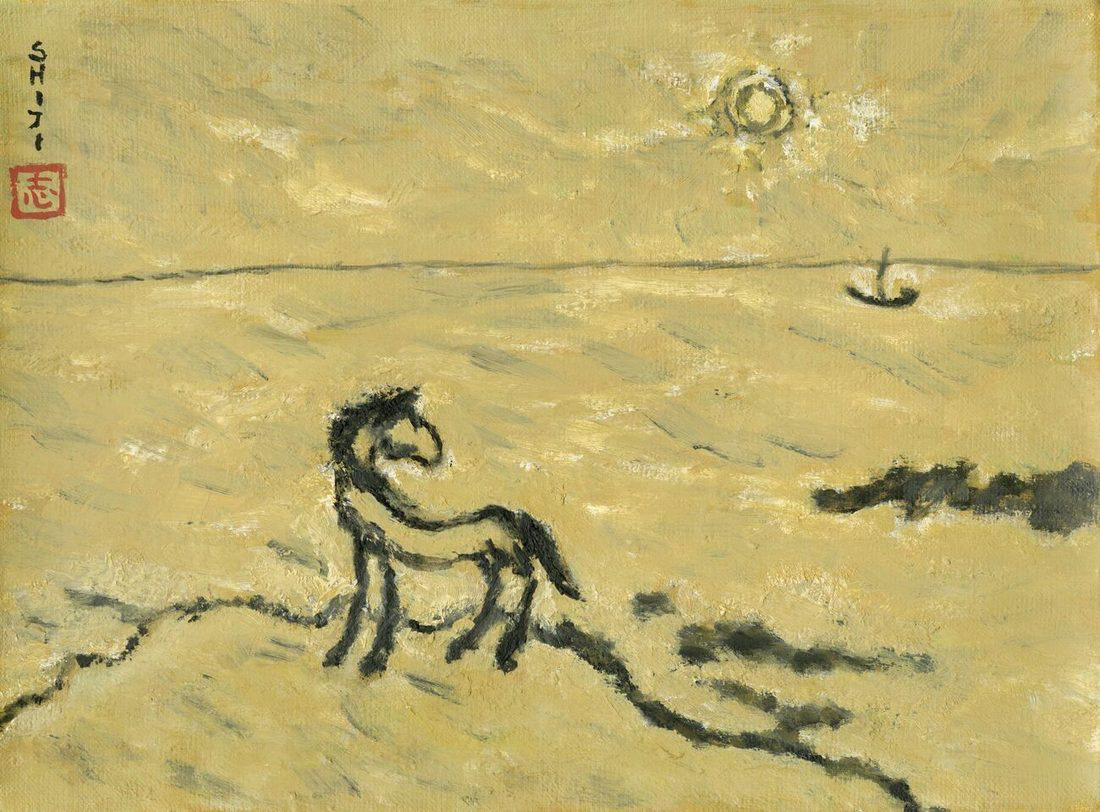
A horse stands. In Tropical Sun (1983) it is beside a black pine; in A Wavering Horizon (2005), beside an old man on a cliff. In The Gaze (2001) a horse stands alone on a hill by the water and seems to turn its head toward the sea. On the horizon is one boat. More than twenty years lie between these pictures. Throughout that time the horse was always in his pictures.
The horse is a running animal. Horses in pictures have often been painted running too. But his horses do not run. The horse in Tropical Sun, the horse in A Wavering Horizon, the horse in The Gaze all stand with four feet on the ground.4 There are the painter’s own words too: “I don’t paint running horses.”5 When a body that can run does not run, what does that body become on the canvas?
2The Horse That Has Lived with People
The Jeju horse is small. After 160 Mongolian horses came to the island in 1276, horses were long raised here and adapted well to rough feed and harsh weather. People ploughed fields, carried loads and travelled with these horses. The Jeju horse was designated a Natural Monument in 1986.6
The horse was there in the painter’s childhood too. Byun Shi-Ji wrote of a childhood event in Art and Fūdo: on the way back from his maternal grandfather’s house with his father, he rode a pony without a saddle and the skin of his backside was rubbed raw. Along with thatched houses bound with thick ropes, stone walls about to crumble and crows on the walls, he wrote, the pony seems to have become one of his favourite subjects.7
The painter also explained why his heart was with horses. According to Neves, he said he was attached to horses because they are a great help to people. Horses help with ploughing, carry people and become faithful companions. Neves goes on to write that horses are very sensitive to changes around them and warn people of approaching storms.8
So this horse’s body differs both from the tiger of the previous case and from the working bodies of chapter 14. The Jeju horse is an animal and also a body that has worked and lived with people.
His horses do not always just stand. The horse in Plowing (1979) walks, pulling a plough. But it does not run. This case looks at the horses among them that stand in place, and calls that look “stillness.” Stillness is different from being unable to move. Only a body that can run can stop.
3What a Still Body Does
Painting a running horse creates speed on the canvas. The legs stretch fore and aft, the body extends long in one direction, and the eye is drawn the way the horse is heading. A horse that does not run makes no such direction. It stays in place.
A still horse forms a pair. In the first two pictures the horse is one, but not alone. In one picture a pine is beside it, in the other an old man. The horse is placed near, and with the distant boat divides the front and back of the picture. The horse in The Gaze is alone. Even so, where it turns its head to look, there is a distant boat.
As the boat is one, the horse too is placed as one. It is not a herd of running horses. Because it is one, the empty space around it looks large.
The wind too appears in the horse’s body. Neves named the places where wind is visible in Byun Shi-Ji’s Jeju pictures: bent branches and fragile houses, the flight of crows, and the tilted head and moving mane of the horse.8 A horse that does not run does not cut through the wind and advance. It receives the wind with head and mane. The horse in A Wavering Horizon (2005) lowers its head a little on the cliff, its mane blowing back. In In the Wind (1984), too, the horse’s mane streams to one side.
Horse and person are not always close. Sometimes the painter gave that distance another meaning. In the January 2005 oral history, showing a picture, Byun Shi-Ji said that some canvases also carry the meaning of North and South divided, unable to go to each other. When the interviewer pointed one by one to the places of horse and person in the picture, the painter continued: “unable to go.”9 This reads as saying he put such meaning in the place where horse and person are apart. Being close and being unable to go. The distance between horse and person also holds meaning.
4Pictures of Running Horses
Nineteenth-century painting and sequential photography treated as an important problem how to make the speed of a running horse visible.10 Byun Shi-Ji did not take up this problem.
His horses show stillness rather than speed. By stopping a body that can run, he stresses the place where the body stands and its relations with its surroundings, rather than the direction of motion.
5The Stillness of a Body That Can Run
The horse’s posture is stillness.
Stillness does not mean lack of strength. The horse is a body that can run. When that body does not run, a place opens beside a person. When a person stands in the wind, the horse meets the same wind. In Neves’s account the horse was the animal that senses a storm first. The picture set that animal in that place.
The still horse keeps its place. That is the work this body does.
The horses in the three pictures seen in this case stand still beside people with all four legs on the ground. This case has read that stillness not as a state of weakness but as the posture of a body that can run keeping its place.
The tiger, a given subject, gained a lean body in passing through his hand, and the horse stood still beside people. Set with the working bodies of chapter 14, bodies on his canvases do not stand alone; they take shape within relations of work, animals and people. This is the provisional conclusion of Argument VII. But this island has a force stronger than animals: the storm. Chapter 16 opens Argument VIII and looks at what the body endures before the storm.
What stood still was a body that could run.
Notes and sources
- ↑ Beomseom is an island off Seogwipo; the beom of its name means tiger. Source of the old tale that tells why Jeju has no tigers:
- ↑ Tiger (1985) was painted at the request of Korea University (author’s confirmation).
- ↑ Korea University website, “Symbol.”
- ↑ The Gaze (2001) is FŪDO 090 in the byunshiji.org 100 Works, Plowing (1979) FŪDO 042, In the Wind (1984) FŪDO 015, A Wavering Horizon (2005) FŪDO 007, and Tropical Sun (1983) FŪDO 008. The horses’ postures are checked against these plates.
- ↑ Words the painter spoke in his lifetime, heard directly by the author (his son) (author’s confirmation, 29 September 2026). No written source has been found. They were quoted once indirectly in chapter 12, section 5.
- ↑ Encyclopedia of Korean Culture, “The Jeju Horse” (by Kim Dae-cheol); Jeinuri, “The Secret of the Birth of the Small but Strong Jeju Horse.”
- ↑ Byun Shi-Ji, Art and Fūdo (Youlhwadang, 1988), “Nostalgia for the Primitive” and “The Folk Art of Jeju,” in the section “Living in Jeju.” The same event appears in the Byun Shi-Ji Oral History Transcript (Korean Modern and Contemporary Art History Oral History Project; interviewer and researcher Lee In-bum), first session (pp. 24–25).
- ↑ Carole Neves (director of policy analysis, Smithsonian Institution), “The Painter and the Sea: Byun Shi-Ji.”
- ↑ Byun Shi-Ji Oral History Transcript (Korean Modern and Contemporary Art History Oral History Project), fifth session (18 January 2005, Gidang Art Museum), pp. 219–220. The title of the picture shown during the conversation does not appear in the transcript.
- ↑ Théodore Géricault, The Derby at Epsom (1821), Musée du Louvre. Eadweard Muybridge’s sequential photographs were taken in 1878.
Contents · Fūdo Is Not Landscape Key Terms and Analytical Categories → Bibliography →