Research/Fūdo Is Not Landscape/Argument V/Chapter 10
Academic edition · Fūdo Is Not Landscape · Chapter 10 · 16 / 34
The Color of Dried Grass and the Black Line
Colour Binds, Line Divides
Argument V · Fūdo Takes Form in Colour, Line, Empty Space and Light
In many pictures of the Jeju years, sky, sea and land are set within one colour, and on it the black line sets up the shapes of things. Colour and line do not work apart; they work leaning on each other. This chapter places the color of dried grass (case A) and the black line (case B) in one chapter and asks how fūdo enters the canvas through these two forms.
Case AThe Color of Dried Grass — From the Colour of a Place to the Colour of Time
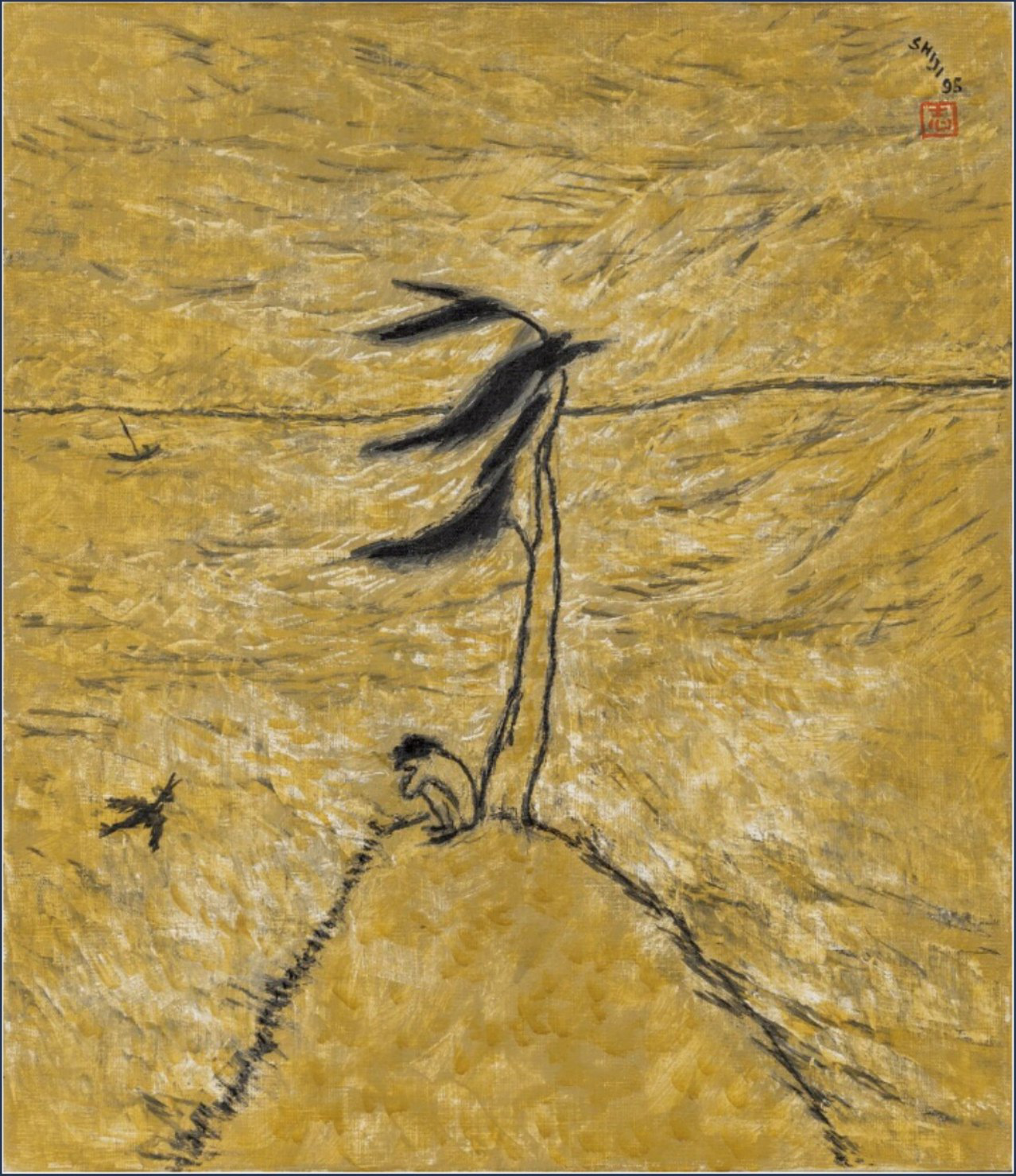
1A Yellowness Seen on the Shore
There is a story he told looking back. One day after coming down to Jeju, having given up the bright colours he had used until then and struggling, he was on the shore. He saw white things, in the sunlight, turn “beyond white, to yellow.” Under strong sun, he said, “every inherent colour changes.” If the sun was this strong on the island, the colours too would differ from other places. Then, speaking of Jeju in colour, would it not be “yellow”? Later he looked back on the beginning of his colour this way.1
In Solitude (1995) a tree stands on a hill, and beneath it a person sits. There is a boat far off and a bird near by. But sky, sea and hill are all one colour. Strokes like dry grass sweep across the whole canvas.2 So it is with many pictures of the Jeju years. Sky, land and sea are not divided into different colours. It differs a little from picture to picture, but one colour, changing only in lightness and darkness, wraps the whole canvas.
This colour is often called ochre, hwangto (yellow earth). This book calls it “the color of dried grass.” Along with the question of the name, this case asks what work this colour does on the canvas.
2What a Name Changes
Calling it ochre first brings to mind the colour of earth. The meaning of the colour leans toward land and place.
The name “the color of dried grass” points to grass standing in an autumn field. The grass was alive, received the sun, met the wind, and dried. The meaning of the colour moves toward time and weather.
If ochre is the name of a material, the color of dried grass is the name of a colour that has passed through time. This book uses this name because it sees the colour not as a marker of a region but as a trace of long-dried time.
3Colour Binds, Line Divides
When the whole canvas is one colour, by what are things distinguished?
Many pictures of the Jeju years do not rely on inherent colour. They do not make things recognizable by painting apples red and leaves green. Things are distinguished less by colour than by dark forms and black lines. In Solitude the hill is divided from the sky by a single black line, the tree stands as a black form, and the person sitting beneath it is a single black dot.
Colour binds things together. Line divides them. Sky, sea and land, house, bird and person are all set within the same colour. On it, black lines and dark forms set up each one’s shape.
This colour is closer to a colour made by the condition in which things are set together than to the colour of any one thing. What can such a colour be called?
4Optically Conditioned Colour and the Colour of Long Duration
The Impressionist series made the optical conditions under which the same object looks different with time of day and weather the central problem of painting.3
Byun Shi-Ji’s color of dried grass can be set beside this tradition but must not be equated with it as the same “conditioned colour.” If Impressionism captured differences of momentary optical conditions in succession, Byun Shi-Ji’s colour tends to converge on a particular tonality through long residence and repeated observation.
What matters in this book, then, is not the extension of colour-theory terms but a difference of time scale. The color of dried grass reads less as the impression of a moment than as a colour system that pictorially compresses sun, wind and memory accumulated over a long time.
This colour does not designate the inherent colour of any particular thing; it binds sky, sea, land and people within the same climatic field. Colour moves from the function of describing objects to the function of organizing relations.
Here “the color of dried grass” is not a name the artist used but this book’s interpretive term. The validity of the name depends on how precisely it brings out a temporality distinct from the ochre that symbolizes Jeju: a colour that was alive, went through sun and wind, and remains dried.
The color of dried grass is not a dead colour. It is the colour of life that has endured long.
5A Conditioned Colour, Neither Inherent nor Local
The color of dried grass, then, does not read as the inherent colour of any one thing. Nor is it a marker announcing Jeju. Local colour here means colour that puts forward a landscape and colours typical of a locality as that region’s marker. The color of dried grass does not read only as such local colour either. The historical context of that concept is treated in the theoretical interim conclusion. The color of dried grass is a colour made by the condition in which sky, sea and land, people and trees are set together. That condition is sun and wind, long-passing time, and the life lived there.
The painter himself did not accept words that tied this colour to local colour. When working, Jeju people wore galot—galjungi in Jeju dialect—clothes dyed with juice pounded from unripe persimmons. When it was suggested that he took his idea from the brown of those clothes, he answered: “It’s different from the colour of galjungi.” If it were the colour of galot, ten pictures would all be the same, but in his pictures the “yellowish tone” differs a little each time he paints.1
This is how fūdo enters the canvas as colour. It enters less through what is painted than through the colour in which everything is set together. And as colour binds everything, the work of dividing things falls to line.
This case has read the color of dried grass as a colour made by the conditions of long time, neither inherent colour nor local colour.
Case A saw that colour binds things together and leaves to line the work of dividing them. Then does the black line on this canvas only divide? Case B starts from Hallasan of 1987 to ask what the black line does.
Case BThe Black Line — A Pictorial Grammar of Outline, Force and Posture
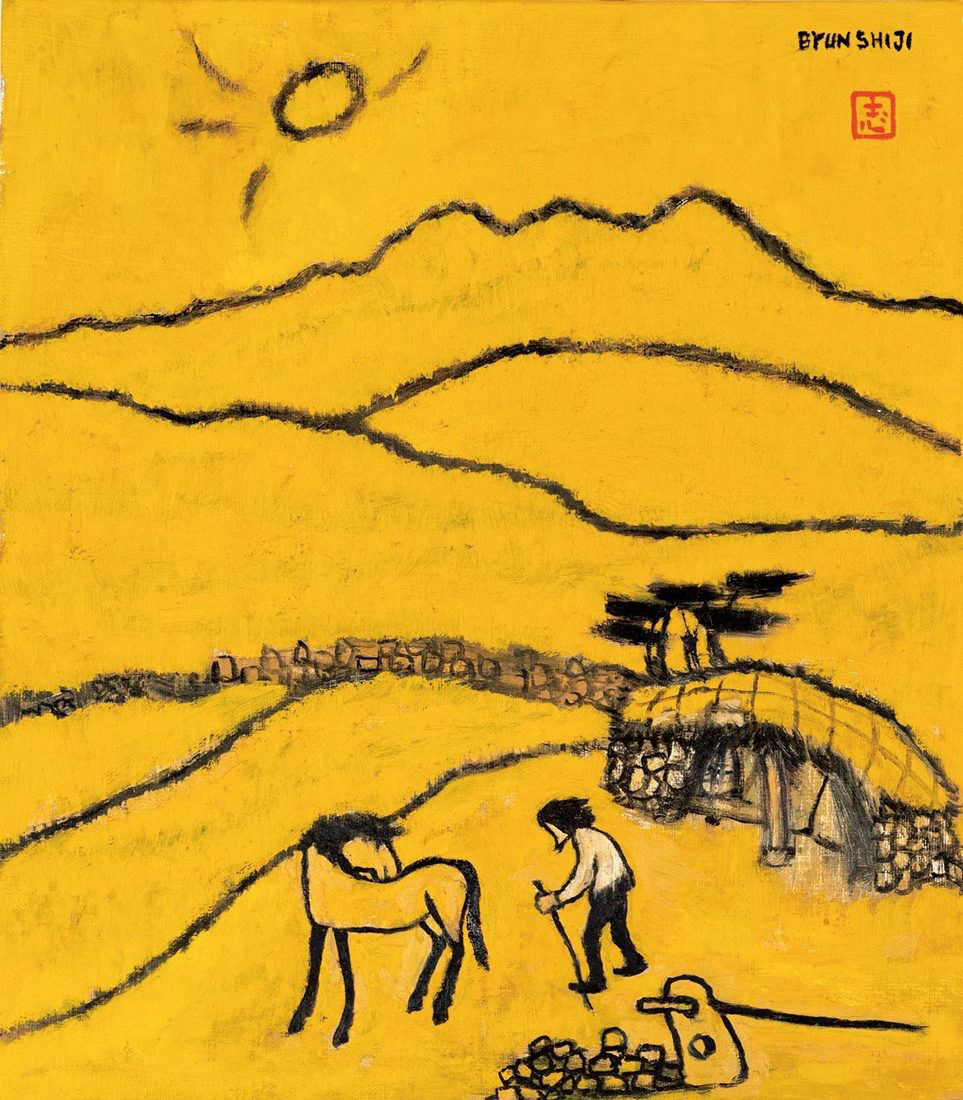
1A Mountain Set Up by Line
In Hallasan of 1987 the whole canvas is the color of dried grass. On it black lines draw the mountain’s ridges in several layers, cross the stone walls, ring the thatched roofs and set up the bodies of horse and person. The person leans on a stick, body bent forward. Take away the lines and what remains is only the dried-grass ground and the sun.4
There are pictures, like Wind of 1991, whose title is something invisible.5 But a picture can speak only through what is visible. The wind itself is not visible. What is visible is what the wind has struck.
With what did Byun Shi-Ji make the invisible wind visible? This case looks for the answer in the black line.
2Bending, Leaning, Rough
In many pictures of the Jeju years the black line has recurring features.
Lines bend and lean rather than run straight: the trunk of the pine, the human back, the line of a low roof.
The direction of bending is often matched in many places on the canvas.
The line is not smooth. Its thickness and darkness are uneven, and the traces of brushwork remain rough. That uneven line conveys movement and tension more than a smooth outline would.
These three features recur across many pictures. They can be seen less as chance than as a way of working.
3Three Things a Single Stroke Does
A single black line does several things at once.
First, it divides. As seen in case A, on a canvas where the color of dried grass binds everything together, it is the line that distinguishes things. On the bright ground the boundary of a black line is distinct. The line draws boundaries between house and land, person and sky.
Second, it records—it leaves the direction of a force that has passed. When lines bend in similar directions, a directionality arises on the canvas as if the same force were acting on many things. The line does not prove the wind as a cause. But it makes one feel as if an invisible force were there.
Third, it sets up. The line leans, and seems about to break, yet continues. A line that continues while leaning makes not a fallen form but a posture of endurance. The bent body to be seen in chapter 16 also stands by this line.
The line closes an outline. But the eye follows the way the line leans, and that direction continues beyond the canvas. So this line is outline, force and posture all at once.
Byun Shi-Ji does not paint the wind. He paints the posture of what the wind has struck.
4“Bone Method in Using the Brush” and the Line in Oil
The East Asian painting principle of gufa yongbi (骨法用筆, “bone method in using the brush”) understands line not as a mere outline but as something in which the skeleton of form and the force of the body that moved the brush remain together.6 Byun Shi-Ji’s black line can be set beside this tradition, but the function a line performs on an oil canvas must be examined separately.
Byun Shi-Ji’s line, too, sets up form. The difference is in the ground. His line lies not as an ink line on paper but on an oil canvas. There, the line makes a leaning posture and the directionality of the picture.
But why black? There are the painter’s own words. After he had gained the yellow ground, he said, he thought of black. Since old times we wrote even letters in ink, and people’s hair and pupils are black. Koreans are a people used to writing in ink, so he thought it might be important in making Korean beauty. So he began to try painting with black alone.7 What he learned from calligraphy and painting theory was examined in the discussion of translation of medium in chapter 7, case A.
5Where Two Bodies Meet
Chapter 8 said that fūdo that has entered the body becomes line. Here there are two bodies.
One is the painted body: things that endure fūdo within the picture, like the old man in the wind, the leaning pine, the low house. The other is the painting body: the movement of the hand and arm of the painter holding the brush remains as line.
It can be read that the body of a painter who lived long in Jeju and the bodies enduring fūdo within the picture meet on the line. The black line is the place where two bodies meet.
This is why this book looks long at line. If colour spreads fūdo across the whole canvas, line leaves the trace of fūdo having passed through the body.
This case has confirmed that the black line divides things, records the direction of force and sets up posture.
Seen together, the two cases show that the color of dried grass and the black line work as a pair. Colour binds sky, sea and land within one condition, and on it line divides things and sets up the posture of what the wind has struck. But on the canvas wide places remain where no line reaches, and those places are also the bright places of the picture. The next chapter treats coloured empty space and the brightness that dwells in it.
The line continues while leaning. On it, a posture stands.
Notes and sources
- ↑ Byun Shi-Ji Oral History Transcript (Korean Modern and Contemporary Art History Oral History Project; interviewer and researcher Lee In-bum), seventh session (1 April 2005), pp. 304–305.
- ↑ Solitude (1995). The canvas is checked against the plate in the byunshiji.org 100 Works (FŪDO 014).
- ↑ Monet’s Grainstacks series. The Art Institute of Chicago’s description of its Stacks of Wheat (End of Summer) (1890–91) states that in May 1891 Monet hung fifteen works of the series side by side in a small room at the Durand-Ruel gallery in Paris. The series is counted at twenty-five works following Wildenstein’s Monet catalogue raisonné (nos. 1266–1290). The dates (end of summer 1890 to spring 1891) and place (Giverny, fields near Monet’s house) also follow these sources.
- ↑ Hallasan (1987). The canvas is checked against the plate in the byunshiji.org 100 Works (FŪDO 009).
- ↑ Wind (1991), FŪDO 016 in the byunshiji.org 100 Works. On a deep green night canvas are a bent tree, a low house, a horse and a person.
- ↑ Xie He (謝赫), the Six Principles in Record of the Classification of Old Painters (古畫品錄): spirit resonance and life movement (氣韻生動), bone method in using the brush (骨法用筆), fidelity to the object in depicting forms (應物象形), suitability to type in laying on colour (隨類賦彩), proper planning in placing elements (經營位置), transmission by copying (傳移模寫).
- ↑ Byun Shi-Ji Oral History Transcript (Korean Modern and Contemporary Art History Oral History Project; interviewer and researcher Lee In-bum), seventh session (1 April 2005), p. 305: “Black—we Koreans from old times wrote letters or whatever with an ink brush.… People’s hair is black, their pupils are black… I began to try painting with that black alone.” His words on the yellow ground (pp. 304–305) are in note a1 of case A.
Contents · Fūdo Is Not Landscape Key Terms and Analytical Categories → Bibliography →