Research/Fūdo Is Not Landscape/Argument V/Chapter 11
Academic edition · Fūdo Is Not Landscape · Chapter 11 · 17 / 34
Coloured Empty Space and Non-Directional Luminosity
Empty Space and Brightness
Argument V · Fūdo Takes Form in Colour, Line, Empty Space and Light
In The Sea of Jeju of 2011, almost the whole canvas is a pale color of dried grass laid on without figures. In Tropical Sun of 1983 a sun is painted, yet there are no shadows. The one is a question of the unpainted place; the other, a question of where the brightness of the canvas comes from. This chapter sets the two cases together and asks what work a wide colour field without figures does on the canvas.
Case AColoured Empty Space — The Materiality of Emptiness and Fūdo
1A Sentence Left in the Notes
In Byun Shi-Ji’s notes this sentence remains:1
What is not painted holds up what is painted.
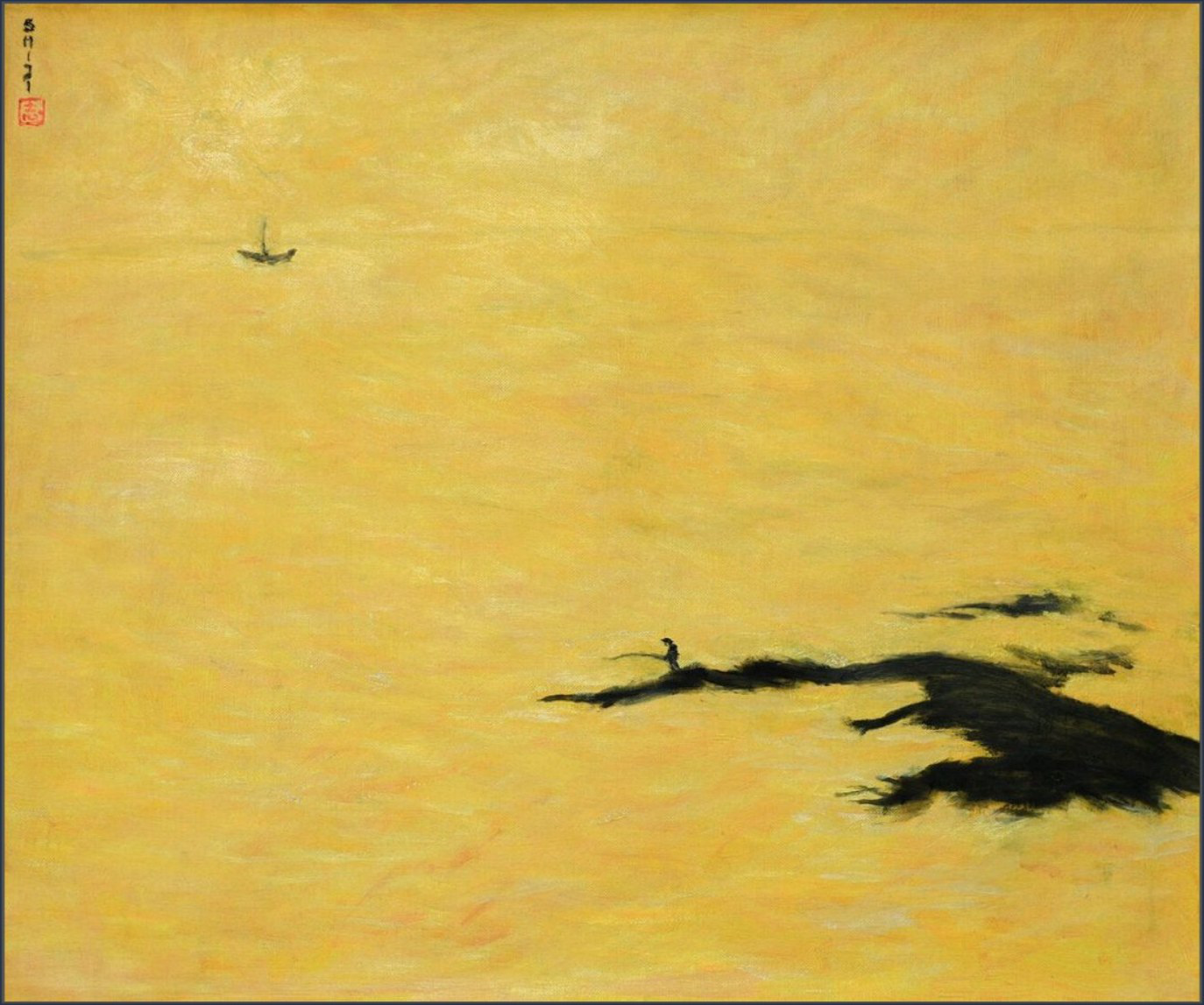
In The Sea of Jeju of 2011, almost the whole canvas is a pale color of dried grass. At the lower right a black rock lies stretched out, and at its end a small person stands, reaching a long fishing rod toward the sea. Far off at the upper left is a small boat. No horizon is drawn.2 What is painted is only the rock, the person and the boat; the rest is unpainted place.
How can what is not painted hold up what is painted? This case reads this one line together with the empty places in his pictures.
In the notes this thought is written as the pair of void (虛) and solid (実) (Notebook 2, images Image_20240121_0007 and 0008). First he spoke of omission. Omission necessarily creates empty space, and omission makes the void the most alive place. The solid is the expressed form; the void is what holds up the expression. And the solid becomes the body of art only when held up by the void; to respect the void is to respect the places brush and ink do not touch, the form beyond form.
2The Place Left Wide
In this case, a place left wide without distinct figures is called “empty space.” In many pictures of the Jeju years, a large part of the canvas is such a place.
“Empty” here does not mean that nothing is there. On the actual canvas that place is a field painted in the color of dried grass. But there are almost no figures of things and no black lines there.
We saw such places in chapter 9 too: the wide space left around the small boat and the small person, where only colour remains, without figures or lines.
Empty space is often read as longing or silence. Before reading it so, something must be examined first.
3Three Things Empty Space Does
Empty space reveals. When the surroundings are empty, a small boat or a small person becomes all the clearer. The person in The Sea of Jeju is the size of a fingernail on the canvas. Yet it is the first thing to catch the eye. The fewer the figures, the better each one is seen.
Empty space leaves open. Because it is left wide, the direction of a bending line is not immediately blocked by another figure. The eye continues that direction beyond the empty space. The eye follows where the fishing rod points. So empty space feels like a place where the wind can pass.
Empty space sets scale. Before a wide empty space, people, houses and trees look small. The larger the empty space, the smaller the person.
Seen this way, empty space is not where the picture ends. It is the place that lets the painted things be seen, connect and have their own size. Set beside these canvases, the sentence in the notes lets us say concretely what “what is not painted” does.
4The Ground Left Bare, an Empty Space with Colour
In old East Asian painting, leaving the ground of paper or silk unpainted has long been practised. Spaces such as water, sky or mist sometimes appear through that empty ground. This is often called the beauty of empty space.
Byun Shi-Ji’s empty space appears differently. His empty space has no figures, but it has colour: the colour of long-accumulated sun and wind seen in chapter 10.
The same “empty space” can do different work depending on how it is made.
5Where Fūdo Spreads Without Figures
Byun Shi-Ji’s empty space is not a place where paper was left bare but a place painted in the color of dried grass.
Seen this way, fūdo is not only in what is painted. It is also in the unpainted place. In this book empty space is not an empty place but a place where fūdo spreads without figures.
In The Sea of Jeju, if you cover the rock, the person and the boat, only colour remains. This case has read that place of colour as a place where fūdo spreads without figures.
Case A has confirmed that empty space painted without figures reveals the painted things, connects them and gives them their size. Yet this wide empty space is also a bright place on the canvas. Case B asks, in Tropical Sun (1983), where that brightness comes from.
Case BNon-Directional Luminosity
Tropical Sun and the Light of the Colour Field
1The Sun in the Title
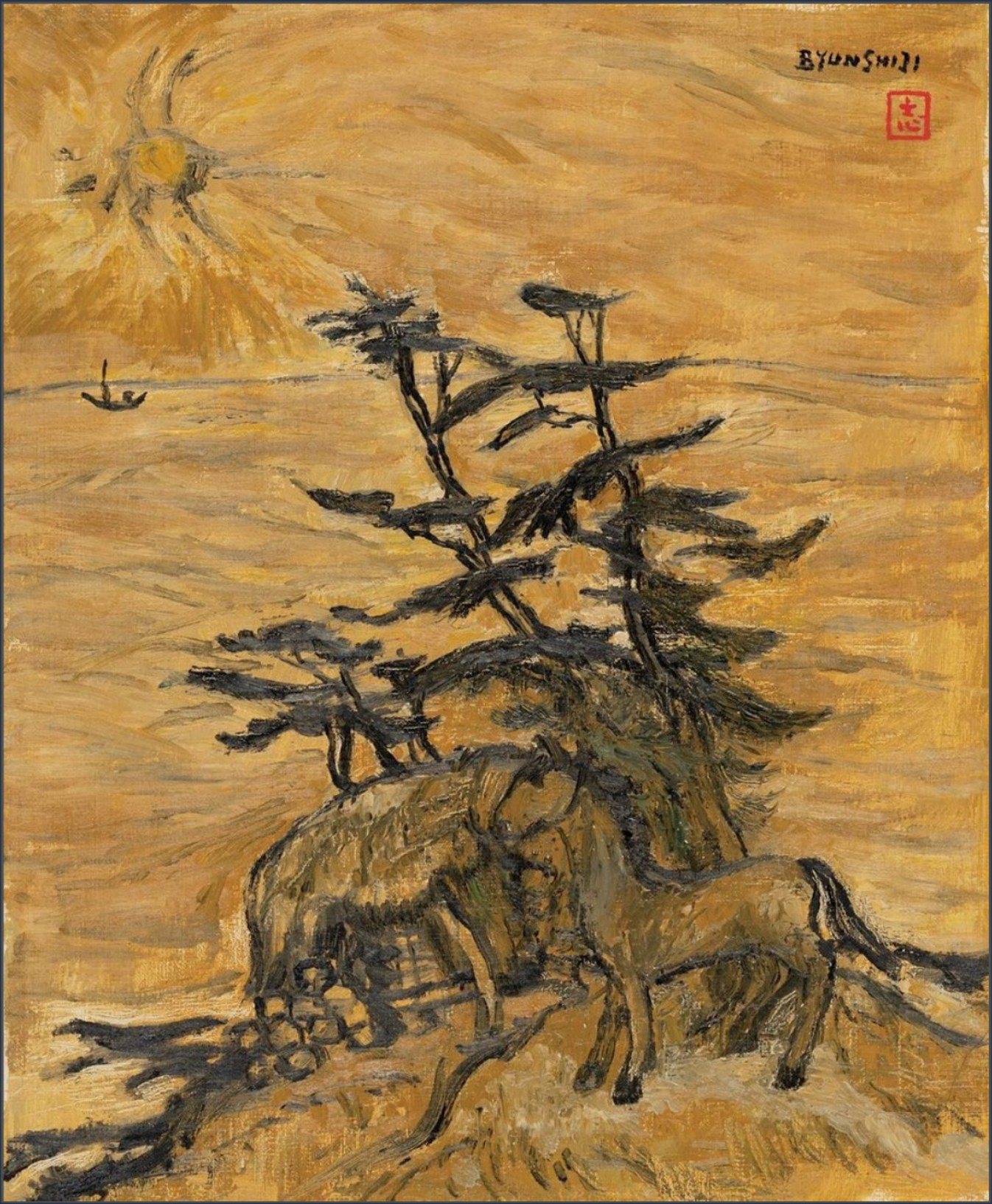
Tropical Sun, painted in 1983, holds the sun in its title.3 In this picture there are a black pine, a thatched house beneath it, a horse and a distant boat. Chapter 9 looked at the distant boat in this picture. This case follows the sun of the title.
The sun is painted. At the upper left, black brushstrokes reach out like rays from a small circle of light. The title “sun” brings to mind light pouring from one side and deep shadows. Yet the shadows this sun would make are nowhere on the canvas. Neither pine nor house nor horse is bright on one side and dark on the other. So it is with many pictures of the Jeju years. The direction of light is not visible. How is the brightness of these canvases made?
2A Spread-Out Brightness
In many pictures of the Jeju years the contrast of light and dark is strong, because black lines and dark figures are set on a bright ground of the color of dried grass. Yet this brightness seems less to come in from one side than to be spread across the whole field painted broadly in the color of dried grass—the colour field itself.
3Three Things That Make Brightness
This brightness can be explained in three ways: two are reasons it is bright, one is the reason it has no direction.
Even within one dried-grass hue, some tones lean toward white and some toward brown. In the works examined in this case, the color of dried grass sits on the light side relative to the black lines and dark forms. As this colour takes up most of the canvas, the whole picture looks bright.
A light colour and black differ greatly in value. Beside black lines and dark forms, the light colour looks lighter still.
There is one more reason this brightness has no direction. The darkness of these pictures comes less from shadow, where light is blocked, than from the colour black. So even with strong contrast of light and dark, the direction of light is not visible.
4Light Gathered on One Side, Brightness Spread Across the Canvas
The chiaroscuro of Western painting has organized the direction of light through deep darkness and local illumination.4
Byun Shi-Ji’s Jeju canvases also have strong contrast of light and dark, but the darkness comes from black lines and figures rather than from shadow. Because he sets black figures on a bright colour field rather than letting light fall from one side, the contrast is strong yet no light source is specified.
5Accumulated Sunlight
Chapter 10 read the color of dried grass as a colour made by long-accumulated sun and wind. The painter himself spoke of this colour in connection with light. According to Neves, the painter said this colour is the colour of the sea when natural light reaches its peak.5 A colour taken from light at its strongest moment became the ground of his canvases for decades. So the brightness of these canvases is the sunlight of a moment and also sunlight repeated and accumulated over a long time.
The empty space seen in case A also connects with this brightness. The wider the place without figures, the more widely the brightness spreads. Empty space is also where light dwells most widely.
From this viewpoint the title Tropical Sun can be read again. The sun is painted at the upper left. But the brightness of the canvas does not come from that one point. The “sun” of the title can also be read as connected with the brightness of the whole canvas rather than with the one painted sun.
In Tropical Sun there is no shadow under the pine or under the horse. This case has confirmed that the brightness of this canvas is not light coming from one side but luminosity dwelling in the colour field.
In both cases the wide colour field without figures was neither empty nor dark. It was a place that holds up what is painted and, instead of light coming from one side, a place where brightness dwells. Argument V thus reaches the provisional conclusion that fūdo becomes the form of the canvas through the color of dried grass and the black line, empty space and light. The theoretical interim conclusion that follows gathers the results of Arguments IV and V and redefines fūdo modernism starting from the name the painter gave, “Jeju painting.”
Light does not come from one side. It dwells in the colour.
Notes and sources
- ↑ A sentence written in Byun Shi-Ji’s notes (author’s confirmation, 29 September 2026). In the transcription of the handwritten notes (excluding the letters and the oral history PDF), this sentence has not been found verbatim. The closest are, in Notebook 2, image Image_20240121_0007, “Not painting is necessary, and only by not painting does the canvas come still more alive” and “The void (虛) is what holds up expression,” and in 0008, “The solid (実) becomes an artistic form only when held up by the void” (high legibility). The sentence below, “Filling is held up by emptying…,” has the same meaning as this line in 0008. Whether this page is the painter’s own idea or a summary of something he read has not yet been determined. The artist’s notes printed in The Way of the Wind: Byun Shi-Ji (Nouveau, 2020), p. 238, also include the sentence “Filling is held up by emptying and only then becomes an artistic form.”
- ↑ The Sea of Jeju (2011). The canvas is checked against the plate in the byunshiji.org 100 Works (FŪDO 010).
- ↑ Tropical Sun (1983). The canvas is checked against the plate in the byunshiji.org 100 Works (FŪDO 008): the sun at upper left (a small circle with brushstroke rays), the boat near the horizon, the thatched house under the pine, the horse at right. There are no shadows.
- ↑ Rembrandt, The Night Watch (1642), oil on canvas, Rijksmuseum, Amsterdam. Its formal title is Militia Company of District II under the Command of Captain Frans Banninck Cocq and Lieutenant Willem van Ruytenburch.
- ↑ Carole Neves (director of policy analysis, Smithsonian Institution), “The Painter and the Sea: Byun Shi-Ji.” Original English: “The color ochre, Byun noted, is the color of the sea when the natural light reaches a peak.”
Contents · Fūdo Is Not Landscape Key Terms and Analytical Categories → Bibliography →