Research/Reading the Masters/Ⅰ Those Who Held the Light
Ⅰ — Those Who Held the Light · No. 06 / 50
J. M. W. Turner — Rain, Steam and Speed
터너 — 〈비, 증기, 속도〉
1844. Oil on canvas, 91 × 121.8 cm. The National Gallery, London.
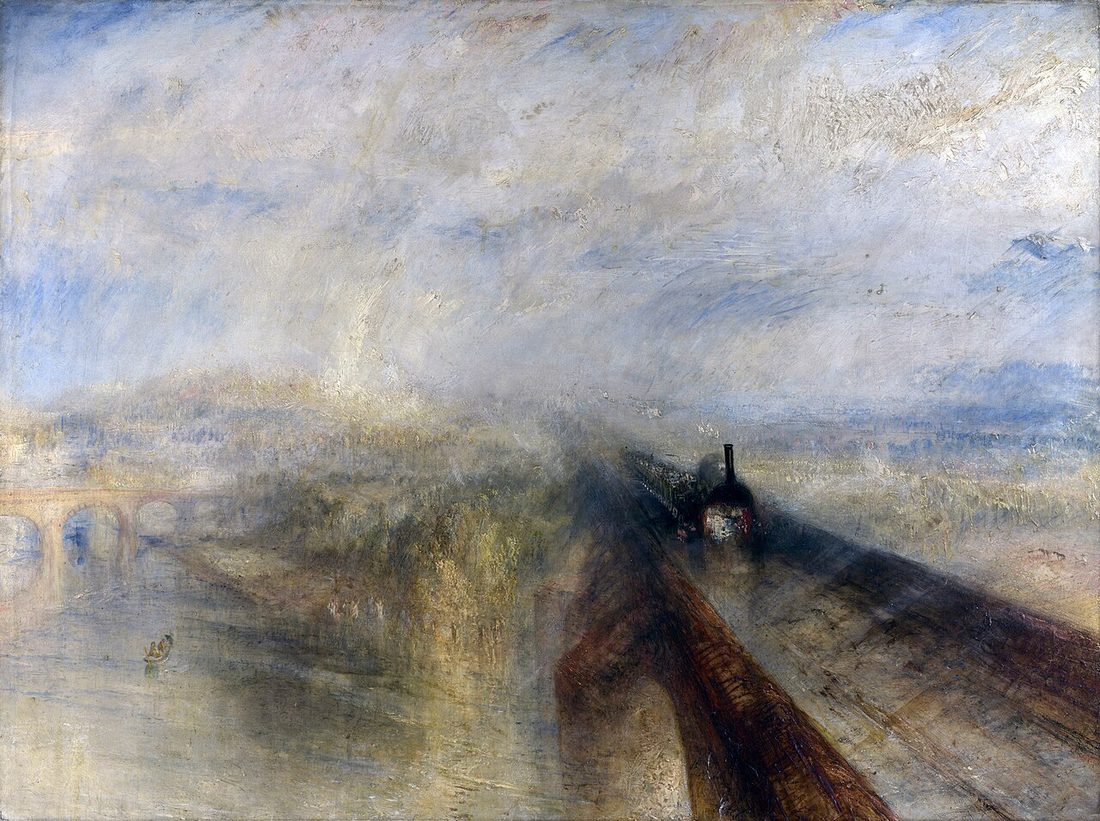

It is a downpour. A train advances head-on across a railway bridge. Form has almost disappeared; rain, steam, and light turn into a single vortex. A black locomotive breaks through its center.
In 1844, the train was still a new kind of beast. Turner painted machinery with the same hand that had painted storms. The power of nature and the power of the Industrial Revolution collide in one field. It is the moment when speed begins to consume landscape.
Turner’s vortex is made of rain and steam, carrying the dizziness of an accelerating world. Byun Shi-Ji’s vortex belongs to the wind of Jeju. One is the sound of an era changing; the other is older than any era. Turner painted what was approaching. Byun painted what would not leave.
Even so, both stand in the same place: before a force that human beings cannot stop. A small hare is said to run before Turner’s train. In Byun’s paintings, a Jeju pony stands before the wind. Flight and endurance are both answers given by living beings.
The train must have arrived somewhere, and the storm must have ended. Yet nothing has ended inside the painting.
The rain falls, and the train is still coming.
The interpretation is the author’s. No unverified statement has been presented as the artist’s own words.