Research/Reading the Masters/Ⅰ Those Who Held the Light
Ⅰ — Those Who Held the Light · No. 05 / 50
Georges Seurat — A Sunday on La Grande Jatte
쇠라 — 〈그랑드 자트 섬의 일요일 오후〉
1884–1886. Oil on canvas, 207.5 × 308.1 cm. Art Institute of Chicago.
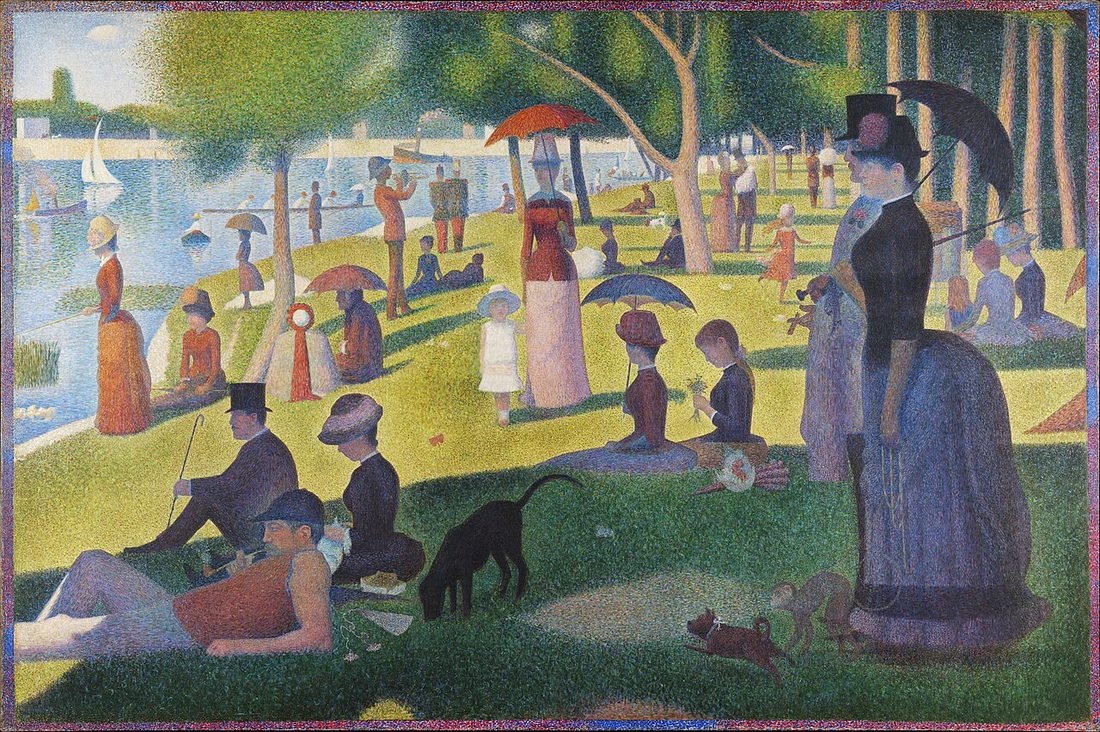

An island in the river, a lawn on a Sunday afternoon. People stand, sit, and walk, yet no one seems to move. Up close, the figures disappear and only dots remain.
Seurat did not mix his colors on the palette. He placed small points of pure color side by side and entrusted the mixing to the viewer’s eye. Chevreul’s theories of color contrast and contemporary optical research supported the experiment. Though the painting was built through calculation, it is not merely cold; the dots carry the slow breathing of a Sunday afternoon.
The figures are still as sculpture. Yet this stillness is not dead. It is time paused for rest. Byun Shi-Ji’s old man also stands still, but his stillness is different. Seurat’s people stop in order to rest; Byun’s old man stops in order to endure. The stillness of leisure is soft. The stillness of endurance is taut.
One dot is almost nothing. Many dots become grass, shade, the shimmer of the river, and the Sunday of an age. A single short black stroke in Byun’s painting is not yet wind. Wind appears only when countless strokes accumulate.
Small, faithful things build large spans of time, just as ordinary days form a life.
The dots have not scattered.
The interpretation is the author’s. No unverified statement has been presented as the artist’s own words.