Research/A Hundred Years of Wind/Ⅷ Philosophy of Art
Ⅷ Philosophy of Art · 99 / 100
Living in Jeju
Near the House, Before the Sea
제주에 산다
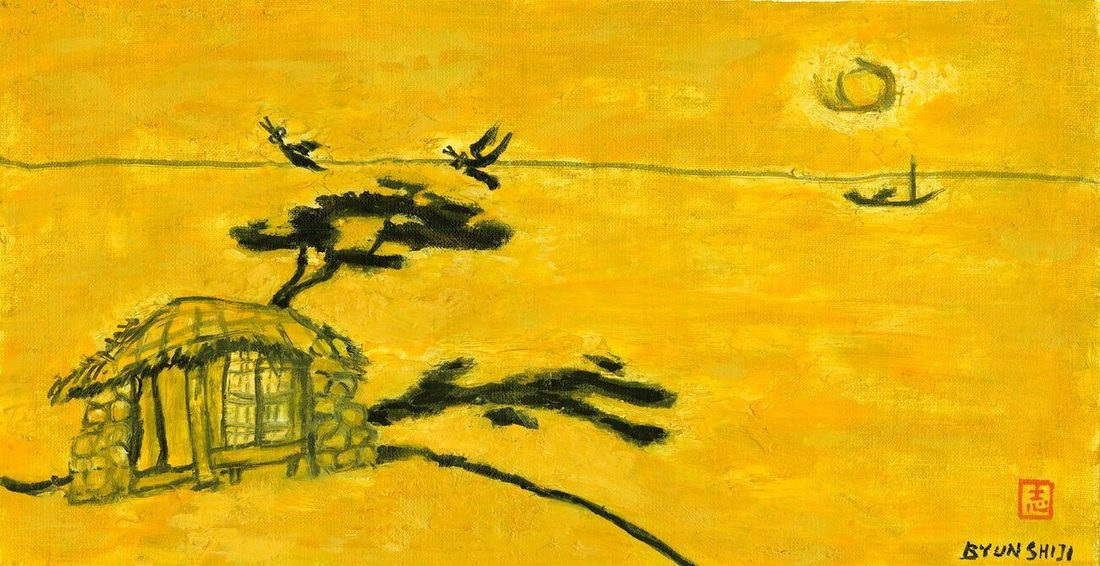
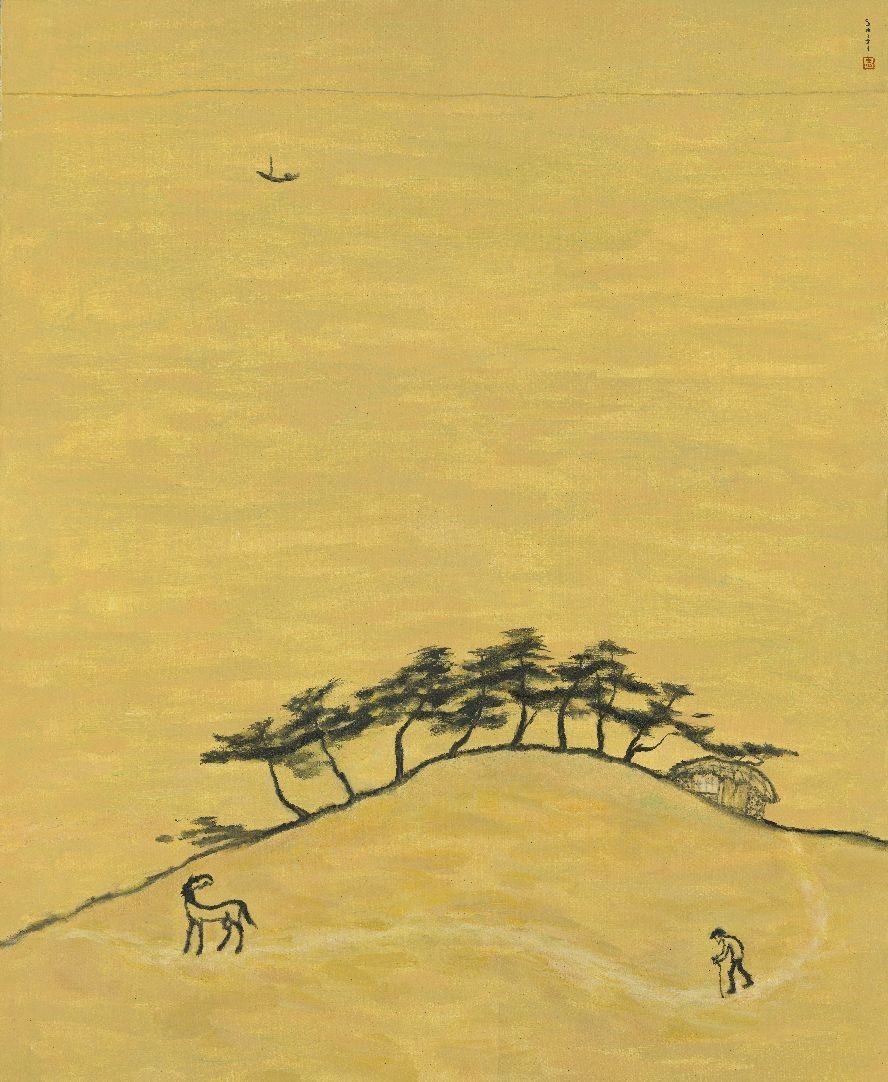
After Writing the Address
In Going This Way, person and pony stand apart.
Broad ground lies between them.
Trees and a house occupy the ridge; the boat is farther away.
Days follow the words “living in Jeju”.
One places the body in relation to weather and meets other people.
One may see a familiar road changed.
Living does not automatically become painting.
Some things are first seen while painting.
Eye and hand move between life and image.
Branches That Disappear
Travelling between Jeju City and his Seogwipo studio, Byun watched the trees.
He remembered bent branches lost when the road was widened.
The familiar route came to hold things no longer visible.
Calling a place home does not mean knowing it completely.
A long-time resident must look again too.
Someone who arrives later can also form a relation with it.
We may cherish the low roof in Empty House.
That does not entitle us to ask people now to live in that same house.
Preserving a painting differs from holding a life in the past.
More Than a Roof
Heidegger asked about dwelling beyond staying inside a building.
He considered earth, sky, divinities and mortal human beings together.
Dwelling also meant caring for things in their own being.
Set those words beside the painting.
But do not simply call the wind divine.
Nor does a house’s presence guarantee safety for the life within.
Where can the body outside the door lean?
What can the small roof keep out?
Before the distant horizon, ask where a person can remain.
Cold Felt Together
In Watsuji’s account of fūdo, cold is more than a number on a thermometer.
Feeling cold, we clothe ourselves and seek shelter.
Ways of living together enter what the body feels.
Wind is not merely a test of how well one person endures.
It directs attention to low roofs, stone walls and bodies standing close.
It asks what is helping to keep the wind out.
The lines left after meeting the same wind are different.
The people and their past days differ.
Reading fūdo must not erase that difference.
A Place Repeated
In their account of the refrain, Deleuze and Guattari consider how familiar rhythm makes a place.
Its boundary can also open to other forces.
A territory is not only ground enclosed and guarded.
House and tree, person and pony recur.
The pony may stand near the person or farther away.
Placing familiar things again makes different intervals.
Byun said the landscape of the mind was not confined to Jeju.
His own concerns could appear in Europe too.
The eye of someone who stayed had not closed off distant places.
Returning to Paint
Dewey considered experience as an exchange between doing and undergoing.
Art is not only a miracle apart from life.
Yet living a day does not turn that day directly into a work.
He watched the storm and returned home to paint.
He waited for the paint to dry.
He thought about the composition again.
Between sea and painting lies the painter’s work.
Fūdo is not a colour that clings to the brush by itself.
Memory and hand choose again from what the body met and the eye learnt.
A painting takes shape within what the materials allow.
Keeping Without Holding Fast
Painting an old house need not mean resisting all change.
What disappeared can be remembered.
The lives desired by those living now can also be considered.
Pony and birds are beside the person.
They are not there only for the human story.
Leave them their bodies and their directions of attention.
Long residence does not produce good relations by itself.
Look at what was maintained and what was newly opened.
Ask again which way the house’s door faces.
In a Familiar Place
Much of life stays outside the painting.
The painting holds choices that are not life copied directly.
Leaving a distance does not sever their relation.
Look again at the same horizon.
Even the same house may be placed differently.
In a familiar place, seek a relation not yet known.
Trees stand along the ridge.
At its end is a small house.
Below, person and pony stand in different places.