Research/A Hundred Years of Wind/Ⅷ Philosophy of Art
Ⅷ Philosophy of Art · 90 / 100
The Poor Artist
What Made Painting Possible
가난한 예술가
Not a List of Possessions
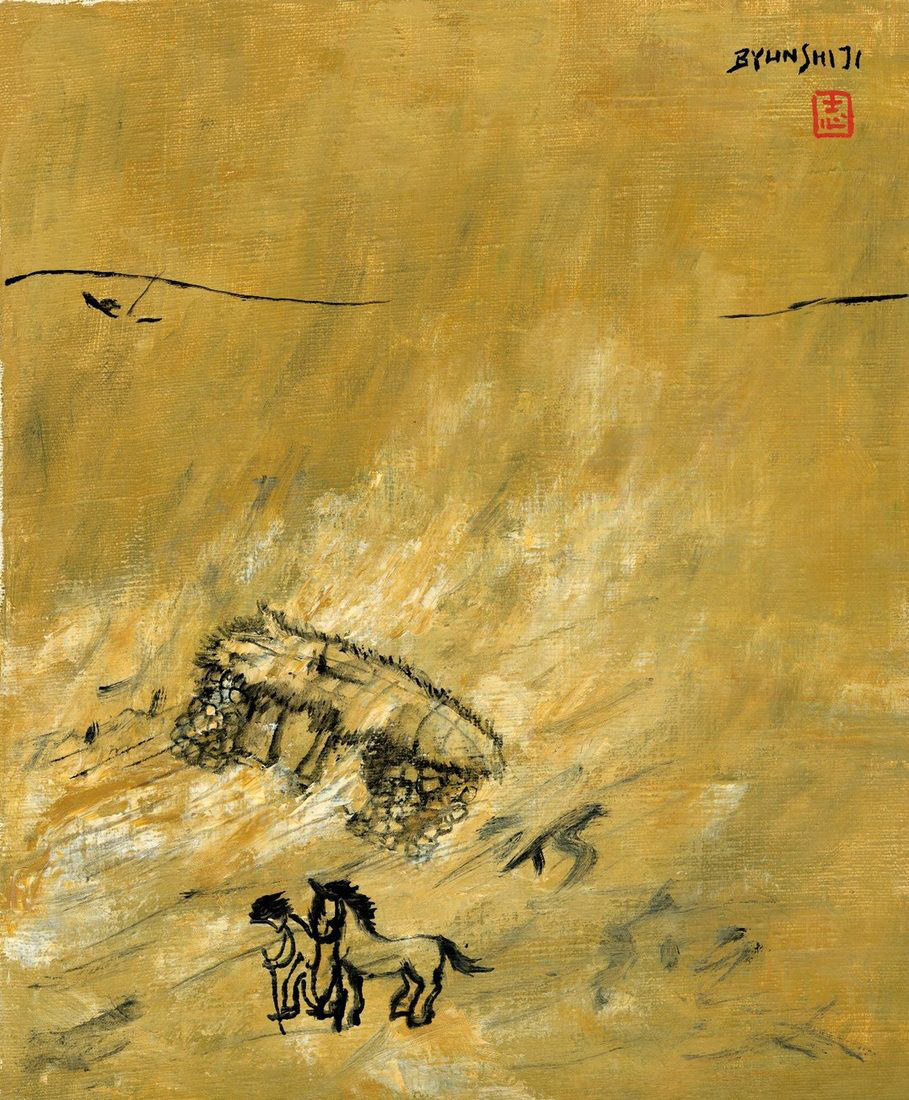
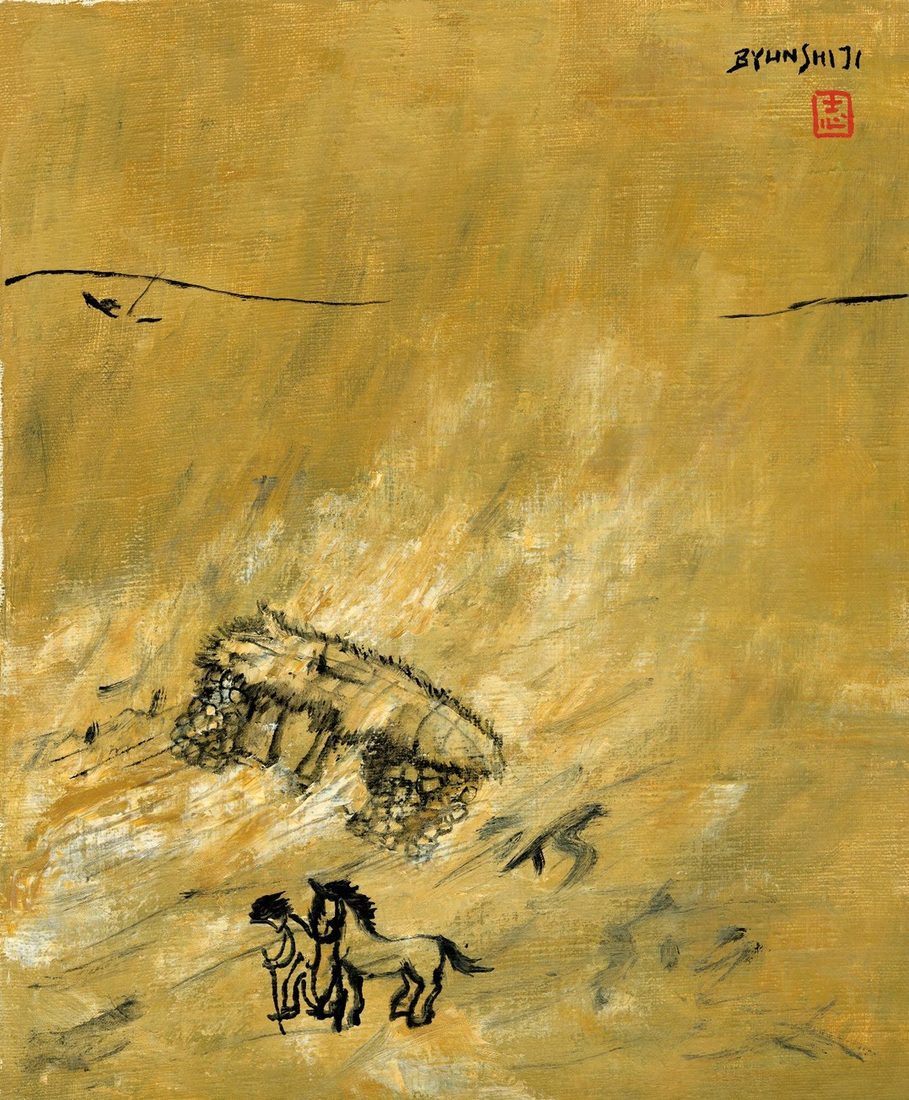
A person and pony stand close near the bottom of Stormy Seas.
The house is above them.
No luxurious things are visible.
But a painting is not a list of everything possessed.
It does not tell us whether the pony is property.
First, see another life beside the person.
Set aside the phrase “poor painter” for a moment.
What had to be there for someone to paint?
Not only a brush, but a day in which to hold it.
Those Who Helped Him Find Books
Byun spoke of substantial financial help from his brothers.
He obtained costly books of Van Gogh and Cézanne.
Other people had a share in the time when he was learning to paint.
That help does not explain away every difficulty.
Ease at one time is not ease for a lifetime.
But a hand obscured by the word “poverty” comes into view.
Someone can receive help and still paint their own work.
In time made possible by another, they choose and paint with their own eye.
The painting may be made alone, but the day may not be.
Few Colours
Few colours do not tell us that paint could not be afforded.
Using less differs from lacking what one needs.
First, look at a rough surface as a surface.
Byun tried in painting a colour he had seen altered by light.
He varied the yellowish range with what he painted.
Before that colour stood an observing eye, not an explanation called poverty.
Leaving something out of a painting can be a choice.
Lacking what life requires is different.
Even when an empty space seems beautiful, keep that distinction.
A Body That Leans
A walking stick stands between body and ground.
It takes some of the body’s lean.
It need not be read as proof that pain created talent.
A slow pace may leave room for thought.
It may also be slow because of pain.
Do not cover that difficulty with the word “wisdom”.
A pony stands beside the person in Stormy Seas.
They have not waited for all the weather to clear before being close.
Companionship is already there among the rough strokes.
Theo’s Name Too
When speaking of Van Gogh, look also at Theo’s support.
Food and lodging cost money; canvas and paint were needed too.
Lack alone did not make the paintings.
Byun’s brothers and Theo belonged to different circumstances.
Yet in both accounts, someone gave help.
The hand receiving it could still choose its painting’s direction.
Do not ask who endured poverty better.
Do not weigh different lives on one scale.
I would rather ask whether the person could paint again tomorrow.
A Day in the Studio
A sale does not make a painting good.
The absence of a sale does not make it more truthful.
Set the painting beside its sales record and look again.
Work needs time and a room.
It also needs food and materials.
They do not leave the day because they were left out of the painting.
Gathering paintings for a museum also happened between people.
There were postcards, requests, and individual approaches.
Work done outside the paintings brought them before viewers.
Beside the Works That Remain
A painting left in a studio is not necessarily an unsold painting.
Absence from a book differs from absence from an exhibition.
Look for the reason, one work at a time.
A later rise in price does not feed a past hunger.
Great praise cannot live that earlier day in someone’s place.
The paintings that remain are not the life that has passed.
Leave a name and a record beside the painting.
Write where it came from, and what is still unknown.
Let the next person stand before it.
So That Life Can Continue
Praise for suffering does not, by itself, help a painter.
Some of the weight might instead be lifted.
I hope care for the paintings can reach the person too.
A painting may be modest.
Its maker’s life need not be deprived.
Enough in a few lines does not mean that a person should need almost nothing.
Rough strokes pass around the house.
Below, the person and pony stand close.
A small patch of ground lies beneath their feet.