Research/A Hundred Years of Wind/Ⅶ Comparison & Context
Ⅶ Comparison & Context · 88 / 100
Reworking East Asian Painting Theory
A Painting Beside Old Words
동양화론의 현대적 변용
Six Questions
Xie He set out six principles for painting:
spirit-resonance, the bone method of brushwork, depicting form, assigning colour, arranging positions, and transmission through copying.
They were not written for the oil paintings of today.
I do not want to fit Byun’s paintings into those words.
I read one phrase and look at the painting again.
I ask whether something previously missed has come into view.
Tradition is not placed in the hand at birth.
We look at other paintings, read, and work things out with our own hands.
Byun’s notes also preserve time spent reading Matisse.
Spirit-Resonance: A Still Body
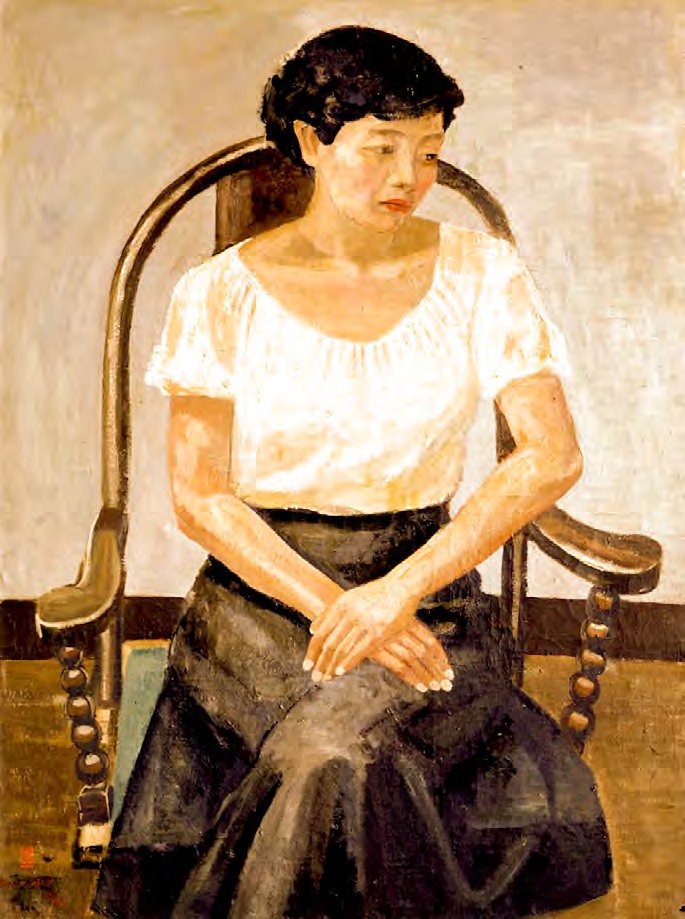
The woman in Portrait of Nemo sits.
Her hands overlap; her gaze turns to one side.
Though she is still, we feel a body inhabiting that place.
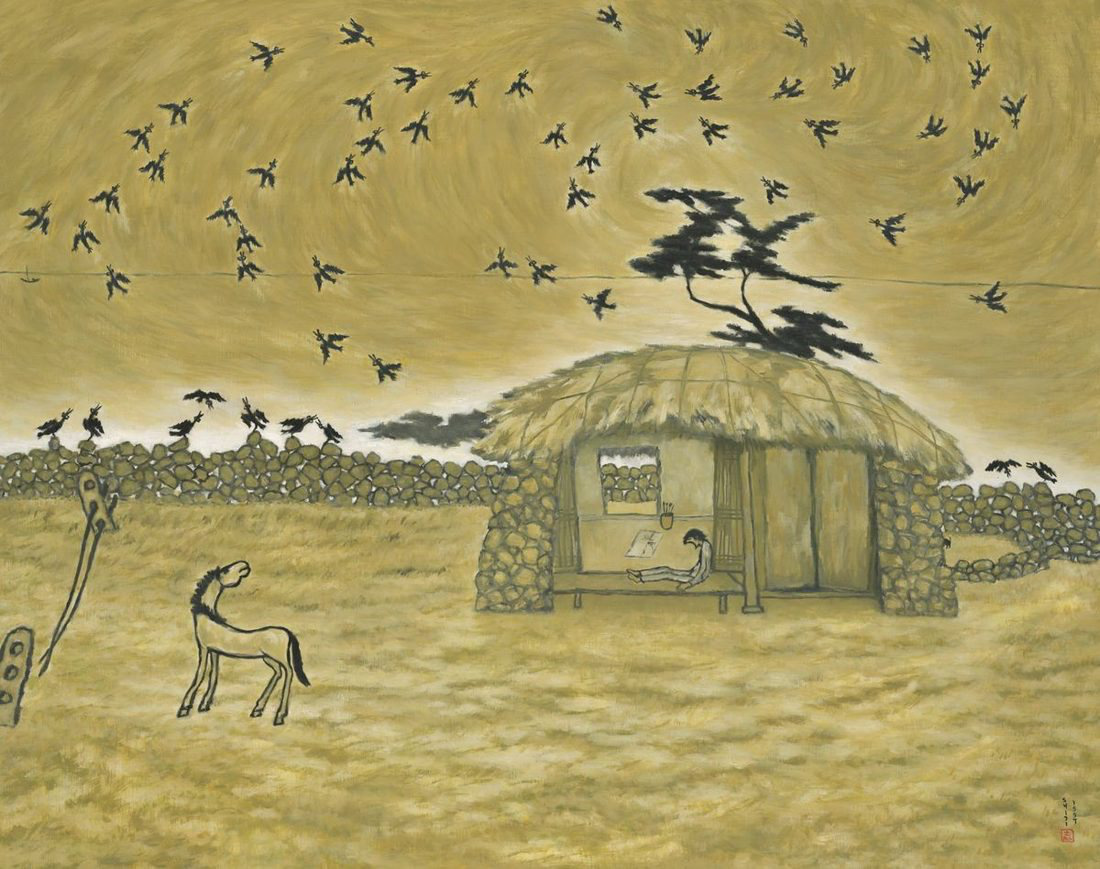
In Wild Dance, a bird flies while another stays on the wall.
The eye moves between them.
The feeling of life does not belong only to the one in flight.
The later writer Guo Ruoxu distinguished spirit-resonance from principles that could be learnt.
His argument should not be merged with Xie He’s.
Nor need it divide people today into those with talent and those without.
Brushwork: Lines That Support a Body
A thick line does not necessarily give a body weight.
A fine line can change that weight by changing direction.
Look also at where it meets another line.
In Portrait of Nemo, the chair’s curved rim passes behind the body.
The arms descend and the hands overlap.
Different curves support one body from different places.
The black strokes of the Jeju paintings may recall ink.
Looking like ink is not the same as being painted in ink.
Beside those strokes, keep the painter’s account of waiting for oil paint to dry.
Depicting Form: Pony and Bird
To paint less, one must first look.
What must remain for us to recognise this body?
Omission is not work done with closed eyes.
The pony and birds in Wild Dance are all sparely drawn.
Yet they are not interchangeable.
A neck, legs, and open wings preserve their different bodies.
Byun said he brought what he had learnt on site into his own style at home.
He did not bring back every detail.
Nor did he abandon what he had seen.
Assigning Colour: Within One Ground
The old principle speaks of assigning colour according to kind.
Byun places different things within a similar range of colour.
Here, the old words and the painting do not fit exactly.
Within the same dried-grass colour, dark and pale remain.
Strokes gather in one place and spread apart in another.
Bodies do not become alike because they share the weather.
The painter said the yellowish tone changed with what he painted.
He did not simply repeat a colour found once.
Before each painting, there was colour to choose again.
Arrangement: Placing the Interval
Where should the house be?
How near the person, and how far the boat?
Painting the things also makes the space between them.
Do not send every bird in Wild Dance into the sky.
Look at the one that stays on the wall.
Its small body brings the eye down as well.
There is space beside the chair in Portrait of Nemo too.
It is not as wide as a sea.
Yet that narrow space helps place the seated body.
Transmission: After Learning
Drawing before a landscape differs from copying another painting.
There is also revising one’s work after hearing a critique.
Learning arrives by more than one route.
Another painter’s sentence lies in the notebook.
The hand that read and copied it takes up a brush again.
It need not make a painting that repeats the sentence.
There is no need to erase the traces of learning.
Nor must one remain where one learnt.
What was carried forward may become clearer before the next painting.
Closing the Old Text
Look at the seated woman beside the birds in flight.
A young painter’s work is not merely practice for his old age.
The body painted then already lives within that painting.
Reading old words can change the eye.
Seeing a painting can change what those words mean.
Close the book for a moment.
Some birds are flying.
Some remain on the wall.
The eye descends to the low stones.