Research/A Hundred Years of Wind/Ⅵ Time & Memory
Ⅵ Time & Memory · 76 / 100
The Light of Childhood
At What Scale Does Memory Return?
유년의 빛
The Child Outside the Window
Among the childhood scenes Byun Shi-Ji recalled in his oral history is a school window. His older brothers were having lessons inside. Too young to join them, he looked in from outside and then went home. What remains first is not the announcement of a great destiny, but the distance between a child and a window.
This memory need not become the origin of every painting. It can nevertheless alter how we look at the later pictures: a place close by that cannot be entered, something visible but beyond reach. We may become attentive to comparable intervals between a small house and a distant boat.
The light of childhood need not always be brilliant sunshine. It may be the brightness of a window separating those indoors from someone outside. Considered in this way, landscape ceases to be merely a beautiful setting. It becomes a space that recalls how far a body could approach.
A Spoonful of Honey and a Horse’s Back
Another memory leads to his maternal grandparents’ home in Hyodon. His father led a horse, with the child riding on its back. His grandfather brought honey from a small storeroom and gave the children a spoonful each. Yet the bareback ride left his skin painfully chafed. Sweetness and pain belonged to the same outing.
To call that childhood nothing but a lost paradise would erase the pain of the ride. To make it only the beginning of hardship would erase the hand offering honey. Perhaps a memory endures partly because it resists reduction to one feeling. The same scene holds sensations that do not cancel one another out.
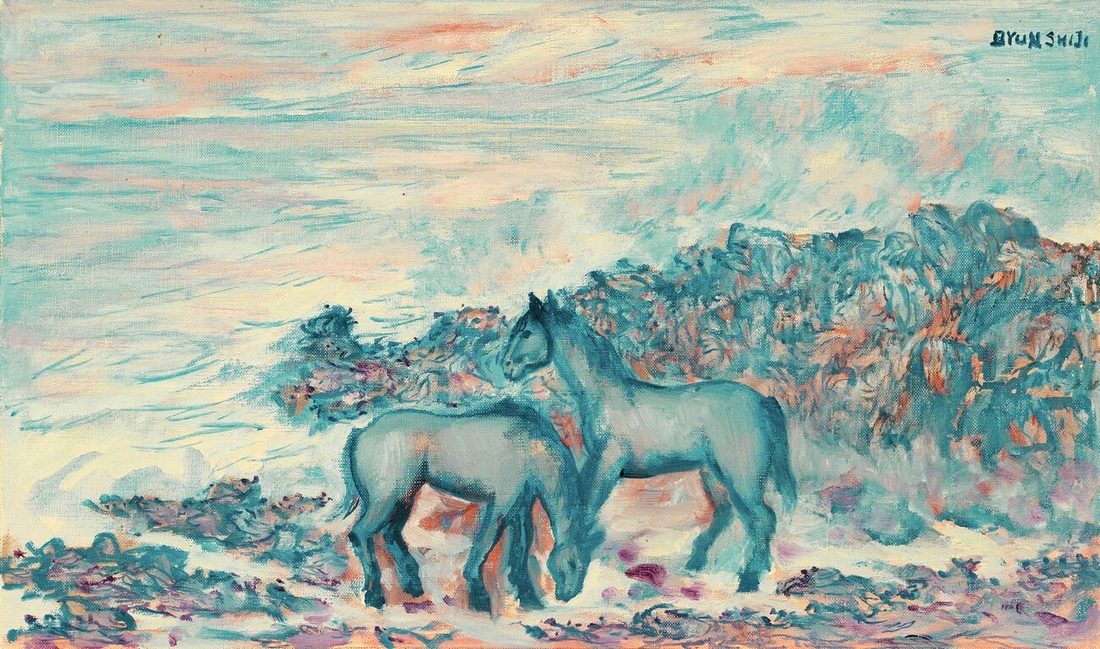
In Jeju Ponies, the nearer animal lowers its head while the one behind holds its neck upright. Their bodies are close, but their postures differ. We cannot identify this picture as a portrait of the horse he rode in childhood. It does, however, invite us to think of the horse as another body encountered at close quarters before it becomes a symbol.
The Madeleine Is Not a Certificate
In Proust’s Swann’s Way, the taste of a madeleine dipped in tea brings back Combray. Yet the episode is not a formula that explains the past at once. An unfamiliar joy comes first, and the narrator repeatedly searches for its origin. Recognition itself takes time.
Placed beside Byun’s paintings, this passage suggests a moment when sensation precedes a story. Before the colour of dried grass, a viewer may feel warmth or distance and only afterwards search for a memory. This is one possibility of viewing, not documentary proof of how the painter’s own memory operated.
A painting that prompts memory does not return everyone to the same childhood. One viewer may recall a dry field, another an old room. Someone else may linger over colour and line without recalling any scene at all. The work does not command a memory. It leaves room for one to arrive.
The Scale of Departure
In remembering the departure for Japan, Byun distinguishes the large vessel from the small boat. The larger ship could not come close to shore; passengers crossed in a smaller craft and were pulled up by hands reaching down. Someone’s white rubber shoe fell into the water. Departure is recalled at the height of hands and feet rather than as a panorama of the island.
We need not entrust the whole meaning of separation to that white shoe. It is first a small object preserved in testimony. Its importance is that a historical movement was also the transfer of individual bodies. For those making the crossing, the sea was not an abstract boundary.
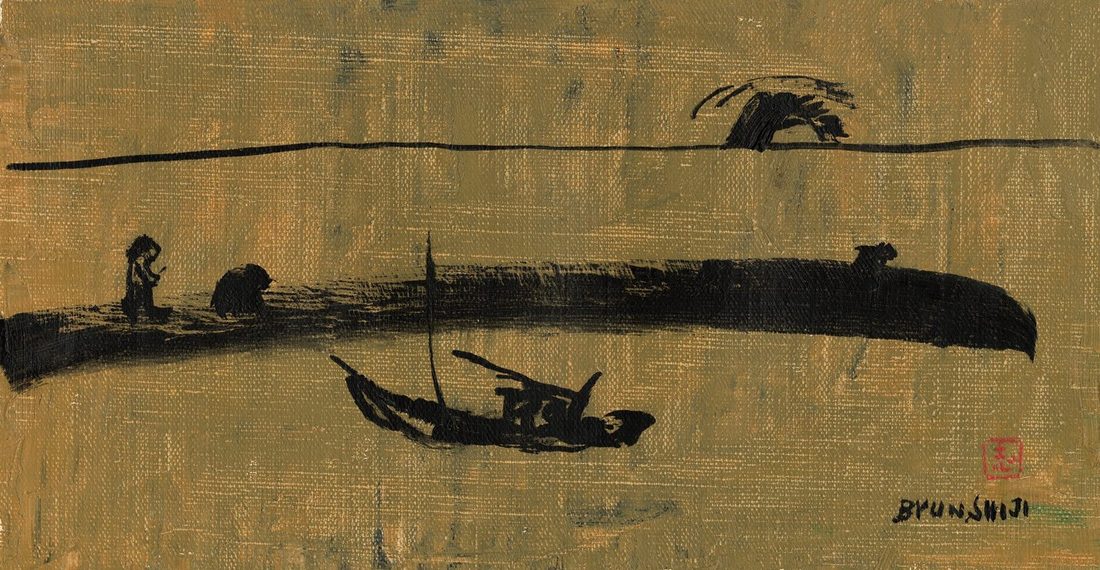
There is an interval between boat and shore in The Jetty as well. But this does not make the work a documentary picture of that departure. Looking at an interval painted at another time, we may consider both distances crossed and distances left uncrossed. Memory is not the answer to a painting; it is one way of approaching it.
Not Light Alone, but Smell
The child of the oral recollection thought he had reached Japan when the ship stopped in Busan. The smell was different. The older painter described it as the smell of oil, of civilisation. A strangeness sensed through the nose preceded geographical recognition. Childhood’s world was not yet arranged as neatly as a map.
This scene prevents us from reducing fūdo—the lived relations of climate, place and human life—to visible local colour. A place does not announce itself only through a difference in light. Smell, the effort of travelling, understanding speech and moments of entrusting one’s body to others all belong to it. A remembered place returns as a gathering of such relationships.
An oil painting is not a container that literally holds a smell or a body’s fatigue. Nearness and distance, a heavy mass and a thin line can instead evoke other sensations. Painting need not duplicate childhood. It can establish new conditions in which something of childhood becomes perceptible again.
Childhood Continues After Departure
Leaving Seogwipo did not close the whole of childhood. What he learned while growing up in Osaka also became his lived time. To call only the sensations of home authentic and all later learning borrowed would split a life formed through movement in two. Childhood is not the property of a single place.
Nor can a sideways glance in a portrait establish that the sitter is longing for home. We can see the direction of a gaze, but not its inward destination. Biography may help us read a figure; it should not become a voice that speaks on behalf of every silence within it.
A broader way to read Byun’s childhood is to consider how several places remain within one hand. It is not a hand that remembers only what it first touched. It selects again from what it has seen and learned, and can paint differently what once pleased it. Memory and learning need not erase each other.
Two Times within the Returning Gaze
In later life, Byun spoke of seeing an old tree still standing and recalling the vanished landscape around it. A tree in the present could call back its remembered surroundings. His account of a landscape of the mind brings together what he sees and what is no longer visible. Memory does not work independently of present observation.
What returns is not a complete restoration of the past. Both the person looking and the surroundings have changed. Attending to what remains and reckoning with what has gone meet within one picture. Because an older landscape passes through a present body to be painted again, the work is both remembrance and a new event.
The light of childhood is therefore not a colour found once and preserved for ever. It can draw nearer or recede whenever it is seen again. The colour of dried grass is more richly understood as a meeting of old sensation and present judgement than as a fixed value sealed inside a child’s eyes.
What Remains in a Spoonful
Make childhood the sole cause of art, and a painting becomes an illustration of biography. Erase childhood altogether, and we may overlook why a small thing holds the mind for so long. What matters is not fixing a single cause, but preserving a distance in which painting and memory illuminate without replacing one another.
After reading the painter’s recollection, we look at the horse again. Its back is no longer something passed over under the simple name of horse. It is a body that may have carried someone, and must also bear its own weight. Yet we need not load the painted animal with every story we have read.
There was a honey jar in the small storeroom of the recollection. A spoonful came from it. After looking at the painting and closing the book, that small measure remains somewhere in the mind.