Research/A Hundred Years of Wind/Ⅵ Time & Memory
Ⅵ Time & Memory · 73 / 100
The Time of Works Not Publicly Shown
How Do We Encounter a Painting Not Yet Seen?
미공개 작품의 시간
The Scope of “Not Publicly Shown”
“Not publicly shown” first describes our route to a work, rather than its character. A painting absent from exhibitions differs from one known through photographs, or one reproduced in a catalogue whose present location is unknown. Nor does unsold mean unshown. Before gathering them under one term, we should ask which doors each has passed through.
During his oral account, Byun mentions many paintings absent from the material then being examined, including works brought from Japan that record his years of study. This gives a reason to look beyond familiar representative works. It does not establish that those paintings were never publicly shown, or where and in what numbers they are now kept.
Seeking an unfamiliar painting is not a promise of an undiscovered masterpiece. One may repeat a known form; another may reveal hesitation before that form was reached. Either must first be seen. The pleasure of discovery should restart judgement rather than replace it.
Before Adding a Story to What Was Not Kept
A story of an artist destroying paintings makes a powerful impression. A story of burning unsold work quickly becomes one of poverty, pride and artistic conscience. Yet an event and its motive require different evidence. Even a documented act of disposal cannot have its reason supplied by a moving sentence written afterwards.
The material examined for this revision did not provide direct support for the claim that Byun burned unsold paintings. No scene of those flames is therefore reconstructed or explained as a noble choice. This is not a finding that it never happened. It means that this essay does not build its argument upon an unverified event.
There may be many circumstances behind keeping a picture or not keeping it. Without knowing working judgements, conditions of storage and relationships at the time, assigning one motive turns the painter into a legendary figure. Leaving a gap in what we know can sometimes respect that person’s choices more fully.
A Painting Undergoes Time Even in Storage
A work continues to exist materially while out of view. Darkness, however, cannot be said to make its colour deeper or nobler. Conservation examines relations among support, paint layers, environment and handling. Discolouration and cracking are conditions to assess individually, not poetic decorations awarded to a painting for waiting.
One photograph cannot disclose every history of a surface. Lighting and photographic conditions can alter the appearance of a mark. Discussing texture as an experience and investigating physical condition can support one another, but they are not the same activity. A sentence of appreciation should not fill the gaps in an examination.
To bring out a work includes care that precedes looking: a safe place for it, a record of its present state, time to examine the reverse as well as the front. Ensuring that it can be seen again may matter more than how quickly it is shown now. The value of waiting arises from care, not neglect.
Not Seen Is Not Nonexistent
A painting we have not seen may already have been an event within the artist’s work. Someone chose paint, paused and looked again before it. Yet we do not necessarily know that particular process. Acknowledging a work’s existence differs from claiming to know the story of that existence.
Public presentation does not first bestow existence upon a painting. It opens new relations. The work is placed beside others, encountered by other eyes and met with questions not previously asked. What changes is not necessarily its substance but its place of reading. A new arrangement can make a different part of the same picture appear first.
A work is not purer because fewer people have seen it, nor does frequent viewing leave only worn-out meanings. An eye can stop anew before a familiar painting. Rather than celebrating the mystery of non-disclosure, we can go further by asking what different modes of encounter reveal and what they miss.
Kafka’s Instructions and the Difference a Record Makes
There are actual documents concerning Kafka’s wishes for his papers. The National Library of Israel records two notes from 1921 and 1922 instructing Max Brod to gather and destroy handwritten materials, letters and drawings. What matters first in this example is not a great writer’s self-negation but the survival of particular instructions.
An example with such instructions cannot simply be transferred to another artist’s unshown work. The question changes depending on whether a prohibition survives or whether records of showing have merely not yet been found. Silence does not always mean refusal. When refusal is documented, however, it should not be erased as though it were a gap.
Comparison does not place Byun inside another writer’s fate. It clarifies the forms of evidence each has left. Where one case has written instructions and another has records still to be examined, that difference must remain. Only then can a shared question about legacy begin.
Not Making the Last Painting the Conclusion of All the Others
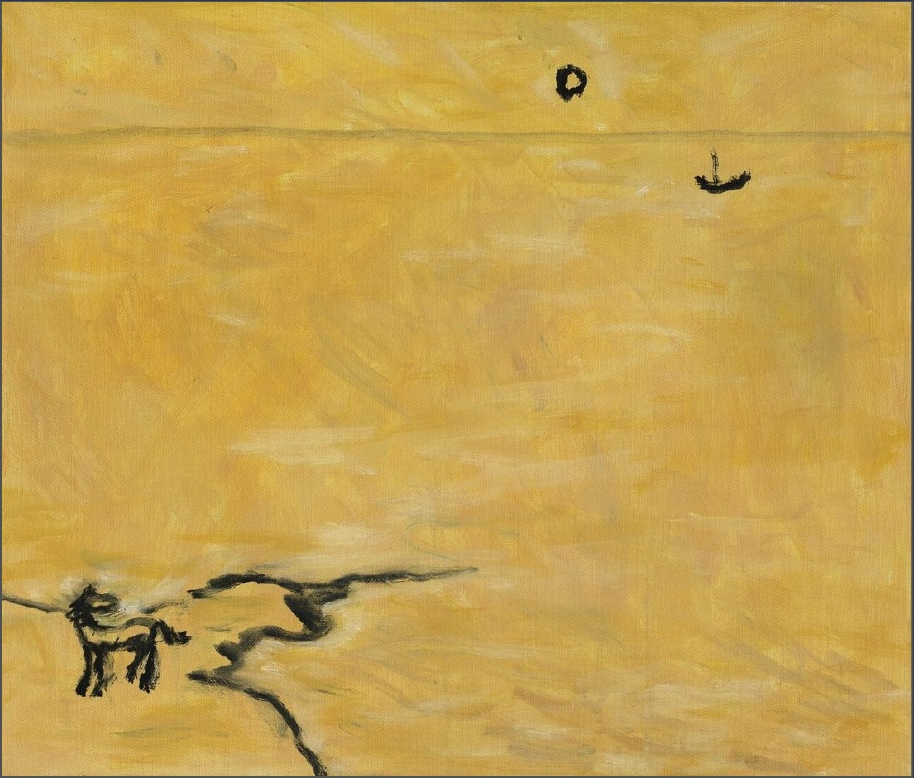
The 2013 work titled The Last Work is included here as a comparison reproduced in a supplied catalogue, not as a newly discovered unshown painting. A pony, sun, small boat and shoreline remain in the picture. To describe an entire career ending in a single dot would make these actual forms disappear.
The pony occupies the ground below; the boat is far away. The wide interval slows the picture’s time. We may read that distance as a concentration of a life. That differs from saying that the painter gathered the meaning of every unshown work into this canvas. The painting does not require such a total account.
The word “last” powerfully directs our order of looking. We want every earlier picture to lead there. But earlier pictures were made in a time that did not know this ending. Valuing the last work is not the same as turning every other work into its advance announcement.
Public Interest and the Responsibility of Showing
A public interest in understanding an artist more widely does not erase ownership and permissions. Korea’s Ministry of Culture, Sports and Tourism distinguishes ownership of an artwork from copyright. Researching and presenting unshown works therefore calls for separate checks of the holder, rights concerning use and surviving records.
Non-disclosure does not establish that anyone may use a work freely after the artist’s death. The Korea Copyright Commission’s guidance distinguishes permission, expiry of protection and donation of rights. This essay makes no ruling on an individual work’s rights. It simply does not equate public value with unrestricted use.
Responsible presentation also includes naming. A working title should not look definitive; an estimated date should remain an estimate; an altered reproduction should disclose the alteration. These small indications do not make a work less beautiful. They allow the next person to examine the same evidence again.
The Time after the Drawer Is Opened
Bringing an unshown work to light does not produce complete understanding of an artist. A new picture may support an old account or unsettle it. A turbulent work may appear beside the claim that all late painting became quiet; an early silence may challenge the claim that the beginning held only technique. More evidence should also change our questions.
The drawer is a metaphor here, not a claim about where every painting was stored. What matters is what follows the opening: recording where a work came from, comparing it and revising a hasty interpretation. To show something is not finally to know everything, but to make closer looking possible together.
A painting is placed somewhere safe. Beside it, a title and date are written down. The fields not known are left blank. Then someone sits before the picture a little longer.