Research/A Hundred Years of Wind/Ⅴ Life & Place
Ⅴ Life & Place · 64 / 100
Byun Shi-Ji at the Smithsonian
Letting a Work Travel Without Erasing Its Place
스미소니언에 걸린 변시지의 그림
Reaching a Museum Wall
The large name Smithsonian encompasses different museums and exhibitions. The place to identify in discussing Byun’s display is the Korea Gallery at the National Museum of Natural History. The Smithsonian’s official record gives the gallery’s operating dates as 8 June 2007 to 5 July 2017.
The Korea Gallery was not an exhibition of paintings alone. Its official description brings together family life, writing, landscape, identity across borders and contemporary art. Within this context, a painting is both an independent work by one artist and part of an exhibition introducing Korea. The two roles are not always identical.
International exhibition therefore does not end with the fact of being displayed. It asks what titles and explanations accompanied the work and what other objects stood beside it. Reaching a distant place means encountering a new context as well as new viewers.
Distinguishing Display from Collection
Reporting on their return in 2017, an article cited the foundation’s account that two works had come back at the end of a ten-year loan agreement. It gave the English titles as Boisterous Dance and Going the way as it is. This documents a history of display on loan, not accession into a permanent collection.
The gallery’s operating dates, the term of a loan and the dates when each original actually hung on a wall should be recorded separately. The sources examined here do not establish every change in the display of individual works. The word permanent should not erase distinctions among display, loan and collection status.
Precise wording does not diminish the achievement. Selection, travel and sustained presentation matter in their own right. When no different status is added to them, a later researcher can begin again from the same facts.
Identifying the Work Before Interpreting the Title
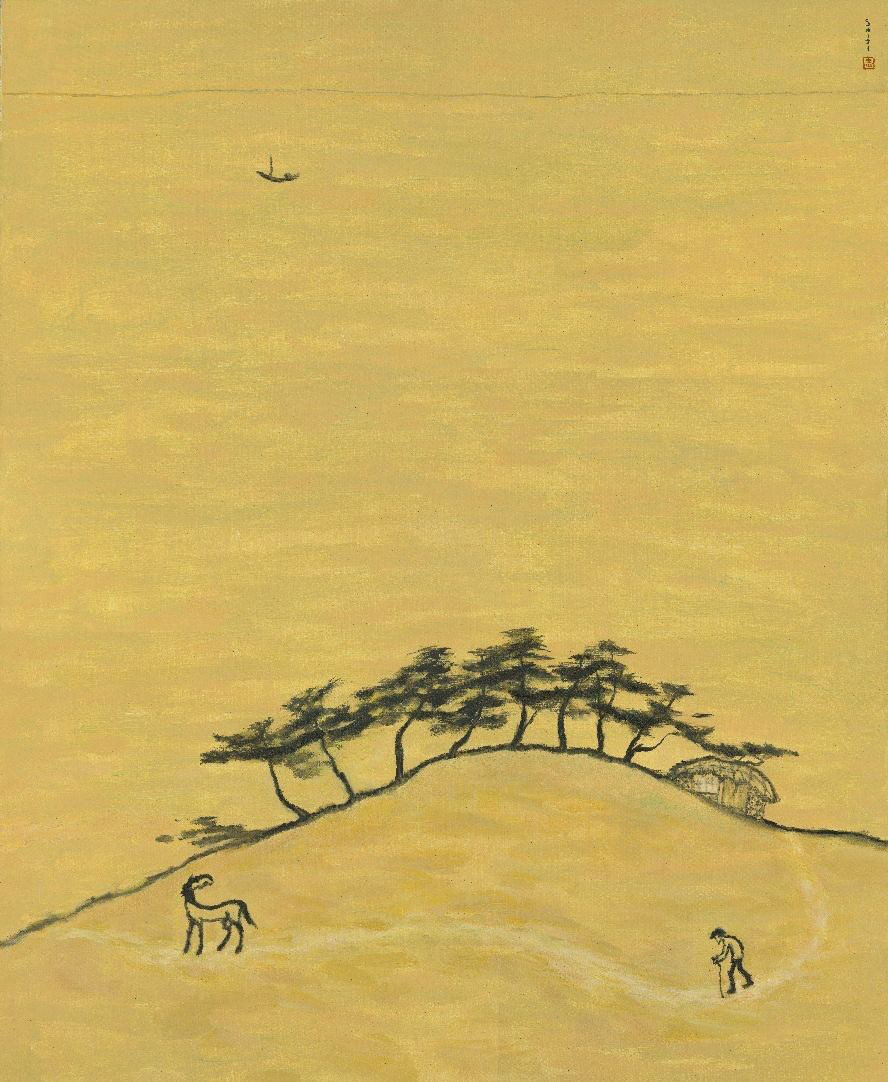
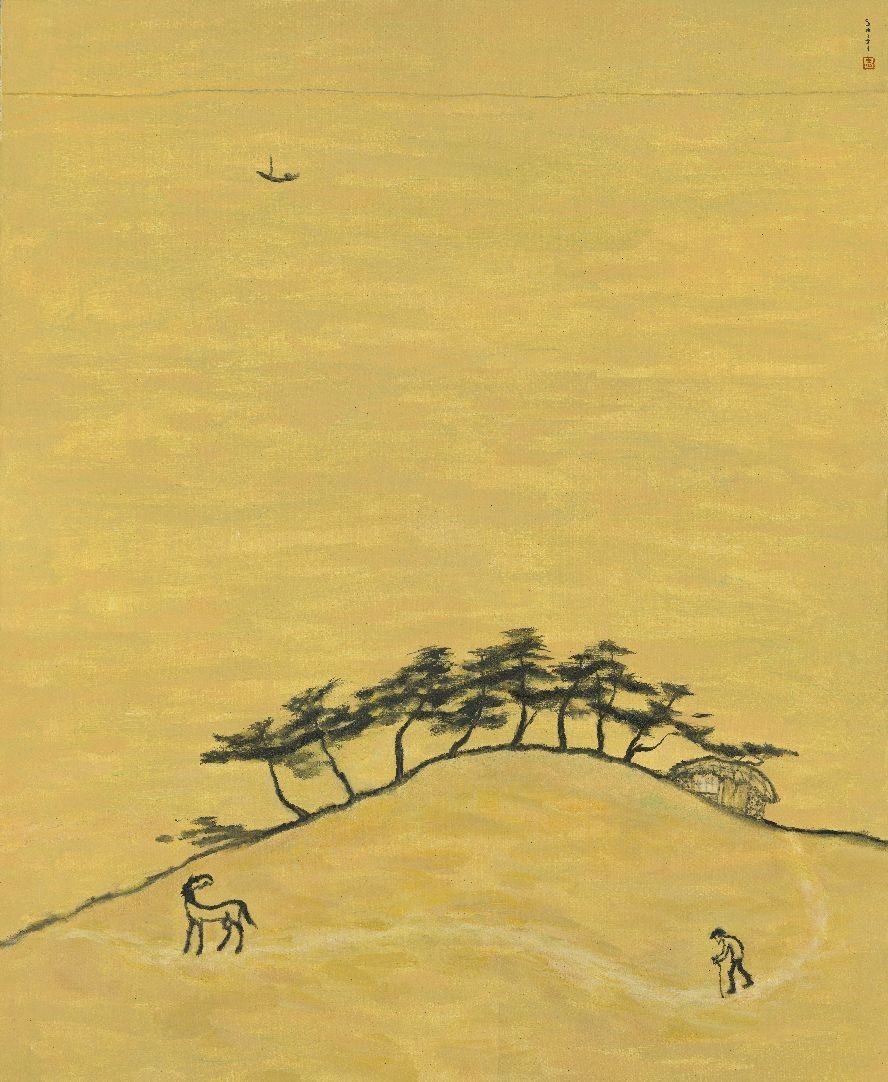
In the supplied catalogue’s Going This Way (2006), a horse on the left and a small person on the right stand apart. Behind them, trees follow the line of a rise, with a low house to the right. A small boat and thin horizon appear in the wide space above. Before declaring the absence of a destination, we should look at the distances between these forms.
A shared title does not by itself establish that this reproduction depicts the work on loan. Date, dimensions, registration number and installation photographs need to connect before a work’s history becomes secure. When a translated title changes, the original title and identifying information should remain alongside it.
Once this distinction is made, the title’s resonance can be considered. This way may imply resignation or continuing with the body one has now. Whichever reading is chosen, the distance between horse and person remains. Interpretation must lean on the picture.
Place Does Not Disappear When a Work Travels
Someone unfamiliar with Jeju may recognise something of their own time in a small body or a distant boat. That possibility does not mean there is no need to learn about Jeju. An initial feeling and subsequently learned local context can change one another.
Dried-grass colour, low houses and stone walls do not summon the same memories for everyone. One viewer encounters an unfamiliar way of life; another finds a scene resembling a childhood landscape. International resonance is less a state in which everyone feels the same than a condition in which different starting points can enter into dialogue around a work.
There is no need to write actual visitors’ feelings on their behalf to establish this possibility. What they felt is a question for interviews and records. Criticism proposes possible readings; an exhibition provides materials through which they may be reached. Resonance and testimony occupy different levels.
The Distance Translation Must Preserve
Translation in an international archive does not mean making everything unfamiliar familiar. Reducing fūdo to weather or local colour loses the relations among place, history, living and the body. Retaining the term with a brief explanation on first use is one way to preserve that difference.
Leaving a term untranslated is not enough either. Visible relations—the postures of horse and person, the distance between house and boat—need to support the concept. English terminology should not make a larger claim than the Korean original.
The work travels without its place being erased; explanation grows without closing the picture. Translation works between these two aims. It enables someone drawn in by an initial feeling to learn more precisely and return to the painting.
Different Ways of Working with Place
Goldsworthy’s Storm King Wall (1997–98) incorporates an older wall on the site and runs among trees and towards a pond. Byun’s stone walls instead appear as lines and intervals within portable canvases. Stones placed on a site and a painting that evokes a place are not the same. Their difference lets us compare how media hold onto place.
Kiefer’s Dein blondes Haar, Margarethe (1981) in the Phillips Collection uses actual straw; the collection’s account connects the work with Celan’s poetry and remembrance of the Holocaust. A documented material and historical reference must be distinguished from reading the weight of fūdo in Byun’s pictures. Not every painted storm can be made a code for a particular event.
The result of comparison is not finally a shared label. It is a clearer view of the differences among stacking stone, attaching straw to a surface and placing house and body through painted lines. Byun then neither substitutes for another artist nor becomes fully explainable through one.
Beyond a Single Centre
The Washington display is an important part of the history through which Byun’s work met new viewers. Its value did not, however, begin at the moment it was hung there. Making in Jeju, reception in Korea and exhibition abroad are connected; none invalidates the others.
The term non-Western modernism also needs care. Learning oil painting is no reason to call a work imitation, and painting Jeju alone does not establish a fully formed originality. It is more persuasive to show how particular forms of training, movement, material and judgement made a particular work.
If climatic modernism is proposed, it should likewise name an enquiry. It asks not for an inventory of regional subjects, but how lived conditions become line, colour and space. What is needed is a language that permits Jeju painting to be compared on equal terms with modern art elsewhere without erasing the differences in advance.
Leaving a Record for Another Look
When an exhibition ends, its records continue the work. Connecting original and translated titles, production details, loan records, installation photographs and labels lets later viewers examine the conditions of the encounter. Such connections carry research farther than a single line naming a famous museum.
Painting by a Korean artist is not the same as hangukhwa, a particular medium category. The fact that Byun worked in oil and the context in which his work was presented as Korean art should both remain visible. Emphasising only one obscures either the experimentation with a medium or the meaning of cultural movement.
In the supplied reproduction, the person is small at the lower right. The horse stands apart on the left. Between the two bodies, there is still room to walk.