Research/A Hundred Years of Wind/Ⅴ Life & Place
Ⅴ Life & Place · 62 / 100
Turner and Byun Shi-Ji
Where We View the Storm, and the Bodies Within It
터너와 변시지
A Vortex and Bodies Beside One Another
In Turner’s Snow Storm—Steam-Boat off a Harbour’s Mouth, a vessel occupies the centre of a vortex. Tate’s collection account focuses on the relation between that boat and its whirling surroundings. The eye searching for the vessel is drawn into the movement around it. An object and the space that makes it difficult to recognise work together.
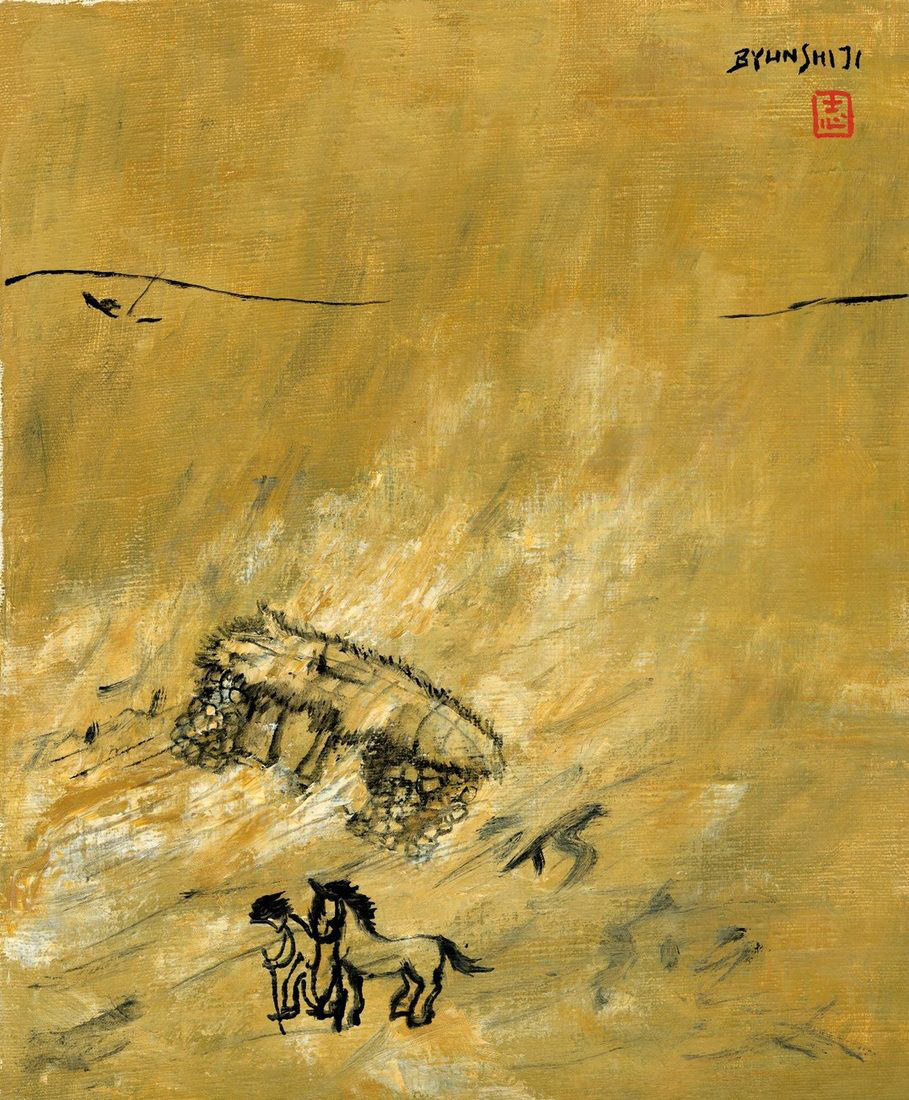
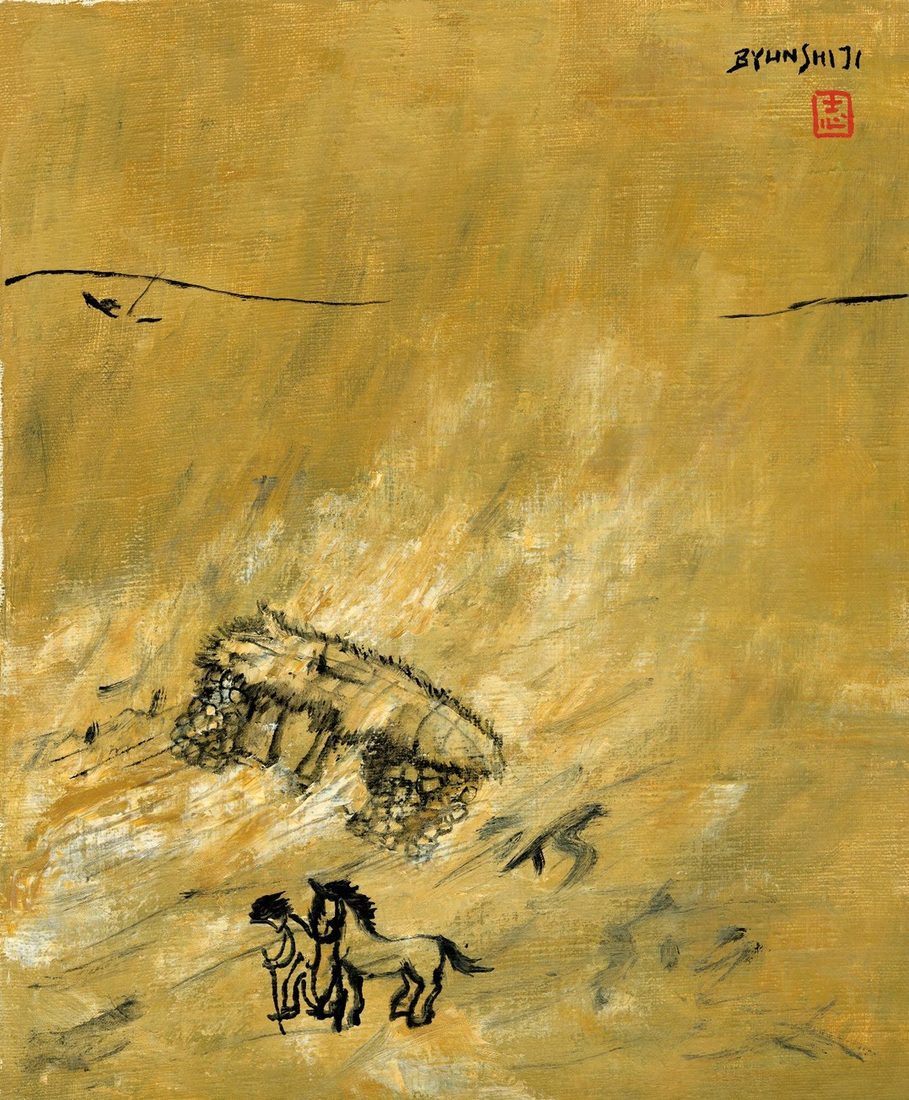
In Byun’s Stormy Seas, a person and a horse stand close beneath a low house. Slanting bright marks cut through their surroundings, while the two bodies retain comparatively distinct contours. A small boat appears far above. Within one picture, nearby bodies and a distant vessel invite thoughts of danger at different scales.
What connects the pictures is not merely the word storm. It is the problem of holding a small form within a larger movement. Turner makes us search for the vessel; Byun lets our gaze move from two nearby bodies into their surroundings. Comparison can begin with that difference in looking.
The Sublime and a Place of Safety
Burke wrote that danger and pain, when they press too closely, cannot provide delight; at certain distances and under certain conditions, another response becomes possible. The sublime concerns more than the magnitude of nature. It also concerns the position of the person looking.
The person viewing a storm in a museum is differently placed from someone who must live through it. Even while the picture’s turbulence appears beautiful, the bodies within it seem to need shelter and ground to stand on. We should look again so that the intensity of appreciation does not erase those needs.
This question remains open in both Turner and Byun. It is difficult to assign terror to one and peace to the other. The proximity of Byun’s person and horse guarantees no safety. Being beside another may not be the opposite of danger, but a relation made within a dangerous world.
An Obscured Boat, a Remaining Contour
Turner’s boat is not presented simply as a clear object detached from its surroundings. This may be read as human defeat, but the painting does not testify to the vessel’s eventual fate. Its unstable visibility first asks how confidently we can know what we are seeing.
The dark contours in Stormy Seas are not walls sealing off the outside. The person’s body and the horse’s body come close and overlap, and both are placed upon the ground. The line distinguishes forms while also making contact. A remaining contour can suggest dependence as well as independence.
It is better, then, not to translate blur as extinction and clarity as victory. Different forms keep different questions alive. One draws attention to an unstable centre; the other to a precarious contact.
Weather Made by Paint
The sensation of a storm does not arise from the subject’s name alone. What matters is the direction of marks, where a bright trace interrupts a dark form and where the density of the surface changes. Before paint describes weather, it directs the movement of the eye.
Moving between the bright diagonals and dark bodies in Stormy Seas, one senses different speeds within the space. The surroundings seem to pass quickly, while the two bodies seem to pause within that movement. This is a speed experienced in the picture, not a measurement of how long the brushwork took.
Marks visible in a reproduction cannot establish a paint recipe. Relations of direction and density can nevertheless be read without a materials analysis. Paint need not be the same substance as an actual wave. Painting’s force lies in allowing one material to evoke another.
Small Does Not Mean Absent
To see Turner’s picture as nature alone is to lose the steam-boat. The vessel is a made object and a trace of the attempt to cross the sea. The absence of visible human faces does not mean that human life has been expelled from the painting.
Nor can Byun’s small figure be diminished merely on account of its size. In Stormy Seas, the eye returns from the broad brightness to the two small bodies. What is painted large and what remains long in the mind can differ. Smallness can bring a relation closer.
At this point, describing an animal that helps a person is insufficient. The horse is also a body standing on the same ground. When we do not too quickly decide which supports which, tension remains between them. That tension may sustain attention longer than a simple promise of comfort.
Comparing London and Seogwipo
International comparison is not a procedure by which a familiar name certifies an unfamiliar one. Calling Byun a Korean Turner would instead risk losing the difference. We place the works together not to make them resemble one another, but to discover forms that looking at either alone might miss.
The story that Turner had himself lashed to a mast to experience a storm is famous, but Tate’s collection account does not establish it as fact. A powerful painting does not need a still more powerful anecdote. Byun’s testimony likewise needs to be read as a retrospective account of experience.
The positions of the two painters can be specified through works and records together. Rather than asking whose sea is truer, we ask where each painting places its viewer. A movement drawing us towards a centre and one returning us to proximity can then illuminate one another.
The Sea Between the Pictures
The sea belongs to no single aesthetic. Neither the sublime nor fūdo can explain it without remainder. These terms open entrances to looking. Beyond the entrance, we must return to colour, line and the small forms in the picture.
The gaze that searched for Turner’s boat moves towards Byun’s person and horse: from a revolving space to a slanting one, from a distant unstable centre to bodies nearby. The viewer may stand in the same place, yet the sensation of standing before a painting changes.
A person is beside the horse. Far above, the boat is small. The eye crosses the distance once more.