Research/A Hundred Years of Wind/Ⅰ Nature & Fūdo
Ⅰ Nature & Fūdo · 3 / 100
The Metaphysics of the Storm
An Unsettled Order and a Body Seeking Its Place
폭풍의 형이상학
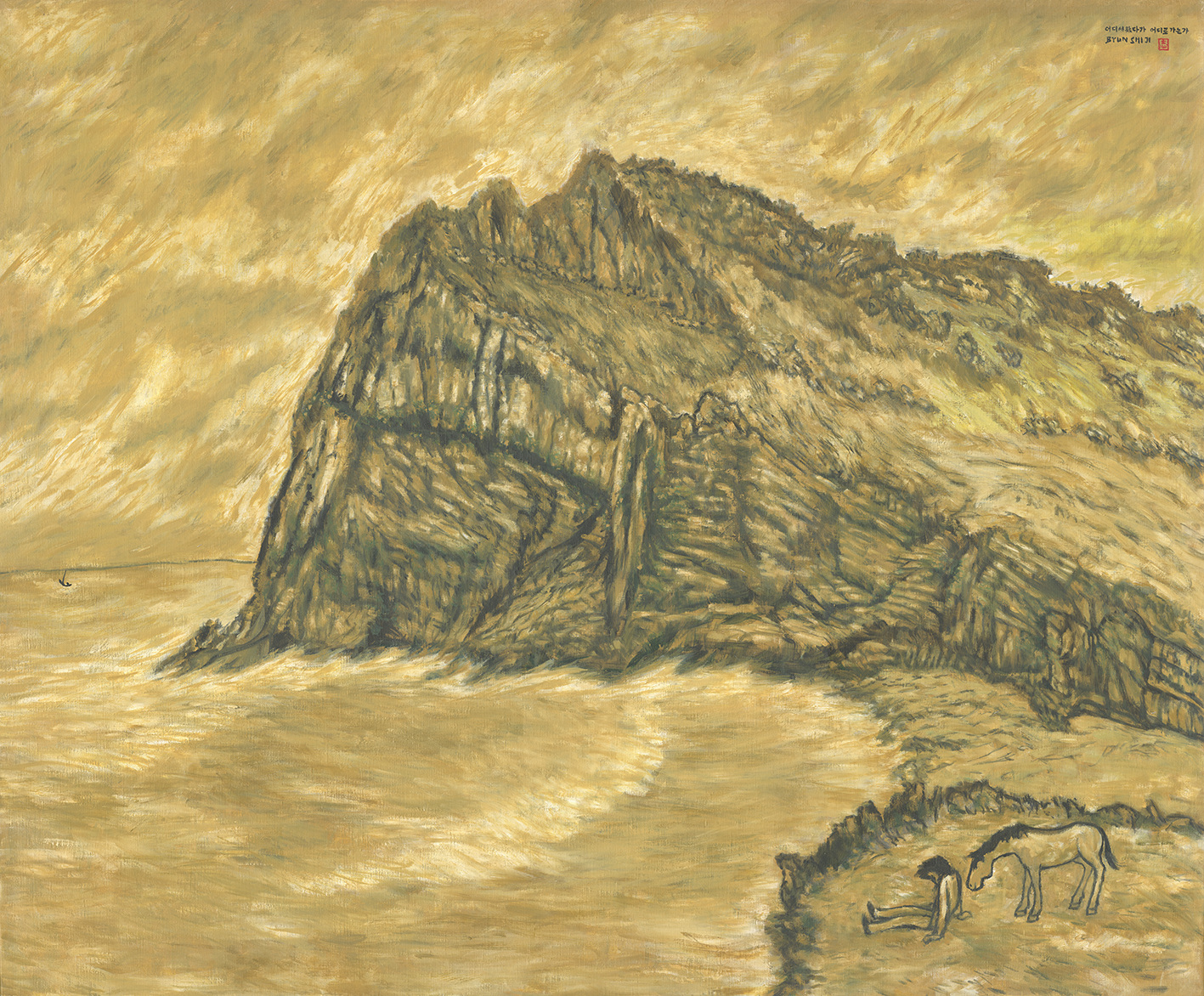
When Wind Becomes a Problem for the Whole Painting
Sensing a trace of wind and standing before a storm are different experiences. Wind may be suggested by the inclination of a single branch. In a storm, that inclination extends into other forms and distances. There are fewer stable places for the eye to rest: attention passes from a tree to the marks in the sky, then back to the roughness of the ground. The storm arises less from the sheer quantity of rough brushwork than from unsettled relations across the painting.
These relations are the starting point for reading Byun’s storms. A thick line alone does not make a storm. What matters is whether lines gather force in one direction, collide and interrupt the gaze, or surround a small form without obliterating it. Roughness has direction; density varies. The force filling the painting works together with the places it leaves open.
A storm painting is therefore not a copy of disorder. It is a pictorial order that makes disorder perceptible. The painter places and stops lines, deciding which passages to press and which to leave open. Even as we feel turbulence, the work has a form that sustains that experience. To overlook the form is to reduce the painter’s work to a trace left by nature.
Return Is Not an Instantaneous Miracle
Byun settled in Jeju in 1975, having lived and worked in Osaka, Tokyo and Seoul. These movements are an important context for his Jeju paintings. Yet knowing the year of settlement is not the same as knowing the instant in which a style took shape. To say that a single day’s typhoon demolished every earlier technique would erase the time of observation and choice that intervened.
A change of form may involve less the loss of everything learnt than a change in how that learning is used. The ability to describe a form precisely can help retain a body in a few lines. A sense of complex composition can work towards the balance of a largely open surface. Change in Jeju need not invalidate the earlier periods; it can put their resources to use in different relations.
This is also why the paintings made in Japan and Seoul should not be treated solely as unfinished steps towards the Jeju work. Each period has its own questions and achievements. The later designation painter of storms should not erase those differences. Return was not a predetermined ending, but an occasion for someone with a long practice behind him to make further choices in a new setting.
The Black Line and the Ground Left Visible
Where rough lines overlap, a pale ground can offer a momentary resting place. Its presence does not, however, resolve the storm. An open passage may make the exposure of a small body more pronounced. The same space can carry both stability and unease. Its meaning changes according to how closely the surrounding lines press upon it.
The dried-grass ground and the black line do not divide simply into warmth and coldness. A pale ground can belong to an arduous world; abundant dark lines can seem to hold a form together. What destroys and what protects are not determined in advance. Colour and line modify one another’s effects as they produce a sense of storm.
The form of the storm cannot, in this sense, be explained solely as an erasing force. It is also a force of retention. A few lines still allow us to recognise a house; a contour still suggests a body’s direction. This differs from a surface on which everything has collapsed into indistinction. For us to understand what the disturbance places at risk, some vulnerable form must remain legible.
The Position of the Viewer and the Position of the Exposed Body
In section 28 of the Critique of Judgement, Kant distinguishes being caught in actual fear from judging nature’s might from a position of safety. This distinction is useful before a storm painting. The viewer stands before the picture; the depicted figure occupies the represented storm. Their positions are not the same.
To read a triumph of spirit over nature immediately into Byun’s small figure is to forget this difference. What first appears is a small body in the presence of a great force. We do not know what the next moment will bring. The painting holds a present of exposure rather than the outcome of a victory. An eye drawn to the grandeur of the scene must return to the small place beneath the body.
This does not deny an experience of the sublime. Great natural forces may evoke wonder and fear. It asks only that admiration for the painting’s scale or intensity should not be the end of looking. Within the same picture are house and person, and a place that must be inhabited. Attention to their vulnerability can accompany the enjoyment of spectacle, but cannot be replaced by it.
A Painting That Does Not Command Endurance
A lowered posture may be read as endurance. That does not make a bent body better than an upright one. A person’s dignity cannot be assessed by whether they stand, sit or lean upon something. Nor is a life made valuable only by having survived a storm. When a painting retains a small body, our first task is to attend to the circumstances of that body.
Endurance need not appear as the single action of resisting rigidly. It can include shifting to a less exposed place, leaning on something else or stopping for a while. Read through these possibilities, the human figure remains neither a powerless object nor a hero. It is a body seeking its next posture within the forces it encounters.
The storm as a metaphor for life becomes more searching here. Rather than suggest that suffering was necessary to produce art, it asks what a person can do within conditions already encountered. Disaster is not a gift to art. The pictorial question concerns a gaze that does not lose sight of lives that must continue.
Experience Is Not the Same as Weather
A painter’s storm may bring lived memory into contact with the observation of weather. Movement between places, livelihood, bodily difficulty and relationships can make the same landscape appear different. Yet the relation between a particular event and a particular painting must be established on its own evidence. Reading every black line as a code for the same historical wound would erase differences of form between works.
Nor need we erase every historical dimension and leave only a supposedly pure nature. A painting does not come into being apart from life. What matters is not to merge a natural storm, pressures experienced by an individual and social experience into a single term. These layers can meet without proving one another. Reading particular records together with particular works is what can connect them.
With that distinction intact, a metaphysics of the storm need not announce a grand destiny behind things. What supports the order we believe to be stable? Where does a body seek a place when that order is disturbed? The painting returns these questions through overlapping lines and the spaces around small forms. As our gaze moves down again, we see the ground remaining beneath the body.