Research/A Hundred Years of Wind/Ⅰ Nature & Fūdo
Ⅰ Nature & Fūdo · 2 / 100
The Ontology of Dried-Grass Colour
Differences Within a Shared Colour
마른 풀잎색의 존재론
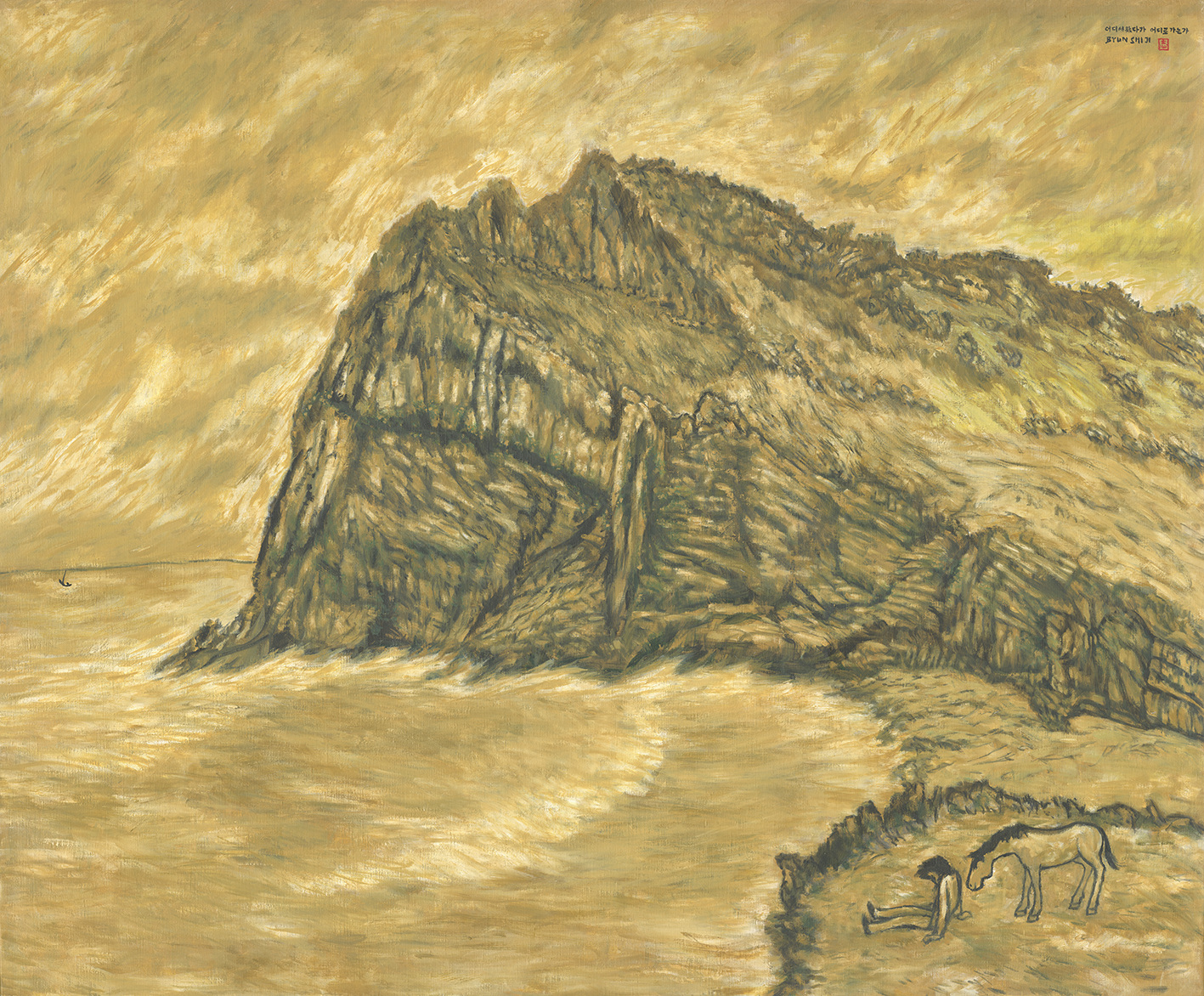
A World That First Appears as One
Viewed from a little distance, Where Do We Come From and Where Are We Going? (1992) approaches us as a single yellow-brown light. Sky, sea, the immense rock face and the small bodies below it are not sharply separated into zones of different colours. Closer looking reveals their differences. Dark marks gather in the cliff; pale brushstrokes spread across the water. A shared range of colour gives rise to unlike surfaces.
This distinction matters. To call Byun’s colour one is not to say that he used only one kind of paint. Light and dark, thickness and the direction of brush marks continue to vary across the surface. Where a painting appears to restrict the number of its colours, small differences within them can become more consequential. What first looked like a single world opens into different textures as we look longer.
This essay calls it dried-grass colour not to propose a new classification of pigment, but to read colour through a sense of time: the grass leaf exposed to sunlight and drying in the wind. Rather than dismiss ochre as a mistaken name, the phrase adds an experience that a colour name alone cannot fully convey.
When Objects Do Not Each Receive a Different Colour
The distinctions grass is green and sea is blue allow quick recognition. In Byun’s paintings, that familiar route is weakened. To distinguish water from land within a similar range of colour, we attend to the direction of lines, the density of marks and the scale of forms. Line and space take on some of the work once performed by colour differentiation. Restraint in colour gives other pictorial elements more to do.
Difference does not disappear. In the painting just considered, person and horse share a range of light with the cliff, but they do not dissolve into the same kind of being. The small bodies retain their contours and remain distinct from the weight of the rock. A common ground does less to erase difference than to make us look again at how difference arises.
We cannot immediately call this the equality of all beings. Sharing a colour does not equalise scale, weight or vulnerability. The person is small; the cliff is large. Colour places them in one world while leaving their asymmetry intact. Indeed, their difference in scale may feel more immediate because they inhabit the same light.
A world of shared colour is therefore not a world in which everything has become one. Different things remain apart without appearing wholly separate. This is less a scene of the human being disappearing into nature than one of a distinct body remaining within it. The colour’s force lies in sustaining connection and distinction at once.
Time Remaining in a Grass Leaf
A dry grass leaf carries traces of something that lived. The shape in which it once held moisture and grew remains after it has dried. Dried-grass colour therefore suggests more than age or wear: it suggests time spent changing. It calls to mind not a newly appeared light but one altered through many days.
This metaphor does not mean that the paint has actually faded in sunlight. A leaf drying and a painter producing a sense of dryness are different processes. Time here is not information about damage or discolouration; it is a sensation arising before colour and surface. Through material, a painter can evoke a duration unlike the material’s actual age.
Nor does that duration signify death alone. Before a dry grass leaf, one person may think of barrenness, another of a season gone by, another of what has lasted. When a colour does not dictate a single feeling, it leaves room for memory. Rather than command sorrow, it becomes a ground upon which different personal times can meet.
Where Looking Evokes Touch
When we describe this colour as rough or warm, we are already using more than the vocabulary of sight. The visible surface calls up sensations of the hand. The lightness of a grass leaf, the sound of turning dry paper, or the coolness of an old wall may become associated with colour. Without touching a painting, looking can invite a tactile imagination.
There is no need to restrict this response to a single national memory shared by every viewer. One person may remember the paper floor of an ondol room; another, a field after summer. What matters is that different memories can arise before the same surface. The particularity of Jeju’s fūdo opens other routes of feeling as it meets a viewer’s life.
This does not erase place. The pictorial relations among dry grass, sea, stone and lowered bodies orient the associations. They are not an unspecified warmth that might belong anywhere. The painting opens memory while bringing us back to its particular lines and things. The viewer’s life and the world made by the painter overlap without becoming identical.
Light and the Work of the Black Line
When a pale ground extends across a broad area, a painting can feel unlike a landscape illuminated from one direction alone. Light seems to remain between objects, making the whole space difficult to explain through the modelling of any one part. We might call this a light that seeps from within. The phrase describes a pictorial effect; it does not assert that the objects literally generate their own light.
The addition of a black line changes the eye’s movement. A gaze travelling across the broad colour field pauses at its edge and locates tree and body, boat and rock. While colour connects the surface, line rearticulates differences within it. The two elements do not merely perform opposed tasks: each makes the other legible.
Reducing colour does not therefore always make a painting simple. When objects are not each given a different colour, a single line has more work to do: distinguish positions, establish weight and convey distance. Fewer colours are neither a sign of poverty nor a guarantee of depth. The question is how precisely form operates within that constraint.
From a Colour’s Name to Pictorial Relations
To identify dried-grass colour directly with Jeju’s soil is to miss the complexity of the choice. An actual landscape contains many colours, and there are many ways of painting a place. Transferring its given colours and reconstructing an experience of it through a restricted palette are different acts. Byun’s colour reveals more when read as a way of seeing a place again than as its replica.
Nor need the colour be treated simply as a return to the homeland’s original hue. The painter had already encountered the light of other places and other ways of painting. The colour made upon returning can also contain the time of those movements. Return does not erase what has been learnt and restore a beginning; it can change the relations among what has been learnt.
To ask about the ontology of colour here is not to elevate a yellow-brown hue into the primal substance of the universe. It is to ask how a painting allows things to share a colour while remaining different beings. That question becomes clearer in the relative sizes of person and rock, the line between sea and sky, and the distances within a shared light than in an expansive symbolism of colour.
Look again at the painting of 1992. Below the cliff’s dark markings lies a pale expanse of water. Far away, a small boat is visible. The sea need not be blue for the water beneath the boat to retain its place.