Research/A Hundred Years of Wind/Ⅰ Nature & Fūdo
Ⅰ Nature & Fūdo · 1 / 100
The Ontology of Wind
An Unseen Force and the Bodies Within It
바람의 존재론
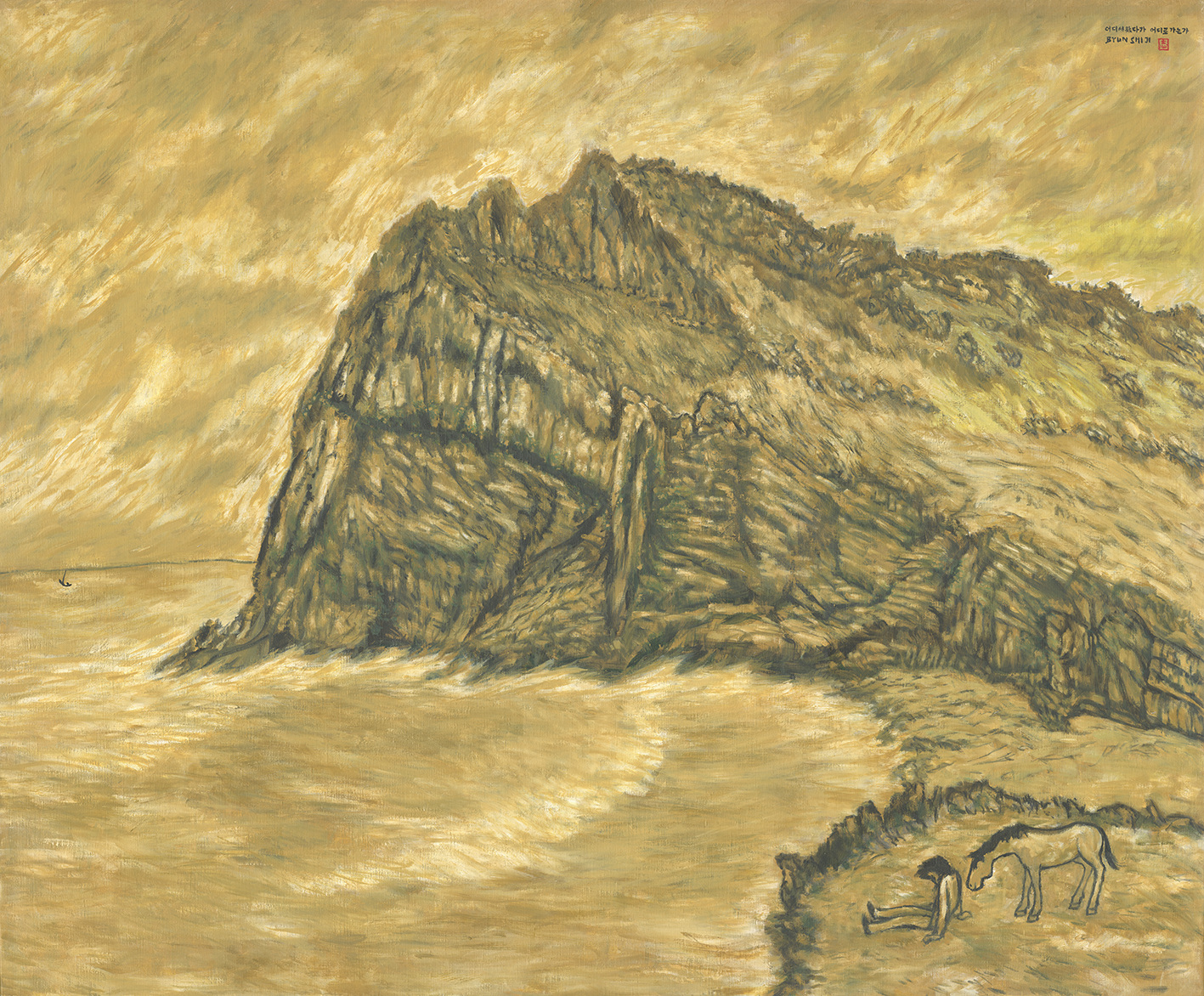
Where Is the Wind?
To find the wind in Byun Shi-Ji’s Jeju paintings, look first at the posture of things: the angle of a leaning tree, the lowered head of a horse, the place a person occupies. What first comes into view is not a separate shape called wind, but the things exposed to it. An eye attending to one object soon moves to its surroundings. We begin to ask whether the force suggested by the leaning tree also bears upon the human figure.
The painted tree does not actually sway. Yet we sense movement. Diagonals draw the eye to one side, while a similar direction recurs in different forms. This recurrence does more than place objects in a row. It brings things that are apart into the presence of a shared force. The forms painted on the canvas are still, but there is tension between them.
Wind cannot therefore be read merely as a sign attached to a single tree. We must also consider the relative sizes of tree and house, the distance between person and horse, and the space extending above them. The same incline may suggest compression in a confined setting and exposure in an open one. The roughness of a line is not the sole measure of the wind’s force. Placement and open space alter our sense of it.
The Unseen and the Absent
The unseen is not the same as the absent. Wind presents no fixed contour, yet its effects become apparent through bodies and things. This does not mean that actual wind inhabits the painting. With paint, the artist creates conditions in which its effects can be felt. A natural force and the pictorial means of suggesting that force are connected, but they are not identical.
The distinction may seem small, but it matters. If wind is called the origin of everything, every painting becomes susceptible to the same explanation. Yet a fine line in a quiet painting and overlapping lines in a turbulent one do different work. The first may suggest a balance that the slightest movement could disturb; the second, an order already unsettled. We need to attend to these differences before gathering them under one name.
To ask about the being of wind here is not to equate an invisible natural phenomenon with an ultimate philosophical Being. Must we see something directly in order to become aware of it? Can we also come to know the world through changes in another body? These are the questions at issue. Rather than posit another entity behind visible things, we read more closely the relations between things and bodies.
Encountering Oneself Within Fūdo
Wind belongs to the landscape before us, yet it also reaches the person looking. Even as we gaze at a distant mountain, our feet rest on the ground. The body that feels cold and the eye that sees a cold landscape are not separate. To read Byun’s figures through fūdo is to recognise them not as ornaments in a view, but as beings already involved with a world.
Watsuji Tetsurō’s Fūdo offers one way into this reading. The experience of cold cannot be fully explained as an independent subject observing an external temperature. We are already in the cold, experiencing it with others. From this perspective, fūdo is not a stage upon which a natural environment and human life, separately constituted, subsequently meet. It is the relational setting in which life unfolds from the outset.
In bringing this thought to Byun’s work, the point is not to conclude that climate determines a people’s character or a painter’s form. People have lived different lives, and exposure to the same wind does not produce the same painting. Watsuji enters the discussion not as a teacher whose direct influence has been established, but as an interlocutor who helps us think about body and place together.
Between fūdo and the painting lies the artist’s work: acquired skills, scenes that remain in memory, compositions revised through repetition. The wind did not move the brush in his place. Looking again at an experienced world, the painter chose what to reduce and where to retain a line. The more closely we read fūdo as a condition of life, the more closely we must attend to the choices made within it.
Where Form and Force Meet
Byun’s black line gives an object its contour while suggesting a force acting upon it. The line forming a tree also reveals its lean. A line describing a person’s back conveys the body’s weight. There is no need to deny that the line is a contour. What matters is that rendering a contour also becomes a way of suggesting the forces to which it is exposed.
In rough, sparse passages, the ground appears between brush marks. The line does not continue as an even band: it breaks, then makes contact again. Changes of thickness, blurred edges and interruptions prevent the eye from travelling at a constant speed. Rather than the painting moving, the act of looking moves. A sense of wind can arise within that changing pace of attention.
Such brushwork may recall calligraphy. Resemblance alone, however, does not establish a lineage. An impression of dryness must likewise be distinguished from the paint’s actual composition. What we can first describe is how the line makes a form recognisable while also making it seem less than fixed.
When the Body Precedes an Emotion
A leaning body may bring fatigue to mind. The lowered head of a horse may suggest a long duration of staying. Yet a lowered head does not necessarily signify sorrow. It may be a posture of balance, or a moment of rest. Emotion is not supplied as a label on the body. It takes shape gradually as our attention moves between that body and the space around it.
The same posture changes according to who or what is nearby. A horse close at hand may accentuate the smallness of a person, or make the distance between them feel like companionship. A distant boat need not be evidence of parting. It may suggest waiting or a route of everyday life. The painting’s few elements modify one another’s meanings rather than repeat a predetermined emotion.
Wind meets feeling in this uncertainty. Just as we sense an unseen force through changes in a body, we may approach an unspoken feeling through posture and distance. The experiences resemble one another, but neither proves the other. A storm does not establish anger, any more than a quiet scene establishes peace of mind.
The Time We Remain Before a Painting
Read in this way, wind becomes more than a motif. It is not weather information added beside a tree, but a way of relating the painting’s inhabitants. To attend to a small person, we take in a wide space; to register the lean of one stroke, we look back at the directions of others. Looking moves from an inventory of objects towards an experience of relations.
Within these relations, the human being stands neither alone as master of the world nor merely as a passive object subjected to nature. A body responds to force by changing its posture. The painter sees the posture and alters a line. Following the line, the viewer becomes aware of their own body. Wind can name a connection among these different movements without reducing them to one thing.
The painting does not move. The line of the tree leans to one side. We stay before it a little longer.