Research/A Hundred Years of Wind/Ⅰ Nature & Fūdo
Ⅰ Nature & Fūdo · 4 / 100
The Two Faces of the Sea
The Same Water, Different Positions in Life
바다의 두 얼굴
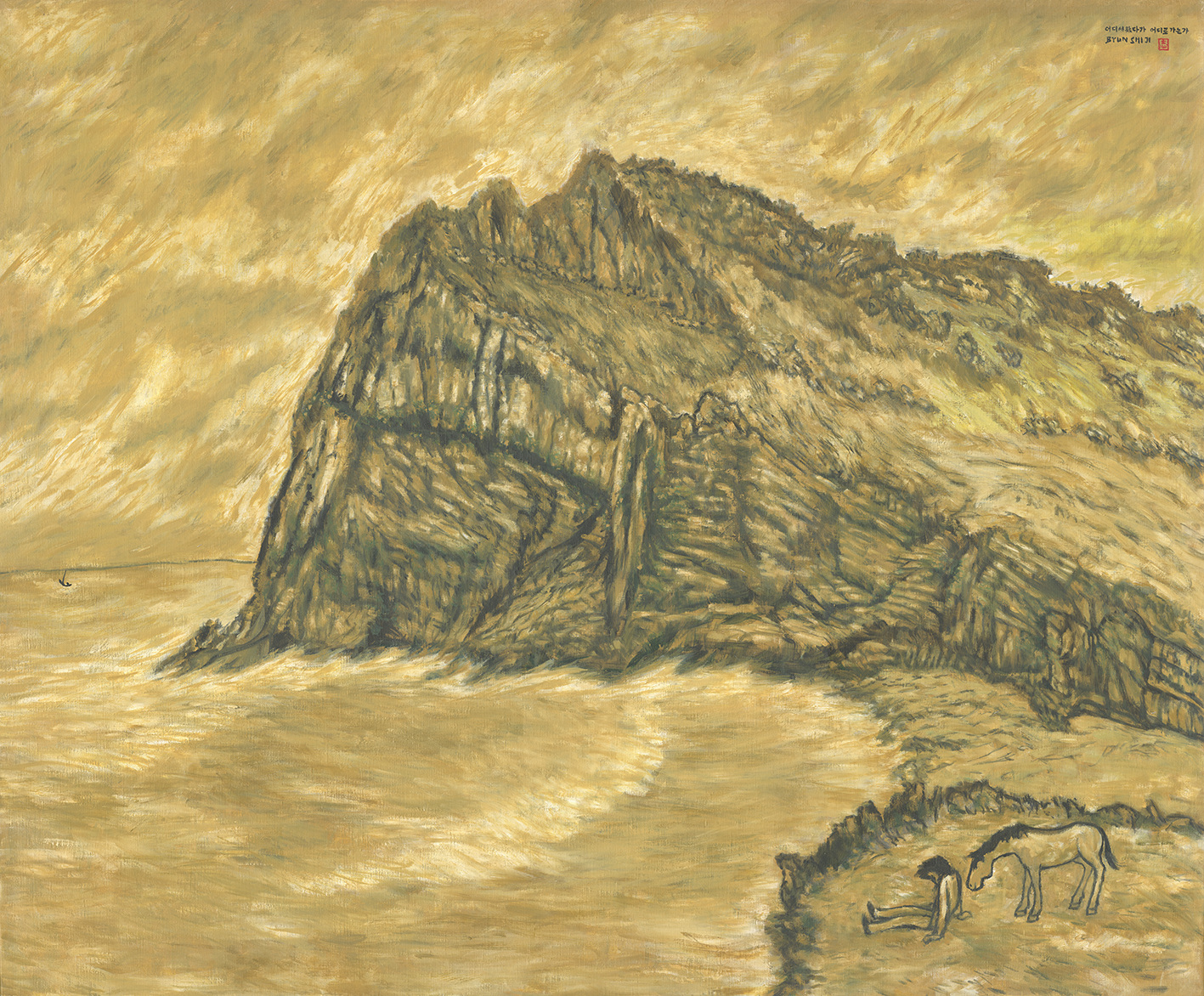
Seeing the Same Sea Differently
Byun Shi-Ji’s seas can be approached through the contrast between calm and turbulence. But calm does not simply mean peace, nor turbulence despair. A still surface may make the distance between a person and a boat feel greater. Conversely, a small form can remain distinct amid many waves and hold our attention. The sea’s appearance and human feeling do not correspond one to one.
The phrase two faces is useful not because it classifies the sea into two kinds, but because it reveals how one place can accommodate different experiences. The same water changes according to where it is seen from, what is being waited for, or whether someone must enter it. The sea is an object before the eyes and a place inseparable from the life of the person looking.
This chapter asks less which emotion the sea symbolises than how sea and person are related. Where the preceding chapter considered the force that unsettles a painting, this one considers the positions from which that force is experienced. Shore and horizon, boat and land, the person looking and the person entering the water provide its starting points.
Distance Remains Even on a Calm Surface
When fewer lines cross the water, the gaze can travel farther. If a pale area extends widely around a small boat, it is the surrounding space that first expands. A passage with fewer marks is not necessarily empty. Its extent makes the boat’s smallness and the remoteness of land perceptible.
That distance may suggest freedom, or an inability to reach something. The calmness of the water alone does not determine the difference. The positions of boat and person, the edge of the picture, and the presence of a nearby form to which the eye can return all play a part. The same stillness acquires a different weight within a composition. Feeling emerges through these relations rather than from the colour of the sea alone.
There is no need, then, to decide that every quiet painting represents the aftermath of a storm. Without a sign of that timing within the work, the events before and after remain open. One stillness may approach waiting; another may suggest an interval in work or a long afternoon. Because the story is not settled, the viewer’s own memories can move before it.
When Waves Turn the Gaze Back
In a turbulent sea, nearby lines catch the eye before it can travel far. Overlapping marks interrupt its passage, and lines running in different directions turn it back. The sea has not become less extensive, but its extent is harder to take in at once. Where distance opened in a long reach across calm water, moving through that distance now seems to require effort.
A small boat or low shoreline can then acquire a different role. It is not merely a small object set against a large sea. It offers a place where the gaze can briefly establish its position: what is on the water, what is beside it, and which way it might turn. Recognising a form among rough lines is also a way of finding direction within the picture.
The viewer may momentarily lose a comfortable distance from the sea. This is not the same as actually sharing the danger of a depicted person. Painting allows us to consider another position while leaving that difference intact. Water that looks beautiful from afar becomes, at close quarters, a force to move through. The sea’s two faces are also a difference in the distance from which it is seen.
Looking at the Sea and Working in It
This difference becomes more concrete when the Jeju sea is understood as a place of livelihood. Haenyeo diving brings the work of gathering seafood together with knowledge of the sea. Testimony recorded by UNESCO also emphasises working within the limits of one’s own breath. Before water is an image of beauty or fear, it is a condition of daily life that continually calls upon bodily capacity and judgement.
This context changes the position from which we read Byun’s marine paintings. The presence of the sea need not always place us in the position of someone enjoying a view. A body close to shore, a posture turned towards the water, or a boat separated from land can be considered within relations of daily life. Beneath the visible surface, our thoughts turn towards the time of people who must move through that water.
Livelihood should not immediately be turned into tragedy, however. Those who work at sea possess skill and judgement, and knowledge shared with others. Knowing danger does not mean living solely in fear. To fix a figure’s posture as an emblem of loss would narrow the range of that person’s capacities and daily life. The painted person should be approached as someone living a life before being made an object of pity.
The Imagination of Water Extends Beyond Two Categories
Bachelard’s Water and Dreams offers one comparative path into images of water. Even the book’s organisation treats clear and flowing waters, deep and sleeping waters, dead waters and violent waters as distinct questions. This cannot be reduced to two formulas in which calm discovers the self and turbulence loses it. Water’s material qualities extend in several directions through memory and dream.
To bring this perspective to Byun is not to assign his paintings a place as illustrations of Bachelard’s theory. It is, instead, to look more closely at differences concealed by a shared name. We attend to brightness and depth, the boundary between water and land, colours that seem to reflect and lines that interrupt the reflection. Even with the same subject, these differences call forth different acts of imagination.
Water may bring our own memories to mind. Yet if the sea becomes a mirror reflecting only those memories, the unfamiliar parts of the painting disappear. The sorrow I feel need not be the painter’s sorrow. Allowing my memory a place while also showing me a scene unlike it: a good interpretation moves between these two possibilities.
The Question an Empty Boat Leaves Open
When no one is visible in a boat, we may immediately ask who has gone. But an empty boat may not yet have left, or it may have been moored after work. A reading that recalls someone who has not returned is possible, but is not the sole fact of the picture. The boat’s orientation, its distance from land and the forms around it must come first. What is empty and why it is empty are different questions.
A sense of absence may linger longer in a place whose meaning remains unsettled. Because the painting has not concluded one person’s fate, the boat can be an object of work and an object of waiting. The sea becomes both passage and distance. One meaning need not be erased for another to emerge. Different times of daily life can gather within the same form.
Before the Same Sea Again
To paint the same sea again is not to copy the same emotion. Moving a boat slightly or altering the height of the horizon changes the world in which a person is placed. Removing one line does more than reduce the water’s movement; it remakes the distance between water and person. A subject can be painted repeatedly because its relations remain open to question even when the subject does not change.
The sea’s two faces are, in this sense, not two emotions standing opposite one another. They are different appearances of a shared world as positions of looking and ways of living change. Neither can be called the one true sea. Between them the water continues to open, and the painting gradually alters the place where we stand.
A line extends towards the horizon. The distant boat is small. Whether it is coming or going calls for a little more looking.