Research/Fūdo Is Not Landscape/Argument IX/Chapter 20
Academic edition · Fūdo Is Not Landscape · Chapter 20 · 31 / 34
The Translation of Fūdo
Pungto, Fūdo, Milieu and the Asymmetry of Translation
Argument IX · Modernity Is Located in Parallel Comparison and Asymmetric Translation
1Two Paintings in Washington
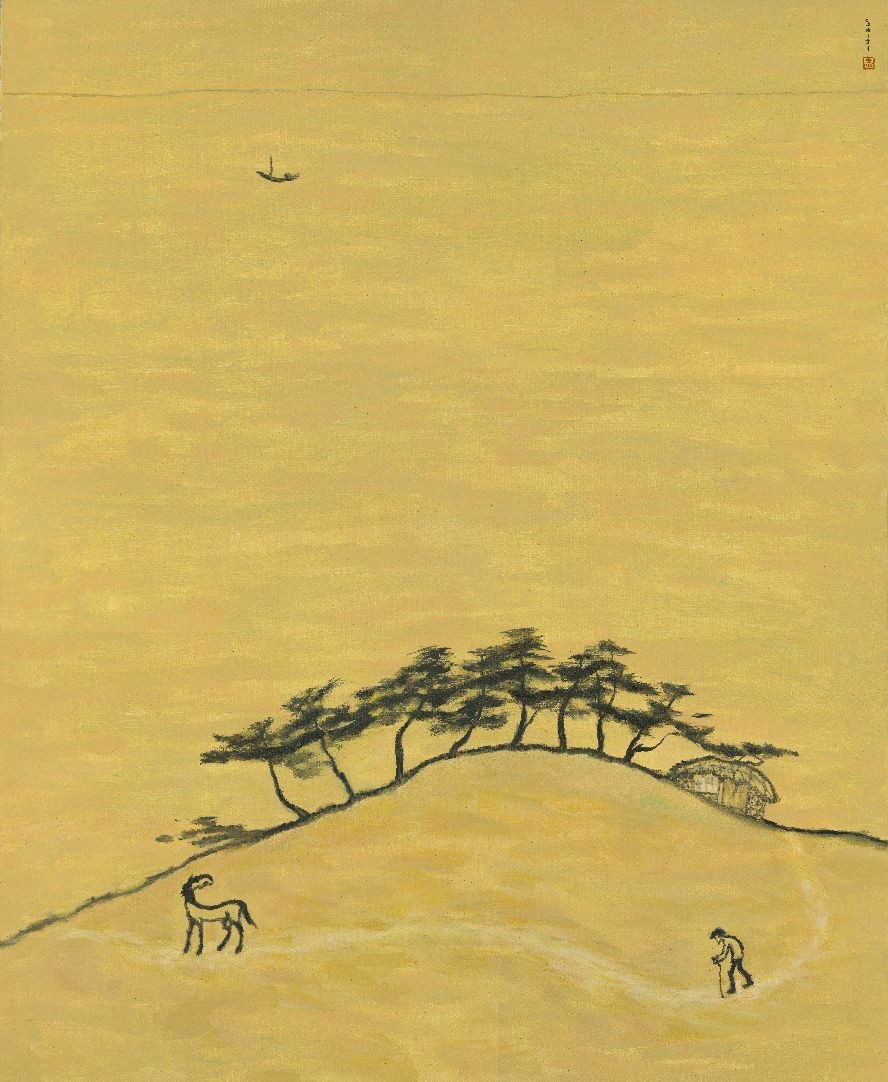
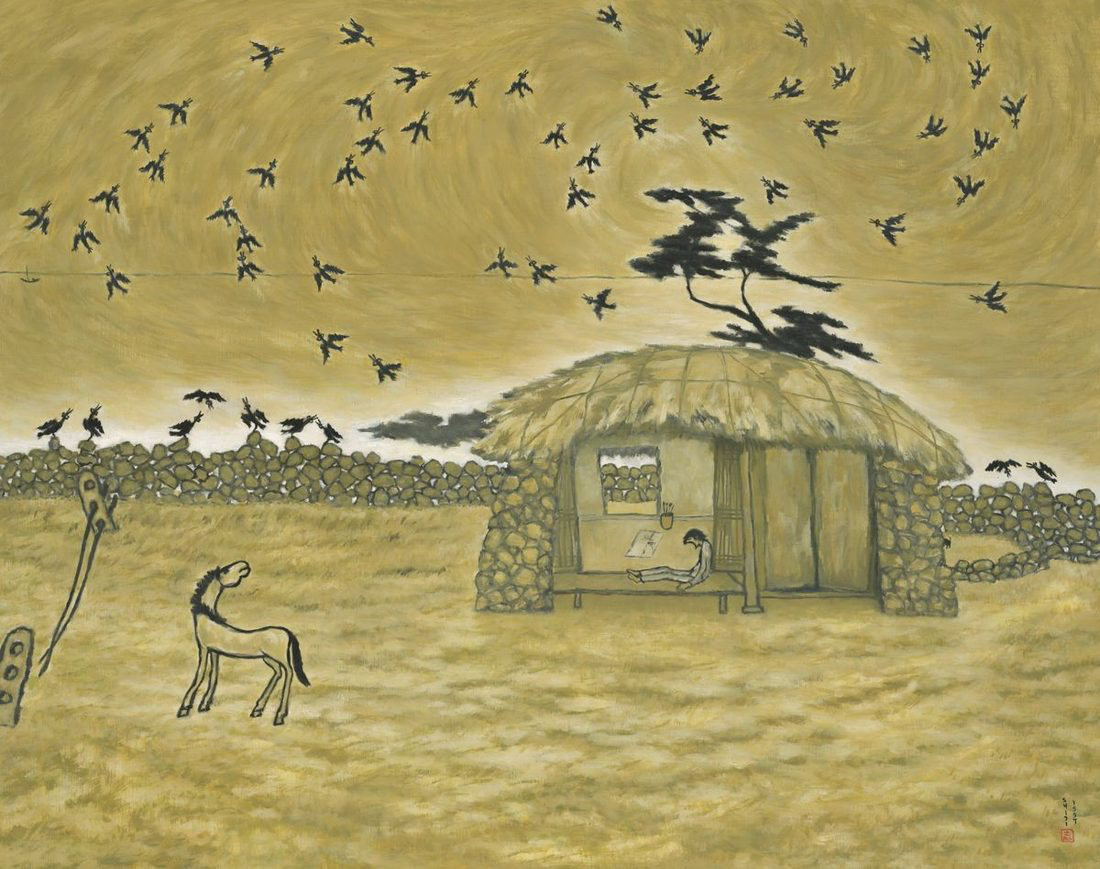
In 2007 two paintings by Byun Shi-Ji were hung in the Korea Gallery of the Smithsonian National Museum of Natural History in Washington: Boisterous Dance and Leaving Along the Path Like This (2006). In Leaving Along the Path Like This there is a low hill where several pines stand, and below it a person with a cane walks a white path. A horse stands in front, at the left of the picture, and far out at sea floats a single boat. The two works stayed there for ten years and returned in 2017.1 Articles of the time do not record in detail how the loan came about.2
The two pictures were introduced in English as “Boisterous Dance” and “Going the Way as It Is.”3 The title Idaero ganeun gil holds both acceptance and carrying on. The English title divided those two meanings between “as it is” and “going.”
Most of the people who stood before them probably did not know the word “fūdo.” Yet the pictures were there before them even without the word. Can fūdo be translated?
2Pungto, Fūdo and Milieu: The Politics of Translation and the Scope of a Concept
風土 is a Sino-Korean and Sino-Japanese word shared by Korean (pungto) and Japanese (fūdo), but the fūdo that Watsuji Tetsurō developed as a philosophical concept in Fūdo (1935) does not mean simply climate or natural environment.4 It refers to a relational structure in which human spatial and social existence and environment are not separated.
The English translation “climate” risks narrowing this relation toward weather.5 Explaining Watsuji’s fūdo, Augustin Berque proposed milieu as a more fitting translation, since milieu captures the mutual constitution of human and environment.
This problem of translation is not a mere choice of vocabulary. Translated as “climate,” the influence of the natural environment is stressed; translated as milieu, the relation in which people, things, society and place are constituted together is stressed. This difference is also why this book reads fūdo as both a “condition of life” and a “mediation of form.”
Byun Shi-Ji’s concept of fūdo, however, must not be reduced to Watsuji’s theory. There is no evidence that Byun Shi-Ji read Watsuji, and his thinking on fūdo formed within his own experience of movement, Korean modern art, life in Jeju and his reflection as an artist. Watsuji and Berque are frameworks of explanation, not evidence of origin. Of the essay of the same title in Art and Fūdo, the painter said, “that essay itself is one I had been thinking about since Japan.”6
3Pictorial Translation: Form Before Words
When a picture crosses a border, what moves first is not the concept but the form. The leaning line, the color of dried grass, the distant boat, the low house and the wide empty space are perceived even by viewers who do not know the word “fūdo.”
But that something is seen does not mean it is read with the same meaning. Carole Neves’s reading of wind in the stone walls, bent pines and waves is one case of translation.7 Her interpretation is not wholly identical with the lived experience of Jeju, but it shows that form can be reconstituted in the language of another culture.
The choice to render mareun pullipsaek in English as “the color of dried grass” reveals the same problem. If “ochre” stresses pigment and the category of hue, “dried grass” calls up the process of sun, drying and time. Translation is not the copying of identity but a critical act of deciding which layer of meaning to put first. The metaphors of translation theory that presuppose not full equivalence but contact and misalignment also explain this.8
4Asymmetric Translation Between the Local and the Global
Byun Shi-Ji held that looking at a work is not completed by the transmission of knowledge alone, and that the viewer adds his or her own experience.9 From this viewpoint, international reception cannot be reduced to a test of “whether Jeju was understood correctly.”
At the same time, it cannot be said that all interpretations are equal. Readings that conflict with the work’s iconography, the artist’s records and the context of Jeju’s life history must be examined critically. Universality is not a free projection that erases context; it forms in the tension between context and the experience of viewing.
The artist’s saying, “What is most local is most universal,”10 is better read not as a declaration that regionality automatically acquires universality, but as a claim that concreteness irreplaceable in any other place becomes, rather, the starting point of translation.
The universality of fūdo is not the extension of sameness but a state in which translatability and untranslatability remain together.
5An International Language for Fūdo Modernism
In English this book first presents pungto, the romanization of the Korean 풍토, and uses milieu in explaining the concept. The analytical term fūdo modernism, too, is not fixed as a proper name of a movement but spelled out according to context as “a modernism of milieu.” “Climate” carries a strong sense of climatic determinism and is not used as the key translation. This notation, however, is limited to this book, which deals with the concept. The same author’s general-reader edition, A Modernism That Does Not Fight, and the byunshiji.org archive use Fūdo. For general readers and archive searches the established name is kept; in the academic edition, which examines the concept’s sources and translation, pungto and milieu are used. The two notations do not correct each other but divide by use. (This web edition, published on the byunshiji.org archive, follows the archive and uses Fūdo.)
The Japanese romanization fūdo is kept only when referring directly to Watsuji’s concept. In explaining Byun Shi-Ji’s fūdo internationally, the Korean pungto and milieu, which brings out the relational meaning, are used distinctly. The translation is not fixed to one word so as not to confuse the historical source of the concept with the meaning newly constituted in the works.
The meaning of Byun Shi-Ji’s pictures within world art history also lies here. They are not the result of refining the regional marker of Jeju into a universal style, but a case revealing the process by which regional experience is translated into pictorial form and can then be interpreted again in other places.
Fūdo is never fully translated. But form lets translation begin.
Notes and sources
- ↑ Kwon Mee-yoo, “Byun Shi-ji’s works return from Smithsonian,” The Korea Times, 22 August 2017; Park Yuna, “Modern artist Byun Shi-ji offers comfort revealing severe loneliness in paintings,” The Korea Herald, 21 October 2020. Both articles give the National Museum of Natural History, a ten-year loan from 2007 and the return in 2017. The name Korea Gallery appears in The Korea Times. Hong Seong-hu also gives a permanent display from 2007. Leaving Along the Path Like This measures 112 × 162 cm (plate caption in the 2022 reissue of Art and Fūdo). The byunshiji.org 100 Works gives Boisterous Dance as a 1997 work (FŪDO 097), and Leaving Along the Path Like This (2006) is FŪDO 054. The canvas of Leaving Along the Path Like This (a hill with pines, a person with a cane on a white path, a horse in front at left, a boat far out at sea) is checked against that plate.
- ↑ The Korea Times, 22 August 2017. It states that Neves, then director of policy analysis at the Smithsonian, came to know the painter on a visit to Jeju. Neither article records how the exhibition came about.
- ↑ The English titles in the two articles. The Korea Times gives “Going the way as it is.”
- ↑ 和辻哲郎, 『風土 — 人間学的考察』 (Iwanami Shoten, 1935). The text paraphrases the opening definition: “ある土地の気候、気象、地質、地味、地形、景観などの総称” (“a general term for the climate, weather, geology, soil fertility, topography, scenery and so on of a given land”). In the text, “weather” renders 気象; “the nature of land and soil,” 地質 and 地味; “the shape and scenery of the land,” 地形 and 景観. 地味 refers to the fertility of the land. On fūdo treated not as natural environment but as “the immediate facts of everyday life,” see the symposium record of the Graduate School of Letters, Kyoto University, “The Possibilities and Problems of Watsuji Tetsurō’s Theory of Fūdo.”
- ↑ Watsuji Tetsurō, A Climate: A Philosophical Study, trans. Geoffrey Bownas (Tokyo: Ministry of Education, 1961); revised edition Climate and Culture: A Philosophical Study (New York: Greenwood Press, 1988). Watsuji Tetsurô, Fûdo, le milieu humain, commentaire et traduction par Augustin Berque (Paris: CNRS Éditions, 2011). Bibliography of the English translations follows the Stanford Encyclopedia of Philosophy, “Watsuji Tetsurō.” In Korean romanization the word is pungto.
- ↑ Byun Shi-Ji Oral History Transcript (Korean Modern and Contemporary Art History Oral History Project; interviewer and researcher Lee In-bum), sixth session (19 January 2005), p. 255. Of the essay of the same title in Art and Fūdo he said, “That essay itself is one I had been thinking about since Japan.” The interviewer mentioned that the books of Hippolyte Taine (1828–1893) were translated and widely read in 1930s Japan and asked whether it concerned fūdo; he answered, “France? I don’t really know.” In Philosophy of Art Taine explained art by race, milieu and moment.
- ↑ Carole Neves (director of policy analysis, Smithsonian Institution), “The Painter and the Sea: Byun Shi-Ji.” Original English: “well worn stone walls, crooked pine trees, and assorted patterns of waves”; on colour, “The color ochre, Byun noted, is the color of the sea when the natural light reaches a peak”; the painter’s words, “To appreciate art, the viewer needs to look at a work of art and add his or her meaning. In sum, works of art are co-created by artists and spectators.”
- ↑ Walter Benjamin, “Die Aufgabe des Übersetzers” (The Task of the Translator, 1923). The text paraphrases this passage: “Wie die Tangente den Kreis flüchtig und nur in einem Punkte berührt… so berührt die Übersetzung flüchtig und nur in dem unendlich kleinen Punkte des Sinnes das Original, um… ihre eigenste Bahn zu verfolgen.”
- ↑ Byun Shi-Ji, Art and Fūdo (Youlhwadang, 1988), “Knowing a Work and Tasting It.”
- ↑ Byun Shi-Ji Oral History Transcript, sixth session, p. 275. His answer after the interviewer summarized a review, ending: “…what is most local can become what is most universal—that’s the idea, I suppose.”
Contents · Fūdo Is Not Landscape Key Terms and Analytical Categories → Bibliography →