Research/Fūdo Is Not Landscape/Argument IX/Chapter 19
Academic edition · Fūdo Is Not Landscape · Chapter 19 · 30 / 34
Modernism Rewritten from the Margins
Jeju, Korean Contemporary Art, Decentring
Argument IX · Modernity Is Located in Parallel Comparison and Asymmetric Translation
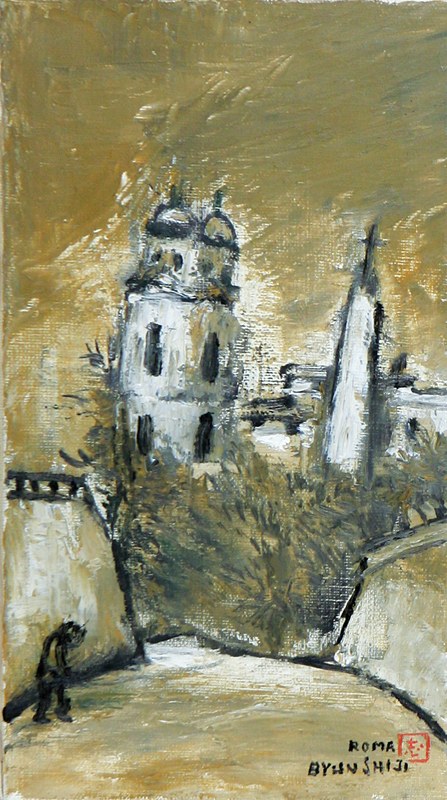
1The Fūdo of Rome
In October 1981 his paintings hung at the Galleria Astrolabio in Rome. It was an exhibition the gallery organized by invitation.1 He left the exhibition to the gallery and set off to sketch. He went south from Rome as far as the seaside town of Sorrento, and to France as well.2
Later he said of Rome at that time: “That fūdo is what matters.” In a place like Rome, he said, everything one sees is artistic, so everything one paints becomes a work.3
For him fūdo was not something found only in Jeju. Where, among the world’s art, do his pictures, grown in the fūdo of Jeju, stand?
2Not from Centre to Periphery, but Rewriting from the Margins
Twentieth-century art history long produced a linear narrative in which innovations arising in central cities spread to the periphery.4
Partha Mitter’s discussion of decentring criticizes the view that reads non-Western art as a belated derivative of the Western canon.5 Neighbouring discussions that have raised the plurality of modernity and the provincializing of European categories have posed the same problem in other disciplines.6 7
This view lets us see Byun Shi-Ji not only as a “regional variant” of styles learned in Japan and Europe, but as a case in which the problems of modern painting were newly constituted in Jeju.
Byun Shi-Ji’s own writing has sentences that resonate with this. While speaking of a common undercurrent beneath the diversity of modern art, he held that the conditions of people, era and climate become the matrix of art. He did not set the universal and the local as mutually exclusive.8
In this book, then, modernism is understood not as a list of styles but as a historical field that constantly re-examines the relations of representation, flatness, colour, line, medium and subject. Byun Shi-Ji’s place is not where the centre was imitated at the edge of that field, but where its questions were reconstituted under different conditions.
3Form Moves, and Place Transforms Form
On his 1981 European journey he painted the landscapes of Rome, Sorrento and France in his own technique, and on returning transferred the sketches into oil.9 Neves wrote that the technique of some of these European pictures foreshadows his later Jeju paintings.10 What matters is what differences the same hand and technique make as they pass through different places.
Conversely, his recollection that the images of architecture and cities he saw in Europe made him see the buildings of Jeju National University anew shows that sight did not move in one direction only.3 It was not that style was transmitted from centre to periphery; experience passing through many places renewed each place’s visuality.
Such two-way movement lets us see fūdo modernism not as an isolated regionalism but as a process of movement and reconstruction.
4Comparative Art History: Different Ways the Land Becomes Form
The purpose of setting the work of Anselm Kiefer and Andy Goldsworthy beside Byun Shi-Ji is not to tie the three artists into one category. The question of the comparison is one: through what mediation does place become the form of the work in each case?
In Kiefer’s work the land appears as historical memory and the weight of matter. Materials such as photographs, sand, straw and lead materialize German history and the scars of the land.11 Place adheres to the surface as actual matter.
In Goldsworthy’s site-specific work, local materials such as stone, ice and leaves and the act of making combine directly with the time of a place. The work arises as an event within the place rather than depicting it.12
In Byun Shi-Ji’s case, place does not enter by attaching earth or stone to the canvas. Through long dwelling and repeated observation it is converted into a pictorial grammar: the tilt of the line, the convergence of colour, the reduction of figures, the widening of empty space. He wrote that what was permitted to him was “to live silently in nature, to be moved by nature and to think, and to carry on formal activity.”13
The differences among the three artists show that “placeness” is not one style but has various structures of mediation. Byun Shi-Ji’s distinctiveness lies less in the matter of place itself than in the translation between a body that lived a place and pictorial form.
5The Place of Fūdo Modernism
In Rome he said he had come not so much to sell works as to show them.14 After returning from Europe he said he had gained confidence in the pictures he painted in Jeju.15 There is no need to read these statements as the modesty of a peripheral painter. They can rather be seen as an attitude of testing how his work looks within another field of art.
Fūdo modernism is not a project to reject the centre or to set up a new centre. Nor is it the same concept as the “aesthetics of not fighting” of chapter 16. But there is a structural similarity, in that it does not take a single centre as the only norm and compares the forms of different places while keeping their differences. Fūdo modernism is an analytical framework that does not set the standard of modernism as a norm derived from a single centre, but compares how form is newly constituted in different places.
The regionality of Jeju, then, is not a trace to be removed in order to enter world art history. It is rather the concrete condition that makes international comparison possible. The task is to explain regionality not by mythologizing it as an essence of “uniqueness” but as a process of formal transformation.
The form grown in the fūdo of Jeju is not cut off from the world; it enters into an asymmetric but equal relation of comparison with the forms of other places.
Notes and sources
- ↑ Byun Shi-Ji Oral History Transcript (Korean Modern and Contemporary Art History Oral History Project; interviewer and researcher Lee In-bum), personal details and career: 6–20 October 1981, 16th Byun Shi-Ji Invitational Exhibition (Galleria Astrolabio, Rome, Italy).
- ↑ Same transcript, sixth session (19 January 2005), p. 266. He said his original purpose was less the exhibition than travelling around Europe to sketch.
- ↑ Same transcript, sixth session, pp. 267–268.
- ↑ One often-cited example is the chart Alfred H. Barr Jr. of the Museum of Modern Art, New York, placed on the cover of the catalogue for the 1936 exhibition Cubism and Abstract Art. It drew modern art as a single stream of European currents linked by arrows.
- ↑ Partha Mitter, "Decentering Modernism: Art History and Avant-Garde Art from the Periphery," The Art Bulletin 90, no. 4 (2008): 531–548.
- ↑ S. N. Eisenstadt, “Multiple Modernities,” Daedalus 129, no. 1 (Winter 2000), pp. 1–29. The text paraphrases these passages: “modernity and Westernization are not identical; Western patterns of modernity are not the only ‘authentic’ modernities” (p. 3); “a story of continual constitution and reconstitution of a multiplicity of cultural programs” (p. 2). Shmuel N. Eisenstadt (1923–2010) was an Israeli sociologist.
- ↑ Dipesh Chakrabarty, Provincializing Europe: Postcolonial Thought and Historical Difference (Princeton, NJ: Princeton University Press, 2000).
- ↑ Byun Shi-Ji, Art and Fūdo (Youlhwadang, 1988), “Art and Fūdo,” in the section “Living in Jeju.” “Undercurrent” (底流) and “formal activity” (造形活動) follow the book’s wording.
- ↑ Byun Shi-Ji Oral History Transcript, sixth session, p. 267. Useong Byun Shi-Ji: European Travel Paintings (Samhwa Publishing, 1982).
- ↑ Carole Neves (director of policy analysis, Smithsonian Institution), “The Painter and the Sea: Byun Shi-Ji.” Original English: “The technique utilized in a number of these works foreshadows his subsequent paintings of Jeju.”
- ↑ Anselm Kiefer (b. 1945), Ways: March Sand (Wege: märkischer Sand, 1980), oil, emulsion, shellac, gelatin silver print, sand and charcoal on linen, 285.2 × 440.7 cm, San Francisco Museum of Modern Art (Doris and Donald Fisher Collection). Materials and dimensions follow the museum’s collection description (accessed 29 September 2026). Kiefer was born in Donaueschingen, Germany, in 1945 and has worked in France since 1992.
- ↑ Andy Goldsworthy (b. 1956), Storm King Wall (1997–98), fieldstone, 152.4 cm × 694.5 m × 81.3 cm, Storm King Art Center, New Windsor, New York (accession no. 1998.1). According to the Art Center’s collection description (accessed 29 September 2026), it was built without mortar by five British wallers, and grew from a planned 750 feet to wind through the trees, enter a pond and continue to the western boundary. The quotation paraphrases Goldsworthy’s words in the same description: “A good wall is drawn, it expresses the landscape through which it travels.”
- ↑ Art and Fūdo, “Natural Beauty and the Artistic Impulse,” in the section “Living in Jeju.” Hong Seong-hu quotes almost the same sentence from Byun Shi-Ji, “Following Mountains, Following Water,” Jeju Sinmun, 2 August 1979.
- ↑ Byun Shi-Ji Oral History Transcript, sixth session, p. 268.
- ↑ Same transcript, sixth session, p. 270.
Contents · Fūdo Is Not Landscape Key Terms and Analytical Categories → Bibliography →