Research/Fūdo Is Not Landscape/Conclusion
Academic edition · Fūdo Is Not Landscape · Conclusion · 32 / 34
When Fūdo Becomes Form
Exile, Blessing, and the Place of Painting
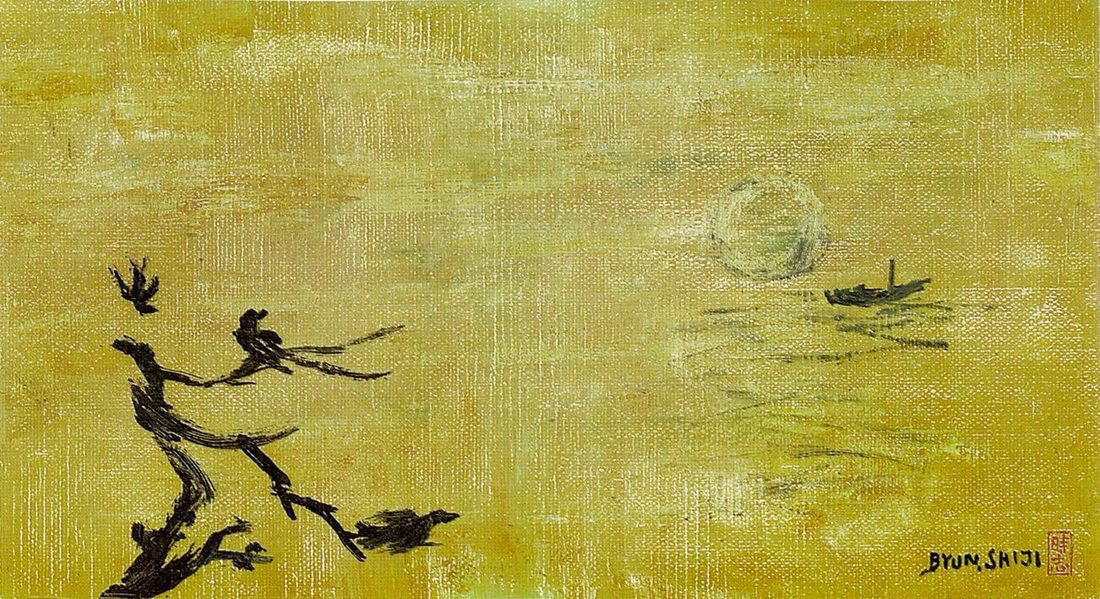
1A Shore Without People
A picture painted in 1979 is recorded in the original sources under the title A Lively Half-Day by the Sea.1 It is also listed in a catalogue of works under the shorter title A Lively Day. Yet there are no people in the picture.
That does not mean the shore is empty. On the left stands a dry tree, and on its branches three crows perch or alight. Over the water on the right the sun hangs low, leaving light on the waves, and a little below and to its right is a small boat. There are no people, but the picture is not still.
This misalignment between title and canvas is the starting point of the conclusion.
2Exile as a Figure of Speech
The painter called his life exile, and the work of painting a blessing.2 This book takes the relation between these two words as one axis.
Exile was originally a punishment that sent offenders to distant places. Byun Shi-Ji never received such a punishment. So the “exile” he spoke of is not the name of a historical fact. It is a figure of speech he borrowed for a state of life: being away from home, and not fully reaching it even after returning.
His life ran from Jeju to Osaka, Tokyo and Seoul, and back to Jeju. The childhood move, art study in Japan, life in Seoul and settling in Jeju in 1975 each had their own circumstances. It was the painter himself who bound these with the one word “exile.” How much of this life, and which parts, that word should be read across is this book’s interpretation. This is stated first.
3The Protagonist of Liveliness
The sea is the sea even without people.
Then the “liveliness” of the title may not refer only to a human mood. It may name the movement of the world that continues even where there are no people. Read this way, the protagonist of liveliness widens from people alone to sea and wind—to fūdo. The person takes a step back from the centre of the picture.
Even without people, fūdo remains. The introduction began with an old man on a hill, and in many chapters of Arguments VI–VIII (chapters 12–17) bodies bent and grew low. In this picture even that person is absent. But this picture was painted only four years after he came to Jeju. The canvas without people is not a conclusion of his last years. This book has merely placed it at the end.
4Not Aestheticizing Exile
These words—calling his life exile and the work of painting a blessing—are powerful but dangerous. Read as a romantic narrative in which the artist’s suffering itself becomes the value of the work, distance from family, illness, the violence of an era and the realities of labour can be consumed as aesthetic resources.
This book’s conclusion is the opposite. Hardship is not form. Between hardship and the work lie repeated labour, habits of observation, choices of material, erasing and overpainting, time spent staying in a place. Conditions of life become art only when they pass through the mediation of work.
“Blessing,” then, can be understood not as compensation for suffering but as a capacity for transformation that work made possible. It can be set beside philosophical traditions that accept or affirm unavoidable conditions,3 4 but Byun Shi-Ji’s “blessing” differs in that it does not stop at acceptance but continues into work. Not because the time of exile was beautiful, but because the act of transforming that time into line, colour, empty space and posture went on.
This distinction preserves the aesthetic meaning of his motto without mythologizing Byun Shi-Ji’s painting.
5Conclusion: When Fūdo Becomes Form
This book has moved the reading of Byun Shi-Ji’s Jeju painting from “pictures depicting Jeju” to “painting formed in Jeju.” Fūdo was not the background of iconography but a condition that reorganized form by mediating perception and body, work and memory.
As a result, the horizon moves from a fixed coordinate to a wavering eye level; the color of dried grass, from a marker of place to a colour of time; the black line, from outline to a record of force and posture; empty space, from lack to a field that makes relation possible. The bent body and the low house, the still horse and the empty boat are transformations of this form inscribed in different beings. The form that does not try to defeat the forces of nature yet does not vanish this book calls “the aesthetics of not fighting,” and the layer where the artist’s memory of the forces of his era meets that form it calls “the posture of resistance.”
This form did not arise by breaking with the modern painting learned in Japan. It is the result of the figure painting of Osaka and Tokyo, the close observation of Seoul’s Biwon and long dwelling in Jeju overlapping and transforming one another. Byun Shi-Ji’s modernism should therefore be seen not as a case of the provincial reception of a central style, but as a case in which skills that moved were reconstituted in a particular fūdo.
Fūdo is not landscape. Fūdo is not an explanation outside the work but the condition of relation through which the work’s lines and colours, bodies and empty places came to exist as they do. The sustained work of turning this condition into form—that is the form of modernism this book has found in Byun Shi-Ji’s painting.
He called his life exile, and the work of painting a blessing. Between the two there was work.
Notes and sources
- ↑ A Lively Half-Day by the Sea (1979). The canvas is checked against the plate in the byunshiji.org 100 Works (FŪDO 080).
- ↑ In his lifetime the painter called his life “exile” and the work of painting “a blessing.” The author (his son) heard these words directly (author’s confirmation, 29 September 2026). The sentence “Life is exile, art is blessing” does not appear verbatim in the oral history transcript or in Art and Fūdo. In the oral history he spoke several times of Jeju as a place of exile in the Joseon period (seventh session, pp. 303, 306–307), and said that when he went to Jeju in 1975 people regarded it as if he were going into exile (third session, p. 140). The sentence has not been found verbatim in the transcription of the handwritten manuscripts either (excluding the letters and the oral history PDF). The oral history PDF has not been transcribed page by page, so checking remains.
- ↑ Zhuangzi, “In the World of Men” (人間世): “知其不可奈何而安之若命 德之至也” (“To know what cannot be helped and accept it as fate—this is the height of virtue”).
- ↑ The German philosopher Nietzsche (1844–1900) speaks of amor fati in section 276 of The Gay Science. As an attitude seeking to affirm even the unavoidable conditions of life, it can be set beside the question of this chapter. It does not imply influence on Byun Shi-Ji. However, handwritten Notebook 2 (image Image_20240121_0040) copies Nietzsche’s words, “We have art lest we perish of the truth” (high legibility). It can be confirmed only that the painter wrote these words in his notes; how they connect with the “blessing” of this chapter cannot be said.
Contents · Fūdo Is Not Landscape Key Terms and Analytical Categories → Bibliography →