Research/Fūdo Is Not Landscape/Argument VIII/Chapter 17
Academic edition · Fūdo Is Not Landscape · Chapter 17 · 27 / 34
Loss and Waiting
Staying Beside and Waiting
Argument VIII · Not Fighting, Yet Not Disappearing
In Ieodo (1980) there is a crow beside an empty boat. In A Long, Long Longing (1981) a person sits reaching a fishing rod without a line toward the sea. Both canvases, painted a year apart, hold something that cannot be reached. This chapter places the two pictures in one chapter and asks in what posture the body remains before what has been lost and what has not yet come.
Case AThe Empty Boat and the Crow — The Space of Loss and Adjacency
1A Bird Beside an Empty Boat
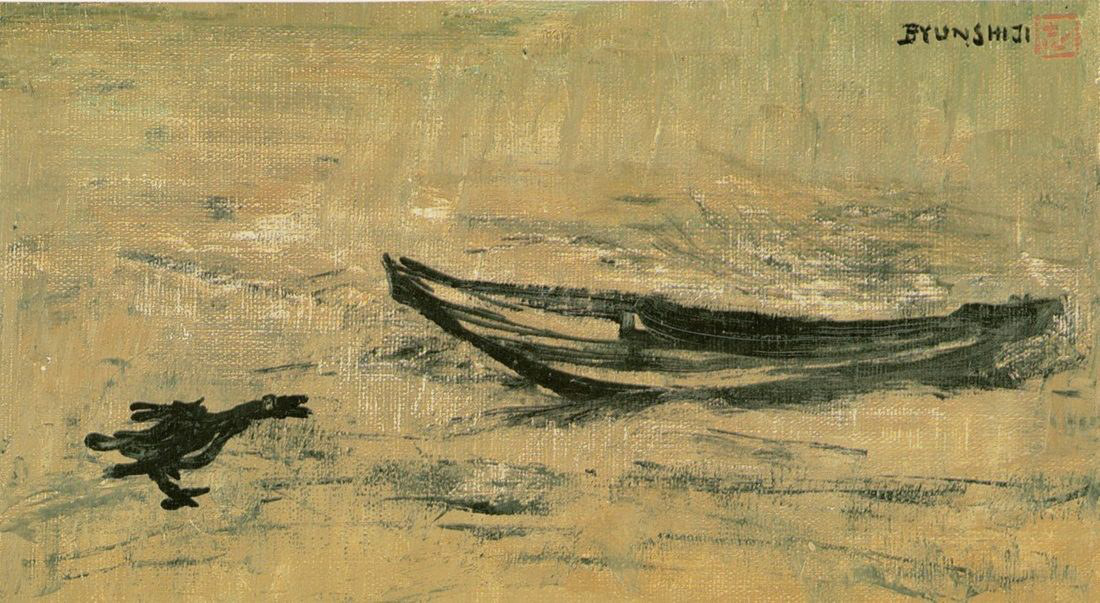
In Ieodo (1980) there is an empty boat. Beside it there is a crow.
The crow is not in the boat. Nor is it on the boat. It is beside it. The boat is on land at the right of the picture, its prow to the left. The crow stands at the lower left, on ground a little apart from the boat. It leans its body forward and stretches its neck toward the boat. Its beak seems open.
Flocks of crows often appear in Byun Shi-Ji’s pictures. The crow in this picture is one. It does not mix with a flock; it is beside an empty boat.
The title is the name of an island. Chapter 6 set this picture beside Ieodo of 1987 to look at repetition and difference. This case asks what the crow beside the empty boat is doing on the same canvas.
2A Boat That Does Not Return, a Bird That Brings News
Ieodo is the name of an island long passed down in Jeju. It is the island where those who went to sea and did not return are said to go, and it is also passed down as a good place people dreamed of—a utopia. The refrain “Iyeodo” appears in Jeju folk songs, including the songs of the haenyeo.1
People not returning from the sea did not happen only in stories. In his oral history Byun Shi-Ji spoke of what he came to know living in Jeju. When typhoons blew, fishing boats sank, and the men did not return, so there came to be more women.2
Crows too have long lived beside people on this island. The painter wrote childhood memories in Art and Fūdo. One is the saying that when a crow cries on a thatched roof, a guest or news will come. The other is the sight of crows flying down to eat the food scattered on the roof after the ancestral rite.3
In his oral history he said the crow is a bird that foresees the days to come. He also said the crows seemed to whisper to one another, even in the years of dictatorship, that a bright day would come.2 Neves wrote that Byun Shi-Ji’s crows announce something, whether good or ill, and do not express indifference. They may be considered ill-omened by fishermen, she said, but are closer to birds that bring news to the village.4
The empty boat brings to mind those who did not return, and the crow brings to mind news.
This case calls the crow’s being beside the empty boat “staying beside.” It is this bird’s posture. In chapter 15 the horse stood still beside something that was there, like the old man or the pine. The crow in this picture is beside an empty place. If stillness is the work of the body, being beside is the work of place.
3An Empty Form and a Black Bird
The boat is one, and the crow is one. Placed one each, the two become a pair.
The empty boat is a form and also an empty place. If the inside of the boat’s outline is empty, the empty boat becomes a small empty space enclosed by line. So it is with the boat in this picture. Inside the outline drawn in black line, the ground colour remains as it is. The crow is black. On the canvas the crow becomes a small place where black gathers. One is empty; the other is filled with black.
Place also makes meaning. If the crow were in the boat, the boat would no longer look empty. If the crow were in the sky above the boat, the two would lie on different levels. Beside each other, the two do not cover each other. The empty boat is seen as empty, and the crow is seen as a crow.
Being beside leaves what is empty empty.
As seen in chapter 6, Ieodo was not a subject painted once and finished. Under the same island’s name the painter painted sea and boat again and again over many years.5
4A Flock in the Sky, One Beside
Unlike cases in Western painting where a flock of crows organizes the movement and emotion of the sky, the crow of Ieodo is placed alone beside an empty boat.6 Neves too wrote that crows appear on Byun Shi-Ji’s canvases in numbers ranging from one to a dozen or so.4
What matters in this comparison is not biographical symbolism but number and place. Flying in a flock, crows become the movement of the sky; remaining as one, a crow becomes the companion of a place.
5Beside an Empty Place
Before what is lost, people often try to do something: to get it back, to forget it, or to fill it with something else. The crow in this picture seems to do none of these. What can be confirmed on the canvas is only place. The boat is empty, and the bird is beside it.
This book reads that place this way. Being beside is not bringing back what was lost. It is leaving what is empty as it is, and being beside it. The aesthetics of not fighting gains one more form here. As the body lowers itself before a strong wind, before loss it remains beside.
By the painter’s account the crow is a bird that foresees the days to come. If the empty boat brings to mind what has passed, the crow faces the days to come. Between them is the present of being beside. Longing faces what has passed; waiting faces what is to come. This picture puts the two in one place.
Between the crow and the boat of Ieodo there is a little distance—neither touching nor far. This case has read this “staying beside” as a posture gained before loss.
The crow beside the empty boat did not bring back what was lost but remained beside it. Then are being beside and waiting the same? Case B asks this question of the body holding a fishing rod without a line.
Case BThe Fishing Rod Without a Line — Waiting, Non-Connection and the Form of Time
1A Fishing Rod Without a Line
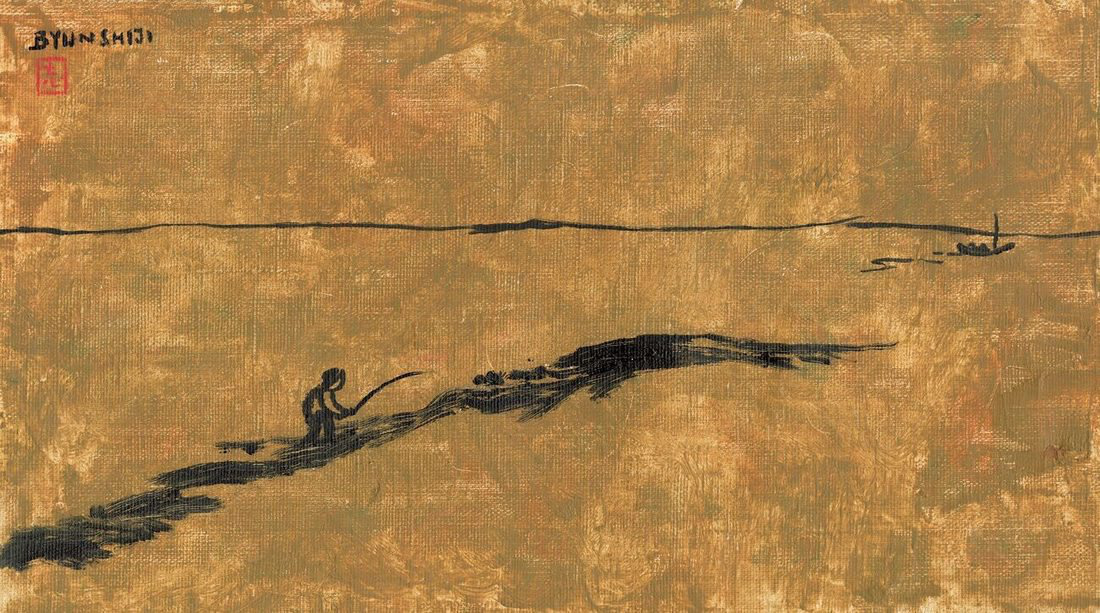
In A Long, Long Longing (1981) there is a long fishing rod reaching toward the sea. There is no line at the end of the rod. The person sits on a black rock that stretches from the lower left toward the centre. He bends his back and reaches the rod toward the sea at the upper right. The horizon is drawn high on the canvas as a single black line, and at its right end below the line is a small boat. Apart from that there is nothing.
Fishing needs a rod, a line and a hook. In this picture the line is missing. With no line, no hook can be let down into the water. Nothing can be pulled up with this rod.
Yet the title does not speak of fish. It speaks of longing—a long, long longing. What does the body holding a rod without a line wait for?
2The Line Is the Path by Which an Answer Comes
A person fishing lets down the line and waits. When something in the water touches the hook, that tremor—the bite—travels up the line, through the rod, to the hand. The line is the path by which an answer from the water reaches the hand.
A rod without a line has no such path. Though there is no path for an answer to come, the body faces the sea. This waiting does not look like waiting for fish.
The title fills that empty place. Longing is a heart turned toward what is not here. Longing faces what has passed; waiting faces what is to come. In this picture the two are in one body. Longing is the heart, and waiting is the posture in which that heart appears in the body.
This case calls this posture “waiting.” Waiting is not doing nothing. It is standing before time with the body set toward what has not yet come.
3A Line That Does Not Reach
On the canvas the rod is a line. A long black line reaches out from the body toward the sea. The line curves up a little and ends in the air. The line of the rod has a direction: from body to sea, from here to there.
But this line does not reach. The line stops at the end of the rod, and beyond it empty space continues. Had there been a line, it would have continued to the water.
The line from the painter’s notes seen in chapter 11—what is not painted holds up what is painted—is read again here.7 In this picture, what is not painted is the line. Not painting the line could be mere omission. But the rod is painted long, and only the line is missing. That omission moves the rod from a tool for fishing toward a gesture of waiting. The longing of the title is read there.
The “long, long” of the title also connects with the canvas. The rod is long. The longer the gesture of reaching, the clearer the distance not reached.
The fishing rod without a line may not be only in this picture. According to “The Language of Painting,” a text giving short descriptions of each work, a fishing rod without a line also appears in Fishing of 1978 and The Cliff of 1993.8 If confirmed by the plates, the fishing rod without a line becomes a motif repeated over fifteen years, beyond the iconography of one canvas.
4A Line That Connects, a Line That Is Absent
Hemingway’s The Old Man and the Sea, which Byun Shi-Ji himself named as a book that inspired him, is a narrative in which the old man and the sea are joined by a taut line.9
In that narrative the line is a line of struggle and also a line joining the old man and the sea.10 A Long, Long Longing, on the contrary, omits the line itself.
East Asian tradition too has fishing stories of waiting for “the right time” rather than fish.11 But that waiting has an ending: a meeting. A Long, Long Longing has no such ending.
There is no line to join with a fish, no hook to catch the right time. The end of this waiting is not in the picture, and the title says only that the longing is long.
Because of this difference, the waiting in this picture is closer to time spent enduring non-reaching itself than to waiting for fulfilment.
5A Posture Before Time
The crow beside the empty boat and the body holding a rod without a line: how do they differ? Being beside is the work of place. The crow is here and now, beside what is empty. Waiting is the work of time. The body holding the rod stands toward what has not yet come. Being beside keeps a place; waiting keeps time.
The bodies of Arguments VI–VIII grew low before the wind (chapter 12), leaned and clung to the ground (chapter 13). They worked at sea and in fields (chapter 14); even a tiger the island never had gained a lean body from the same hand, and the horse stood still beside people (chapter 15). They endured storms, and bent without breaking (chapter 16). And they stayed beside an empty boat (chapter 17, case A). These postures were mostly gained before wind or an empty place. Waiting is a posture gained before time.
The rod of A Long, Long Longing ends before it reaches the water. From its end on is empty space. This case has read waiting as a posture before time.
Being beside keeps a place; waiting keeps time. The two cases show that even before what is lost and what does not come, the body does not vanish but remains. With this, Arguments VI–VIII (chapters 12–17) reach one provisional conclusion: fūdo leaves posture on the body, and that posture stands on the canvas in a form that does not try to win yet does not vanish. These postures stood on the forms seen in Arguments IV and V (chapters 8–11): the color of dried grass, the black line and empty space. Argument IX places these forms and postures in comparison with contemporary Korean painting. Chapter 18 sets Byun Shi-Ji’s path beside the other paths Korean painting took in the same period, and chapters 19 and 20 widen that comparison into questions of decentred modernism and the translation of fūdo.
The line was not painted. In its place there is waiting.
Notes and sources
- ↑ On the Ieodo legend and the folk-song refrain: Yonhap News (Byun Ji-cheol), “[Jeju Culture Again!] (40) ‘Ieodo,’ an Island of Illusion and a Real Island,” published in Jeinuri.
- ↑ Byun Shi-Ji Oral History Transcript (Korean Modern and Contemporary Art History Oral History Project; interviewer and researcher Lee In-bum), fifth session (18 January 2005, Gidang Art Museum). His words on crows are on pp. 219–220; on typhoons and the sinking of boats, p. 221.
- ↑ Byun Shi-Ji, Art and Fūdo (Youlhwadang, 1988), “Nostalgia for the Primitive” (原始), in the section “Living in Jeju.”
- ↑ Carole Neves (director of policy analysis, Smithsonian Institution), “The Painter and the Sea: Byun Shi-Ji.”
- ↑ Dates of Ieodo, based on the list in “The Language of Painting”: 1977, 1978, 1980, 1987, 1991 (two works), 2005. The 1978 work (46 × 38 cm) is reproduced in Art and Fūdo. The canvas is checked against the plate in the byunshiji.org 100 Works (FŪDO 063).
- ↑ Van Gogh Museum collection description, “Wheatfield with Crows” (1890); Vincent van Gogh, letter 898 to his brother Theo and Theo’s wife Jo van Gogh-Bonger (Auvers-sur-Oise, c. 10 July 1890). The editors’ notes identify the large canvases the letter mentions as Wheatfield under Thunderclouds, Wheatfield with Crows and Daubigny’s Garden.
- ↑ A sentence written in Byun Shi-Ji’s notes (author’s confirmation, 29 September 2026). The same sentence as in chapter 11, note 1.
- ↑ Work descriptions in “The Language of Painting”: Fishing, 1978 (“when waiting sinks into the sea in place of a fishing line”); The Cliff, 1993 (“with a fishing rod without a line”). The canvas is checked against the plate in the byunshiji.org 100 Works (FŪDO 083).
- ↑ Carole Neves (director of policy analysis, Smithsonian Institution), “The Painter and the Sea: Byun Shi-Ji.”
- ↑ Ernest Hemingway, The Old Man and the Sea (1952). Hemingway received the Pulitzer Prize for this work in 1953.
- ↑ Sima Qian (historian of Han China), Records of the Grand Historian, “Hereditary House of Taigong of Qi.” Jiang Taigong’s name was Lü Shang, and the man he sought to meet was the Western Earl of Zhou, the future King Wen before he became king. The straight hook and fishing without bait appear in later storybooks such as Wuwang fa Zhou pinghua and Fengshen yanyi.
Contents · Fūdo Is Not Landscape Key Terms and Analytical Categories → Bibliography →