Research/Fūdo Is Not Landscape/Argument VIII/Chapter 16
Academic edition · Fūdo Is Not Landscape · Chapter 16 · 26 / 34
Storm and the Bent Body
The Enduring Posture and the Form of Bending
Argument VIII · Not Fighting, Yet Not Disappearing
In Typhoon (1983) the person on the rock looks at the sea with back rounded and bent. The old man in The Old Pine and the Old Man (1987) also leans forward on his cane. This chapter places a storm picture and the bent body in one chapter and asks in what form the body remains before the forces of wind and of an era. It is where the two analytical terms proposed in the introduction, “the aesthetics of not fighting” and “the posture of resistance,” are examined again with the works.
Case AStorm and Era — The Overlap of Natural Force and Political Memory
1The Painter of Storms
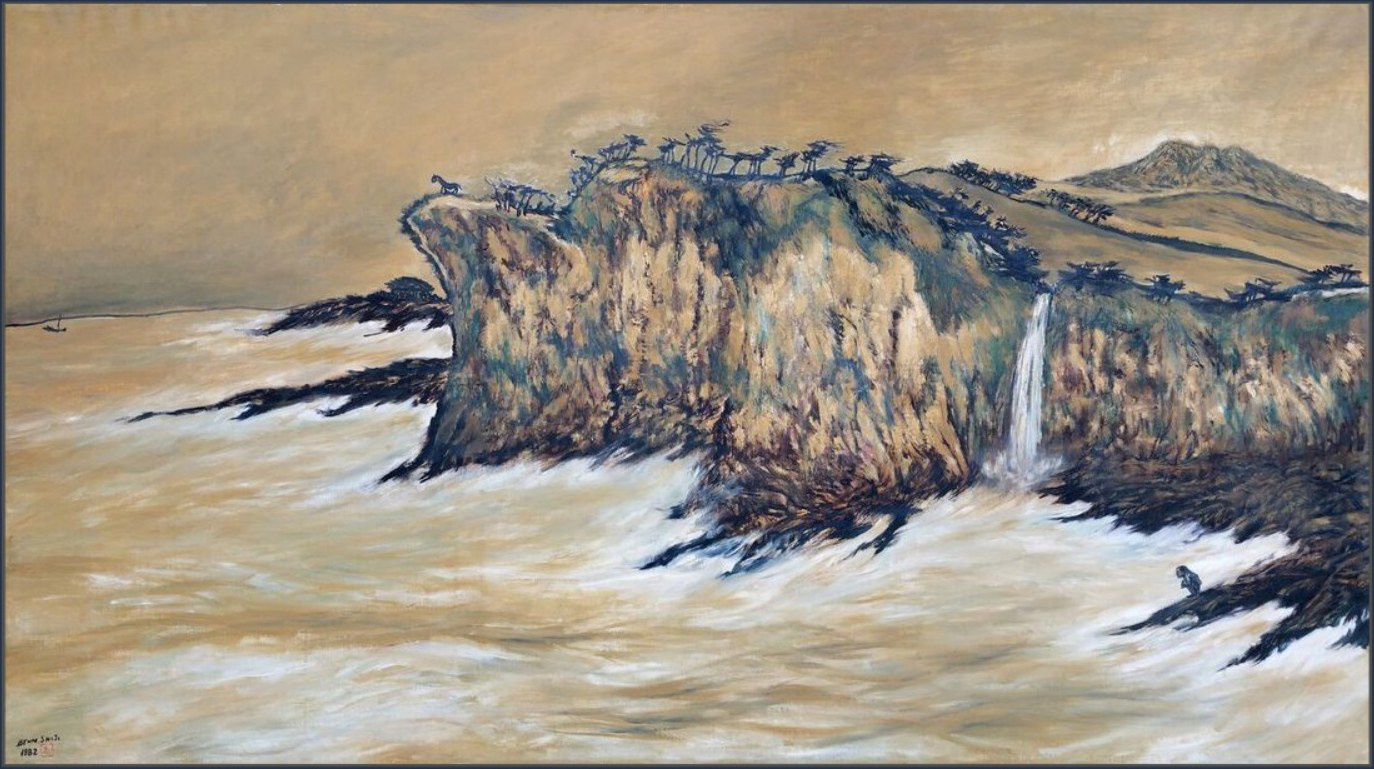
The title Typhoon (1983) is the name of a kind of weather1—the name of the strongest wind. There is only one person on the canvas. On a black rock by the water at the lower right he sits crouched, looking at the sea with back rounded and bent. At the edge of the cliff on the left stands a horse, and the small pines on the cliff all lean to one side. Byun Shi-Ji is called “the painter of storms.”2 This picture is one of his storm paintings.
This case asks whether his storm is only weather.
2A Storm Is First a Storm
Jeju lies on the path typhoons often take. Byun Shi-Ji’s storm is first of all this island’s storm.
There are also the facts of the time. In the early 1980s Korea was under a military regime in which former soldiers held power. Typhoon was painted in that period.
And there are the painter’s own words. In 2005 oral history he said that the will of Jeju people trying to survive in the wind and his own heart resisting dictatorship fitted the subject “psychologically.” Yet he also said one should not paint the political situation openly but sublimate it into art: “A typhoon too is not just a typhoon, but a typhoon sublimated into art.”3
This testimony, however, is not a contemporary record from 1983, when Typhoon was made, but a retrospective statement some twenty years later. Rather than using it as direct proof of the work’s original intention, it should be treated as a later self-interpretation showing how, late in life, the painter reconnected his storm paintings with political memory.
That does not mean the storm becomes merely a metaphor for the era. The island’s wind blows as it is. On that wind, the era overlaps.
The painter himself, in Art and Fūdo, named people, era and climate together as the conditions that form the ground of art.4 This book reads fūdo as a word that holds not only weather but the time people have lived within it. So the island’s wind and the wind of the era can be read together in one canvas.
3A Nameless Storm
There are no soldiers, no slogans on the canvas. There are only wind and a body. The era gets no name within the picture.
Where is the era? In the posture of the body. The body in this picture grows low before the wind. It holds on, grown low.
The lines do the same work. On one canvas there are lines that reveal the force of the wind and lines that set up the body. The wind blows, and the body stands.
The era was not painted by name. It was painted as posture.
4Words Outside the Picture
In Western painting too there are cases that join the event of a storm with the narrative of picture and title.5 But the title of Typhoon leaves only the name of a weather. The work’s political meaning is stated not in markers on the canvas but in testimony some twenty years later.
5The Enduring Posture
The body in the storm endures. “To endure” is the verb this case has followed.
The testimony links his storm paintings to resistance. What is visible on the canvas is the shape of lowering the body and remaining. This book reads that body not as a body that has retreated but as a body of resistance that writes no name. The enduring posture stays in the body even after the storm has stopped.
This case has seen that the storm is first the island’s storm, and that the memory of the era overlaps on it but is painted not as a name but as posture. In Typhoon the pines lean and the person on the rock bends his back.
The enduring body is mostly bent. Case B reads this bending as a form, and sets up together, in two layers, “the aesthetics of not fighting” before the forces of nature and “the posture of resistance” before the forces of an era.
Case BThe Form of the Bent Body — The Aesthetics of Not Fighting and the Posture of Resistance
1Bending in Tokyo, Bending in Jeju
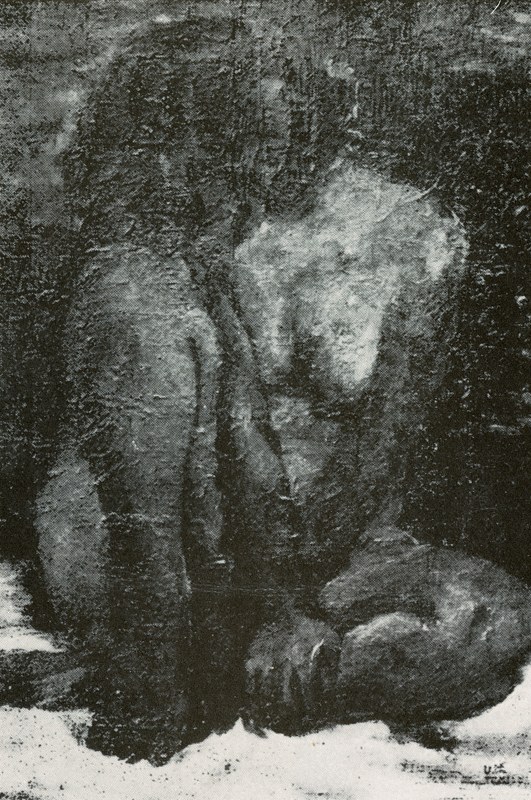
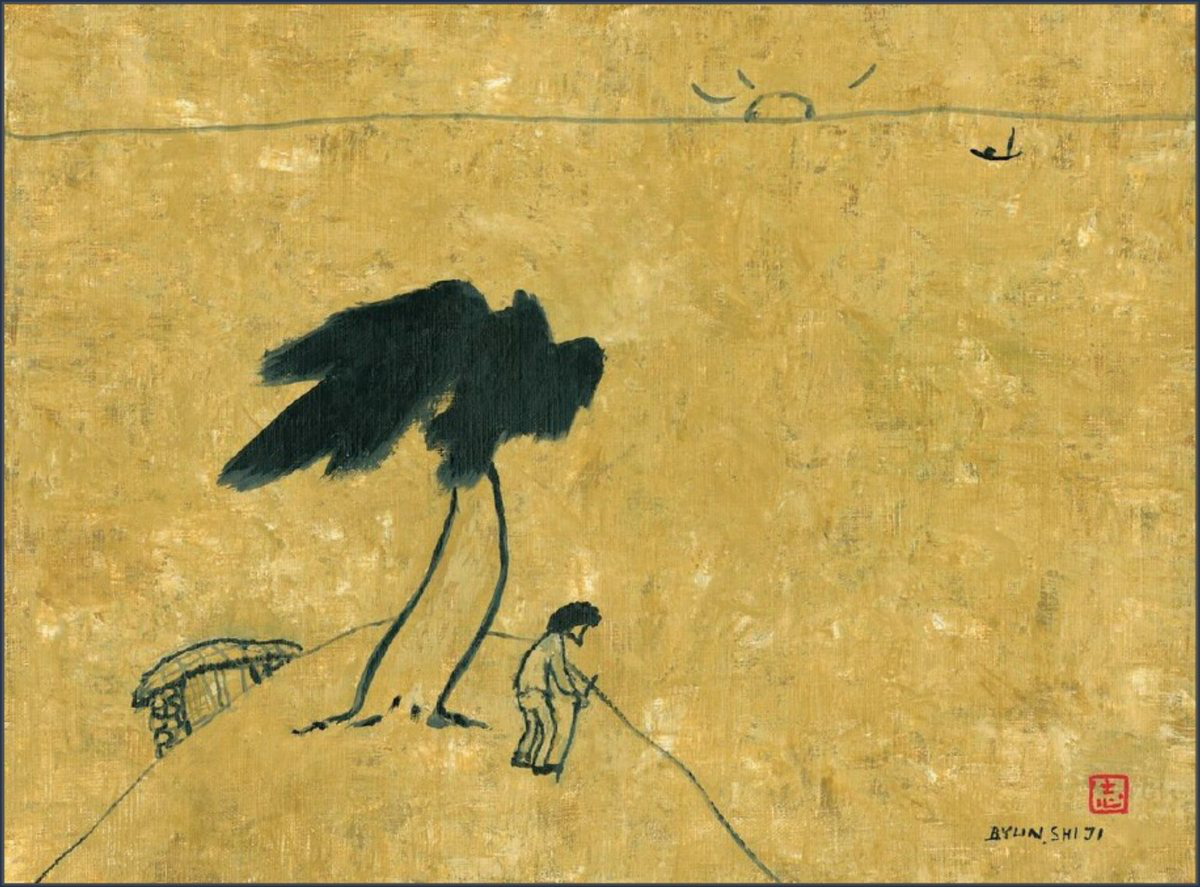
Between Nude with Bowed Head of 1953 and The Old Pine and the Old Man of 1987 lie some thirty years and different places. The first is a figure painting of the Tokyo years; the second, an old man within the fūdo of Jeju. Yet in neither picture does the body stand straight. In the body of the woman with one leg folded to the side and the body of the old man leaning forward on his cane there is a shared form: “bending.”
This repetition shows something important. The bent body is not an icon first created by the Jeju wind. It is more accurate to see that a bodily sense existing before Jeju met the fūdo of Jeju and gained a new formal meaning.6
Bending must therefore not be reduced at once to a symbol of hardship, defeat or Jeju-ness. First one must see the posture that recurs across different times, and how that posture changes in the Jeju years within black lines and wide empty space.
2The Painter’s Language: Resistance and the Impossibility of Overcoming
In 2005 testimony Byun Shi-Ji described the lives of Jeju people as “the tenacity of trying to survive, fighting and resisting the wind.” In the same context he recalled that his own feeling of resistance against dictatorship fitted the subjects of Jeju’s fūdo psychologically.7
In Art and Fūdo, on the other hand, he wrote of looking at the horizon from the pier with the sense that humans “will never be able to overcome great nature.”8
The two statements do not erase each other. The recognition that nature cannot be conquered shows the layer of “the aesthetics of not fighting”; the aversion to political power and the memory of resistance show the layer of “the posture of resistance.” The problem is not choosing one of the two. It is discerning how two attitudes toward different objects overlap and part on the canvas.
The words “fighting and resisting” in the testimony also remind us that the name “the aesthetics of not fighting” must not be read as the absence of resistance. Not fighting does not mean not enduring; it means not trying to defeat nature. The question of this case, therefore, is not whether he fought or not. It is what form a body that underwent two layers of force gained on the canvas.
3A Body That Bends but Does Not Collapse
The figures of the Jeju years are not heroic bodies pushing back the wind head-on. They lower the body, tilt its central axis and enter into relation with a cane, a horse or a tree. But they do not vanish from the canvas. The core of this body is neither winning nor losing but persistence.
Bending and destruction differ. A bent line continues while changing direction; a broken line is cut. Byun Shi-Ji’s black line is rough, as if about to break, yet holds the figure to the end. The body may grow small but is not erased.
4How Posture Becomes Line
In the figure paintings of the Tokyo years, bending is presented through anatomical volume and pose. In the Jeju years the same bodily sense is compressed into a few black lines. This change connects with this book’s account of repetition: “posture remains, form changes.”
What matters is that the line does not stop at describing the body. The tilt and direction of the line make the flow of force across the whole canvas, and set old man, tree and roof, different things, within the same field of fūdo.
The bent body, then, is a formal structure before it is an iconographic symbol. When the body’s central axis, the direction of the black line, the pressure of empty space and the tilt of surrounding things work together, “bending” becomes a relational grammar of the canvas.
In this respect the fūdo of Jeju reads not as an external background to the body but as a condition that organizes the body’s lines.
5Limits of Comparison and the Posture of Resistance
In paintings of labour, the bent body is often presented as the motion of a repeated act.9 Byun Shi-Ji’s old man is bent even when standing, and in that bending not only labour but age, bodily memory and the pressure of fūdo overlap.
Qu ze quan (曲則全, “bent, then whole”) and buzheng (不爭, “not contending”) in chapter 22 of the Daodejing serve as a comparative coordinate showing that bending and not contending can be linked with persistence.10 But since there is no evidence that Byun Shi-Ji took this chapter as a basis for his painting, the comparison is limited to formal similarity, not influence.
The two analytical terms are also used within this limit. A body that does not conquer nature yet does not vanish belongs to the layer of “the aesthetics of not fighting”; a body that does not represent the feeling of political resistance through slogans yet leaves a posture of having received force belongs to the layer of “the posture of resistance.” The two layers are not the same but can overlap on the canvas.
It is important neither to glorify this overlap as heroism nor to reduce it to passivity. Bending is not a mark of weakness but a way of entering into relation with force, and that relation persists in the form of line and posture.
6Conclusion: The Aesthetics of Not Fighting and the Posture of Resistance
The conclusion of this case lies in setting up the two layers together. Before natural forces like wind and sea, the body chooses adjustment over conquest. This is “the aesthetics of not fighting.” In the artist’s recollection of historical and political forces, on the other hand, there is an explicit language of resistance. This is “the posture of resistance.” The two layers are not the same, but they meet in the bent body, the leaning tree, the low house and the unbroken line.
“The form of the bent body” is the pictorial place where the two cross without becoming the same. Used apart in this way, they preserve both the artist’s testimony and the facts of the canvas, and avoid hastily equating the different forces of nature and politics.
In The Old Pine and the Old Man the old man’s back and the pine’s trunk both lean. But both remain on the canvas. What fūdo left is not an expression of defeat but a posture of persistence.
The storm case showed that the memory of an era remains on the canvas not as a name but as posture. The case of the bent body showed that this posture is a bodily sense continuing from the Tokyo years that gained the form of the black line in Jeju. Set together, the two cases make bending neither defeat nor heroic confrontation, but the way a body that underwent the forces of nature and of an era remains without vanishing, the two never becoming the same. Chapter 17 looks, through the crow beside an empty boat and the fishing rod without a line, at how the body remains before empty places and time rather than wind.
The bent body is not a defeated body. It is a body that sustains relation even after receiving force.
Notes and sources
- ↑ Typhoon (1983). The canvas is checked against the plate in the byunshiji.org 100 Works (FŪDO 019).
- ↑ The epithet “painter of storms.”
- ↑ Byun Shi-Ji Oral History Transcript (Korean Modern and Contemporary Art History Oral History Project; interviewer and researcher Lee In-bum), fifth session (18 January 2005, Gidang Art Museum), pp. 221–222. He said that the will of Jeju people to survive, tying down thatched roofs and building stone walls to endure the wind, and his heart of “resisting the dictatorship” meant that “psychologically the subject now fits.” He went on to say that while holding the political situation one “must sublimate it into art”: “A typhoon too is not just a typhoon, but a typhoon sublimated into art.” In the same transcript, fifth session, p. 219, he said the crow seems to whisper “under the dictatorship” that a bright day will come.
- ↑ Byun Shi-Ji, Art and Fūdo (Youlhwadang, 1988), “Art and Fūdo,” in the section “Living in Jeju”: “The conditions of people, era and climate become the matrix of art.”
- ↑ J. M. W. Turner, Snow Storm – Steam-Boat off a Harbour’s Mouth, exhibited at the Royal Academy in 1842, oil on canvas, 91.4 × 121.9 cm, Tate, London (N00530). The full title at exhibition was “Snow Storm – Steam-Boat off a Harbour’s Mouth making Signals in Shallow Water, and going by the Lead. The Author was in this Storm on the Night the Ariel left Harwich.” Some have later doubted whether the painter was actually on board. This chapter uses only the words of the title.
- ↑ The Old Pine and the Old Man (1987). The canvas is checked against the plate in the byunshiji.org 100 Works (FŪDO 079): on a hill, an old man bent forward on his cane; the top branches of a pine swept to the left; a small thatched house; the sun and one boat above the horizon.
- ↑ Byun Shi-Ji Oral History Transcript (Korean Modern and Contemporary Art History Oral History Project; interviewer and researcher Lee In-bum), fifth session (18 January 2005, Gidang Art Museum), p. 221. The quoted words lead on to the statement that this tenacity and his heart of “resisting the dictatorship” fitted the subject “psychologically.”
- ↑ Byun Shi-Ji, Art and Fūdo (Youlhwadang, 1988), “The Sun and Sea of Jeju,” in the section “Living in Jeju.”
- ↑ Jean-François Millet, The Gleaners (Des glaneuses, 1857), oil on canvas, 83.5 × 110 cm, Musée d’Orsay, Paris. Reading the gestures of the three women as three stages of a repeated motion—bending, gathering, straightening up again—follows the Musée d’Orsay’s description of the work (accessed 29 September 2026).
- ↑ Daodejing (received text), chapter 22: “曲則全… 不自矜故長 夫唯不爭 故天下莫能與之爭 古之所謂曲則全者 豈虛言哉 誠全而歸之.” The chapter closes by saying that the old saying “bent, then whole” is not empty words. 長 can be read as “endure long” or as “become foremost”; this chapter follows the former. The idea of seeing the soft and weak as signs of life also appears in chapter 76.
Contents · Fūdo Is Not Landscape Key Terms and Analytical Categories → Bibliography →