Research/Fūdo Is Not Landscape/Argument VI/Chapter 13
Academic edition · Fūdo Is Not Landscape · Chapter 13 · 21 / 34
Forms That Endure the Wind
Grown Posture and Built Posture
Argument VI · Fūdo Organizes Posture
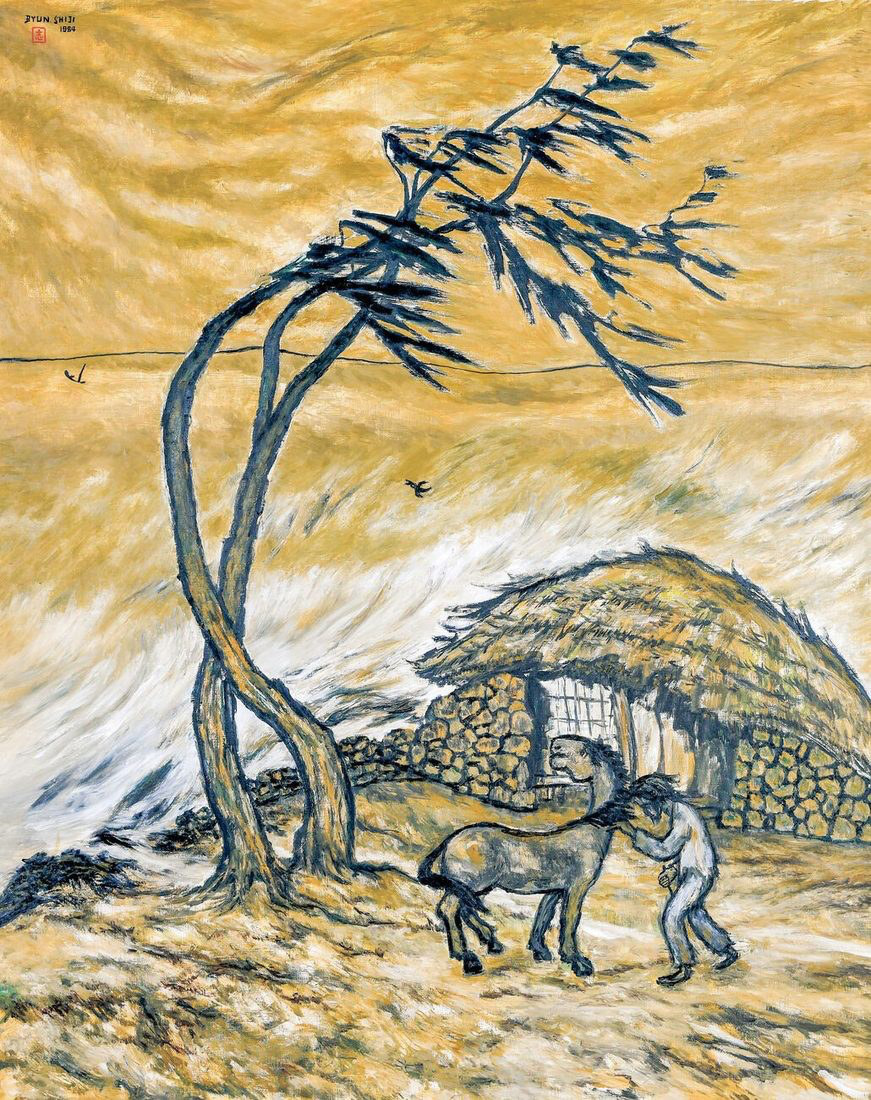
In Storm of 1984, two pines are bent trunk and all, and beneath them is a thatched house ringed by a stone wall. A leaning tree and a low house are together in one picture. Neither can move away from the wind. This chapter places two cases in one chapter and asks what posture the wind leaves on things that cannot move.
Case AThe Leaning Tree — The Posture of a Tree and the Form of Persistence
1The Bent Pine
In Storm of 1984, two pines are bent to the right, trunk and all. The branches stream the same way. Beneath them is a thatched house ringed by a stone wall, and a person, holding a horse by the head, bends his body forward. Brushstrokes like white waves cross the middle of the canvas.1
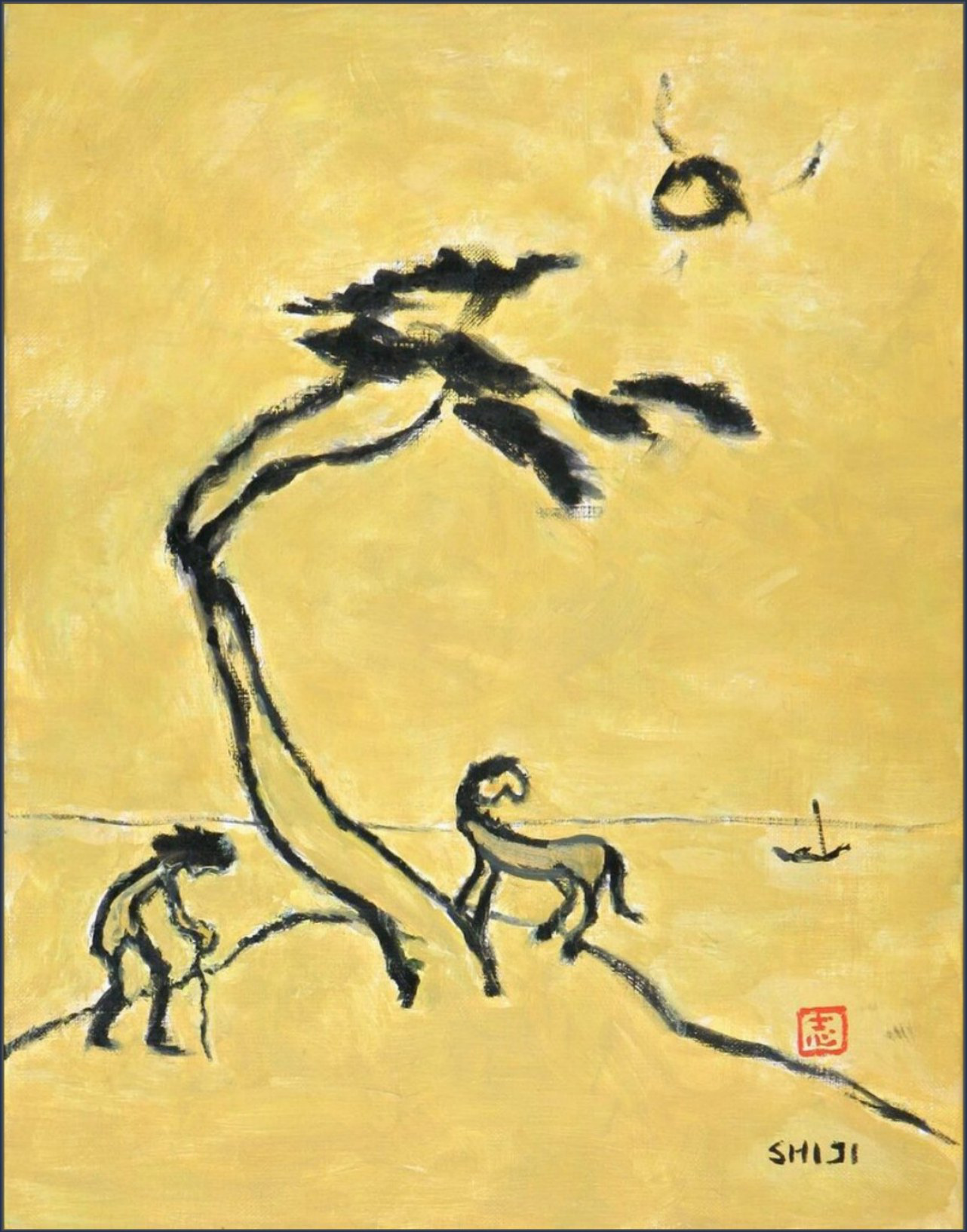
In many works of the Jeju years, trees leaning to one side rather than standing straight appear again and again. There are pines, and there are trees that have shed their leaves.
How does a tree enter into relation with the wind? This case follows the second verb of Argument VI: “to lean.”
2A Body That Cannot Leave
People can move their steps to avoid the wind. Horses move too. Trees do not move their roots.
So in the body of a tree that has stood long in the same place, the conditions in which it grew are carved. Trees lean for many reasons. Light and the shape of the land, soil and the place to grow also make trees lean. Wind is one of them. In a tree long struck by wind from one side, the direction of that wind may remain in the shape of its branches and crown. On the coasts of Jeju too, it is said, there are trees leaning to one side from the northwest wind.2
A leaning tree points less to a wind that passed once than to wind long endured. Which actual tree a tree in a picture depicts cannot be known. But Byun Shi-Ji’s leaning trees can be read alongside such trees.
3Tilt and Leaves
The posture of a tree in a picture can be read through its tilt and its leaves.
Trunks lean to one side rather than standing straight. The tree in Storm is bent trunk and all, and the trunk in The Tree That Reaches Toward the Sky (2007) bends once and then rises upward again.3 When many trees lean in a similar direction, a direction arises on the canvas as if the same force had passed. Of the tilt, height and direction of posture, trees show tilt most clearly.
When a deciduous tree drops its leaves, the shape of its branches and trunk is laid bare. A tree that has shed its leaves is first of all the look of an actual season. This case does not read it at once as a symbol of loneliness or decline.
When the leaves are gone, the tree comes closer to line. On the canvas, trunk and branches readily look like black lines. It is where the black line seen in chapter 10 becomes the body of a tree.
4The Pine That Withers Late, the Leaning Pine
In East Asian tradition the pine has been read as a figure of long endurance.4 But in the pines of Byun Shi-Ji’s Jeju years, endurance appears less as unchanging green than as a leaning posture.
The pines of Tropical Sun and Storm stand not as green but as dark forms, and keep in their bodies the direction of long-endured wind.
The two do not oppose each other. They are only different ways of showing endurance. Whether enduring always means staying the same is asked again in chapter 16, on the bent body.
5Fūdo Remaining in the Tree
A tree cannot leave. So in the body of a tree that has stood long in one place, the fūdo of that place remains as the posture of tilt. This tilt is not yet called defeat. A leaning tree is different from a fallen tree. Its roots are in the ground, and its trunk stands while leaning. What that means is asked after seeing more bodies.
The two pines of Storm bend to the right, leaving on the canvas the direction in which the wind passed. This case has seen that a tree leans as it grows, and carves fūdo into its body with that tilt.
The posture of the leaning tree was gained in growing. Then what posture do things that do not grow—things people built—gain in the wind? Case B asks this question of Jeju’s low houses.
Case BThe Low House — Architecture, Dwelling and the Craft of Wind
1A House Beneath Three Birds
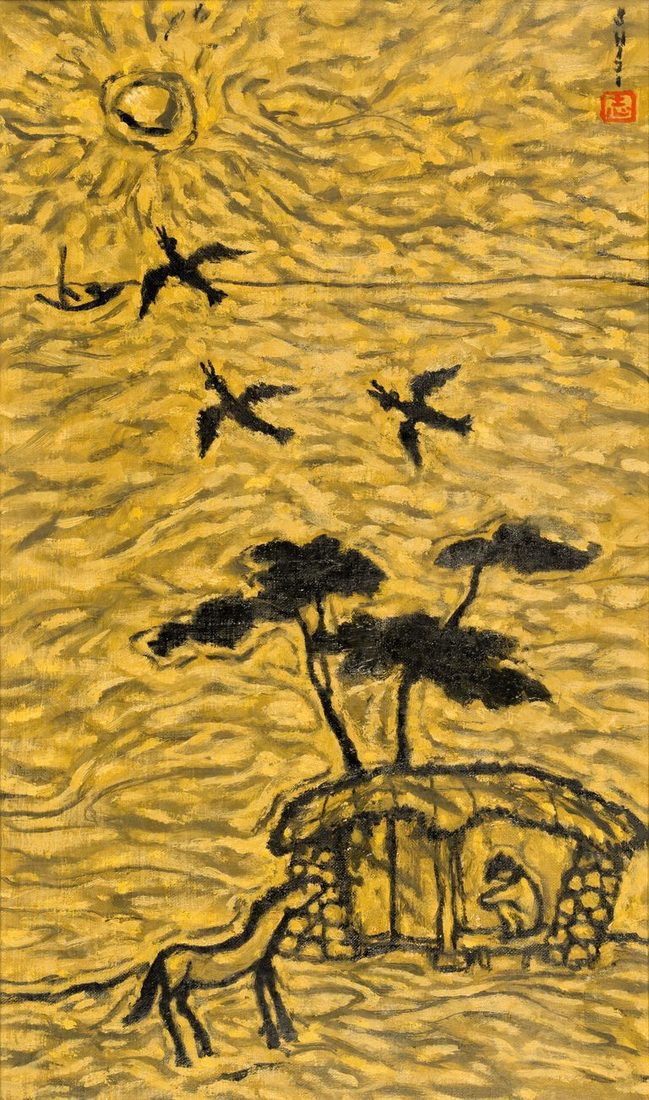
In Longing (1996) there is a house, and above it three birds.5 The house is in the lower part of the picture. Its width is about half the canvas, and its height not even half of that. Two trees stand above the roof, and above them the sky takes up most of the canvas. A horse stands in front of the house, and a person sits crouched in the doorway. In many pictures of the Jeju years, houses are not large. Thatched houses are often drawn low, as if clinging to the ground.
The tree of case A grows and leans without being able to move its roots. The house is different. Houses are built by people. What posture did people give the house in the wind?
2A House Built in the Wind
In his oral history the painter explained the houses of Jeju in connection with the wind. People tied the thatched roofs down tight “to have some resistance against the wind,” and built the stone walls so the wind would escape through the gaps.6 In Art and Fūdo he wrote of Jeju’s thatched houses as “thick roofs of sae grass that have overcome fierce winds” (sae is the grass used to thatch roofs).7
The explanations in folklore survey materials agree. The old thatched houses of Jeju had a gentler roof pitch than those of other regions. The roofs were tightly bound with ropes, and high stone walls were built around them. The ropes woven like a net over the roof are explained as a preparation against strong winter winds. Elements such as the winding olle (a narrow lane leading to the house) and the jeongnang (long poles laid across the gate place) are also seen as related to the wind. These features are said to be more pronounced in villages north of Hallasan, which receive the winter northwest wind strongly.8
The wind is not the only reason, however. A rainy climate is also said to have shaped the houses. Building materials and ways of life may act together as well.
3Lowness on the Canvas
The houses in the pictures are low too. If the tree shows tilt, the house shows height.
The low house does three things on the canvas.
The house is close to the ground. The line of the roof often seems joined to the line of the land, so the house looks like part of the ground.
The house is small. It grows small before wide empty space, and, like one distant boat, its smallness reveals the breadth around it.
The house leaves what is above. In Longing, too, the place above the house holds three birds. When the house is low, the sky above it remains wide.
4Grown Posture, Built Posture
The tilt of the tree and the lowness of the house look alike but differ. The tree leans as it grows, adjusting to wind and light. The house is built by people taking account of the wind. One is a grown posture, the other a built posture.
A built posture holds human knowledge and skill. Of such houses the painter spoke of resistance, and wrote that they had overcome the wind. That resistance was not the shape of standing tall and striking back. It was the shape of binding, piling and sitting low.
So it is with the gaps in the stone walls the painter spoke of. By his account, the wall does not block all the wind but lets it escape through the gaps. Blocking and letting flow are in one wall.
5Fūdo Remaining in the House
Fūdo does not leave traces only on natural things. People take account of fūdo and make the forms of life. On Byun Shi-Ji’s canvases that form recurs as the low house.
The title Longing is also the name of a feeling, seen in the theoretical interim conclusion, that can be read again in different lives. Set together with the title, this low house looks both like a house enduring the wind and like a place someone longs for.
This case has seen that the lowness of the house is a posture people built taking account of the wind, and that on the canvas it becomes a form that clings to the ground and leaves the sky above.
The tree leaned as it grew, and the house grew low as it was built. The two cases show that the wind tilts and lowers things that cannot move rather than knocking them down, and that this posture becomes on the canvas the forms of tilt and height. Together with the lowered bodies of chapter 12, this is the provisional conclusion of Argument VI: fūdo organizes posture. Argument VII asks how that posture changes in relation with work and animals, and chapter 14 leaves the low house for the bodies that work at sea and in the fields.
The house did not stand tall. It clung to the ground and sat long.
Notes and sources
- ↑ Storm (1984). The canvas is checked against the plate in the byunshiji.org 100 Works (FŪDO 022).
- ↑ Encyclopedia of Jeju Culture (Digital), “Wind”: on the coastal northwest wind and trees leaning to one side.
- ↑ The Tree That Reaches Toward the Sky (2007) is FŪDO 013 in the byunshiji.org 100 Works. The canvas is checked against its plate.
- ↑ Analects, “Zihan” (子罕): “歲寒然後知松柏之後彫也” (“Only when the year grows cold do we know that the pine and cypress are the last to wither”).
- ↑ Longing (1996). The canvas is checked against the plate in the byunshiji.org 100 Works (FŪDO 087).
- ↑ Byun Shi-Ji Oral History Transcript (Korean Modern and Contemporary Art History Oral History Project; interviewer and researcher Lee In-bum), fifth session (18 January 2005), p. 221. He said people “tie down even thatched houses tight to have some resistance against the wind,” and make the stone walls too “so the wind goes out through holes.” These words lead on to the tenacity of Jeju people trying to survive in the wind.
- ↑ Byun Shi-Ji, Art and Fūdo (Youlhwadang, 1988), “Nostalgia for the Primitive” (原始), in the section “Living in Jeju.”
- ↑ On the structure of old Jeju thatched houses and the wind: Encyclopedia of Jeju Culture (Digital), “Wind”; Encyclopedia of Seogwipo Culture (Digital), “Thatched Houses of Jeju Island”; Jeju Studies Center, Jejuhak Archive (materials on thatched roofs).
Contents · Fūdo Is Not Landscape Key Terms and Analytical Categories → Bibliography →