Research/Fūdo Is Not Landscape/Argument VI/Chapter 12
Academic edition · Fūdo Is Not Landscape · Chapter 12 · 20 / 34
The Body of the Wind
The Posture Fūdo Leaves on the Body
Argument VI · Fūdo Organizes Posture
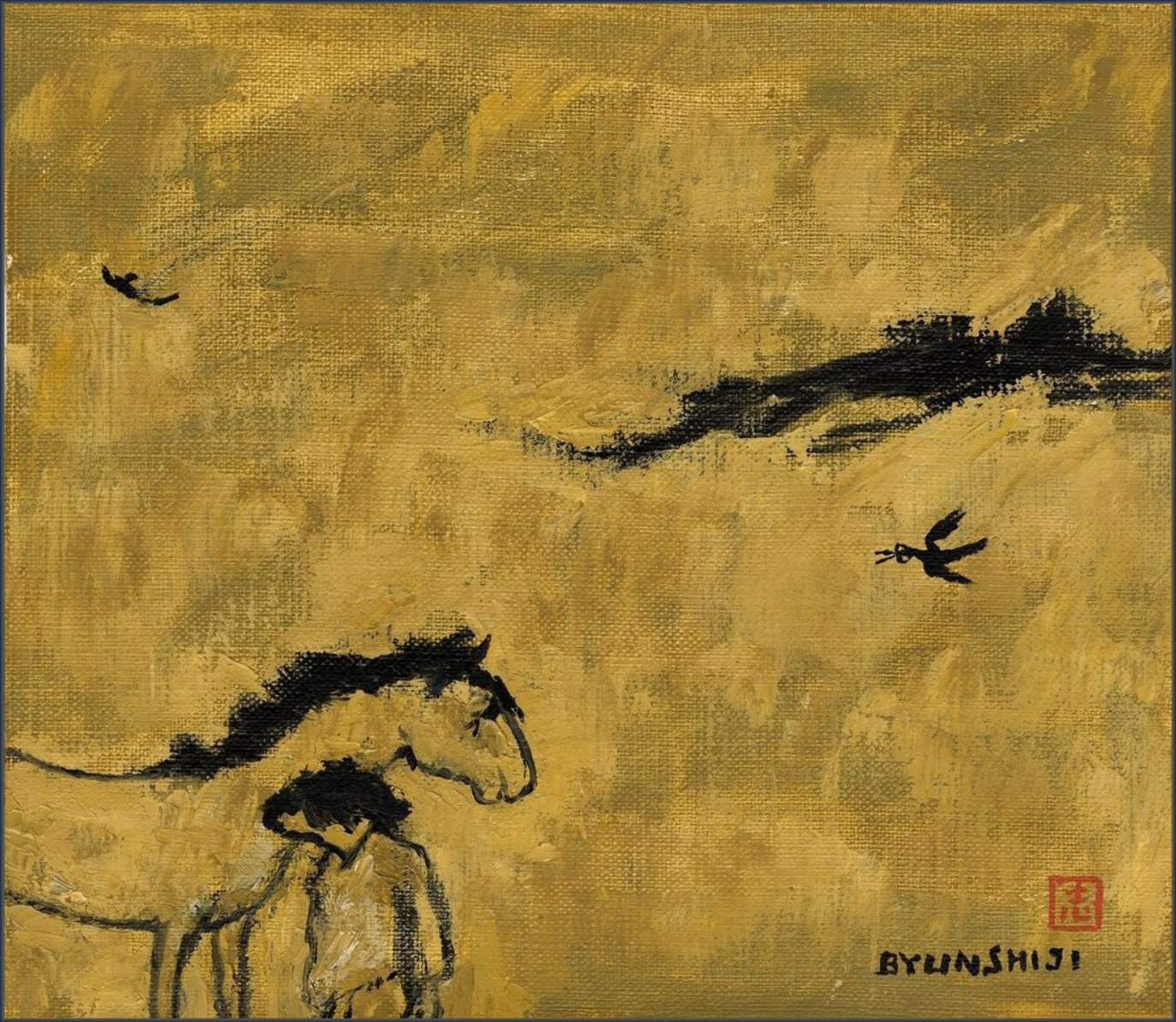
1Two Bodies in the Wind
In In the Wind, painted in 1984, there are a horse and a person.1 Both are at the lower left of the picture. The horse has lowered its head, and its mane streams to one side. The person stands below the horse’s head and seems to bow his head. Above, two birds fly, and brushmarks like black clouds cross the canvas. Jeju is an island on the path where typhoons often pass. Wind is no stranger to this island’s fūdo.
As seen in Arguments IV and V (chapters 8–11), the wind itself is not painted. What is on the canvas is what the wind has struck. If those chapters looked at the forms fūdo left in the picture, Arguments VI to VIII (chapters 12–17) look at the postures fūdo left on the body. This chapter’s question is what happens to the body when it meets a strong wind.
2Things That Grow Low
In many pictures of the Jeju years, the things struck by wind have something in common.
People lower their bodies and lean to one side. Pines lean. Thatched houses are low, as if clinging to the ground. In many pictures the wind seems less a force that blows things away than a force that lowers them.
The lowered things are mostly not fallen. They remain on the canvas, lowered. The verb this chapter follows is “to grow low.”
3The Word “Posture”
In this book posture means the outward shape of the way a body enters into relation with the forces around it. It does not only receive force; it enters into relation with it. In the body of a person holding an umbrella tilted in the wind, the shape of receiving the wind and the shape of standing against it appear together.
Posture can be read in three ways: tilt, height and direction. The centre of a body or thing does not stand straight but leans to one side. The body grows low, and things cling close to the ground. Many things lean in a similar direction, creating a directionality as if they receive the same force.
Chapter 10 said the black line sets up posture. If line is the means by which posture is held on the canvas, posture is the trace fūdo leaves on the body.
4The Movement of the Wind, the Body Long Struck by Wind
In Western painting there are cases in which brushwork itself makes the movement of the wind visible.2 On Byun Shi-Ji’s canvases, movement is spoken less by gestures representing the wind than by the posture of beings long struck by it. The one foregrounds motion; the other, sustained bodily transformation.
5Different Bodies
His pictures do not hold only lowered bodies. There are horses that do not run, haenyeo diving, trees that have shed their leaves, bent old men. There is also a tiger painted on request. That tiger has a body with ribs showing.
In his lifetime the painter said he did not paint running horses and did not paint fat haenyeo.3 The canvases agree with those words. The horses in the pictures stand or walk slowly, and the body in Haenyeo (1979) is lean and long. The two remarks are not the same thing. The first chose a movement; the second chose a body. He did not paint bodies in fūdo carelessly.
The conditions of work and season, food and climate remain directly on the body. Bodies showing such traces appear often on his canvases. This chapter does not read these bodies at once as signs of poverty or suffering; it first looks at the bodies as they are. Time remains in colour, and time remains in bodies.
These bodies are not alike, so they cannot be tied to one meaning. Some lean, some grow low, some stop. On these different bodies remain the postures of their relation with fūdo.
This chapter has confirmed that the wind appears on the canvas less as a force that blows things away than as one that lowers them, and that this force remains on different bodies as different postures. The following chapters follow these bodies one by one. Chapter 13 looks at those among them that cannot move—trees that cannot move their roots and houses that people built—and how they meet the wind.
The wind passes. Posture remains on the body.
Notes and sources
- ↑ In the Wind (1984). The canvas is checked against the plate in the byunshiji.org 100 Works (FŪDO 015). Haenyeo (1979) is FŪDO 040.
- ↑ Vincent van Gogh, Wheat Field with Cypresses (1889). Painted at Saint-Rémy in the south of France; there are several pictures of the same composition.
- ↑ Both remarks are words the painter spoke in his lifetime, heard directly by the author (his son) (author’s confirmation, 29 September 2026). No written source has been found. The remark on running horses is seen again in his own words in chapter 15, and the remark on haenyeo in chapter 14.
Contents · Fūdo Is Not Landscape Key Terms and Analytical Categories → Bibliography →