Research/Fūdo Is Not Landscape/Argument IV/Chapter 9
Academic edition · Fūdo Is Not Landscape · Chapter 9 · 14 / 34
Distance and Flatness
The Distant Boat and the Flat Surface
Argument IV · Fūdo Is a System of Sight and Distance
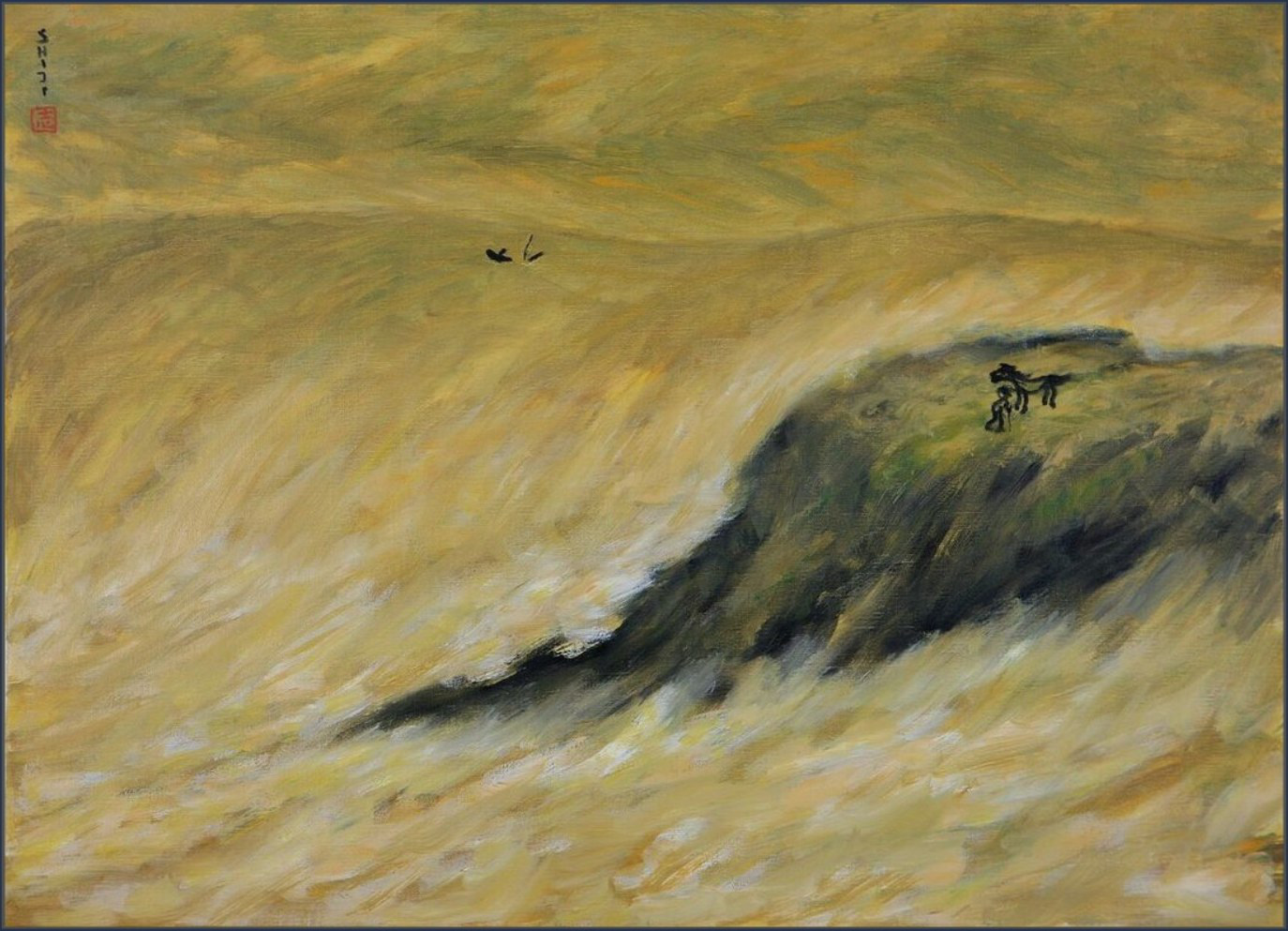
Far out at sea in A Wavering Horizon (2005) there is one boat. This canvas, with few things and its colour gathered into one, reads as flat, yet that one small boat makes the sea distant. This chapter asks both how the distant boat makes distance (case A) and why that distance remains on a surface whose depth has been reduced (case B). The two are two sides of one question: how the sight of a life on an island organizes distance.
Case AThe Form of Distance — Distant Boat, Horizon, the Sight of an Island
1A Boat, Not a Bird
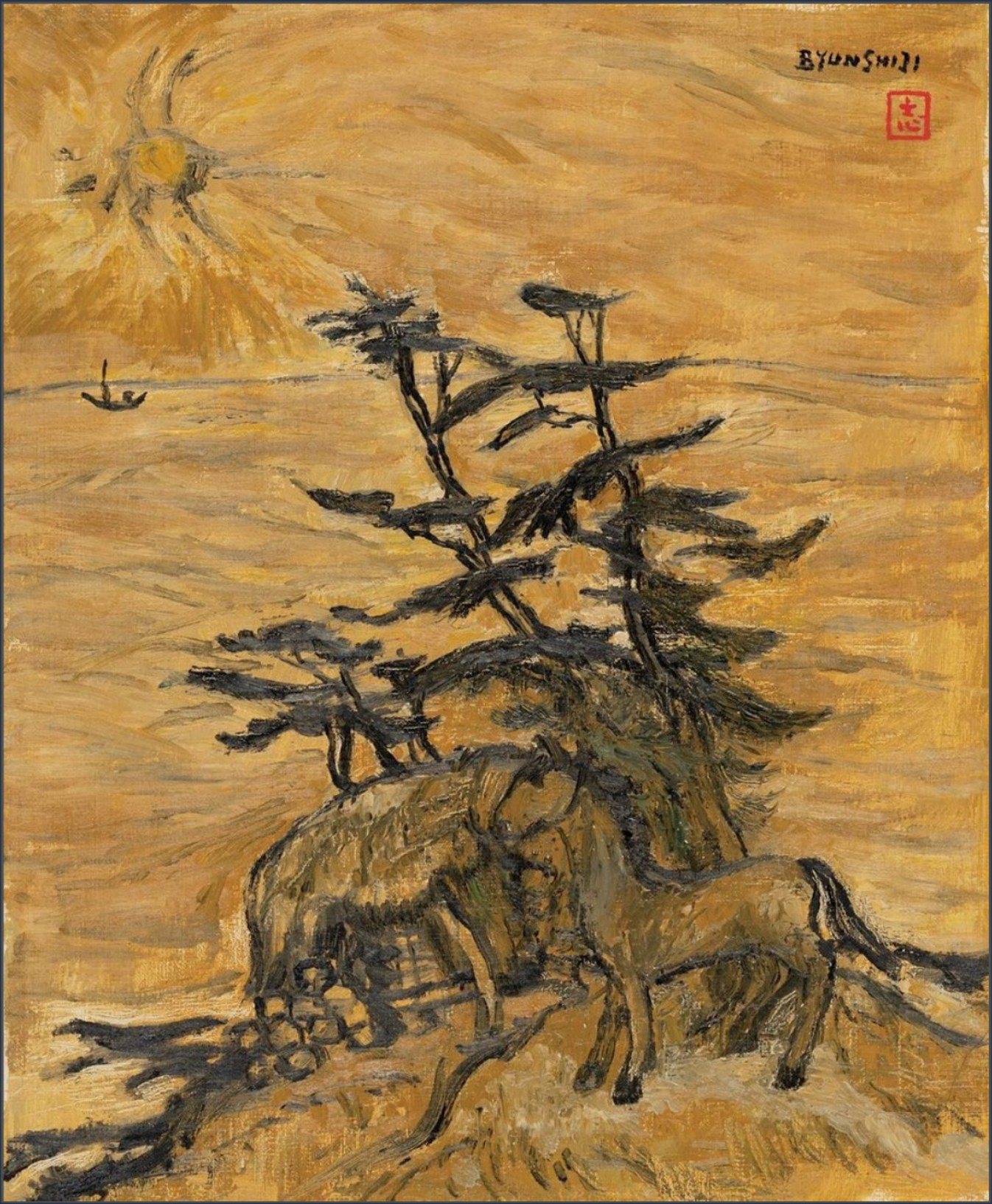
In Tropical Sun (1983) a tall black pine stands in the middle of the picture, with a horse beside it. The sun is up at the upper left. And far out at sea there is one boat. A Wavering Horizon (2005) also has an old man on a cliff, a horse and one distant boat.1
This small black form near the horizon might at a glance look like a bird. But it is a boat. Up close, a small mast stands. At least in the two pictures examined in this case, the boat is a single one.
What work does this one small boat do in the picture?
2Near and Far
The two pictures share something. There is one boat far out at sea, and other things closer than it: in one picture a pine and a horse, in the other an old man and a horse. The seeing eye readily moves from the near things to the distant boat.
Distance in a picture arises between the near and the far.
This structure recurs in two pictures more than twenty years apart, 1983 and 2005. It is not a device used once and dropped.
3Size, Place, Number
This distance is made by size, place and number.
The boat is very small. The simplest principle of perspective—that far things look small—is used here. One small boat makes the sea distant.
As seen in chapter 8, the horizon is the eye level of the viewer. In these pictures the boat is placed near that horizon: the place where the sea is farthest on the canvas.
There is only one boat. Around the small boat a broad sea remains. One boat is used like a mark on a scale that measures the breadth of the sea.
In these two pictures distance does not arise from painting many things. It arises from placing one thing far away.
4A Figure on the Cliff and a Distant Sailboat
In nineteenth-century European landscape painting there are also cases that make depth by setting a near cliff beside distant sailboats.2 What matters is difference more than similarity. In those canvases many sailboats extend the depth, while in Byun Shi-Ji’s two pictures one boat alone measures the distance of a broad sea.
5Near Land, Far Horizon
On many of Jeju’s coasts, sea and horizon open beyond the end of the land. In Byun Shi-Ji’s pictures too, near land and far horizon are often set together. The distant boat then makes the distance between near land and far sea feel greater. Such canvases can be read in connection with the sight of a life lived on an island.
The picture does not say whether the boat is leaving or returning. Because it cannot be known, the seeing eye stays long in the distance.
An eye that has lived long on an island does not see only what is near. It keeps going to the far. Fūdo does not change only the near. It also changes the way of seeing the far.
In the pictures this case examined, the boat is one, and near the horizon. That one boat makes distance, and that distance widens the sea.
There is one boat. So the sea is wide.
Case A has confirmed that the distant boat makes distance through size, place and number. Yet the canvases of the Jeju years are also flat surfaces that reduce the devices of depth. Case B asks, with the modernist discussion of flatness, how distance remains on a surface whose depth has been reduced.
Case BFlatness and Distance — The Modernist Surface and the World That Remains
1Back to the First Picture of Argument IV
Back to A Wavering Horizon (2005), seen in chapter 8: an old man on a cliff, a horse, and one boat far out at sea.
The canvases of the Jeju years gather into the bright color of dried grass and black; things are few, and empty space is wide. The modelling of light and shadow gives things a round, full volume. The strong contrast of this canvas does not do that work. It only sets up black lines and figures. So the canvas reads as flat.
Yet if you cover the distant boat, the sea reads flat like a wall, and when the boat appears it grows distant again. Depth has been reduced, so why does it look far?
2Depth and Distance
Space in a picture can be divided into two kinds.
One is the devices that produce depth. The converging lines of linear perspective seen in chapter 8, differences of light and dark, and aerial perspective create a sense of space continuing into the picture. Aerial perspective is a method of conveying the depth of the atmosphere by reducing differences of colour and value and blurring forms as they recede.
The other is the relation of far and near: recognizing from the size and position of things which is near and which is far.
In the late works examined in this case, neither the blurring of colour and form with distance nor the modelling of volume with strong light and dark stands out. Even so, the difference between near and far remains.
3Without Stressing Depth
What does distance arise from? Size, place and number.
The size of a boat is known from experience. As seen in case A, small size and a place near the horizon make the boat distant.
This canvas makes distance without using many of the devices of traditional perspective. Distance is not made only by digging deep into the picture. It can also arise on a flat surface, from relations of size and place. And it is the viewer’s eye that reads that relation as “far.”
4Modernism After Flatness
In “Modernist Painting,” Clement Greenberg described as the core of modernism the process by which painting becomes aware of the conditions of its own medium, above all the flatness of the canvas.3 This account set out one powerful lineage of twentieth-century painting, but it has limits in explaining non-Western painting in which representation and place persisted.
Byun Shi-Ji’s late canvases do not hide their flatness. Bright colour fields and black lines stress the surface on which the paint lies. But that surface does not abandon representation. People, horses, houses and boats still create relational distance, and the horizon leaves the direction of the world.
Rather than placing his painting as a “late case” of Greenbergian flatness, then, it is more productive to see it as a distinct modernist construction that holds at once the tension of flatness and representation, surface and distance. This tension becomes an important formal condition of what this book goes on to call fūdo modernism.
5Reduced, Not Removed
Byun Shi-Ji weakened depth but did not remove the world. While accepting the flat surface, he kept the relation of near land and far horizon. Here the self-reflection of modernism does not converge on the “purity” of the medium; it moves to the question of how a sight that has lived in one place reorganizes the canvas.
This is why the distant boat matters. The boat is a remnant of traditional perspective and at the same time a small marker that fixes the direction in which the island’s sight goes far. Flatness and distance do not cancel each other; they coexist in tension.
This coexistence makes it hard to place Byun Shi-Ji’s painting on either side, simple representationalism or simple formalism. That middle ground is exactly why this book discusses fūdo and modernism together.
The two cases show that distance does not arise only from digging deep into the canvas. The size and place of one small boat leave a far place on a flat surface, and what reads that far place is an eye that lived on an island. The provisional conclusion of Argument IV is that fūdo is not a background but a system of sight and distance woven from horizon, distant boat and eye level. Argument V moves on to the colour and line that fill this wide surface, treating the color of dried grass and the black line in chapter 10.
The canvas is flat. But the distance from the world does not disappear.
Notes and sources
- ↑ Tropical Sun (1983) and A Wavering Horizon (2005). The canvases are checked against the plates in the byunshiji.org 100 Works (FŪDO 008, 007).
- ↑ Caspar David Friedrich, Chalk Cliffs on Rügen (Kreidefelsen auf Rügen, c. 1818), oil on canvas, 90.5 × 71 cm, Kunstmuseum Winterthur (Oskar Reinhart Collection).
- ↑ Clement Greenberg, “Modernist Painting.” First presented in 1960 as a Voice of America radio lecture; a revised text appeared in Art and Literature 4 (1965).
Contents · Fūdo Is Not Landscape Key Terms and Analytical Categories → Bibliography →