Research/Fūdo Is Not Landscape/Argument IV/Chapter 8
Academic edition · Fūdo Is Not Landscape · Chapter 8 · 13 / 34
From Landscape to Fūdo
Argument IV · Fūdo Is a System of Sight and Distance
A Wavering Horizon and Embodied Sight
1The Problem of a Wavering Horizon
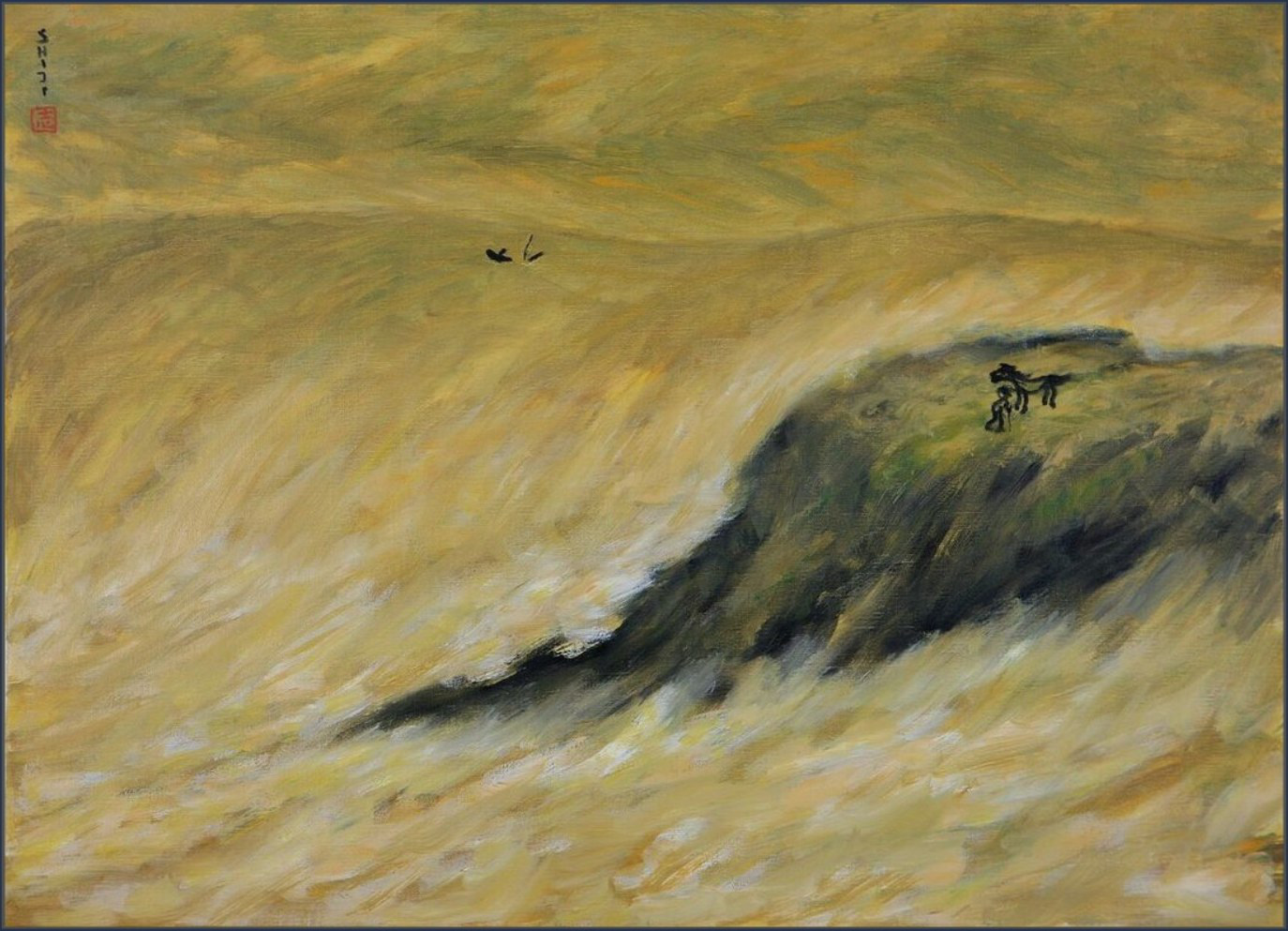
In A Wavering Horizon, painted by Byun Shi-Ji in 2005, there are an old man on a cliff, a horse and a boat far out at sea.1 The old man leans on a cane, and the horse stands beside him. Sea and sky run together in long strokes of a single color of dried grass. But what first draws the eye is the title.
The horizon is, by its very name, a level line lying straight. But this picture’s title says that the line wavers.
What wavers? Starting from this question, this chapter, the first of Argument IV, sets out the concept of “fūdo” that underlies Arguments IV and V.
2The Viewpoint of Landscape and the Relationality of Fūdo
It matters that linear perspective connects the horizon of the picture to the viewer’s eye level. Perspective since the Renaissance has been a device that organizes the world visually through one fixed viewpoint, and that viewpoint presupposes a distance between the seeing subject and the seen world.
As said in the introduction, Watsuji Tetsurō held in Fūdo that such a subject–object division alone cannot explain the relation of human beings and environment.2 Cold is not first given as “an object over there”; it arrives as an experience that already makes the body shrink. Fūdo is not a list of external nature but the way human existence is open beyond itself—a structure of spatial, social and historical relations.
This is also why Augustin Berque held that fūdo is better translated as milieu than as climate.3 Milieu stresses the relationality in which natural environment and human subject constitute each other. In this book “fūdo” is used close to this mutually constitutive sense.
Merleau-Ponty’s phenomenology of perception helps carry this discussion into the question of sight. The body is not a transparent device observing the world from outside but a subject that has a position in the world, moves and sees. In his discussion of Cézanne, perception is treated not as copying a finished world but as a process in which the world forms within perception.
From this viewpoint there is no need to reduce the “wavering” of A Wavering Horizon to a description of a natural phenomenon. More important is the way the fixed viewpoint loosens, and the unstable position of a body set in the wind is reflected in the lines and brushwork of the picture.
If landscape is “the world looked at,” fūdo is “the world lived.” The former is a question of the viewpoint that organizes a scene; the latter a question of the relation in which body and place form each other.
This distinction is not absolute. Landscape too holds lived experience, and fūdo too is visually constructed. But in explaining Byun Shi-Ji’s Jeju painting this book distinguishes the two concepts strategically, in order to ask “under what conditions he came to see” as much as “what is seen.”
The proposition “fūdo is not landscape” is therefore not a declaration against landscape. It is a proposal to extend the scope of analysis to the conditions of perception that form a landscape, the habits of the body and the time of daily life.
This extension also differs from environmental determinism. Jeju did not automatically produce the painter’s lines and colours; a body that had passed through long training responded to the conditions of Jeju and reorganized its existing formal language.
A Wavering Horizon shows that reorganization most compactly. The horizon changes from a fixed coordinate into the place where the relation between body and world wavers.
3Changes of Form: Line, Colour, Eye Level
Fūdo that has entered the body changes the form of the picture. Form here means the structure that makes up the canvas, such as line, colour and composition.
First, line. In many works of the Jeju years, lines bend and lean rather than run straight. Pines bend, and human bodies grow low. The black line does not stop at outlining things; in many places on the canvas it makes force lean in the same direction. So this line is an outline and also looks like the posture of things enduring the wind. It can be read as fūdo that entered the body becoming line. This line is treated separately in chapter 10.
Second, colour. Many pictures of the Jeju years gather into the color of dried grass, a yellowish tone recalling the dry grass of autumn fields. Sky, land and sea are set within one colour. This colour is not used as a marker introducing a region. It is a colour that sets different things together under the same wind and sunlight. Here the difference appears between a colour that advertises regional features and “fūdo” as a condition of life. This distinction continues in chapter 10 and the theoretical interim conclusion.
Third, eye level. If the horizon is eye level, a wavering horizon is a wavering eye level. The “wavering horizon” of the title makes one doubt an eye level fixed in one place. The viewer, too, finds it hard to stay only in the comfortable place of an observer. The canvas has no horizon drawn as if with a ruler. Sea and sky run together in long strokes of one colour, and the place where the grain of the brushwork changes does the work of the horizon. That place is not straight.
4Single Viewpoint and the Sight of the Body
Cézanne is often counted as the painter who opened the door of modern art. In his pictures, tables and bowls look slightly askew. Merleau-Ponty did not see this as a mere mistake.4 As said in the previous section, for him the world is not seen ready-made but forms while we see and feel. He read Cézanne as trying to capture exactly that process.
After Cézanne, one current of modern art began to ask not “what does the world look like” but “how does a person with a body see the world.” The wavering horizon can be set alongside this question.
Byun Shi-Ji was a painter who had properly learned perspective in Japan. It is hard to say he abandoned what he learned. It is more accurate to say that in the life of Jeju he gradually loosened those rules.
A picture freed from a single viewpoint is not a question only of Western modernity. East Asian landscape painting, too, was never bound to one viewpoint. Guo Xi, a painter of eleventh-century Song China, divided ways of seeing mountains into three: high distance, deep distance and level distance5—looking up, looking deep into, and looking far at the same height. So there is no need to explain Byun Shi-Ji’s pictures only as “departures from Western perspective.”
5Fūdo and Modernism
Fūdo changes “how one comes to see” more than “what one paints.” What this book seeks to follow is not the painting of fūdo but the process in which eyes and body changed within a fūdo change the form of painting.
To place this process within the history of painting, the word modernism is needed. Modernism refers to the various currents of art that appeared from the late nineteenth century on. These currents began to question anew existing modes of representation and the rules of painting. How to paint became as important a question as what to paint.
Byun Shi-Ji carried that question on. Going to Jeju, he did not go back to tradition. He rewove the methods of modern painting he had already learned within the conditions of life in Jeju. Perspective loosened, colours were reduced, lines grew rough, empty space widened.
In 1975 he moved from Seoul to Jeju and settled, and painted there until 2013. In 1988, thirteen years after coming to Jeju, he wrote in the preface to his book Art and Fūdo: “Jeju has now become for me less an artistic space than an aesthetic ground and a method.”6 For him Jeju was, before a view to look at, the condition that set his way of seeing and painting. That his canvases have no horizon drawn with a ruler can also be read with this condition.
This chapter has set out the proposition “fūdo is not landscape” as a question of perception and form. That fūdo took a long time to become form was seen in chapter 4, case B. The next chapter follows a single boat far out at sea to examine how the eye that lived on an island organizes distance.
The horizon does not waver. It wavers only for a person standing in the wind.
Notes and sources
- ↑ A Wavering Horizon (2005). The canvas is checked against the plate in the byunshiji.org 100 Works (FŪDO 007).
- ↑ Watsuji Tetsurō (和辻哲郎), Fūdo: A Study of Human Existence (風土―人間學的考察; Iwanami Shoten, 1935).
- ↑ Augustin Berque, "Milieu et logique du lieu chez Watsuji," Revue Philosophique de Louvain 92, no. 4 (1994): 495–507.
- ↑ Maurice Merleau-Ponty, “Le doute de Cézanne” (1945), in Sens et non-sens.
- ↑ Guo Xi (郭熙), The Lofty Message of Forests and Streams (林泉高致), “Advice on Landscape” (山水訓).
- ↑ Byun Shi-Ji, Art and Fūdo (Youlhwadang, 1988), “Preface” (spring 1988, in the Jeju studio). The same sentence is cited in chapter 4.
Contents · Fūdo Is Not Landscape Key Terms and Analytical Categories → Bibliography →