Research/Fūdo Is Not Landscape/Argument III/Chapter 7
Academic edition · Fūdo Is Not Landscape · Chapter 7 · 11 / 34
Xieyi Written in Oil, and Subtraction
Translating Xieyi, and Subtraction
Argument III · Representation Passes Through Repetition and Subtraction to Become Expression
In Art and Fūdo (1988) Byun Shi-Ji set the words of Delacroix and Laozi side by side in one chapter. In 2006 he gave the title A Single Dot to a picture in which only one boat remains. The first is a matter of translating long-trained representational skill into the language of another pictorial tradition; the second is a matter of what to leave, and how much. This chapter sets the two cases together and asks how a hand that passed through representation reaches expression by way of subtraction.
Case AXieyi (寫意) Written in Oil — Representation, Expression, Translation of Medium
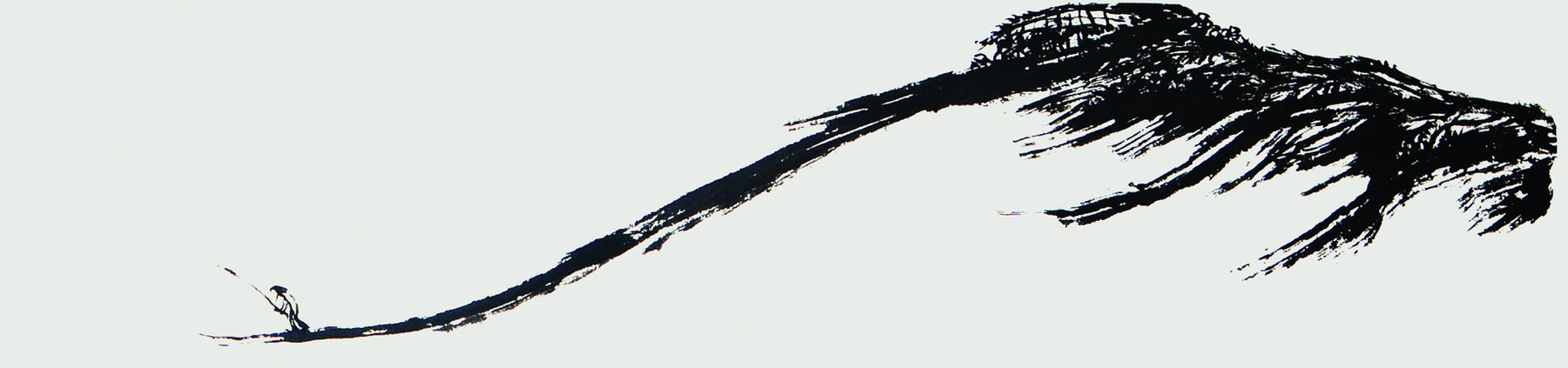
1A Chapter Without Commentary
Art and Fūdo (1988) has a short chapter called “Delacroix and Laozi.”1
First come the words of the nineteenth-century French painter Delacroix (1798–1863), known for paintings of strong colour and movement. His words are these: the model is not as vivid as when seen with the eye of imagination. Nature is so powerful that when one takes up the brush to paint it, the conception is already broken.
Then come the words of Laozi, the ancient Chinese thinker said to be the author of the Daodejing: “The Way that can be called the Way is not the constant Way” (道可道非常道).
After that there is no commentary.
A clue to what he tried to grasp through the repetition seen in chapter 6 seems to lie in this short chapter. Why did he put a Western painter and an ancient Eastern thinker in one place?
2Translating Xieyi: Beyond an East–West Binary
The distinction between xingsi (形似, formal likeness) and xieyi (寫意, painting the idea) has a long lineage in East Asian painting theory, but it cannot be generalized into a fixed binary of “West = representation, East = expression.”2 What matters is how Byun Shi-Ji himself thought about this opposition in Art and Fūdo, and what choices he made in actual work.
In “Representation and Expression,” contrasting the classical Western idea of art with the tradition of Eastern painting, Byun Shi-Ji wrote that Eastern painting approaches the meaning of its subject by subtracting what is unnecessary from exact description.3 This statement should be read not as an objective definition of all Eastern and Western art but as a historical language that he constructed in the 1980s to explain his own pictorial problem.
This book takes up that language critically and uses the analytical phrase “xieyi written in oil.” Here xieyi does not mean an Eastern essence. It refers not to abandoning the capacity for exact representation, but to a way of working that rearranges long-acquired representational skill through compression, omission and the rhythm of line.
The key therefore lies less in a declaration of East–West synthesis than in the translation of medium. The temporality of the ink line and the layerable materiality of oil, the single stroke and repeated overpainting, have different time structures, and Byun Shi-Ji adjusted that difference within his own work.
3A Line That Stands by Giving Up Colour
A newspaper article of August 1981 reported that he was showing ink paintings for the first time. According to the article, he called this work, which took in elements of Eastern painting, “an experiment to see what kind of picture would come out if I went back to oil.”4
His artist’s notes contain this sentence: “A line comes into being by giving up colour.” When a line passes over paper there is a weight pressing on the paper. That weight, he wrote, is the most central quality of line, and colour does not have it. He also wrote that the surface of Eastern painting shrinks in form but “the meaning it contains within is great.” In the same notes there is a page dividing line, not yet fully revealed, as “potentiality,” and colour, fully revealed, as “actuality.”5
This thought can be read in the canvases of the Jeju years. Colour gathers into the color of dried grass, and figures stand in black line. Neves saw the contrast between this black line and the ground colour as rooted in the technique of Eastern painting in ink on hanji paper.6
But canvas is not hanji. In his words, Eastern painting is finished on the spot where the brush is taken up, while in oil one must take up the brush again over several days, after what has been painted has dried to some degree.7 In Eastern painting the work of “gradually erasing what is unnecessary” may be said to gather, after long training, into a single stroke. In his oil paintings, that work can be read as divided into the time of taking up the brush again over several days.
4Where Brush and Word Cannot Reach
Brush and ink were not strange to him. His calligraphy from elementary school writing class was always posted in the classroom.8 At the Osaka Art School he went into the Eastern painting studio, got a sheet of paper and tried drawing “for fun.”9 Later, when he was offered an ink painting exhibition in Gwangju, a city with a deep tradition of Eastern painting, he wondered “how dare” a Western-style painter do it. He might be criticized, but he decided to try, and held the exhibition.10
Back to the two men of that chapter. In the same book he called Delacroix one “who staked his whole life on colour in modern painting.”11 Yet what he quoted in that chapter is not about colour. It is the saying that taking up the brush before nature breaks the conception.
Laozi’s words are often read this way: the Way that can be named in words is not the constant Way. When a name is given, something slips out beyond the name. It can be read that one man saw in the brush, and the other in words, the same thing: there is something that flees when one tries to grasp it.
That does not mean he painted invented landscapes. He said that pictures painted from imagination or fancy have no reality, no sense of the real, and without that sense they have no power to move. What he saw, he said, is transferred into his own style, “not just as the scene was.”12
5Not from Representation to Expression, but Expression That Has Passed Through Representation
Byun Shi-Ji’s Jeju painting did not reach expression after abandoning representation. Because he had a hand that had learned the structure of the figure, perspective, light and colour, he could reduce a body to a few lines and leave one small boat in a broad field of colour.
Xieyi, then, is not a category opposed to realism. It is closer to the works to understand it as a process of subtracting what has been fully seen and can be fully painted, leaving the core of a relation.
There is also a page in the notes that links subtraction to age (Notebook 2, images Image_20240121_0011 and 0012). The beauty of old age, it says, rests on youth but stands on a clarity that arises when appetites are erased, and its end is a state of stillness. Whether this page is the painter’s own writing or a summary of something he read cannot be determined. But it sees subtraction not as the discarding of youth but as something founded on youth. It points the same way as “expression that has passed through representation,” above.
Here the black line is not a simple borrowing from Eastern painting but takes on a new function within the medium of oil. The line connects at once outline and gesture, weight and direction, body and fūdo.
Rather than the familiar phrase “a fusion of East and West,” it is more accurate to see Byun Shi-Ji’s Jeju painting as the result of translating different pictorial traditions and the times of different media within one person’s working process.
Case A has confirmed that Byun Shi-Ji’s xieyi is not the result of abandoning representation, but a process of subtracting what could be fully painted to leave the core of a relation. Then, after subtraction, what remains, and how much? Case B carries this question on in A Single Dot of 2006.
Case BThe Logic of Subtraction
A Single Dot and Minimal Form
1A Single Dot
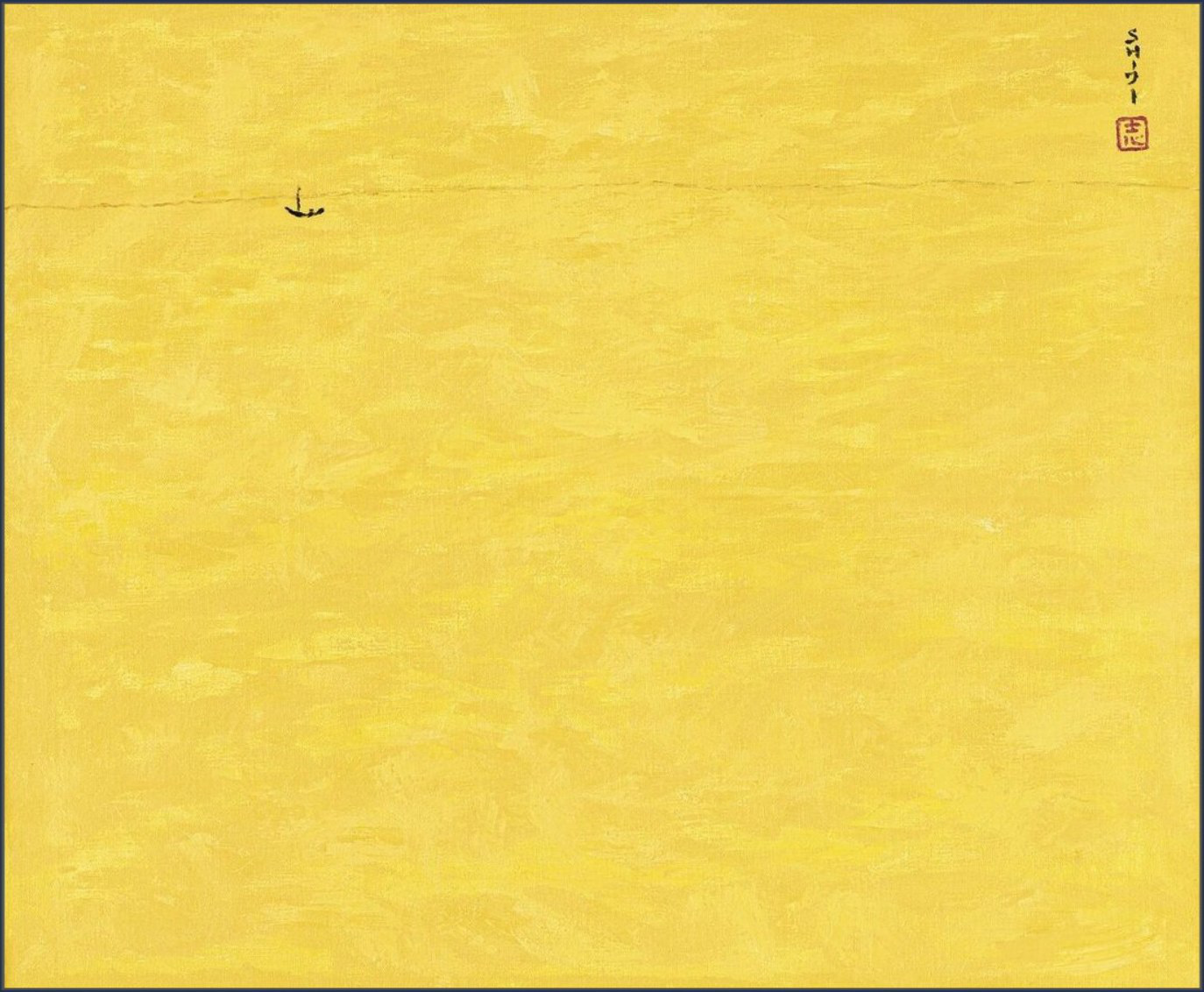
The 2006 picture A Single Dot asks, from its title on, what to leave and how much.13
The whole surface is a bright color of dried grass. At about one fifth of the height from the top, a thin black line passes horizontally. It is not straight as if ruled; it wavers a little, as drawn by hand. Just below that line, off to the left, is a small boat, almost the size of a dot, as if one mast stands and one person rides in it. Apart from the boat there is nothing. The sky above the line and the broad sea below it are empty in the same colour.
The painter left these words: “I want to express Jeju with a single dot.”14 The title is read together with them. Seen with how the late pictures left less and less, the title leads to the question of how much can be left with little.
Many of Byun Shi-Ji’s late pictures leave little. Yet the canvas does not look empty. This case asks why.
2What Was Reduced
Compared within Byun Shi-Ji’s own work: as seen in chapter 4, the pictures of his first period in Jeju had bright, varied colours. In many pictures of the Jeju years, colour gathers to two poles: the bright color of dried grass and black. The distant boat to be seen in chapter 9 is also a single boat. A Single Dot speaks of one from its title.
In many late pictures, things grow fewer, colours are reduced and empty space widens. This book calls this “subtraction.”
3What What Remains Does
Where things have been subtracted, what remains takes on more work.
So it is with what chapters 9 to 11 will examine. To say it in advance: one boat bears distance, one tonality bears unity, a few black lines bear posture, a wide empty space bears brightness.
Seen this way, subtraction is not only taking away. At least in the pictures this book examines, the less is left, the more work what remains does.
When things grow fewer, the empty space grows larger. When the empty space grows larger, the field of the color of dried grass widens. When that field widens, the place where fūdo appears without figures widens too.
4Repetition and the One
In Korean contemporary art the “dot” has also been used as a unit organizing repetition and density, as in Kim Whanki’s dot paintings.15 But the core of A Single Dot is not the repetition of dots; it lies in leaving only one and enlarging the empty space around it.
5Subtraction and Fūdo
Subtraction is not poverty. It is a way of gathering work into what remains.
This matters in this book. Fūdo does not appear by painting many things. It appears more widely when things are reduced and the empty space of the color of dried grass is widened around them.
In A Single Dot, once the single dot catches the eye, the dried-grass-coloured surface is read as sea. This case has confirmed that subtraction is a way of gathering work into what remains and showing fūdo more widely.
Together the two cases show that Byun Shi-Ji’s expression comes not from the place where the training of representation was abandoned, but from the place where it was passed through and subtracted. This is the provisional conclusion of Argument III. Representation is not abandoned; it moves into expression by way of repetition (chapter 6), translation of medium and subtraction. What kind of sight the eye and hand formed this way gained on meeting the fūdo of Jeju is treated in Argument IV, whose first chapter, chapter 8, asks about the difference between landscape and fūdo through the title A Wavering Horizon (2005).
He subtracted the figures. He did not subtract the fūdo.
Notes and sources
- ↑ Byun Shi-Ji, Art and Fūdo (Youlhwadang, 1988), “Delacroix and Laozi.” The book spells the name “Deullakeurwa.” Laozi’s words are the first line of chapter 1 of the Daodejing. The original source of the Delacroix words (journal, letters, lecture notes) has not been found. In the 2022 reissue (Purple), an ink painting by the painter (c. 2000) appears with this chapter. The words are copied in the handwritten notebook manuscript Nos. 82–83 (images img20240209_21282952 and 21293231, being deciphered): “The model is not as vivid as when you see it with the eye of your imagination … breaks the [power of?] conception, and even if through it one may obtain a series of beautiful studies, in the end one will make a work without variation[?].” The summary in the text shortens this ending. This page lies within the section “Form,” so whether it is the same text as the book’s chapter “Delacroix and Laozi” needs checking. Delacroix’s original source has not yet been found.
- ↑ The distinction between xingsi and xieyi follows Hong Seong-hu’s explanation. He wrote that the painter’s artist’s notes attend to “xieyi, which expresses an inner spirit and intent (意趣), rather than xingsi (形似), which values outward form.” Hong Seong-hu (researcher, Institute of Korean Art History, Myongji University), “Beyond Boundaries: The Life and Art of Byun Shi-Ji,” in the “Art and Fūdo” file.
- ↑ Art and Fūdo, “Representation and Expression.” Handwritten notebook manuscript No. 58 bears the title “Representation and Expression (6),” and No. 59 (image img20240209_21040872) records “形似,” 神韻, “氣韻生動” and, on empty space, “a universe standing within a single stalk of bamboo (一枝의 竹)” (low legibility).
- ↑ Hong Seong-hu, same essay, quoting Kim Gwang-hyeop, “Domestic exhibition with some sixty paintings by Paik Young-su, established in Paris. Byun Shi-Ji, painter in the ultra-fine brush style, active in Jeju, shows ink paintings for the first time,” Dong-A Ilbo, 27 August 1981.
- ↑ Byun Shi-Ji, “Artist’s Notes,” in The Way of the Wind: Byun Shi-Ji (Nouveau, 2020), p. 238; quoted in Hong Seong-hu, same essay. The same words appear in the handwritten notes (Notebook 2, images Image_20240121_0003 and 0004): “The coming into being of line lay in giving up colour,” “The surface of the East is shrinking; in form it is shrinking, but what it contains within is great,” “Comparing colour and line, line is potentiality. Colour is actuality” (being deciphered). Whether this page is the painter’s own idea or a summary of something he read has not yet been determined.
- ↑ Carole Neves (director of policy analysis, Smithsonian Institution), “The Painter and the Sea: Byun Shi-Ji.” Original English: “The scale of many of Byun’s paintings and the contrast between dark and black lines and the yellow brown, amber, and gold backgrounds are based on the traditional oriental technique of drawing with black ink on Hanji, a type of Korean paper.”
- ↑ Byun Shi-Ji Oral History Transcript (Korean Modern and Contemporary Art History Oral History Project; interviewer and researcher Lee In-bum), sixth session (19 January 2005), pp. 275–276. The same words appear in the seventh session (1 April 2005), pp. 300–301.
- ↑ Same transcript, first session (3 December 2004, Gidang Art Museum), p. 30. Seodo is brush calligraphy.
- ↑ Same transcript, second session (4 December 2004), p. 66. This was at the end of the war, when few students came to school. When the interviewer asked, “You also did some ink painting…,” he answered, “I tried that kind of thing too.”
- ↑ Same transcript, sixth session, p. 269.
- ↑ Art and Fūdo, “Challenge and Experiment in Colour.” The chapter “Braque’s Rebellion” in the same book also has the sentence: “Delacroix did not take nature just as it is for his compositions.”
- ↑ Byun Shi-Ji Oral History Transcript, seventh session, pp. 299–300. The transcript writes “style” as seutairu.
- ↑ A Single Dot (2006). The canvas is checked against the plate in the byunshiji.org 100 Works (FŪDO 026).
- ↑ Words the painter spoke in his lifetime, heard directly by the author (his son) (author’s confirmation, 29 September 2026). No written source has been found. On p. 117 of “The Language of Painting,” the editor gives Jeju Island (1976) the subtitle “The archetype of Jeju painted with a single dot.”
- ↑ Kim Whanki (1913–1974) lived and worked in New York from 1963 until his death in 1974. Where, in What Form, Shall We Meet Again (1970); the title comes from a line of Kim Kwang-seop’s poem “In the Evening.” It won the grand prize at the first Korean Art Grand Prize Exhibition organized by the Hankook Ilbo in 1970.
Contents · Fūdo Is Not Landscape Key Terms and Analytical Categories → Bibliography →